Chapter 4: Traffic Control
 Call Kai
 Learn
Learn Practice Test
 Spaced Repetition
 Match
Match Flashcards
 Knowt Play
1/34

There's no tags or description
Looks like no tags are added yet.
Name | Mastery | Learn | Test | Matching | Spaced | Call with Kai | Chat |
|---|
No analytics yet
Send a link to your students to track their progress
35 Terms
Regulation Signs
normally are white rectangles with black letters or symbols, but some are different shapes, and some can use red letters or symbols.
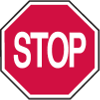
Stop Sign
COLOR: Red, with white letters.
MEANING: Come to a full stop, yield the right-of-way to vehicles and pedestrians in or heading toward the intersection. Go when it is safe.
You must come to a stop before the stop line, if there is one. If not, you must stop before you enter the crosswalk.
If there is no stop line or crosswalk, you must stop before you enter the intersection, at the point nearest the intersection that gives you a view of traffic on the intersecting roadway.
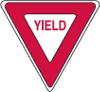
Yield Sign
COLOR: Red and white, with red letters.
MEANING: Decrease speed as you reach the intersection. Prepare to stop and yield the right-of-way to vehicles and pedestrians in or heading toward the intersection.
You must come to a full stop at a YIELD sign if traffic conditions require it. When you approach a YIELD sign, check carefully for traffic and be prepared to stop.
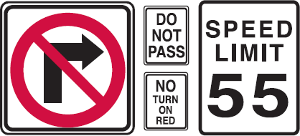
Other Regulation Signs
COLOR: White, with black and/or red letters or symbols.
MEANING: These signs give information about rules for traffic direction, lane use, turns, speed, parking and other special requirements.
Some regulation signs have a red circle with a slash over a symbol. This indicates that an action, like a right turn, is not allowed or that some vehicles are restricted from the road. Rectangular white signs with black or red letters or symbols are indications to be alert for special rules.
Warning Signs
normally are yellow and diamond-shaped, with black letters or symbols.
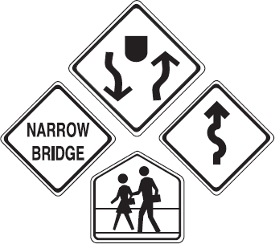
Warning Signs
COLOR: Yellow, with black letters or symbols.
MEANING: You are approaching a hazardous location or a location where there is a special rule, as shown in the sample signs.
Sometimes a warning sign is joined with a yellow and black "recommended speed" sign. This indicates reduced speed is advised in that area.
Destination Signs
are green with white letters and symbols.
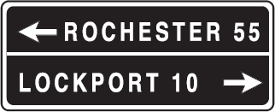
Destination Signs
COLOR: Green, with white letters.
MEANING: Show the direction and distance to locations.
Service Signs
are blue with white letters and symbols.
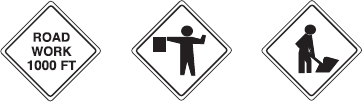
Work Area Signs
COLOR: Orange, with black letters or symbols.
MEANING: People are at work on or near the roadway and traffic can be controlled by a flag person. A work area speed limit as low as 25 MPH (40 km/h) can be posted.
Even if no speed limit is provided, you must drive at a reduced speed through the work zone and you must always obey the flag persons.
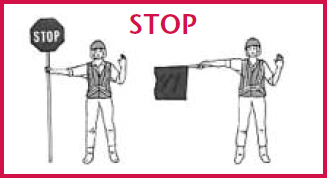
STOP
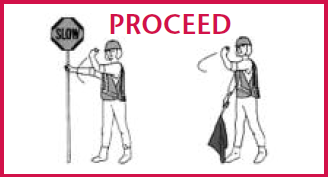
PROCEED
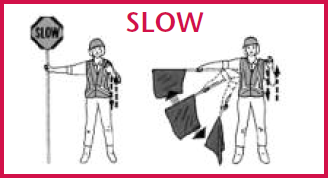
SLOW
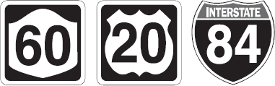
Route Signs
COLOR: Varied.
MEANING: Indicate interstate, U.S., state or county routes. The shape tells you the type of route you are on.
When you plan a trip, use a highway map to decide which routes to take. During the trip, watch for destination signs so you will not get lost, or have to turn or stop suddenly.
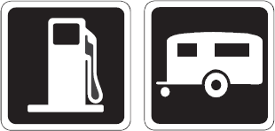
Service Signs
COLOR: Blue, with white letters or symbols.
MEANING: Show the location of services, like rest areas, gas stations, camping and medical facilities.
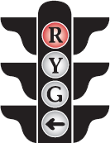
Traffic Lights
Are normally red, yellow and green from the top to bottom or left to right.
At some intersections, there are lone red, yellow or green lights. Some traffic lights are steady, others flash.
Some are round, and some are arrows. State law requires that if the traffic lights or controls are out of service or does not operate correctly when you approach an intersection, you must come to a stop as you would for a stop sign.
You must then continue according to the rules of right-of-way, unless you are told to continue by a traffic officer.
Steady Red
Stop. Do not go until the light is green.
Green arrow + red light: You may go in the arrow’s direction only if the intersection is clear.
Right turn on red: Allowed after a full stop and yielding to pedestrians and oncoming traffic (unless prohibited by signs).
Left turn on red: Allowed only from a one-way street to another one-way street after stopping and yielding.
Do NOT turn on red if:
A NO TURN ON RED sign is posted
A sign, signal, or pavement marking prohibits the turn
You are in New York City (unless a sign allows it)
School buses carrying pupils: Cannot turn right on red.

Flashing Red
Means the same as a STOP sign:
Stop, yield the right-of-way, and go when it is safe.
Red Arrow
Do not go in the direction of the arrow until the red arrow light is off and a green light or arrow light goes on.
A right or left turn on red is not permitted at a red arrow.
Steady Yellow
The light will change from green to red. Be prepared to stop for the red light.

Flashing Yellow
Drive with caution.
Yellow Arrow
The protection of a green arrow will end. If you intend to turn in the direction of the arrow, be prepared to stop.

Steady Green
Go
Yield to other traffic at the intersection as required by law

Green Arrow
You can go in the direction of the arrow,
Still yield the right-of-way to other traffic at the intersection as required by law
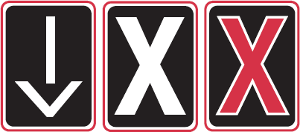
Lane Use Control Light
Special above the pavement lights are sometimes used to indicate which lanes of a highway can be used at certain times:
Steady Red "X": Do not drive in this lane.
Steady Yellow "X": Move out of this lane.
Flashing Yellow "X": Lane is only for left turns.
Green Arrow: You can use this lane.
Pavement Markings
Divide lanes and show where vehicles should drive.
Tell you when you can pass or change lanes.
Show which lanes are for turns.
Mark where you must stop for signs or traffic signals.
Arrows show the direction of traffic flow.
Memory tip:
Road markings = Lane rules + Passing rules + Turning rules + Stopping points.
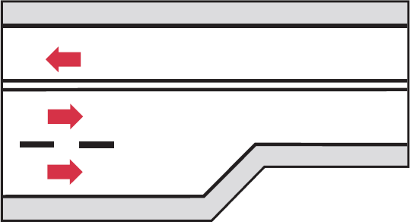
Edge and Lane Lines
Edge lines: Show where the travel lane ends and the shoulder begins.
Do not cross an edge line unless directed by police/authorized officials or allowed by an official sign.
An edge line angled toward the center means the road becomes narrower ahead.
White lines: Separate lanes of traffic moving in the same direction.
Yellow lines: Separate traffic moving in opposite directions.
Lines can be solid or broken and may have one or two lines.
Memory tip:
⚪ White = Same way
🟡 Yellow = Opposite ways
Edge line = Road boundary
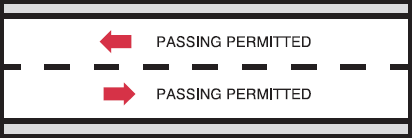
One broken line
You may pass or change lanes if:
It is safe, and
You do not interfere with traffic.
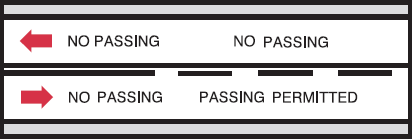
Solid line with broken line
If you are on the side with the solid line, you cannot pass other vehicles or go across the line
exception: making a left turn into a driveway.
If you are on the side with the broken line, you can pass if it is safe to and you will not interfere with traffic.
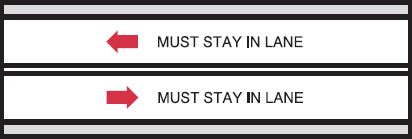
Double solid lines
You can not pass or change lanes.
You cannot go across the lines except to
Turn left into/out of a highway
Enter/leave a driveway
Make a U-turn where allowed
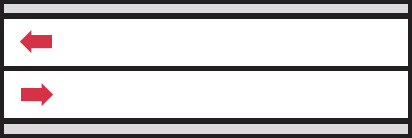
One solid line
Passing or changing lanes is allowed only when necessary because of:
Road obstructions
Traffic conditions
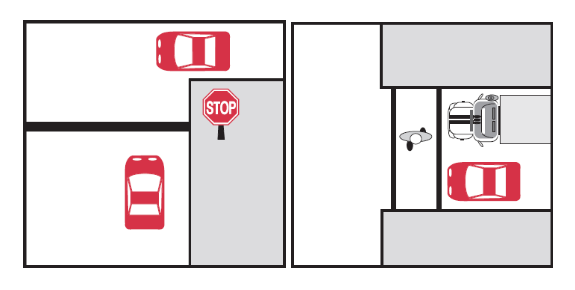
Stop and Crosswalk Lines
Stop line: A white line across your lane showing where you must stop.
Crosswalk: Two parallel lines showing where pedestrians cross.
If required to stop by a STOP sign, YIELD sign, traffic light, or traffic officer:
Stop before the stop line (if present).
Otherwise, stop before the crosswalk.
Stop at a crosswalk when yielding to pedestrians, in-line skaters, or scooter riders.
A single stop line may be placed farther back to give large vehicles (buses, trucks, tractor-trailers) room to turn.
Memory tip:
Stop line = Where your vehicle stops.
Crosswalk = Where people cross. 🛑🚶♂
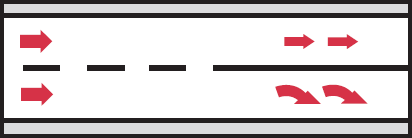
Arrows
Arrows show which lanes you must use.
You must be in the correct lane before you reach the solid line that separates the lanes.
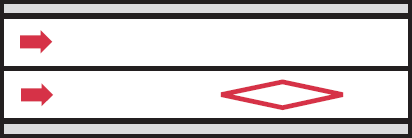
Diamond Symbol
Indicates a reserved lane for:
🚌 Buses
🚗 HOV (High-Occupancy Vehicles/carpools/vanpools)
🚲 Bicycles
Other special vehicles
You may only use the lane if your vehicle meets the requirements shown on signs.
Do not enter unless allowed by the rules in effect.
On city streets, broken white lines may allow regular vehicles to enter an HOV lane to make a right turn at the next intersection.
Reserved lanes help reduce traffic and keep important vehicles moving efficiently.
Memory tip:
💎 Diamond = Designated lane (special vehicles only).
Traffic Officers
Directions given by traffic officers take precedence over signs, signals or pavement markings.
Among the persons authorized to direct traffic are police officers, fire police, highway work area flag persons, school crossing persons, and school bus drivers.