Applications of psychology to health
 Studied by 0 people
 Call Kai
 Learn
Learn Practice Test
 Spaced Repetition
 Match
Match Flashcards
 Knowt Play
1/73

Earn XP
Description and Tags
Unit 4
Name | Mastery | Learn | Test | Matching | Spaced |
|---|
No study sessions yet.
74 Terms
What is stress (as defined by Seyle 1936)
The non-specific response of the body to any demand
Demands can be psychological or physiological
To experience stress a stressor must be present
Stress is experienced when a person perceives that the demands of the stressor exceed their ability to cope
What are the types of stress (Seyle; 1936)
Distress
Eustress
What is distress?
A negative psychological response to a stressor as indicated by the presence of negative psychological states (such as anger, fear, or feelings of hopelessness + helplessness)
*Impedes ability to perform at an optimum level
*Can lead to health risks
E.g. death of a loved one, financial difficulties, conflicts, etc.
What is eustress
The positive psychological response to a stressor, as indicated by the presence of positive psychological states (such as excitement, enthusiasm, and optimism)
*Occurs when there is stress yet a feeling of being capable to overcome
*Beneficial as it increases alertness and energy levels, leading to optimum performance
*Normally enjoyable and can motivate behaviour
E.g. exams, performances, grand final game, driving test, new job, interviews, etc.
What is a stressor?
Any person, object, or event that challenges or threatens an individual, thus causing feelings of stress
(sources of stress)
From internal or external factors
What are the types of stressors?
Environmental stressors
Psychological stressors
Social stressors
Cultural stressors
What are environmental stressors?
The conditions and physical surroundings of an individual
E.g. noise, temperature, smell, pollution, natural disasters, etc.
What are psychological stressors?
Caused by emotional and cognitive factors
E.g. graduating, new job, buying a house, relationship changes, etc.
What are social stressors?
Stems from relationships and interactions with society
E.g. peer pressure, and conflicts with family and friends
What are cultural stressors?
Cultural identity, values, and cultural norms
E.g. discrimination or loss of cultural practices
What are characteristics of stressors?
Nature: the type of stressor
Duration: the time frame (short-term or long-term)
Strength: the severity/intensity of the stressor
What is the GAS model of stress - model of stress?
The General Adaption Syndrome (GAS) model is used to describe the physiological changes that the body automatically goes through when it responds to stress
SEYLE 1983 - biological perspective
Stressor = physical reactions = stress as a response
What physiological changes occur when initially exposed to stress?
Heart rate increases
Breathing rate increases
What are the 3 GAS stages?
Alarm
Resistance
Exhaustion
What is the alarm stage (GAS)?
The initial response to a stressor
First shock occurs where the body’s resistance drops below normal and responds as if it has been injured.
Then countershock occurs where the sympathetic nervous system activates to prepare for fight or flight. This occurs 6-48 hours after initial stress is detected.
The amygdala detects threat and signals the hypothalamus (SNS). This triggers the release of adrenaline, noradrenaline, and cortisol.
What do adrenaline, noradrenaline and cortisol do?
Adrenaline: increases heart rate and supports conversion of glycogen
Noradrenaline: causes blood vessels to constrict and blood pressure to increase
Cortisol: increases pain tolerance, reduces performance of the immune system, and impairs cognitive ability
All secreted from the adrenal gland
What is the resistance stage (GAS)?
If the stressor remains, the body enters this stage as it attempts to re-stabilise its internal systems and fight the stressor
The parasympathetic nervous system begins to counteract the heightened arousal
Stress hormones continue to be secreted to help the body to cope and energy is directed towards maintaining the stress
If the stress is continued and not resolved, the third stage is reached
What is the exhaustion stage (GAS)?
It occurs if the stressor continues for a prolonged period, limiting the effectiveness of the adrenal glands, blood sugar drops and physical health declines
The body’s resources become depleted, which leads to fatigue, low motivation, impaired immunity, and increased risk of mental and physical illness.
How did Holmes and Rahe (1967) describe stress?
As a significant change in life that requires a response or adjustment to be made
Assumption that life changes are stressful events and according to this theory personality, life experiences, and social support do not affect the impacts of stress or adjustments made as a result
What is the Social readjustment scale - stress as a stimulus?
The Social readjustment scale or Holmes and Rahe stress scale, 1967, assesses the amount of stress that has been experienced by an individual in the past year
It is comprised of 43 life events and a score of 1 to 100 has been allocated to each event, e.g. vacation has a score of 13 LCU (life change units) and the death of a close family member has a score of 63 LCU
The LCU estimates the amount of response and readjustment required if the event is experienced
The individual receives a score based on their total stress adjustment
What are the strengths of LCU as a measurement tool?
Quantitative data is collected, which is easy to statistically analyse
What are the limitations of LCU as a measurement tool?
Responses rely on subjectivity and honesty from participants
No reasoning for responses/rich data (common limitation of quantitative data)
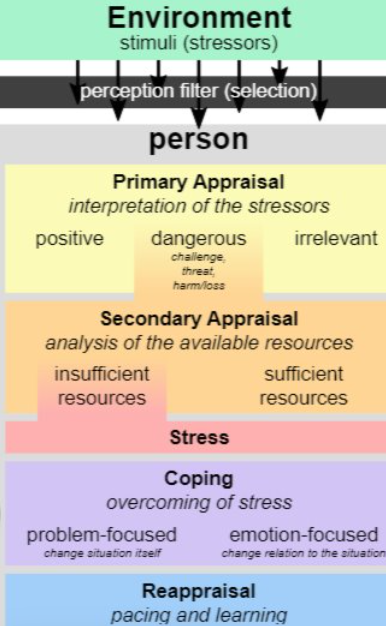
Explain stress as a transaction, Lazarus and Folkman, 1984
They suggested that individuals utilise their perception of a stressful situation and their subjective past experiences to help them cope
The stress response depends on emotions and psychological factors that are unique to the individual
The emphasis of this theory is on the relationship between the person (including their unique traits), and the characteristics of the environmental event taken place
Lazarus and Folkman, 1984, psychological perspective
Explain stress as a transaction with the diagram:
What are the stages within the transactional model of stress?
Primary appraisal
Secondary appraisal
What is primary appraisal?
When the individual notices a stressor in their environment and decides whether it is irrelevant, a challenge, or a threat/loss/risk
What is secondary appraisal?
The individual assesses both the internal and external resources that are available and evaluate whether they can meet the demands of the stressor
What are methods for coping stress (Lazarus and Folkman, 1984)
Emotion focused coping
Problem focused coping
What is emotion-focused coping?
The goal is to manage the emotional reactions to stress. This will be used when an individual perceives that they do not have the resources to deal with the stressor
E.g. meditation, talk-therapy, relaxation techniques, etc.
What is problem-focused coping?
The goal is to address the root cause of the stress. This will be used when an individual perceives that they do have the resources to deal with the stressor
E.g. quitting a job, etc.
What are coping strategies for stress?
Maladaptive coping
Adaptive coping
What is maladaptive coping?
Coping strategies that involve harmful and unhealthy stress management that exacerbates its adverse effects
These strategies avoid dealing with the stressors that are causing the problems
E.g. negative self-talk, denial, and substance abuse
What is adaptive coping?
Beneficial and productive methods for managing stress that can decrease the adverse impacts of stress
E.g. meditation, exercise, and positive reframing
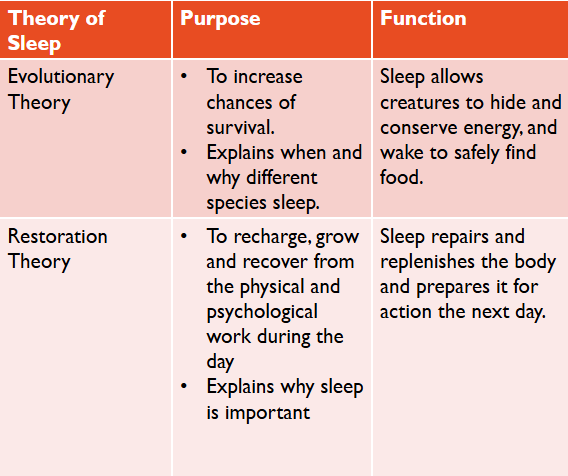
What are the two purposes of sleep?
Evolutionary
Restorative
What is the evolutionary purpose of sleep?
A theory stating that sleep serves as a means to increase an animal’s or human’s chance of survival in its environment
Early humans used the daytime rather than nighttime to eat, drink, and reproduce, as there was greater risk of injury in the dark, as well as predators at night that could threaten their survival
Sleeping at night allowed for energy to be conserved
Sleep depends on the need to find food and the animals vulnerability to predators
What is the restorative purpose of sleep?
A theory stating that sleep allows us to recharge our bodies and recover from the physical and psychological work during the day; also allowing our body’s growth processes (homeostasis) to occur
Recuperation theories of sleep claim that homeostasis of the body (balance of internal physiological functioning) is disrupted when humans are awake and that sleep acts to restore it
Sleeping allows the energy levels that decline during wakefulness to be restored: repairs and replenishes the body, increases alertness, increases immunity to disease, enhances mood, and activates growth hormones.
Summary table comparing the two purposes of sleep:
What is the sleep-wake cycle?
The recurring pattern of wakefulness and sleep that individuals undergo on a daily basis
Usually measured by recording times of regular events, like when we eat and when we sleep
This cycle is regulated by the circadian rhythm, body temperature, metabolic rate, and the release of hormones
What is the circadian rhythm?
The biological cycle that lasts around 24 hours and controls the nocturnal release of hormones, including melatonin (hormone that regulates sleep-wake cycle)
Found in the hypothalamus and is called the suprachiasmatic nucleus (SCN)
Dominant sleep-wake cycle
Why is sleep important?
Impacts:
Restoring energy
Recovering from injury/illness
Memory
What are the 4 stages of sleep?
NREM 1
NREM 2
NREM 3
REM
Explain NREM 1
Sleep state: transitional period between wakefulness and sleep
Heart rate decreases
Eye movements are a slow rolling movement that stop once individual is asleep
Muscles relax
Lasts 1-7 minutes, if the individual is not interrupted they quickly move into NREM 2 and minimal time is spent in this stage
Explain NREM 2
Sleep state: light non-rem sleep
Heart rate slows down
Eye movement stops
Muscles continue to relax and there are occasional muscle twitches
Length of stage: 10-25 minutes, increases in length (after the first time it occurs) with each repetition of the sleep cycle
Explain NREM 3
Sleep state: deep non-rem sleep
Heart rate continues to slow down
Minimal eye movement
Muscles are at their most relaxed state
Length of stage: 20-40 minutes, then after the first few sleep cycles it reduces in length
Explain REM (stage 4)
Sleep state: dreams occur
Heart rate increases to match the rate when awake (varies based on dream content)
Rapid eye movement, visual information is not transmitted to the brain
Muscles are temporarily paralysed (except for breathing and eye movement)
Involves high level of brain activity
Length of stage: 10-60 minutes, with it increasing over the night ranging from a few mins to an hour
Expand more on the sleep cycle:
Each night of sleep is made up of (4-6) sleep cycles that last between 90-110 minutes
The sleeper enters stage 1 NREM sleep, which usually happens once per night
After stage 1 the sleeper progresses through stages 2 and 3, reaching deeper sleep. They then reverse back to stage 2 before entering REM sleep
E.g.: NREM 1 - NREM 2 - NREM 3 - NREM 2 - REM
These cycles can be visualised in a hypnogram
In the 4th, 5th, and sometimes 6th cycle, stage 3 NREM becomes rare and more time is spent in REM
NREM stage 3 is mostly involved with restoring the body and physical energy
REM sleep is most important for restoring brain function, such as memory and concentration
What is sleep deprivation?
The condition of not getting sufficient sleep
What are the causes of sleep deprivation?
Shift work
Drugs
Sleep environment
Stressors
How does shift work cause sleep deprivation?
Shift-work involves altering the sleep-wake cycle and consequently reducing the amount and quality of sleep
Humans have hormones, such as melatonin, that help to regulate the sleep-wake cycle and circadian rhythm
Trouble sleeping is caused by the disruption of hormones and lack of sleep cues - disrupting the consistent nature of the circadian rhythm and sleep cycle
How do drugs cause sleep deprivation?
Some drugs impact sleep stage progression/quality, reducing NREM sleep, and affecting REM sleep
Caffeine is a stimulant drug that speeds up the CNS
Alcohol is a depressant that slows down the CNS
Alcohol and caffeine both negatively impact sleep
How does sleep environment cause sleep deprivation?
A bright environment and/or loud environment can disrupt the sleep-wake cycle
How do stressors cause sleep deprivation?
Stressors cause anxiety and anxiety can cause issues falling and staying asleep
E.g. test/exam, headache (illness), school, etc.
What are the two types of sleep deprivation?
Partial/acute sleep deprivation
Chronic sleep deprivation
What is partial/acute sleep deprivation?
The severe reduction or complete lack of sleep over a short-period of time
Usually less than 5 hours over a 24 hour period
The effects are reversed once adequate sleep returns
E.g. studying, illness, all-nighter, jet-lag, stress, etc.
What are the effects of partial sleep deprivation?
Attention: lapses in attention
Mood: decreases in mood and increases in irritability. Emotional processing is affected
Reflex speed: reaction times increase, taking us longer to react to stimuli
Vision: can become blurry, eye twitches may occur and eyes become sensitive to light
*Reversible once adequate sleep is achieved
What is chronic sleep deprivation?
The persistent reduction of sleep over a long period of time
Spans for more than a few weeks to years
The effects are harder to reverse, sometimes leading to negative health outcomes
E.g. sleep disorders, work-life balance, health conditions, etc.
What are the effects of chronic sleep deprivation?
Heart disease: increases blood pressure and high cholesterol (leading to heart disease)
Obesity: increases the intake of high energy foods, as well as overall amount of food intake
Insomnia: difficulties falling and staying asleep (low sleep latency)
Anxiety: emotional regulation is negatively impacted, which can increase anxiety (cycle of anxiety = trouble sleeping = anxiety)
*Typically hard to reverse
What is sleep hygiene?
The behaviour and sleep environment that can result in a healthy sleep
What are techniques to improve sleep hygiene?
Management of electronic devices
Consistent sleep patterns
Sleep environment
How can management of electronic devices improve sleep hygiene?
It is recommended that electronic device use is ceased one hour before bedtime
Electronic devices emit blue light which prevents melatonin production
This results in brain stimulation that reduces both sleep quality and duration
How can consistent sleep patterns improve sleep hygiene?
It is critical for the circadian rhythm to have a consistent bed time routine and sleep hygiene
Consistent bedtime and wake time helps the body clock and prevents sleep deprivation
How can sleep environment improve sleep hygiene?
Bed should be used for sleeping and intimacy only - including minimal use of electronic devices - this creates a cognitive link between the bed and sleep
What was the aim of study: restricting bedtime mobile phone use?
To determine how limiting use of mobile phones before bedtime affects mood, working memory, pre-sleep arousal, sleep quality, and sleep habits
He et al, 2020
What were the participants and materials of He, et al, 2020 study
Participants: 38 university students who had the habit of using mobile phones before bed, as well as experiencing poor sleep quality
Materials: positive and negative affect schedule (PANSAS), n-back task, pre-sleep arousal scale (PSAS), Pittsburg sleep quality index (PSQI), and an online sleep diary
What is the Positive and negative affect schedule (PANSAS)
Self-report measure
20 statements each requiring the completion of a 5-point likert scale
Positive and negative emotions over the past week were assessed
What is the n-back task?
Working memory is tested
Computer program used where participants are presented with a series of numbers and required to respond when; a specific number is presented, when two identical numbers are presented one after the other, and finally when a number is identical to the one that appeared two numbers prior
What is the pre-sleep arousal scale (PSAS)?
Self-report measure
5-point likert scale for each of the 16 statements that pertain to cognitive and somatic arousal experienced when trying to fall asleep in bed
Cognitive arousal refers to thoughts (e.g. worrying about falling asleep)
Somatic arousal refers to physiological symptoms (e.g. increased heart rate)
What is the Pittsburg sleep quality index?
Self-report measure
19 items that assess sleep quality and disturbances over the past month where a high score of 21 indicates sleep disturbances
What is the online sleep diary
Self-report measure
Daily record, including bedtime, time taken to fall asleep, wake up time, time arisen from bed, sleep duration, length of time mobile phone was used during the day and length mobile phone was used between 9pm and sleep time
What was the design for He, et al, 2020
IV: use of mobile phones before bedtime vs no mobile phone use for 30 minutes before bedtime
DV: mood, working memory, pre-sleep arousal, sleep quality, and sleep habits
What was the procedure of the He, et al 2020 study?
Researchers obtained approval from the ethics committee, participants volunteered and signed online informed consent sheets
Participants completed all tests to gain a base-line of results
Participants were randomly assigned to either the experimental or control group (19 in each)
Participants in the experimental group did not use mobile phones for 30 minutes before bedtime. Participants in the control group continued with their normal mobile phone use
At the 4 week mark, participants completed the same tests and results were compared
What was the key findings of the He, et al, 2020 study?
Participants who did not use their mobile phone for 30 minutes before bedtime were shown to take less time to fall asleep, stayed asleep for longer, had improved quality of sleep, reduced pre-sleep arousal, improved positive affect, reduced negative affect, and showed improvement in their working memory
What was the contribution of the He, et al, 2020 study?
Recent study that uses established measures, allowing it to be replicated by other researchers
With replication comes the ability to assess reliability
What are the limitations of the He, et al, 2020 study?
Sample size was small, limiting ability to generalise results to the population the sample was taken from
All measures, except n-back test, gathered subjective data from participants as they included self-report measures and online diary entries
Subjective measures should ideally be used in combination with physiological measures, as these collect objective data that is likely to be less biased