Restrictive Lung Diseases
 Call Kai
 Learn
Learn Practice Test
 Spaced Repetition
 Match
Match Flashcards
 Knowt Play
1/55

There's no tags or description
Looks like no tags are added yet.
Name | Mastery | Learn | Test | Matching | Spaced | Call with Kai | Chat |
|---|
No analytics yet
Send a link to your students to track their progress
56 Terms
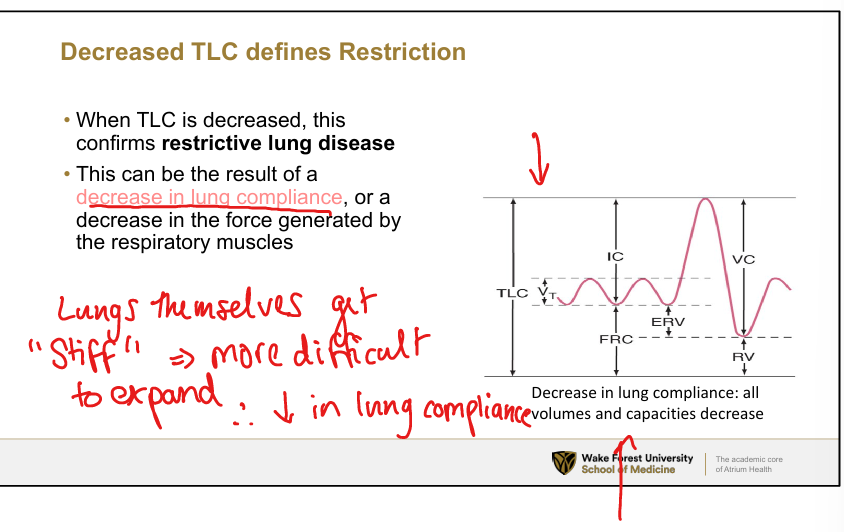
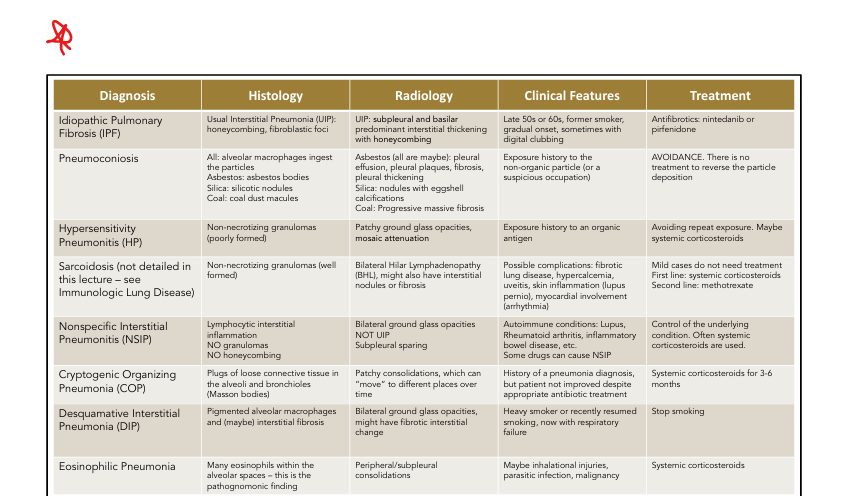
What causes decreased lung compliance in restrictive lung disease?
Interstitial lung disease → stiff lungs → ↓ TLC, ↓ all volumes.
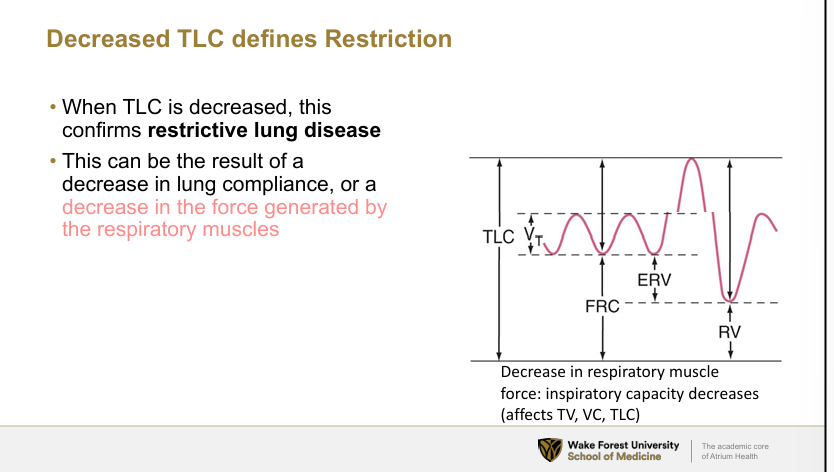
What causes decreased respiratory muscle force in restrictive lung disease?
Neuromuscular disease → ↓ inspiratory capacity → ↓ TLC.
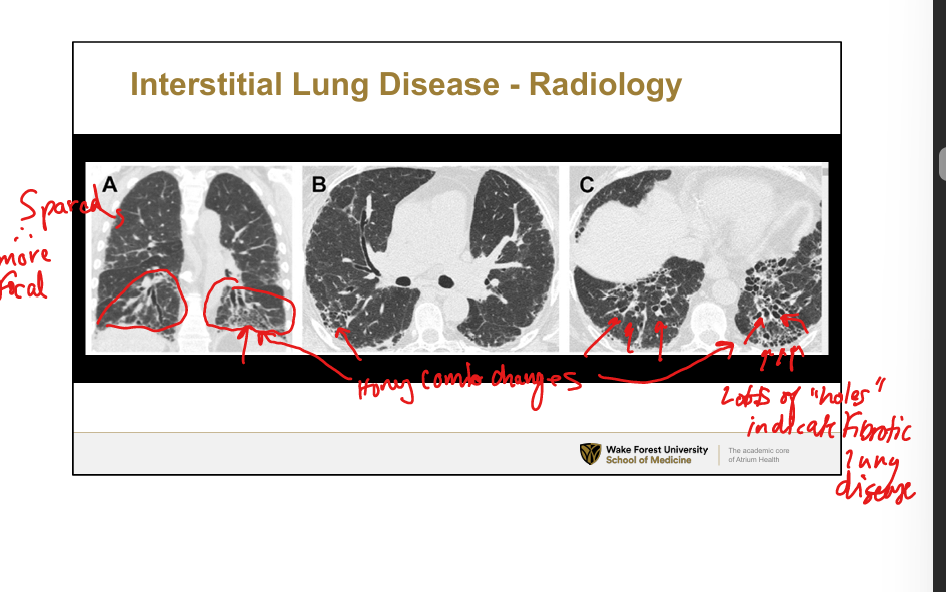
Radiologic hallmark of Interstitial Lung Disease
Abnormalities in interlobular septa > airways

What is honeycombing?
Clustered cystic airspaces at lung periphery → hallmark of advanced fibrosis (UIP/IPF).
Neuromuscular disease examples
ALS, Myasthenia Gravis, Guillain-Barré/CIDP, phrenic nerve injury.
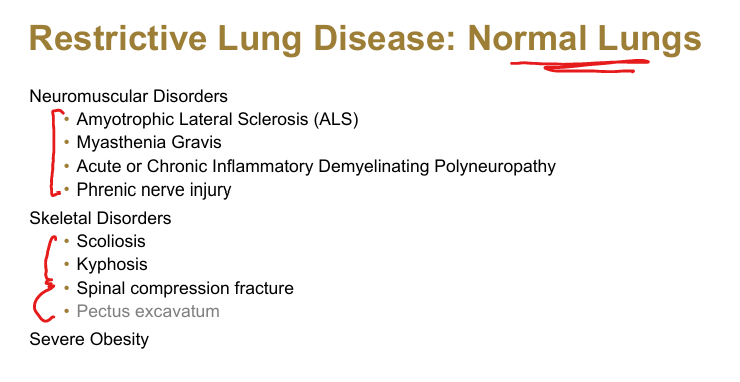
Phrenic nerve injury diagnostic test
Abnormal sniff test with paradoxical diaphragm motion.

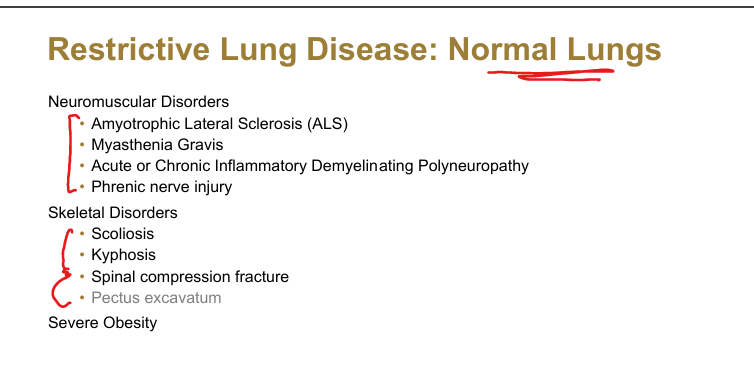
Musculoskeletal causes of restriction
Scoliosis, kyphosis, pectus excavatum, spinal compression fractures.
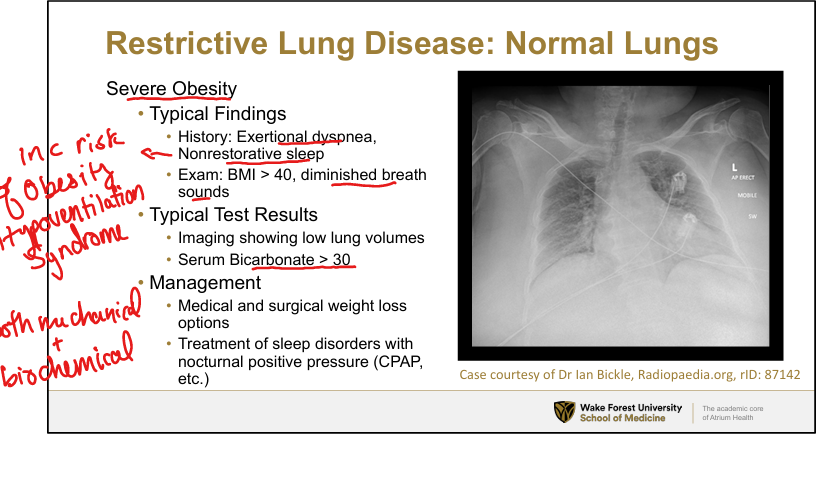
Obesity restrictive disease mechanism
Chest wall mass → ↓ lung volumes + hypoventilation.
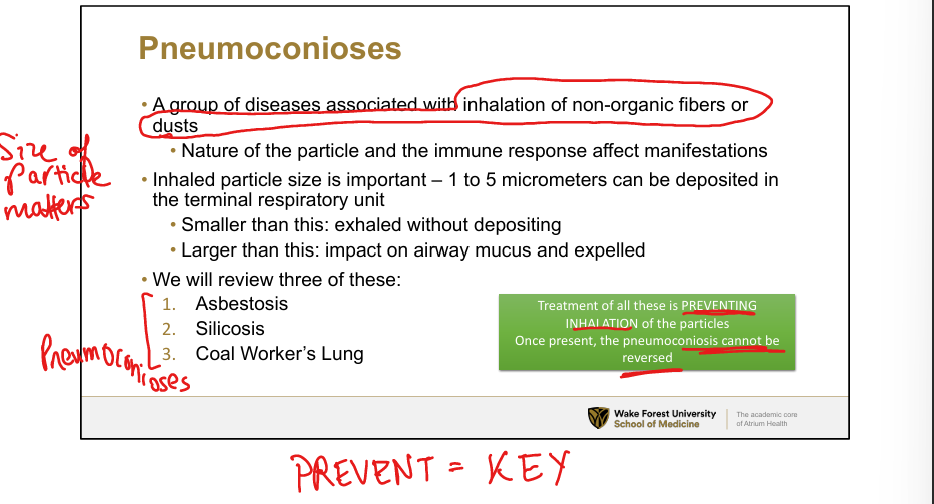
PNEUMOCONIOSIS — Definition
Restrictive ILD caused by inhalation of inorganic dusts/fibers.
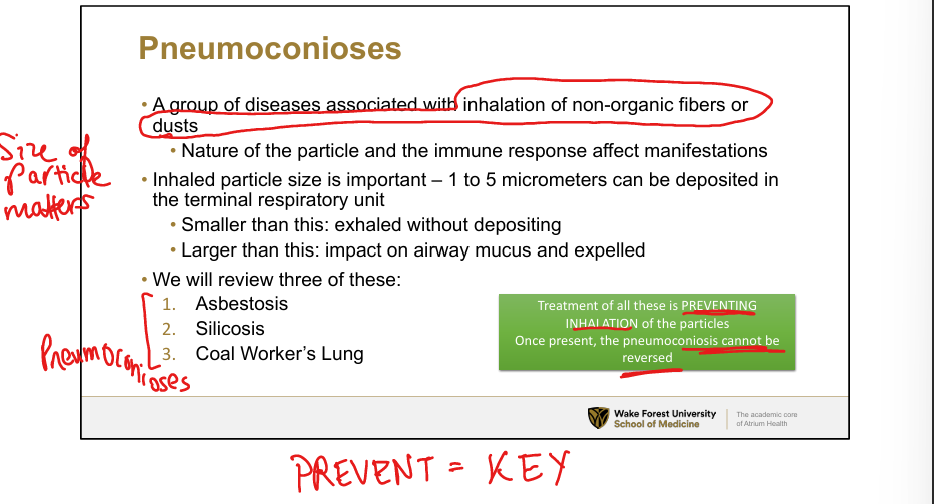
Particle size relevance in pneumoconioses
1–5 µm reach terminal respiratory unit
Pneumoconiosis treatment
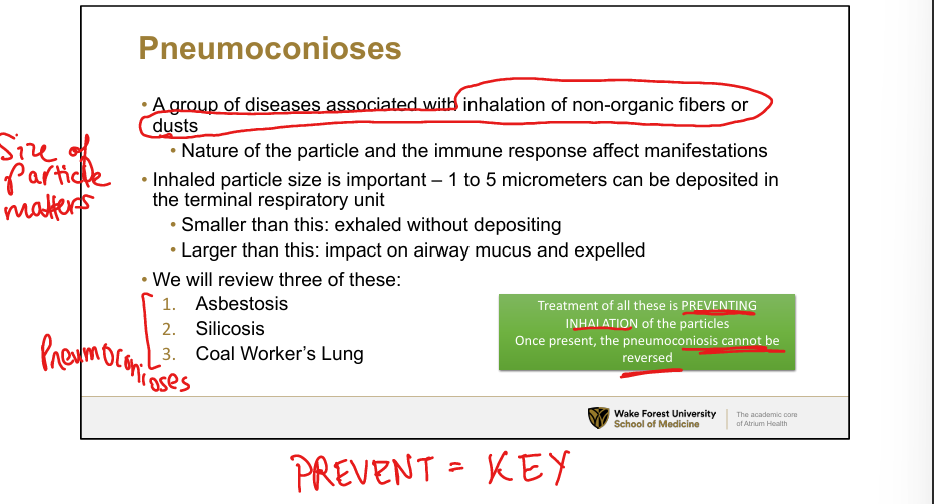
PREVENT exposure — irreversible once fibrosis occurs.
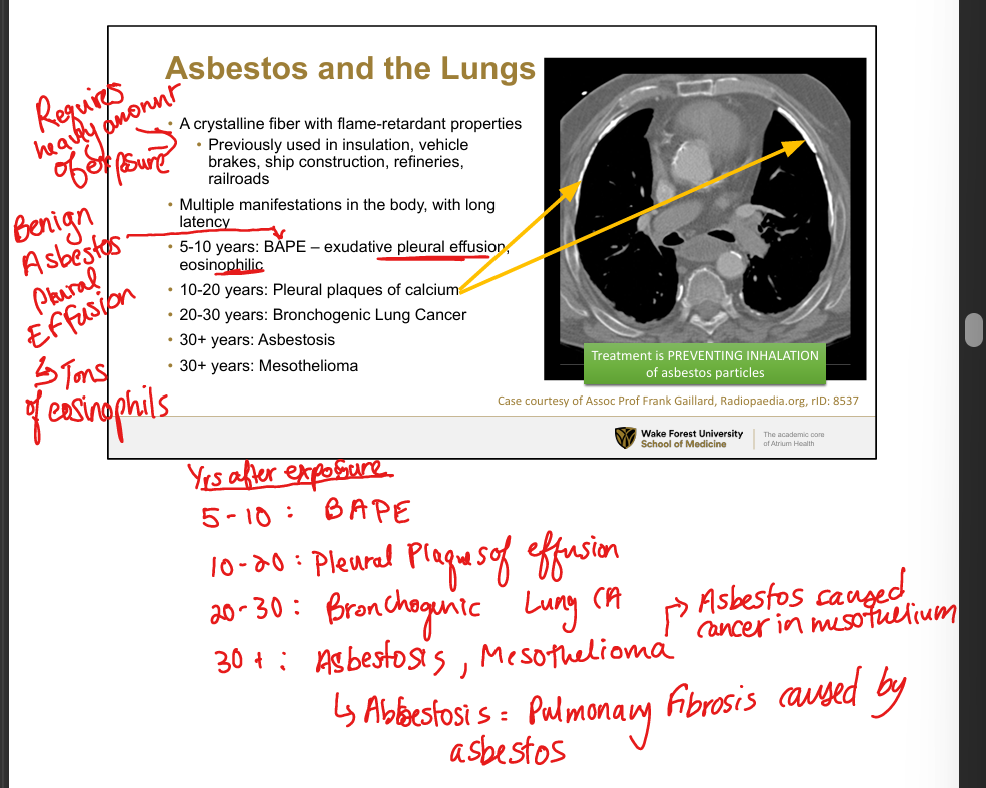
Asbestosis exposure sources
Insulation, shipyards, brakes, refineries.
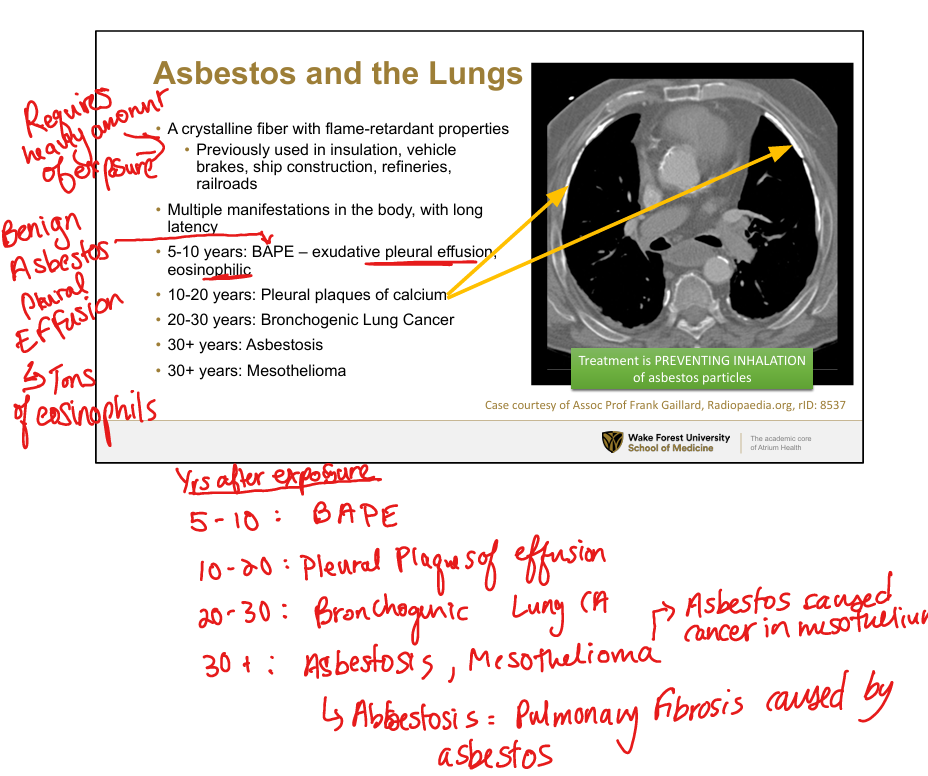
Asbestos timeline
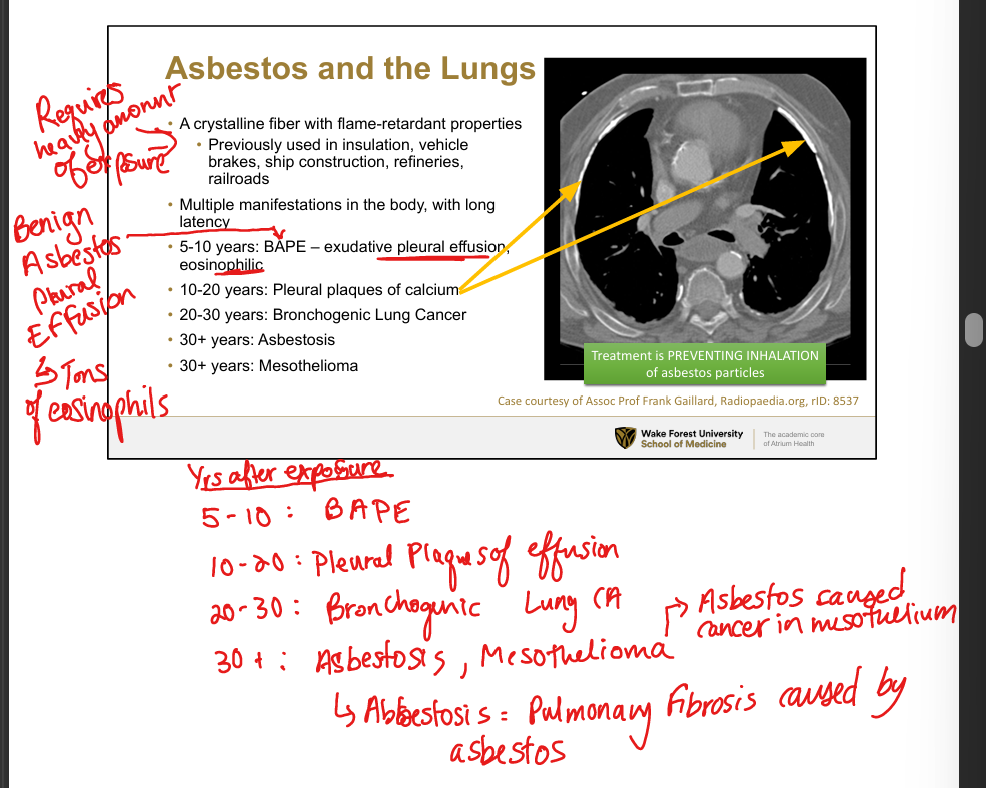
5–10 yrs: BAPE(Benign Asbestos Pleural Effusion)
10-20yrs: Pleural plaques of Ca2+
20-30yrs: Bronchogenic lung cancer
30+ yrs: Asbestosis, Mesothelioma
Asbestosis pathology
Fibrosis + asbestos bodies (ferruginous bodies) required for diagnosis.»fibrosis of the lung caused by asbesto fibers
(macrophages eat asbestos but cant digest them so they stay in the respiratory tract where eventually they get inflammed and fibrotic tisuse forms)

Asbestosis radiology
Basilar fibrosis, honeycombing, pleural plaques.
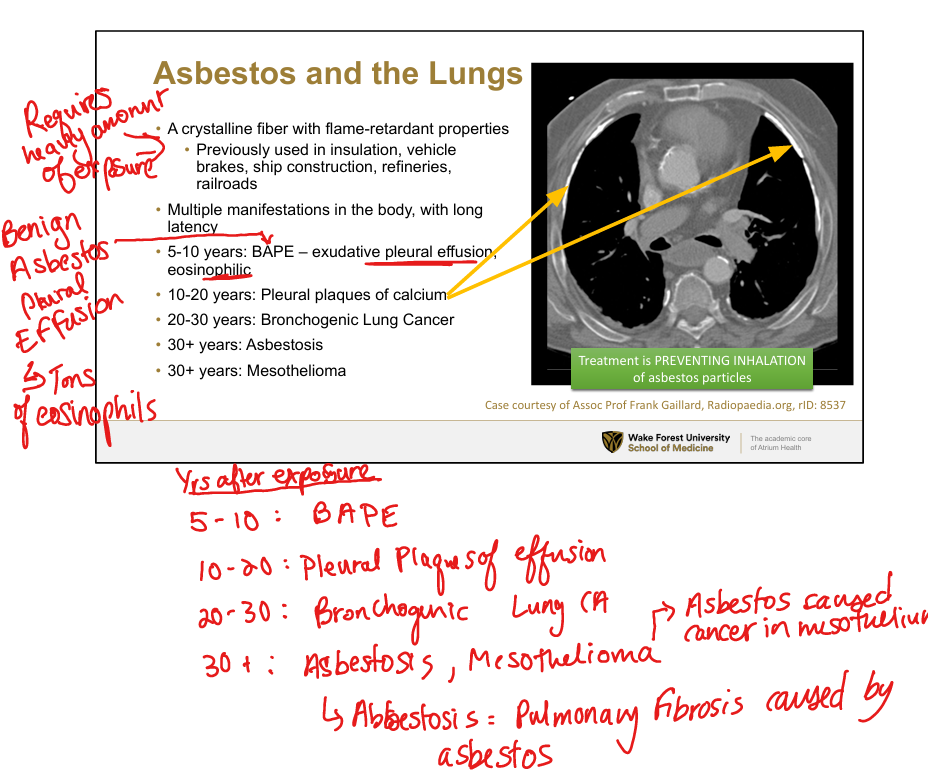
Asbestos cancer associations
30+ yrs after exposure: Bronchogenic carcinoma (most common), mesothelioma (classic).
Silicosis exposure sources
Sandblasting, quarry work, construction, stonemasons.
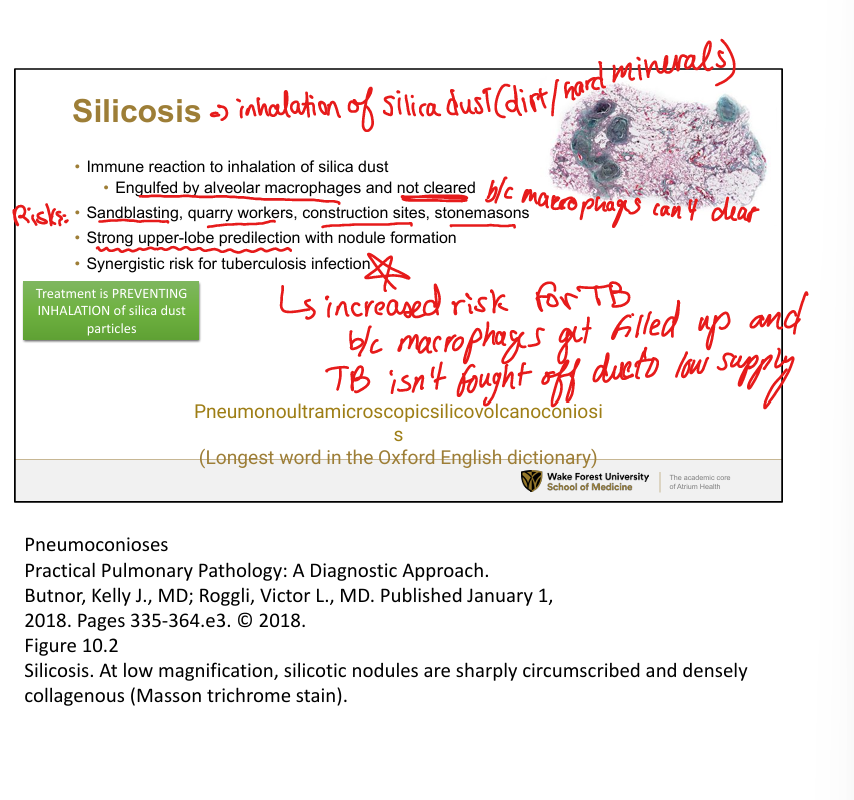
Silicosis pathology + pathogenesis
Inhale silica dust>alveolar macrophages ingest but cant clear»forms Silicotic nodules (collagenous), upper-lobe predominant.

Silicosis radiology
Eggshell calcifications of hilar lymph nodes.
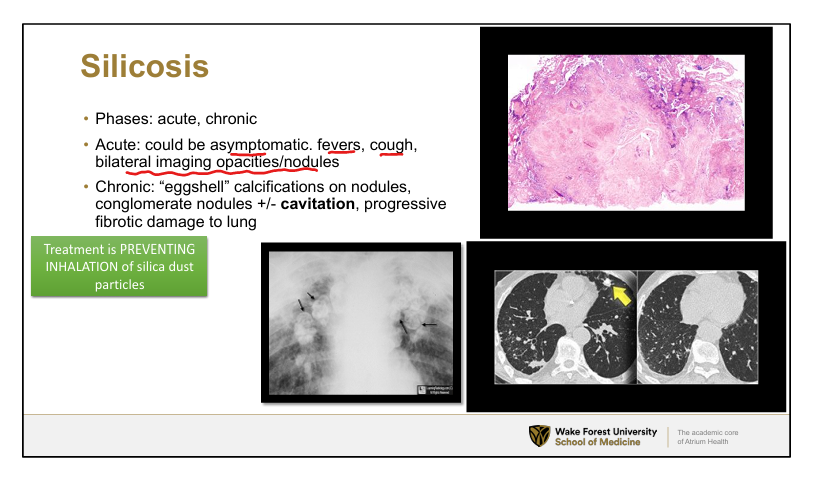
Silicosis TB risk
High — macrophage dysfunction+depletion increases TB susceptibility.
Silicosis treatment
Avoid exposure
Coal worker’s pneumoconiosis cause
Inhalation of coal dust + silica + ash»they get eaten by macrophages but not cleared. Form fibrotic nodules that can lead to progressive massive fibrosis
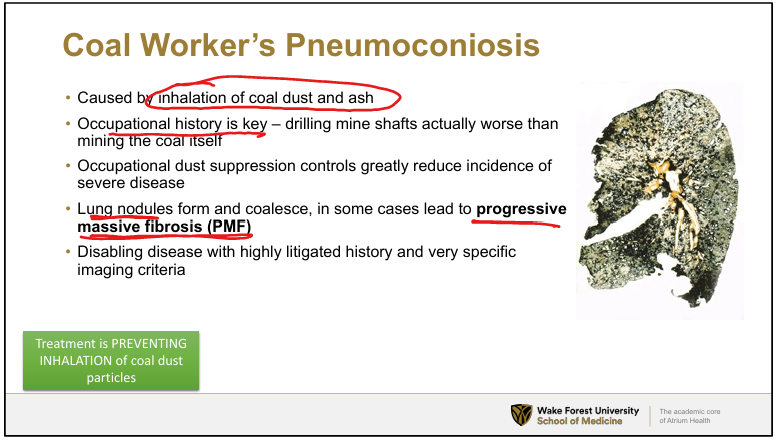
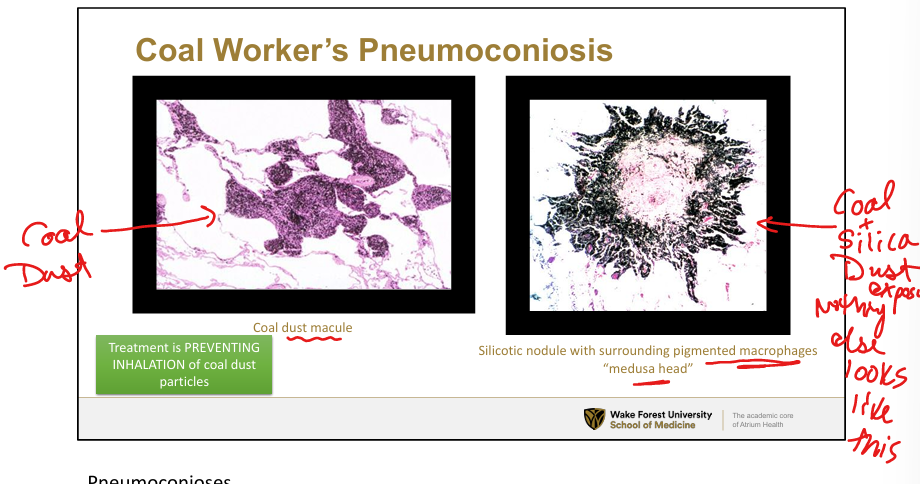
Coal worker’s pneumoconiosis pathology
Coal dust macules and silicotic nodules with surround pigmented macrophages

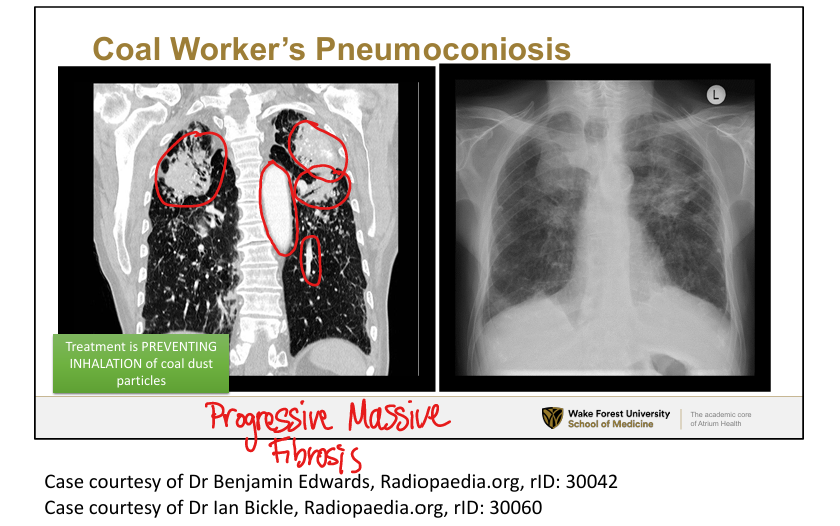
Coal worker’s pneumoconiosis treatment
Avoid exposure.
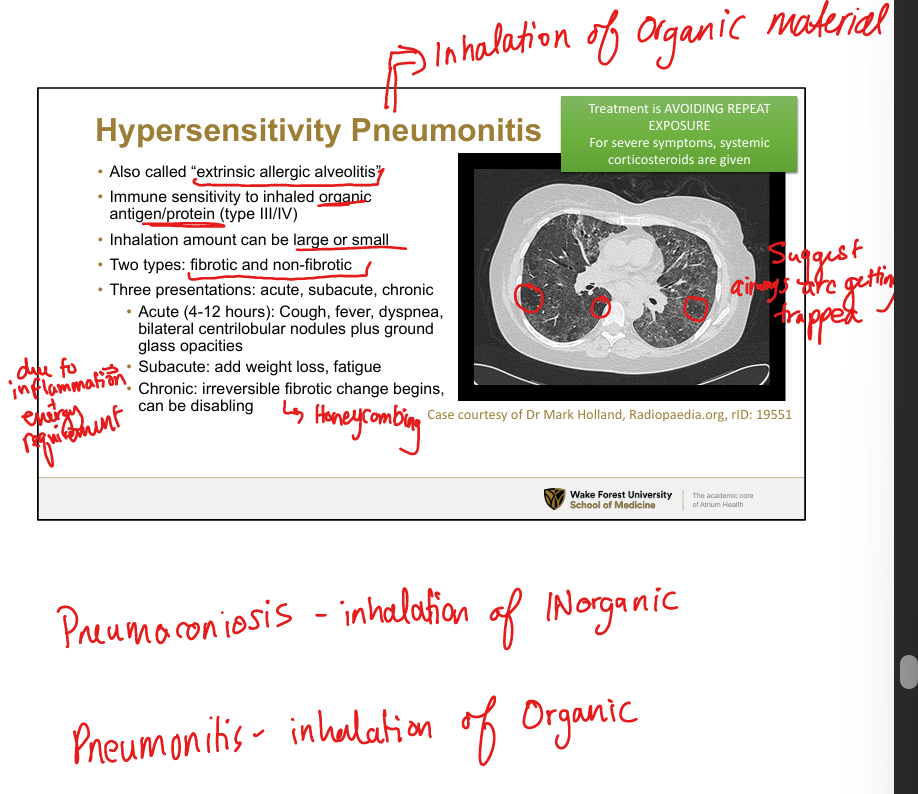
HYPERSENSITIVITY PNEUMONITIS — Definition
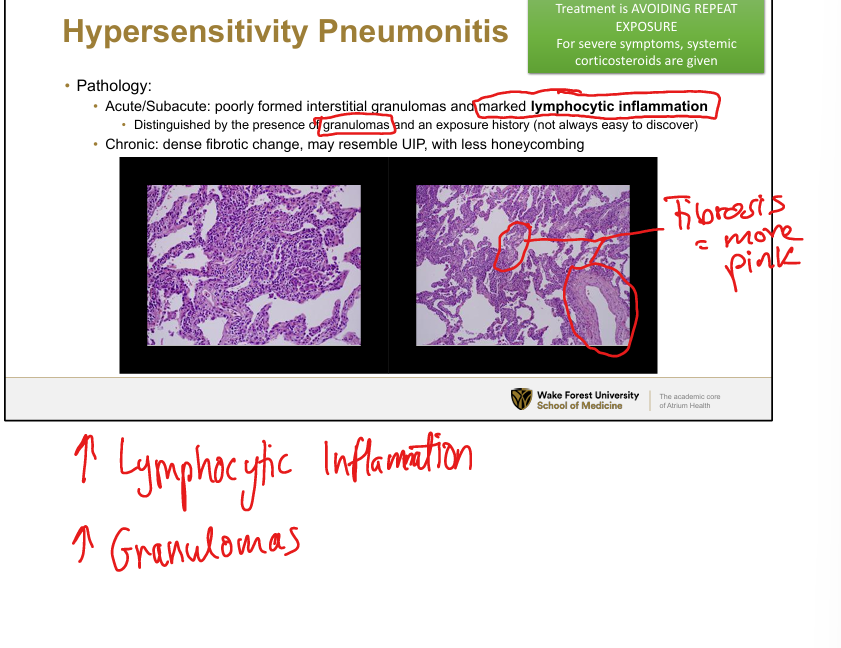
Immune-mediated reaction to inhaled organic antigens (Type III/IV).
Hypersensitivity Pneumonitis exposures
Farmer’s lung, pigeon breeder’s lung, hot-tub lung, bagassosis, maple bark stripper’s disease.

Hypersensitivity Pneumonitis acute presentation
4–12 hrs post exposure: fever, cough, dyspnea, ground glass opacities, centrilobular nodules.
Hypersensitivity Pneumonitis chronic presentation
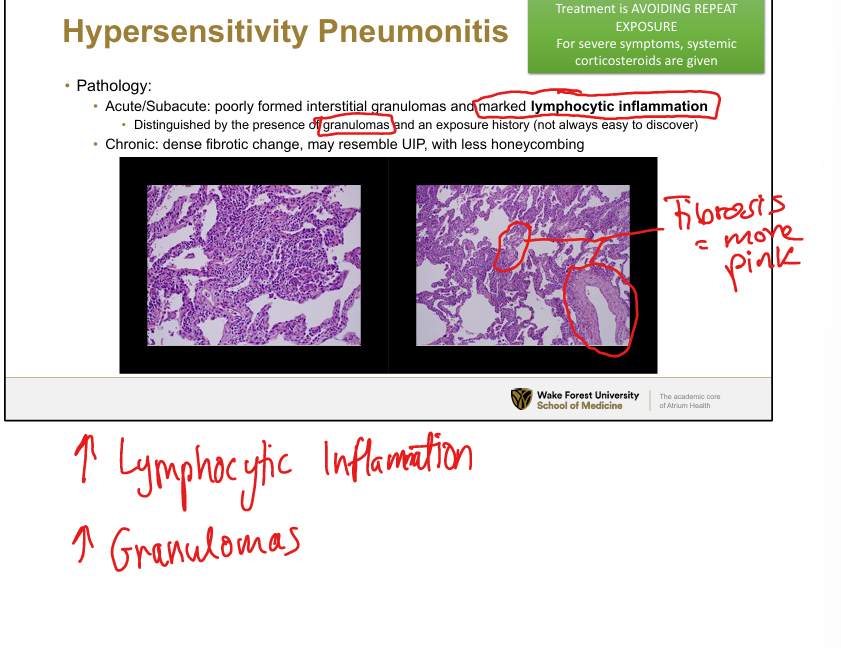
Fibrosis, honeycombing, disabling disease.
Hypersensitivity Pneumonitis pathology
Poorly formed non-necrotizing granulomas + lymphocytic infiltrate.
Hypersensitivity Pneumonitis treatment
Avoid exposure to aggrevating agent as increased exposure can lead to fibrosis
Pneumonitis vs Pneumoconiosis
Pneumonitis=inhaled Organic( hay, bird stuff); Pneumoconiosis=inhaled INorganic (dust/coal/silica etc)
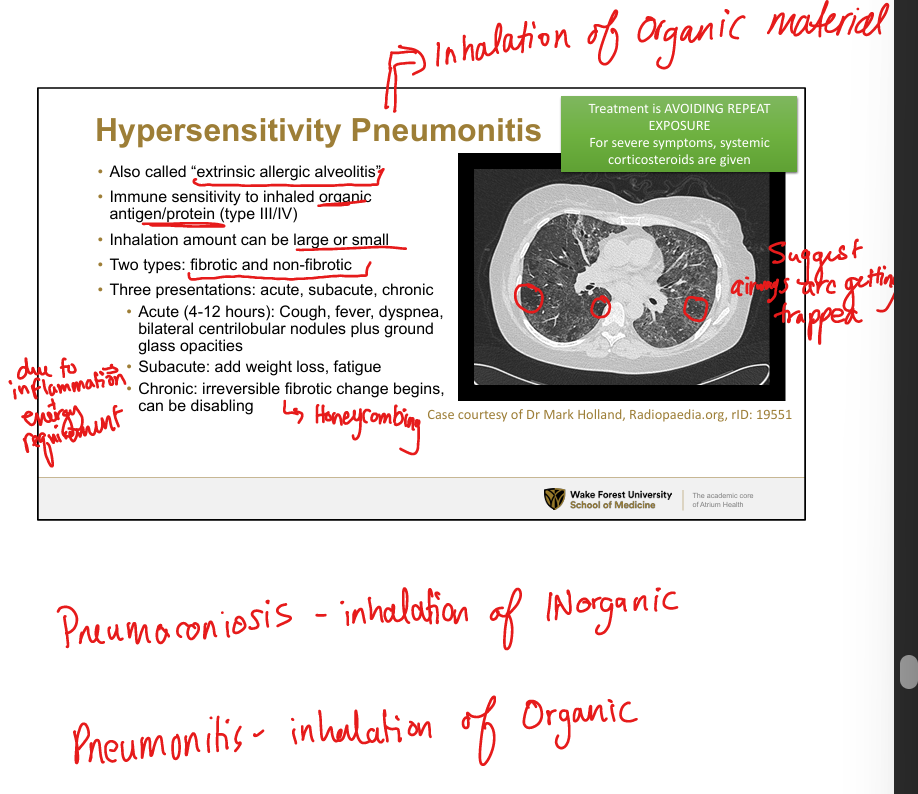
Granulomatous Inflammation in ILD causes
Hypersensitivity pneumonitis, sarcoidosis, drug-induced pneumonitis, infections (TB, atypical mycobacteria).

What is granulomatous inflammation?
Multinucleated giant cells with granulomas, usually non-necrotizing,
USUAL INTERSTITIAL PNEUMONIA (UIP) — Pathology
Temporal heterogeneity, fibroblastic foci, honeycombing.
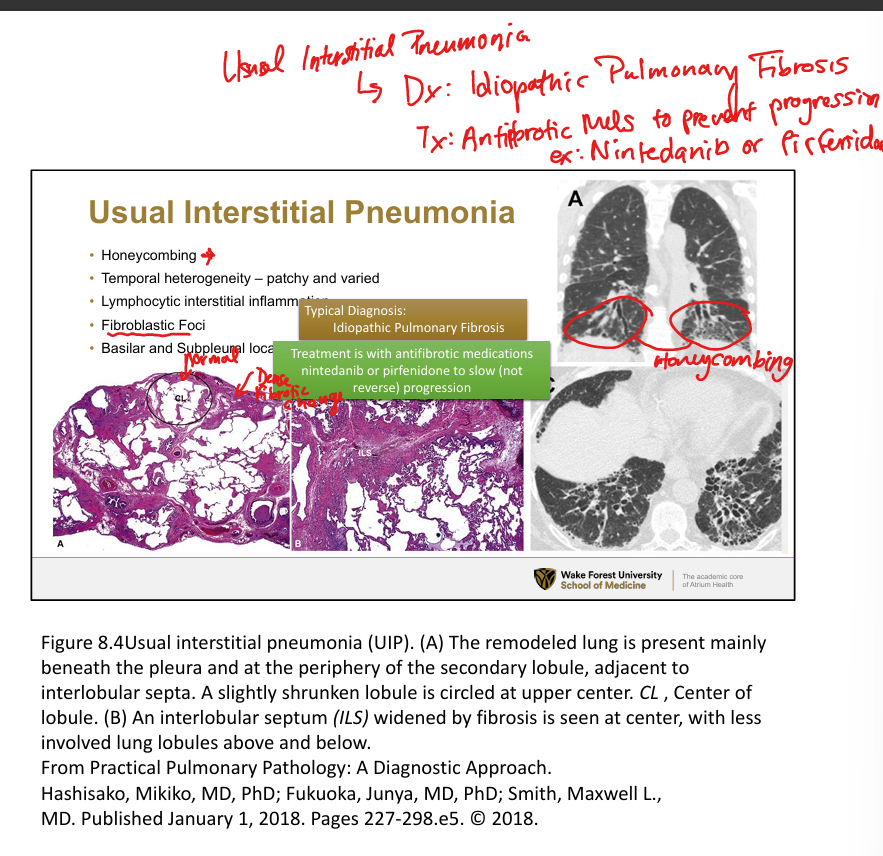
USUAL INTERSTITIAL PNEUMONIA (UIP) radiology
Basilar + subpleural fibrosis with honeycombing.

USUAL INTERSTITIAL PNEUMONIA (UIP) clinical diagnosis + Tx
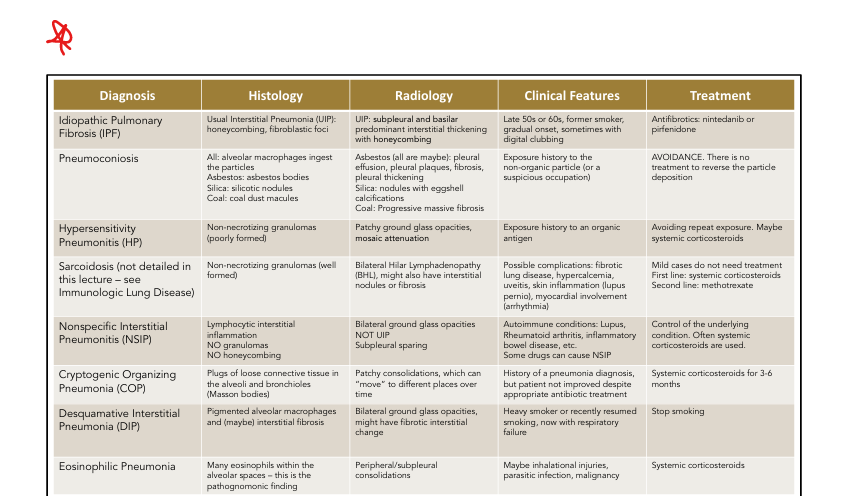
Idiopathic Pulmonary Fibrosis (IPF). Tx: with antifibrotic meds like nintedanib or pirfenidone to slow progression
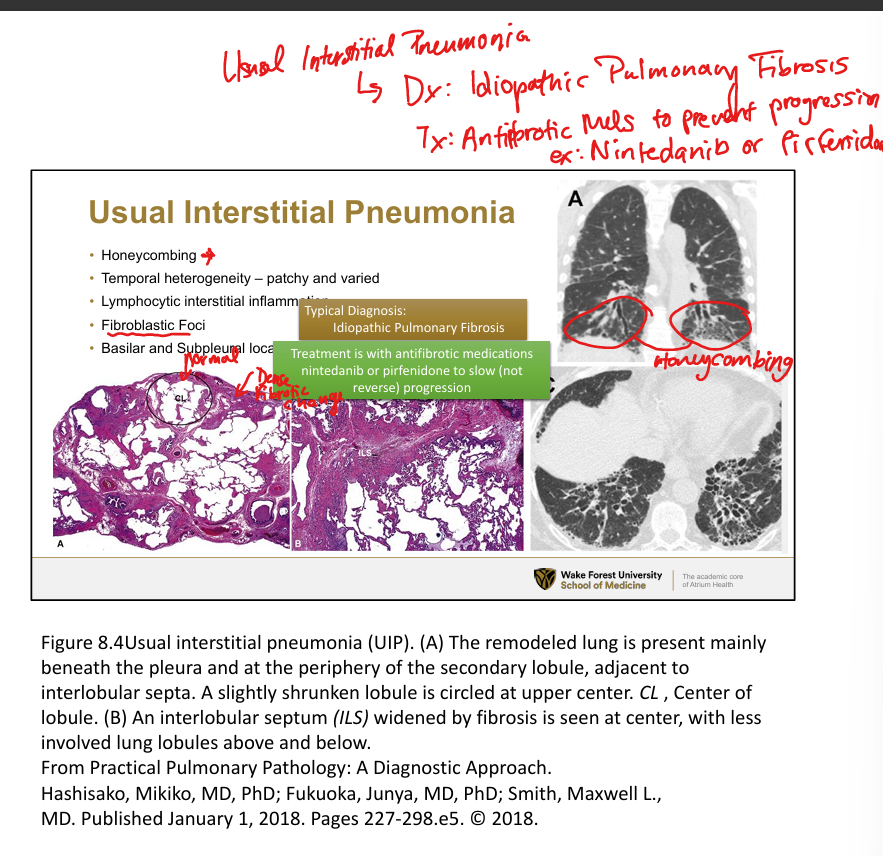
Idiopathic Pulmonary Fibrosis patient profile
Late 50s–60s, former smoker, progressive dyspnea, clubbing.
Idiopathic Pulmonary Fibrosis treatment
Antifibrotics: nintedanib or pirfenidone (slow progression, do not reverse).
NONSPECIFIC INTERSTITIAL PNEUMONIA (NSIP) — Pathology
Temporal homogeneity, lymphocytic inflammation, NO honeycombing.
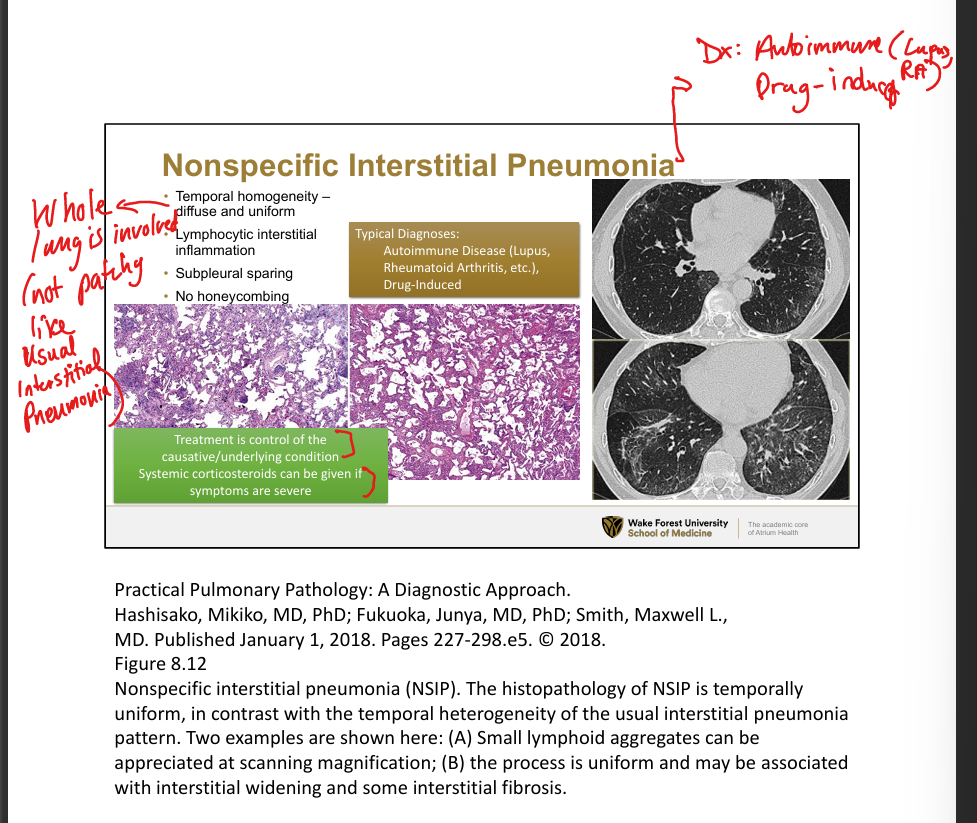
Nonspecific Interstitial Pneumonia Dx associations
Autoimmune disease (RA, lupus), drug-induced.

Nonspecific Interstitial Pneumonia treatment
Treat underlying condition (autoimmune, drug induced)
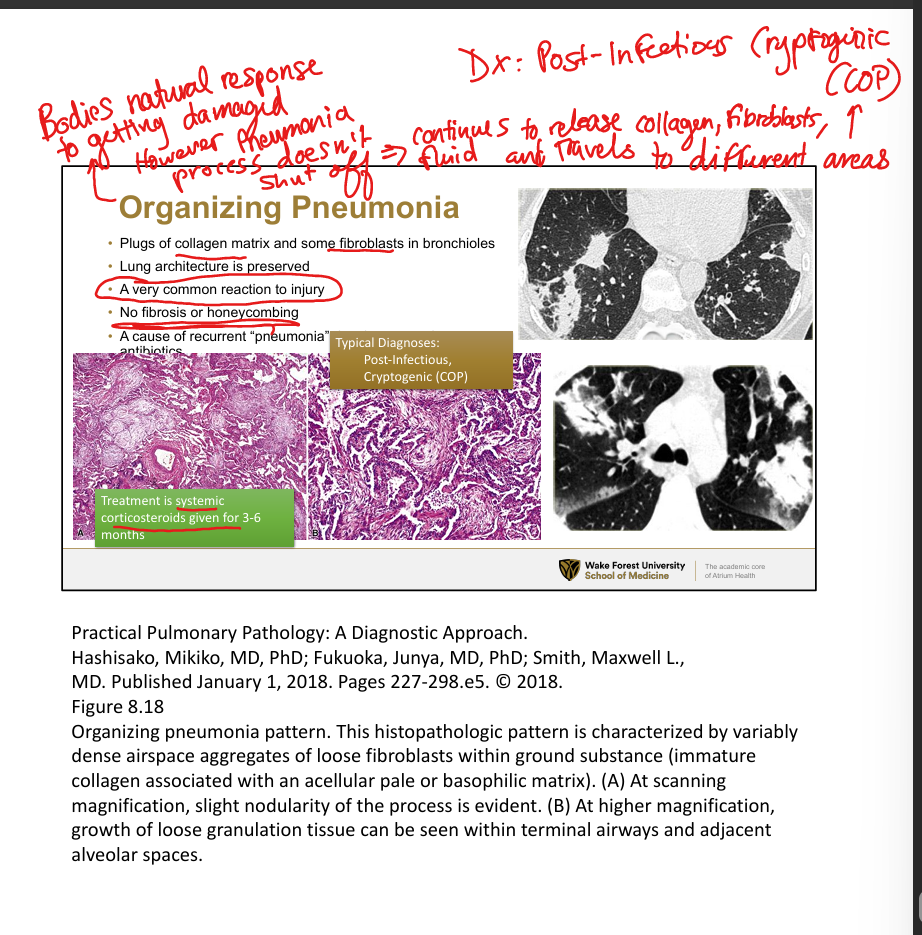
ORGANIZING PNEUMONIA (OP/COP) —
Masson bodies: plugs of loose connective tissue and fibroblasts in bronchioles/alveoli that don’t get shut down. Can lead to Dx: Post-Infectious Cryptogenic (COP)
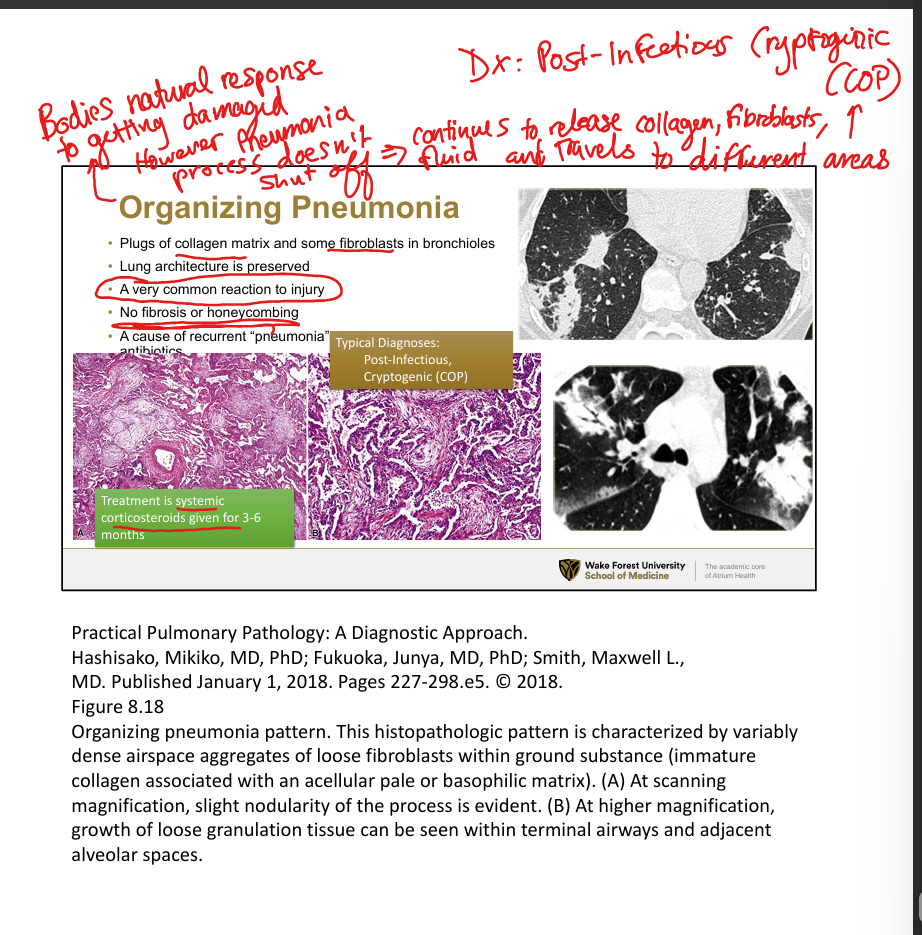
Organizing Pneumonia (COP) clinical clue
“Pneumonia” not improving with antibiotics.
Organzing Pneumonia treatment
Systemic corticosteroids for 3–6 months.
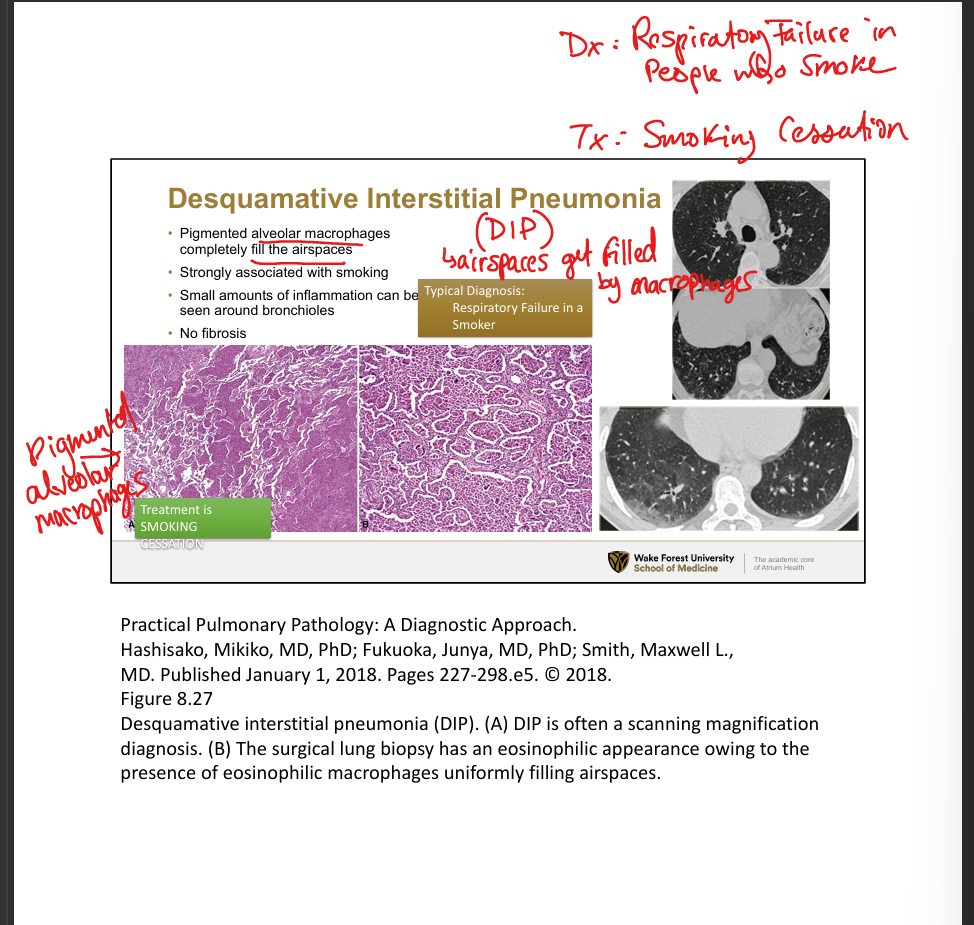
DESQUAMATIVE INTERSTITIAL PNEUMONIA (DIP)
Pigmented alveolar macrophages filling airspaces. Srtrongly associated with smoking. No fibrosis
DESQUAMATIVE INTERSTITIAL PNEUMONIA (DIP) association? Tx?
Strongly linked to smoking. Smoking cessation
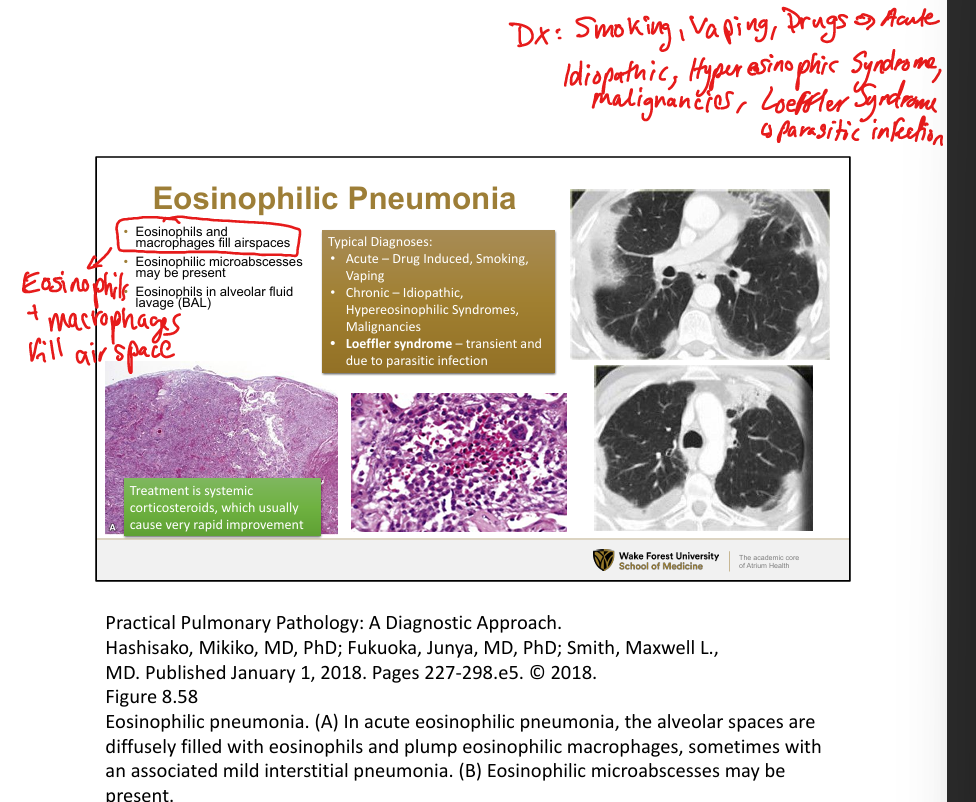
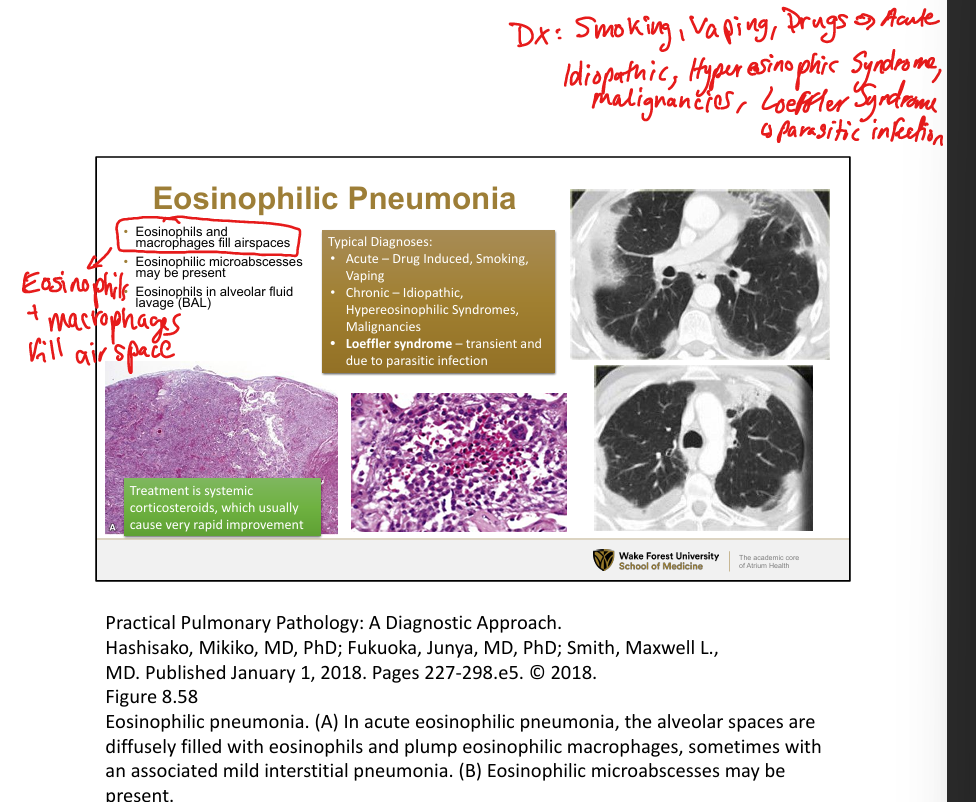
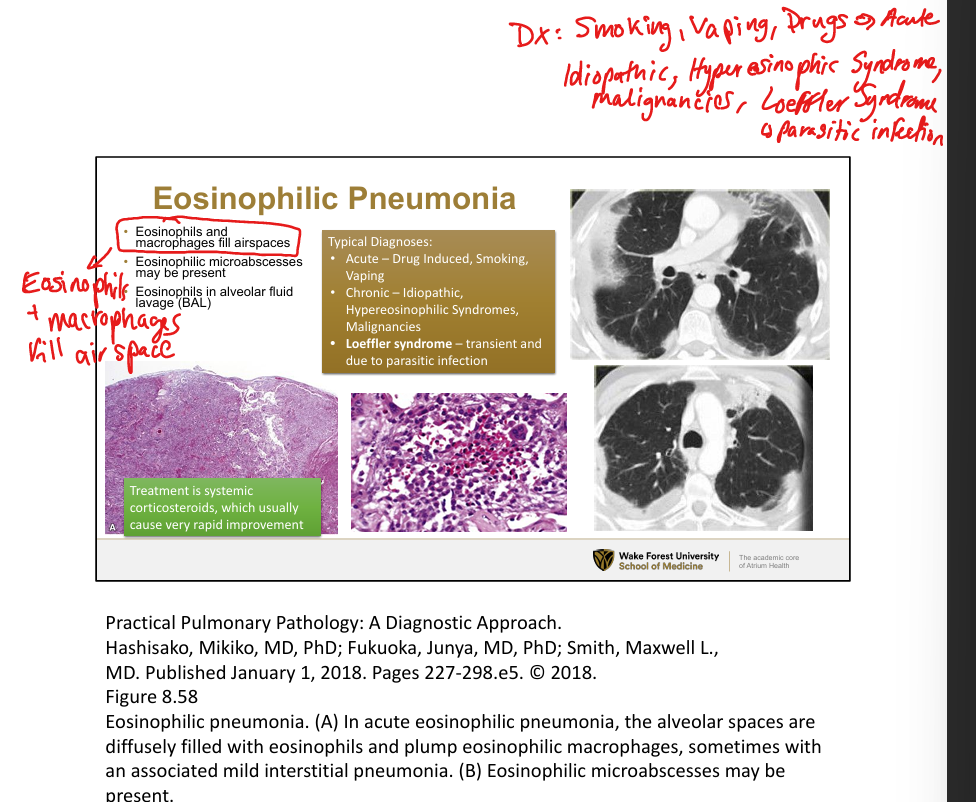
EOSINOPHILIC PNEUMONIA — Pathology
Eosinophils + macrophages filling alveoli
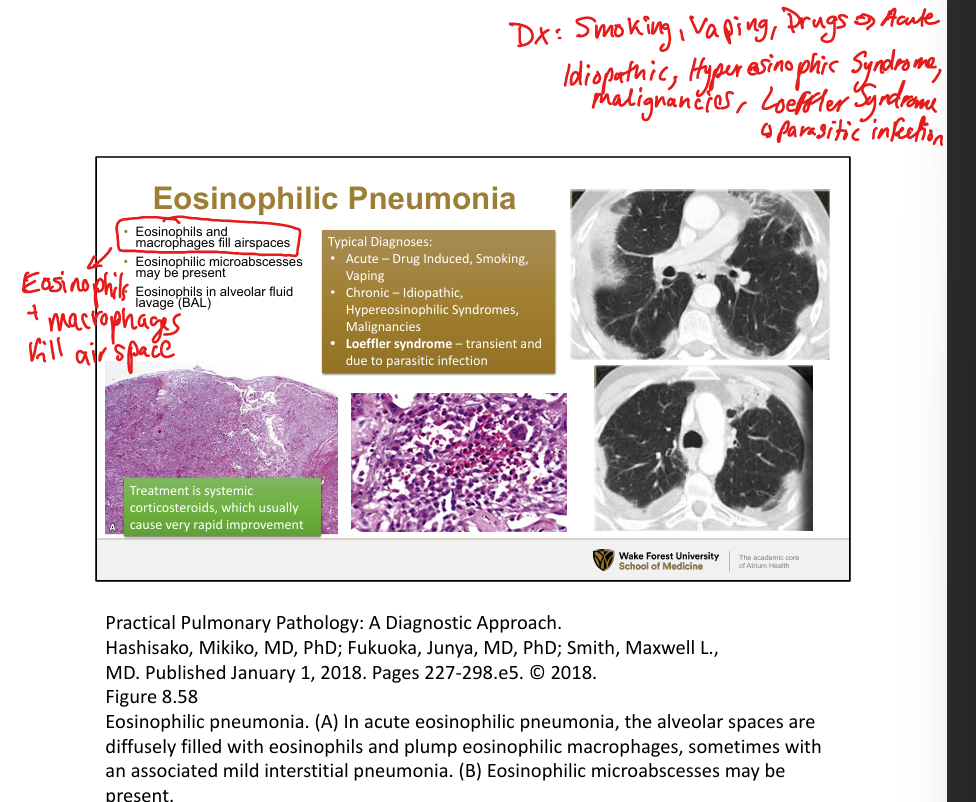
Acute eosinophilic pneumonia causes
Smoking, vaping, drugs
Chronic eosinophilic pneumonia causes
Idiopathic, hypereosinophilic syndromes, malignancy.
Loeffler syndrome
Transient eosinophilic pneumonia due to parasitic infection.
Eosinophilic pneumonia treatment
Systemic corticosteroids → rapid improvement.

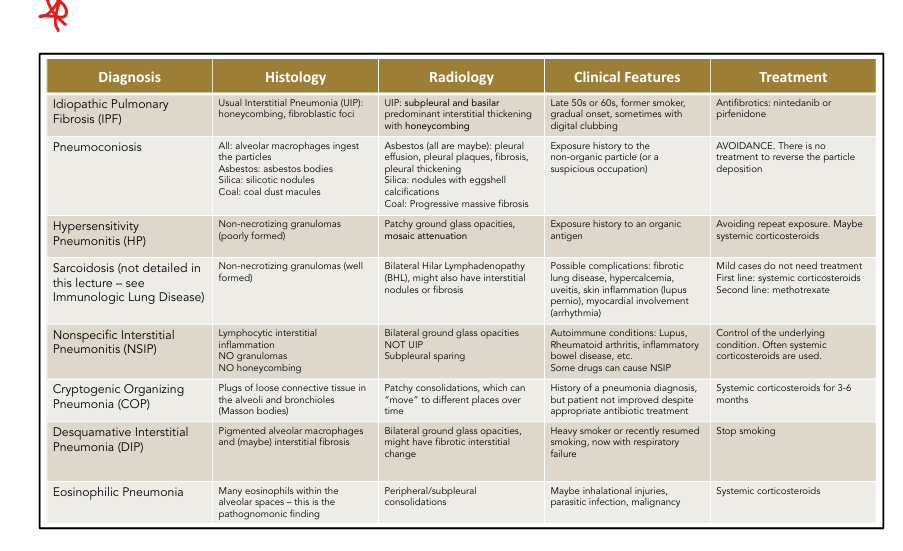
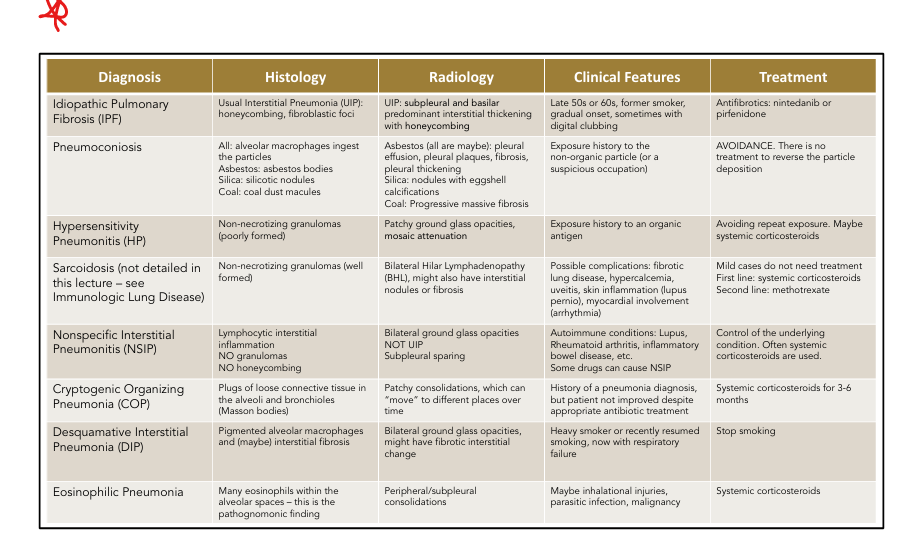
Table
Key granulomatous ILDs (2 whats the difference)
Hypersensitivity Pneumonitis (poorly formed), sarcoidosis (well formed), infections.
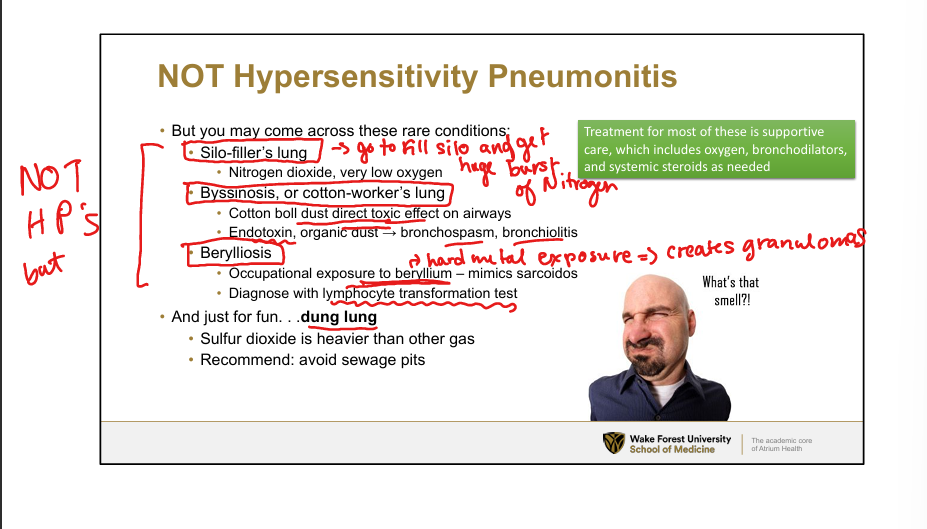
Silo-Fillers Lung
Open silo and get huge burst of nitrogen inhaled, very low O2
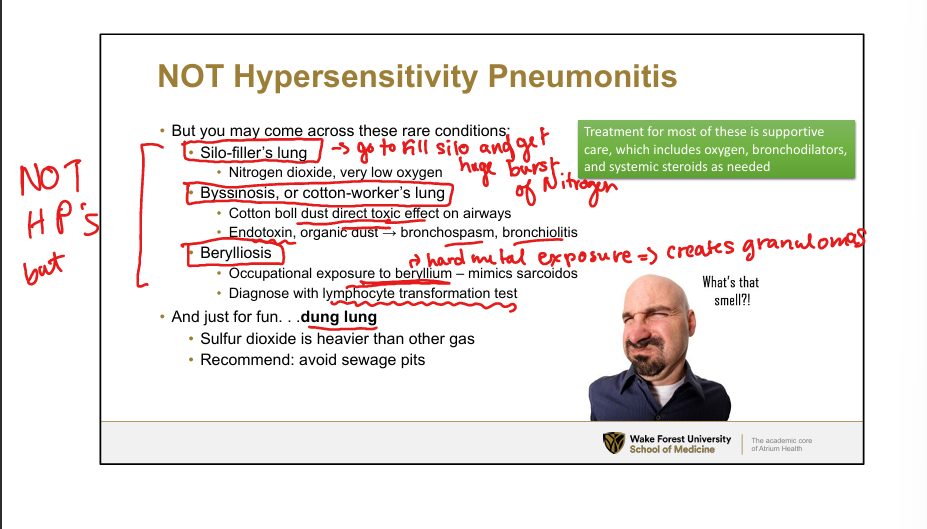
Byssinosis (Cotton-workers lung)
Cotton ball dust direct torxic effect on airways via endotoxin»bronchospasm, bronchiolitis

Berylliosis, Dx?
Occupational exposure to beryllium which mimics sarcodiosis; Dx: with lymphocyte transformation test