a&p - exam 2 muscles (o/ins/inv/funtion)

0.0(0)
Studied by 0 people
call kaiCall Kai
Locked
learnLearn
examPractice Test
spaced repetitionSpaced Repetition
heart puzzleMatch
flashcardsFlashcards
GameKnowt Play
Card Sorting

1/31

encourage image

There's no tags or description

Looks like no tags are added yet.

Last updated 7:14 PM on 6/30/26
Name
Mastery
Learn
Test
Matching
Spaced
Call with Kai
Chat

No analytics yet

Send a link to your students to track their progress

32 Terms

1
New cards

lateral cricoartenoid

INTRINSIC ADDUCTOR

origin: anterolateral surface of cricoid arch

insertion: muscular process, anterior surface of arytenoid

innervation: CN X, RLN (recurrent laryngeal nerve)

function: moves muscular process anteriorly; for adduction, it participates in rotating arytenoid bringing vocal process toward midline; increases medial compression
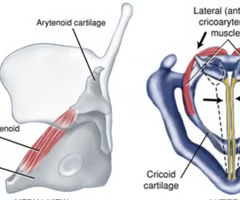
<p><span>INTRINSIC ADDUCTOR</span><br><br><span>origin: anterolateral surface of cricoid arch</span><br><br><span>insertion: muscular process, anterior surface of arytenoid</span><br><br><span>innervation: CN X, RLN (recurrent laryngeal nerve)</span><br><br><span>function: moves muscular process anteriorly; for adduction, it participates in rotating arytenoid bringing vocal process toward midline; increases medial compression</span></p>
2
New cards

transverse arytenoid

INTRINSIC ADDUCTOR

origin: lateral-posterior margin of one arytenoid

insertion: lateral-posterior margin of opposite arytenoid

innervation: CN X, inferior branch of RLN (recurrent laryngeal nerve)

function: contraction causes arytenoids to slide along long axis toward midline; medial compresses vocal fold; pulls arytenoids closer
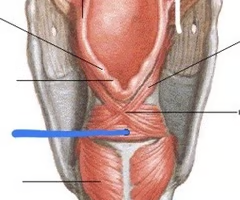
<p><span>INTRINSIC ADDUCTOR<br><br>origin: lateral-posterior margin of one arytenoid<br><br>insertion: lateral-posterior margin of opposite arytenoid<br><br>innervation: CN X, inferior branch of RLN (recurrent laryngeal nerve)<br><br>function: contraction causes arytenoids to slide along long axis toward midline; medial compresses vocal fold; pulls arytenoids closer</span></p>
3
New cards

oblique artenoid

INTRINSIC ADDUCTOR

origin: posterolateral surface of muscular process; adjacent surface

insertion: apex of opposite arytenoid

innervation: CN X, RLN (recurrent laryngeal nerve)

function: pulls apex medially which approximates arytenoids; regulates medial compression
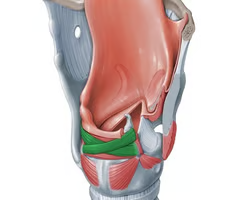
<p><span>INTRINSIC ADDUCTOR<br><br>origin: posterolateral surface of muscular process; adjacent surface<br><br>insertion: apex of opposite arytenoid<br><br>innervation: CN X, RLN (recurrent laryngeal nerve)<br><br>function: pulls apex medially which approximates arytenoids; regulates medial compression</span></p><p></p>
4
New cards

posterior cricoarytenoid

INTRINSIC ABDUCTOR

origin: posterior cricoid lamina

insertion: posterior aspect of muscular process of arytenoid cartilage

innervation: CN X, RLN

function: rocks arytenoid cartilage laterally, abductor; medial part acts to stabilize and fix arytenoid
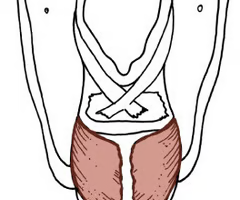
<p><span>INTRINSIC ABDUCTOR</span><br><br><span>origin: posterior cricoid lamina</span><br><br><span>insertion: posterior aspect of muscular process of arytenoid cartilage</span><br><br><span>innervation: CN X, RLN</span><br><br><span>function: rocks arytenoid cartilage laterally, abductor; medial part acts to stabilize and fix arytenoid</span></p><p></p>
5
New cards

cricothyroid (pars recta)

INTRINSIC TENSOR

origin: anterior surface of cricoid beneath the arch

insertion: lower surface of the thyroid lamina

innervation: CN X, external branch of SLN (superior laryngeal nerve)

function: actively tenses or elongates vocal folds (increases distance between thyroid and vocal process, which elongates vocal fold and increases its tension); depresses thyroid relative to cricoid
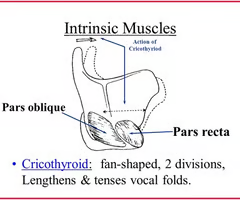
<p><span>INTRINSIC TENSOR</span><br><br><span>origin: anterior surface of cricoid beneath the arch</span><br><br><span>insertion: lower surface of the thyroid lamina</span><br><br><span>innervation: CN X, external branch of SLN (superior laryngeal nerve)</span><br><br><span>function: actively tenses or elongates vocal folds (increases distance between thyroid and vocal process, which elongates vocal fold and increases its tension); depresses thyroid relative to cricoid</span></p><p></p>
6
New cards

cricothyroid (pars oblique)

INTRINSIC TENSOR

origin: cricoid cartilage lateral to pars recta

insertion: thyroid cartilage between laminae and inferior horns

innervation: CN X, external branch of SLN (superior laryngeal nerve)

function: actively tenses or elongates vocal folds (increases distance between thyroid and vocal process, which elongates vocal fold and increases its tension); depresses thyroid relative to cricoid
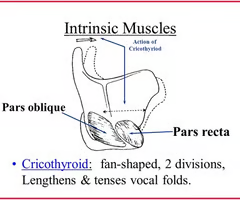
<p><span>INTRINSIC TENSOR</span><br><br><span>origin: cricoid cartilage lateral to pars recta</span><br><br><span>insertion: thyroid cartilage between laminae and inferior horns</span><br><br><span>innervation: CN X, external branch of SLN (superior laryngeal nerve)</span><br><br><span>function: actively tenses or elongates vocal folds (increases distance between thyroid and vocal process, which elongates vocal fold and increases its tension); depresses thyroid relative to cricoid</span></p><p></p>
7
New cards

thyroartenoid muscle

composed of thyrovocalis and thyromuscularis

acts as a regulator of longitudinal tension
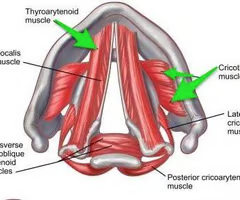
<p><span>composed of thyrovocalis and thyromuscularis</span><br><br><span>acts as a regulator of longitudinal tension</span></p>
8
New cards

thyrovocalis

INTRINSIC TENSOR

origin: inner surface, angle of thyroid

insertion: course back to lateral-inferior aspect of arytenoid vocal process

innervation: X vagus, RLN (recurrent laryngeal nerve)

function: tenses vocal folds (when opposed by other intrinsic muscles)
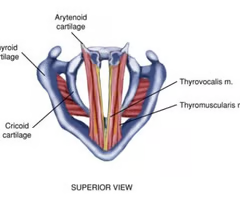
<p><span>INTRINSIC TENSOR</span><br><br><span>origin: inner surface, angle of thyroid</span><br><br><span>insertion: course back to lateral-inferior aspect of arytenoid vocal process</span><br><br><span>innervation: X vagus, RLN (recurrent laryngeal nerve)</span><br><br><span>function: tenses vocal folds (when opposed by other intrinsic muscles)</span></p>
9
New cards

thyromuscularis

INTRINSIC RELAXER

origin: inner surface, angle of thyroid

insertion: swing-off lateroposterosuperior direction into base and muscular process of arytenoid

innervation: X vagus, RLN (recurrent laryngeal nerve)

function: relaxes vocal fold, adduction
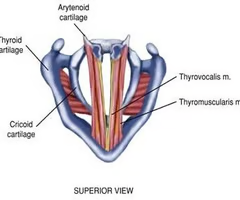
<p><span>INTRINSIC RELAXER</span><br><br><span>origin: inner surface, angle of thyroid</span><br><br><span>insertion: swing-off lateroposterosuperior direction into base and muscular process of arytenoid</span><br><br><span>innervation: X vagus, RLN (recurrent laryngeal nerve)</span><br><br><span>function: relaxes vocal fold, adduction</span></p>
10
New cards

thyroepiglottic

INTRINSIC AUXILLARY MUSCLE

origin: inner surface, thyroid angle

insertion: lateral epiglottis

innervation: X vagus, RLN (recurrent laryngeal nerve)

function: dilates the laryngeal opening; compresses laryngeal saccule for mucus secretion
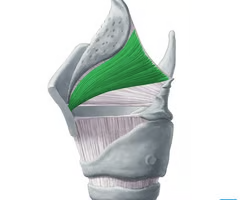
<p><span>INTRINSIC AUXILLARY MUSCLE</span><br><br><span>origin: inner surface, thyroid angle</span><br><br><span>insertion: lateral epiglottis</span><br><br><span>innervation: X vagus, RLN (recurrent laryngeal nerve)</span><br><br><span>function: dilates the laryngeal opening; compresses laryngeal saccule for mucus secretion</span></p>
11
New cards

aryepiglottic

INTRINSIC AUXILLARY MUSCLE

origin: continuation of oblique arytenoid from apex

insertion: lateral epiglottis

innervation: X vagus, RLN (recurrent laryngeal nerve)

function: deflects epiglottis over airway opening to help protect the airway during swallowing; constricts laryngeal opening
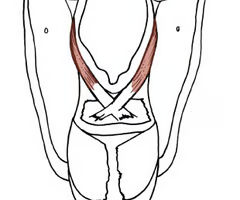
<p><span>INTRINSIC AUXILLARY MUSCLE<br><br>origin: continuation of oblique arytenoid from apex<br><br>insertion: lateral epiglottis<br><br>innervation: X vagus, RLN (recurrent laryngeal nerve)<br><br>function: deflects epiglottis over airway opening to help protect the airway during swallowing; constricts laryngeal opening</span></p>
12
New cards

digastric - anterior belly

EXTRINSIC SUPRAHYOID

origin: inner surface of mandible, near symphysis

insertion: hyoid via intermediate tendon

innervation: CN V (trigeminal), inferior alveolar nerve

function: pulls hyoid up and forward
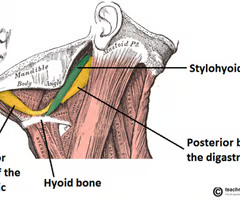
<p><span>EXTRINSIC SUPRAHYOID</span><br><br><span>origin: inner surface of mandible, near symphysis</span><br><br><span>insertion: hyoid via intermediate tendon</span><br><br><span>innervation: CN V (trigeminal), inferior alveolar nerve</span><br><br><span>function: pulls hyoid up and forward</span></p>
13
New cards

digastric - posterior belly

EXTRINSIC SUPRAHYOID

origin: mastoid process of temporal bone

insertion: hyoid via intermediate tendon

innervation: CN VII (facial), digastric branch

function: pulls hyoid up and back
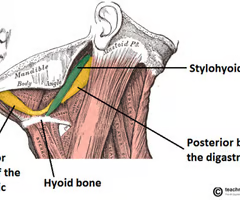
<p><span>EXTRINSIC SUPRAHYOID</span><br><br><span>origin: mastoid process of temporal bone</span><br><br><span>insertion: hyoid via intermediate tendon</span><br><br><span>innervation: CN VII (facial), digastric branch</span><br><br><span>function: pulls hyoid up and back</span></p>
14
New cards

stylohyoid

EXTRINSIC SUPRAHYOID

origin: posterior/lateral (styloid) process of temporal bone

insertion: splits into 2 slips passing around intermediate tendon to insert into corpus of hyoid

innervation: CN VII (facial), stylohyoid branch

function: contraction draws hyoid up and backward, moving it posteriorly
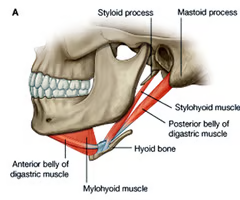
<p><span>EXTRINSIC SUPRAHYOID<br><br>origin: posterior/lateral (styloid) process of temporal bone<br><br>insertion: splits into 2 slips passing around intermediate tendon to insert into corpus of hyoid<br><br>innervation: CN VII (facial), stylohyoid branch<br><br>function: contraction draws hyoid up and backward, moving it posteriorly</span></p>
15
New cards

mylohyoid

EXTRINSIC SUPRAHYOID

origin: inner bony ridge of mandible (mylohyoid line)

insertion: midline raphe; posterior-most attach to corpus of hyoid

innervation: CN V (trigeminal), mylohyoid branch from inferior alveolar nerve

function: elevates hyoid, floor of mouth, and tongue; with hyoid in a fixed position, it assists in depressing the mandible
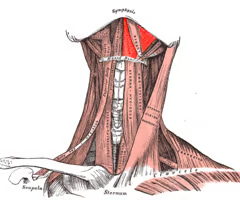
<p><span>EXTRINSIC SUPRAHYOID</span><br><br><span>origin: inner bony ridge of mandible (mylohyoid line)</span><br><br><span>insertion: midline raphe; posterior-most attach to corpus of hyoid</span><br><br><span>innervation: CN V (trigeminal), mylohyoid branch from inferior alveolar nerve</span><br><br><span>function: elevates hyoid, floor of mouth, and tongue; with hyoid in a fixed position, it assists in depressing the mandible</span></p>
16
New cards

geniohyoid

EXTRINSIC SUPRAHYOID

origin: short tendon from mental symphysis of mandible

insertion: corpus of hyoid

innervation: C1 spinal nerve via CN XII (hypoglossal)

function: elevate and draw hyoid forward
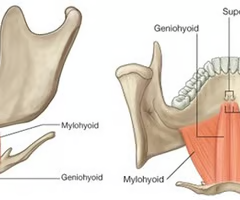
<p><span>EXTRINSIC SUPRAHYOID</span><br><br><span>origin: short tendon from mental symphysis of mandible</span><br><br><span>insertion: corpus of hyoid</span><br><br><span>innervation: C1 spinal nerve via CN XII (hypoglossal)</span><br><br><span>function: elevate and draw hyoid forward</span></p>
17
New cards

hyoglossus

EXTRINSIC SUPRAHYOID

origin: greater horns and body of hyoid

insertion: posterior, lateral portion of tongue

innervation: CN XII (hypoglossal, motor branch

function: elevates hyoid, lingual depressor; influences position of larynx indirectly
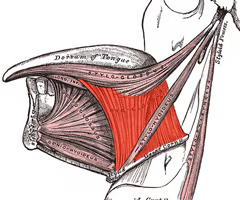
<p>EXTRINSIC SUPRAHYOID</p><p></p><p>origin: greater horns and body of hyoid</p><p></p><p>insertion: posterior, lateral portion of tongue</p><p></p><p>innervation: CN XII (hypoglossal, motor branch</p><p></p><p>function: elevates hyoid, lingual depressor; influences position of larynx indirectly </p>
18
New cards

genioglossus

EXTRINSIC SUPRAHYOID

origin: mental symphysis of mandible

insertion: lowermost fibers of corpus of hyoid; upper dorsum and tip of tongue

innervation: CN XII (hypoglossal), motor branch

function: extrinsic tongue muscle; contraction elevates hyoid
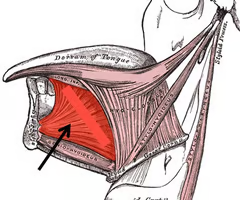
<p><span>EXTRINSIC SUPRAHYOID<br><br>origin: mental symphysis of mandible<br><br>insertion: lowermost fibers of corpus of hyoid; upper dorsum and tip of tongue<br><br>innervation: CN XII (hypoglossal), motor branch<br><br>function: extrinsic tongue muscle; contraction elevates hyoid</span></p>
19
New cards

sternohyoid

EXTRINSIC INFRAHYOID

origin: manubrium sterni, clavicle

insertion: inferior margin of hyoid corpus

innervation: ansa cervicalis, C1-C3

function: draws hyoid down; fixes hyoid when lower jaw is opened against resistance
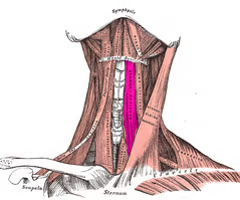
<p><span>EXTRINSIC INFRAHYOID</span><br><br><span>origin: manubrium sterni, clavicle</span><br><br><span>insertion: inferior margin of hyoid corpus</span><br><br><span>innervation: ansa cervicalis, C1-C3</span><br><br><span>function: draws hyoid down; fixes hyoid when lower jaw is opened against resistance</span></p>
20
New cards

omohyoid - superior

EXTRINSIC INFRAHYOID

origin: intermediate tendon

insertion: lower border, greater horn of hyoid

innervation: ansa cervicalis C1

function: depresses hyoid; prevents neck region from collapsing during deep inspiratory efforts
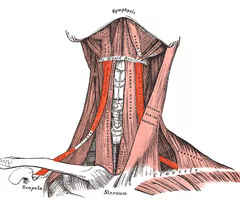
<p><span>EXTRINSIC INFRAHYOID</span><br><br><span>origin: intermediate tendon</span><br><br><span>insertion: lower border, greater horn of hyoid</span><br><br><span>innervation: ansa cervicalis C1</span><br><br><span>function: depresses hyoid; prevents neck region from collapsing during deep inspiratory efforts</span></p>
21
New cards

omohyoid - inferior

EXTRINSIC INFRAHYOID

origin: upper border scapula

insertion: intermediate tendon, just above the sternum

innervation: ansa cervicalis, C2-C3

function: depresses hyoid; prevents neck region from collapsing during deep inspiratory efforts
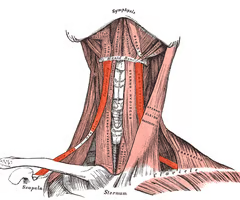
<p>EXTRINSIC INFRAHYOID</p><p></p><p>origin: upper border scapula</p><p></p><p>insertion: intermediate tendon, just above the sternum </p><p></p><p>innervation: ansa cervicalis, C2-C3</p><p></p><p>function: depresses hyoid; prevents neck region from collapsing during deep inspiratory efforts</p>
22
New cards

sternothyroid

EXTRINSIC INFRAHYOID

origin: posterior surface of manubrium sterni & 1st costal cartilage

insertion: oblique line of thyroid

innervation: XII hypoglossal and spinal nerves C1 and C2

function: draw thyroid cartilage down
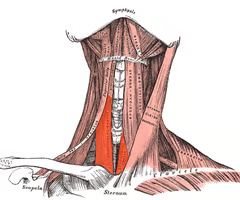
<p><span>EXTRINSIC INFRAHYOID</span><br><br><span>origin: posterior surface of manubrium sterni &amp; 1st costal cartilage</span><br><br><span>insertion: oblique line of thyroid</span><br><br><span>innervation: XII hypoglossal and spinal nerves C1 and C2</span><br><br><span>function: draw thyroid cartilage down</span></p>
23
New cards

thryohyoid

EXTRINSIC INFRAHYOID

origin: oblique line of thyroid lamina

insertion: lower border of greater horn of hyoid

innervation: spinal nerve C1 via CN XII (hypoglossal)

function: contraction decreases distance between thyroid and hyoid; thyroid fixed = depresses hyoid; hyoid fixed = elevates thyroid
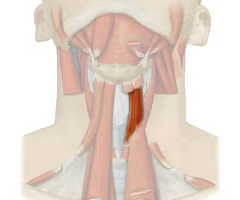
<p><span>EXTRINSIC INFRAHYOID</span><br><br><span>origin: oblique line of thyroid lamina</span><br><br><span>insertion: lower border of greater horn of hyoid</span><br><br><span>innervation: spinal nerve C1 via CN XII (hypoglossal)</span><br><br><span>function: contraction decreases distance between thyroid and hyoid; thyroid fixed = depresses hyoid; hyoid fixed = elevates thyroid</span></p>
24
New cards

superior pharyngeal constrictor

OUTER CIRCULAR LAYER

origin: hamulus, pterygomandibular raphe; mylohyoid line, mandible

insertion: median raphe, pharyngeal tubercle

innervation: CN X via pharyngeal plexus

function: pull pharyngeal wall forward to assist in closing nasopharynx; narrows the upper pharyngeal segment
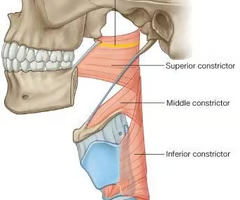
<p><span>OUTER CIRCULAR LAYER</span><br><br><span>origin: hamulus, pterygomandibular raphe; mylohyoid line, mandible</span><br><br><span>insertion: median raphe, pharyngeal tubercle</span><br><br><span>innervation: CN X via pharyngeal plexus</span><br><br><span>function: pull pharyngeal wall forward to assist in closing nasopharynx; narrows the upper pharyngeal segment</span></p>
25
New cards

middle pharyngeal constrictor

OUTER CIRCULAR LAYER

origin: stylohyoid ligament, horns of hyoid bone

insertion: median raphe, pharynx

innervation: CN X via pharyngeal plexus

function: narrows diameter of mid portion of pharynx
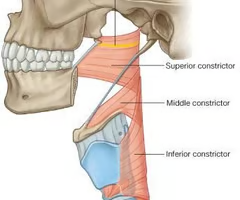
<p><span>OUTER CIRCULAR LAYER</span><br><br><span>origin: stylohyoid ligament, horns of hyoid bone</span><br><br><span>insertion: median raphe, pharynx</span><br><br><span>innervation: CN X via pharyngeal plexus</span><br><br><span>function: narrows diameter of mid portion of pharynx</span></p>
26
New cards

inferior pharyngeal constrictor muscle consists of…

thyropharyngeus & cricopharyngeus

27
New cards

thyropharyngeus

origin: oblique line of thyroid lamina and inferior cornu

insertion: median raphe

innervation: CN X via pharyngeal plexus

function: constricts lower pharynx, elevates larynx
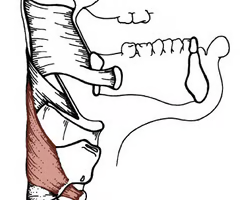
<p><span>origin: oblique line of thyroid lamina and inferior cornu</span><br><br><span>insertion: median raphe</span><br><br><span>innervation: CN X via pharyngeal plexus</span><br><br><span>function: constricts lower pharynx, elevates larynx</span></p>
28
New cards

cricopharyngeus

aka upper esophageal sphincter

origin: cricoid

insertion: median raphe

innervation: CN X via pharyngeal plexus; external LN and RLN motor CN X

function: conform sphincter like tube
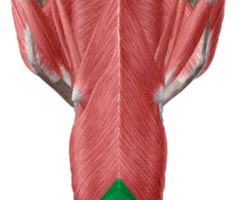
<p><span>aka upper esophageal sphincter</span><br><br><span>origin: cricoid</span><br><br><span>insertion: median raphe</span><br><br><span>innervation: CN X via pharyngeal plexus; external LN and RLN motor CN X</span><br><br><span>function: conform sphincter like tube</span></p>
29
New cards

salpingopharyngeus

INNER LONGITUDINAL LAYER

origin: auditory tube

insertion: lateral pharyngeal wall (converges with palatopharyngeus muscle)

innervation: CN X via pharyngeal plexus

function: elevates lateral pharyngeal wall
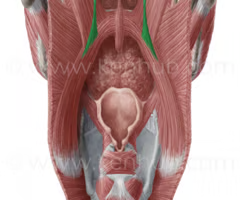
<p><span>INNER LONGITUDINAL LAYER</span><br><br><span>origin: auditory tube</span><br><br><span>insertion: lateral pharyngeal wall (converges with palatopharyngeus muscle)</span><br><br><span>innervation: CN X via pharyngeal plexus</span><br><br><span>function: elevates lateral pharyngeal wall</span></p>
30
New cards

palatopharyngeus

INNER LONGITUDINAL LAYER

origin: posterior border of hard palate; palatine aponeurosis

insertion: posterior border of the lamina of the thyroid cartilage

innervation: CN X via pharyngeal plexus

function: narrow pharynx; acts as sphincter to lower the palate and decrease distance between arches (swallowing and gagging)
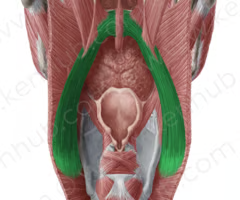
<p><span>INNER LONGITUDINAL LAYER</span><br><br><span>origin: posterior border of hard palate; palatine aponeurosis</span><br><br><span>insertion: posterior border of the lamina of the thyroid cartilage</span><br><br><span>innervation: CN X via pharyngeal plexus</span><br><br><span>function: narrow pharynx; acts as sphincter to lower the palate and decrease distance between arches (swallowing and gagging)</span></p>
31
New cards

stylopharyngeus

INNER LONGITUDINAL LAYER

origin: styloid process of temporal bone

insertion: lateral pharyngeal wall

innervation: CN IX (glossopharyngeal)

function: elevates and opens pharynx, especially during deglutition
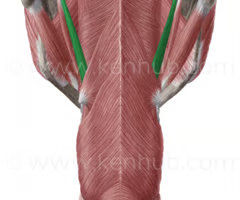
<p><span>INNER LONGITUDINAL LAYER</span><br><br><span>origin: styloid process of temporal bone</span><br><br><span>insertion: lateral pharyngeal wall</span><br><br><span>innervation: CN IX (glossopharyngeal)</span><br><br><span>function: elevates and opens pharynx, especially during deglutition</span></p>
32
New cards

pharyngeal plexus nerve

formed by pharyngeal branches of the glossopharyngeal nerve and vagus nerve & superior cervical ganglion

innervates muscles of pharynx (except stylopharyngeus)



