21.-2.28 Electricity
 Call Kai
 Learn
Learn Practice Test
 Spaced Repetition
 Match
Match Flashcards
 Knowt Play
1/89

There's no tags or description
Looks like no tags are added yet.
Name | Mastery | Learn | Test | Matching | Spaced | Call with Kai | Chat |
|---|
No analytics yet
Send a link to your students to track their progress
90 Terms
What is current?
The rate of flow of electric charge (amount of charge passing a fixed point per unit time)
What does an ammeter do?
Ammeters measure charge through in one second
What is 1 amp equal to?
1 amp is equivalent to a charge of 1 coulomb flowing in 1 second
What is charge flowing in a circuit? (what particles?)
Delocalised electrons
![<p>Fill in the gap: Ammeters must be connected in [ ] with the component being measured</p>](https://assets.knowt.com/user-attachments/5a92163b-21ef-4353-9eb1-c4983b52da09.png)
Fill in the gap: Ammeters must be connected in [ ] with the component being measured
Series
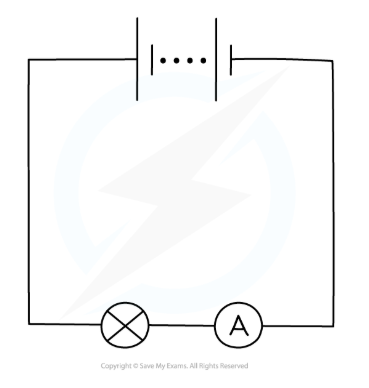
Why are the wires in an electric circuit made of metal?
Metal is a good conductor of electric current
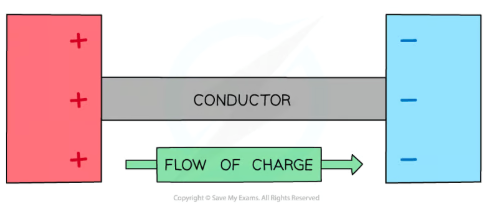
What is conventional current?
The flow of positive charge from the positive terminal to the negative terminal of a cell
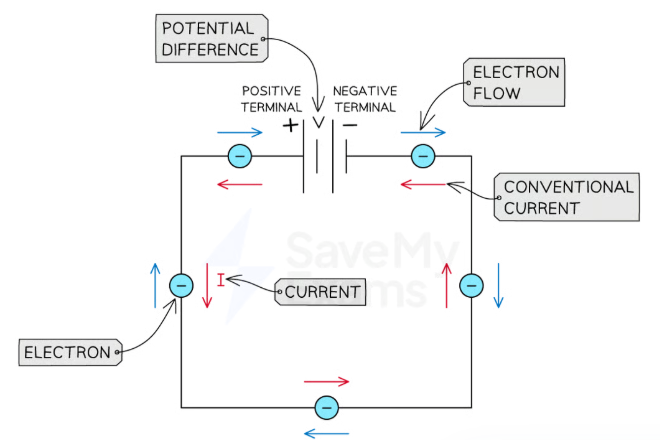
What is electron flow?
The flow of negatively charged electrons from the negative terminal to the positive terminal of a cell
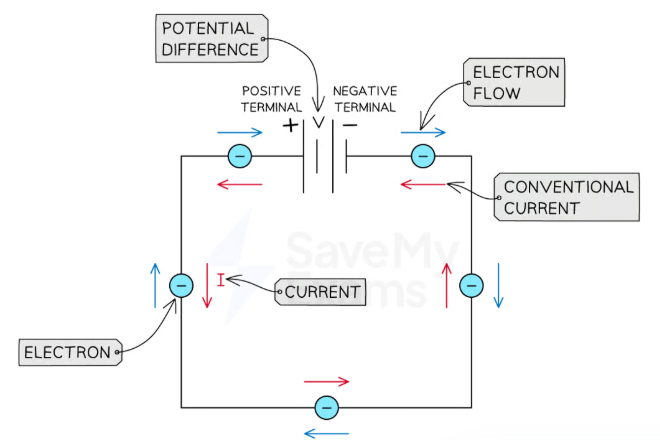
What equation relates current, charge and time? Write the equation then expand with units
Q = I x t
Charge (coloumbs) = Current (amps) x Time (seconds)
How many amps is 10mA?
10 × 10-3A
What is voltage defined as?
The energy transferred per unit charge passing between two points
What is 1 volt equivalent to?
1 joule of energy by 1 coulomb of charge
Fill in the gaps:
As electrons flow through a cell, they [ ] energy
As electrons flow through a circuit, they [ ] energy
As electrons flow through a cell, they gain energy
As electrons flow through a circuit, they lose energy
How is voltage measured?
Voltage is measured using a voltmeter
How are voltmeters differently set up to how ammeters are set up?
Voltmeters must be set up in parallel with the component being measured
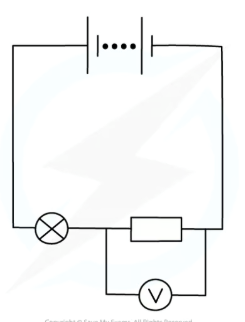
What can voltage also be described as?
The potential difference between two points in a circuit
What is the equation linking energy transferred, voltage and charge? Equation then full with units.
E = Q x V
Energy transferred (joules) = Charge moved (coulombs) x voltage (volts)
What is one volt equivalent to?
One joule per coulomb
What is resistance?
The opposition of a component to the flow of electric current through it
What is resistance measured in?
Units of ohms Ω
All [ ] [ ], including [ ], have some value of resistance
All electrical components, including wires, have some value of resistance
Why are wires often made from copper?
Copper has low electrical resistance so is a good conductor
What is the equation connecting current, voltage and resistance?
V = I x R
Voltage (volts) = Current (amps) x Resistance (ohms)
What are the two ways of joining electrical components?
Series or parallel
In a series circuit, the current has…
The same value at any point
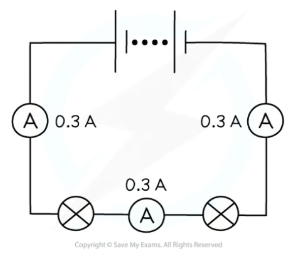
Why does increasing the number of components in a circuit reduce the current flowing through the circuit?
Increasing the number of components increases the total resistance, hence less current flows through the circuit
What is a parallel circuit?
A circuit that has two or more loops, or more than one path that electrons can take
Parallel circuits contain junctions and branches. What are these?
Junctions are points where two or more wires meet to form a new branch, which is a section of wire between junctions

Fill in the gaps: The [ ] of the current in the [ ] branches is equal to the [ ] current before and [ ] the branches
The sum of the current in the individual branches is equal to the total current before and after the branches
Explain why charge is conserved in a circuit:
Electrons cannot be created or destroyed
From where to where does current flow from?
Current flows from the positive terminal to the negative terminal of a cell
In a series circuit, how is the total voltage shared across components?
In a series circuit, for components of varying or equal resistance, the higher the resistance, the higher the voltage across the component
What is the total voltage across each branch in a parallel circuit equal to?
The voltage of the power supply
Name 2 advantages of a series circuit:
All components are controlled by a single switch
Fewer wires are required
Name 2 disadvantages of a series circuit:
Components cannot be controlled separately
If one component breaks, all other components stop working
Name 2 advantages of a parallel circuit:
Components can be individually controlled using their own switches
If one component breaks, others will continue to function
Name 2 disadvantages of a parallel circuit:
Many more wires involved, meaning it can be more complicated to set up
All branches have the same voltage as the supply making it more difficult to control voltage across individual components
When two or more resistors are connected in series, the total resistance is equal to…
The sum of their individual resistances
Why does increasing the number of resistors increase the overall resistance?
The charge now has more resistors to pass through
Describe current in a series circuit:
Current is the same at all points and in each component
Describe voltage in a series circuit:
The voltage of the power supply is shared between the components
Describe total resistance in a series circuit:
Total resistance is the sum of the resistances of each component
Describe current in a parallel circuit:
Current from the supply splits in the branches
Describe voltage in a parallel circuit:
Voltage across each branch is the same
Describe total resistance in a parallel circuit:
Total resistance is less than that of each component
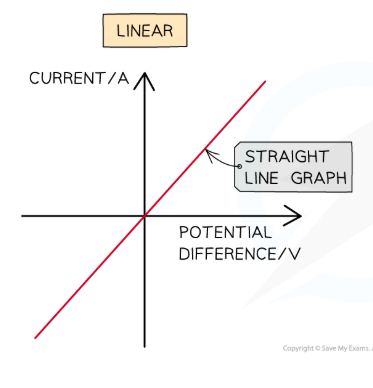
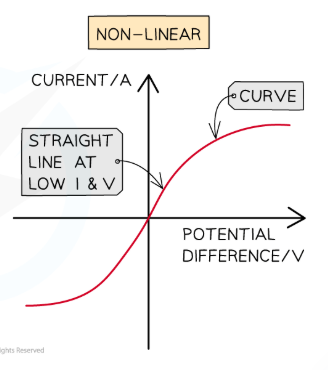
What does an IV graph show?
The relationship between current and voltage
What does the IV graph look like when the relationship between current and voltage is linear?
The IV graph is a straight line which passes through the origin - the resistance is constant
What does the IV graph look like when the relationship between current and voltage is not linear?
The IV graph is not a straight line - the resistance is not constant
What components of linear IV graphs?
Fixed resistors and wires at constant temperature
What four components have non-linear IV graphs?
Filament lamps
Diodes
LDRs
Thermistors
What five things are required to investigate the relationship between current and voltage of different components?
Ammeter
Voltmeter
Variable resistor
Power source
Wires
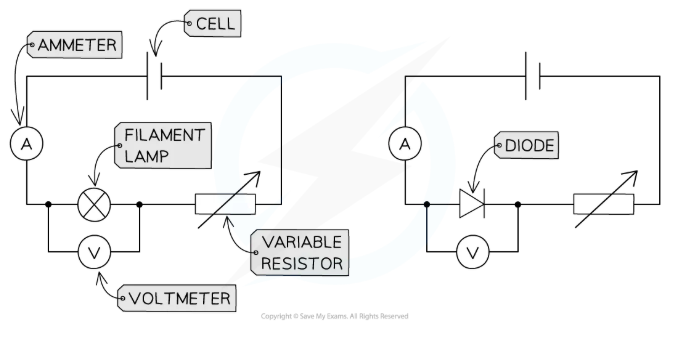
Describe the resistance of fixed resistors:
Fixed resistors have a resistance that remains constant
What can variable resistors do?
Variable resistors can change the resistance by changing the length of the wire that makes up the circuit
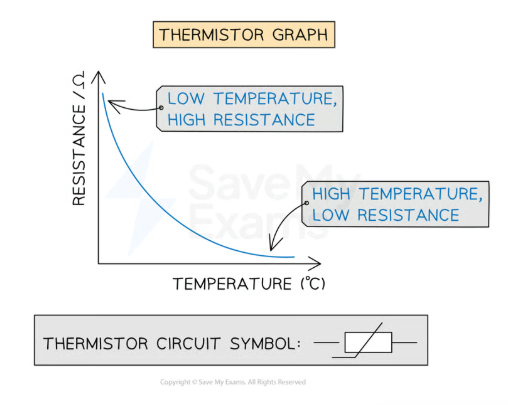
What does the resistance of a thermistor depend on? Give a specific relationship
A thermistor’s resistance depends on its temperature. As the temperature increases, the resistance of a thermistor decreases
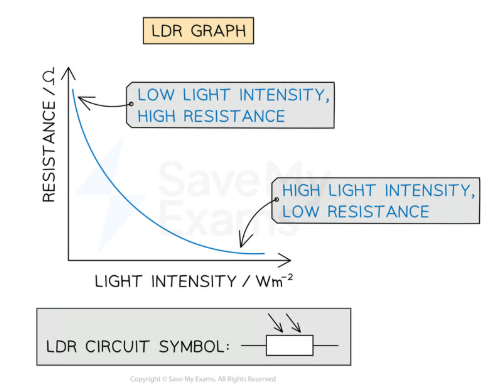
What does LDR stand for?
Light dependent resistor
What do LEDs and lamps do when a current flows through them?
They illuminate
What does a ‘diode’ mean?
Diodes only allow current to flow through them in one direction
What do two arrows pointing towards a symbol mean?
The component is light-dependent
What do two arrows pointing away from a symbol mean?
The component is light-emitting
What is power defined as in electricity?
The amount of energy transferred per second
What is the equation to calculate the power of an electrical component?
P = IV
Power (watts) = Current (amps) x Potential difference (volts)
What is the unit of power Watts (W) equal to?
Joules per second (J/s)
What is a fuse?
A safety device designed to cut off the flow of electricity to an appliance if the current becomes too large
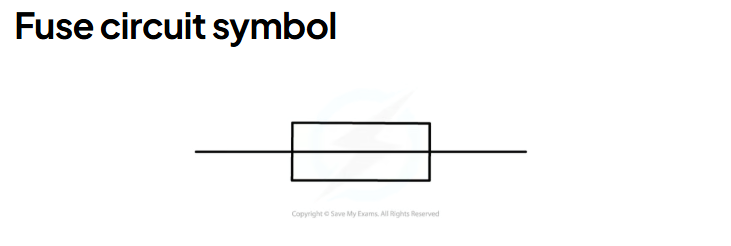
How does a fuse protect an electrical device?
Excessive current causes the thin metal wire in the fuse to heat up and melt
Wire breaks, stopping current flow
Prevents overheating, appliance damage, fires
What is the rule for selecting an appropriately rated fuse for an appliance?
Calculate the operating current using I = P/V
Choose the fuse rating that is the next size up from that calculated current (out of 3A, 5A, 13A)
What happens if a fuse rating is chosen incorrectly? (Either too high or too low?)
If the fuse rating is too low, the fuse blows during normal operation when the current is acceptable. If the fuse rating is too high, the fuse will not melt in time during a fault, risking fire or damage
When is work done in a circuit?
Work is done when charge flows through a circuit
What is E = P x t?
Energy (joules) = Power (watts) x Time (seconds)
How can E = Pt also be written?
E = IVT, because P = IV
True or False: Is work done the same as energy transferred?
True, they are the same
Mains electricity is…
Potentially lethal: potential differences as small as 50V can pose a serious hazard to individuals
What insulating material are electrical safety wires covered with?
Rubber
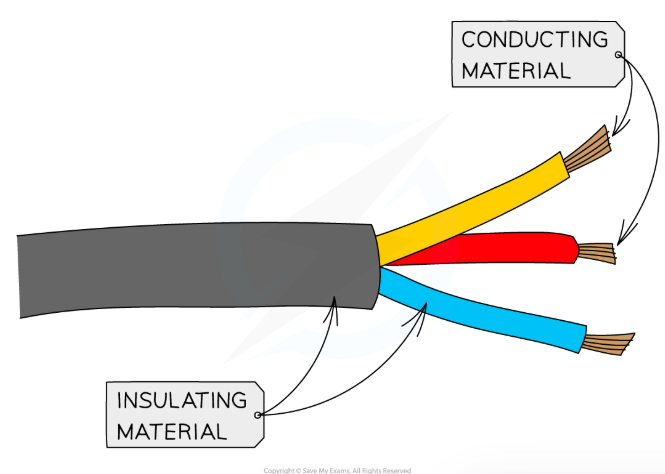
What is the earth wire?
An electrical safety feature
What does a circuit breaker contain?
An automatic electromagnet switch that breaks the circuit if the current exceeds a certain value
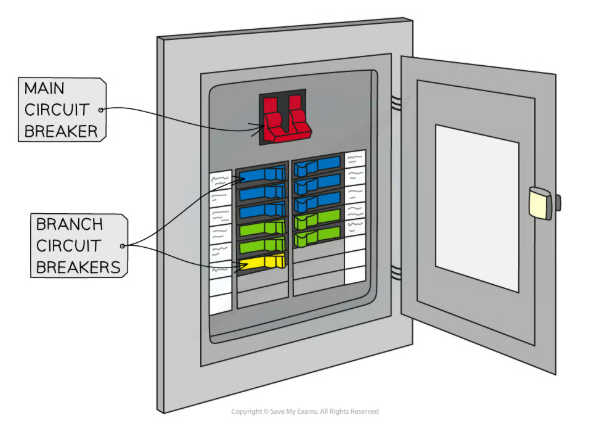
Why are circuit breakers better than fuses as electrical safety devices?
Circuit breakers don’t melt or break, work much faster, and can be re-used
Why does the temperature of a resistor increase?
Due to the collisions of the free electrons within the wire
What can mains electricity be supplied by? Two options.
Mains electricity can be supplied by alternating current or direct current
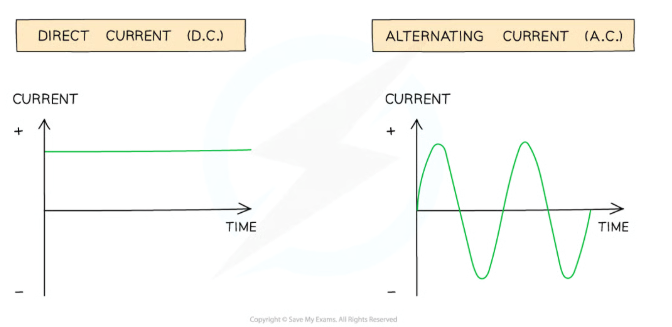
What is DC (direct current) defined as?
A steady current, constantly flowing in the same direction in a circuit, from positive to negative

What is AC (alternating current) defined as?
A current that continuously changes its direction, going back and forth around a circuit

![<p>Compare the differences between DC and AC</p><ol><li><p>DC is [ ] and in [ ] [ ], whereas AC is [ ] [ ] [ ]</p></li><li><p>DC is produced by [ ] and [ ], AC is [ ] by [ ] [ ]</p></li><li><p>DC has a [ ] and [ ] terminal, AC has [ ] [ ] [ ]</p></li></ol><p></p>](https://assets.knowt.com/user-attachments/660718c2-056a-4741-be3d-34ea040aa0c8.png)
Compare the differences between DC and AC
DC is [ ] and in [ ] [ ], whereas AC is [ ] [ ] [ ]
DC is produced by [ ] and [ ], AC is [ ] by [ ] [ ]
DC has a [ ] and [ ] terminal, AC has [ ] [ ] [ ]
DC is continuous and in one direction, whereas AC is constantly changing direction
DC is produced by cells and batteries, AC is produced by mains electricity
DC has a positive and negative terminal, AC has two identical terminals
What is a conductor?
A material that allows charge to flow through it easily
Name four examples of conductors:
Silver, copper, aluminium, steel
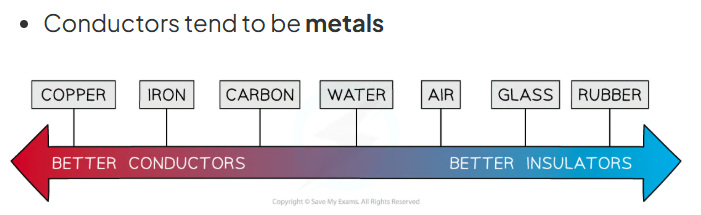
What is an insulator?
A material that has no free charges, hence does not allow the flow of charge through them very easily
What is the IV and DV in investigating charging by friction?
IV: Rods of different material
DV: Charge on the rod
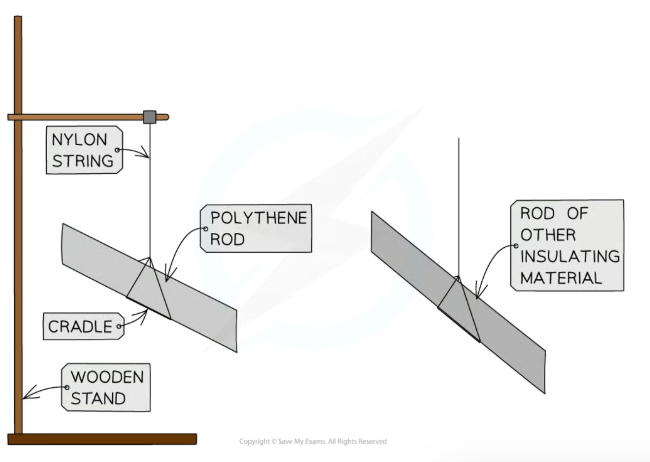
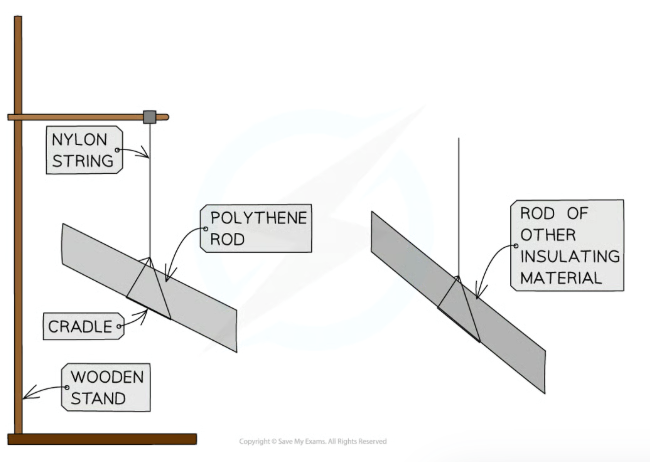
What are the control variables in investigating charging by friction? (Name 3)
Time spent rubbing the rod
Same type of cloth
Same length of rod
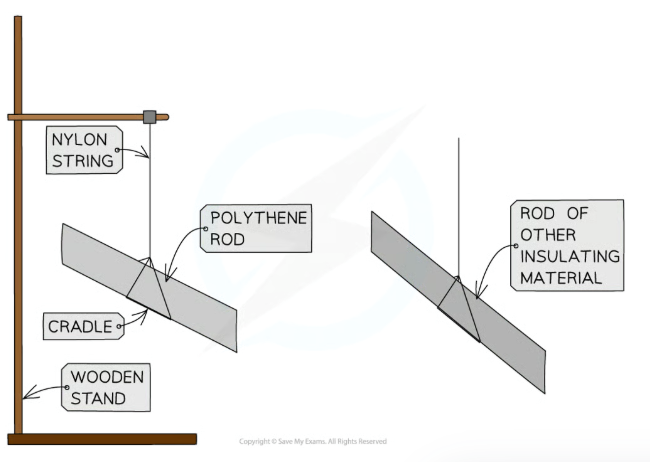
What is the purpose of the cradle and the nylon string?
To suspend charged rods so they can move freely when forces act on them
Why must suspended/testing rods not touch?
Touching would discharge the rods, causing electrostatic forces to disappear
What is the charge acquired by a polythene rod rubbed with cloth?
Negative, because electrons are transferred to it from the cloth
What is the charge acquired by an acetate rod rubbed with cloth?
Positive, because electrons are transferred away from it to the cloth
What are random errors in investigating charging by friction?
Drafts, breezes, or table vibrations affecting the movement of the suspended rod. More information in SME notes.