Mod 16: Scientific Foundations
 Call Kai
 Learn
Learn Practice Test
 Spaced Repetition
 Match
Match Flashcards
 Knowt Play
1/179

There's no tags or description
Looks like no tags are added yet.
Name | Mastery | Learn | Test | Matching | Spaced | Call with Kai | Chat |
|---|
No analytics yet
Send a link to your students to track their progress
180 Terms
What is matter?
composition of the universe and may be solid, liquid, gas
What is a gas?
a fluid, and is compressible and easily changes volume with changes in pressure and temp
What is a liquid?
a fluid that exhibits minimal to no compressibility, and may change volume with changes in pressure and temp
What is a solid?
a material that resists changes in shape and volume
What do fluids constantly do?
change shape and move
What are shape and movement determined by?
gravity
pressure
friction
viscosity
What is an example of high viscosity?
Honey is more viscous than water
What are the 3 types of fluid flow?
laminar
turbulen
transitional
What is laminar flow?
flow in which all molecules of a fluid travel in parallel path within the tube
In laminar flow, molecules in the center of the tube …
move the fastest
Where is laminar flow seen in the body?
in the smallest airways (terminal bronchioles)
What is turbulent?
irregular, chaotic flow
exhibited when vasculature makes sharp turns
What is transitional flow?
a mixture of laminar and turbulent
turbulent in the center
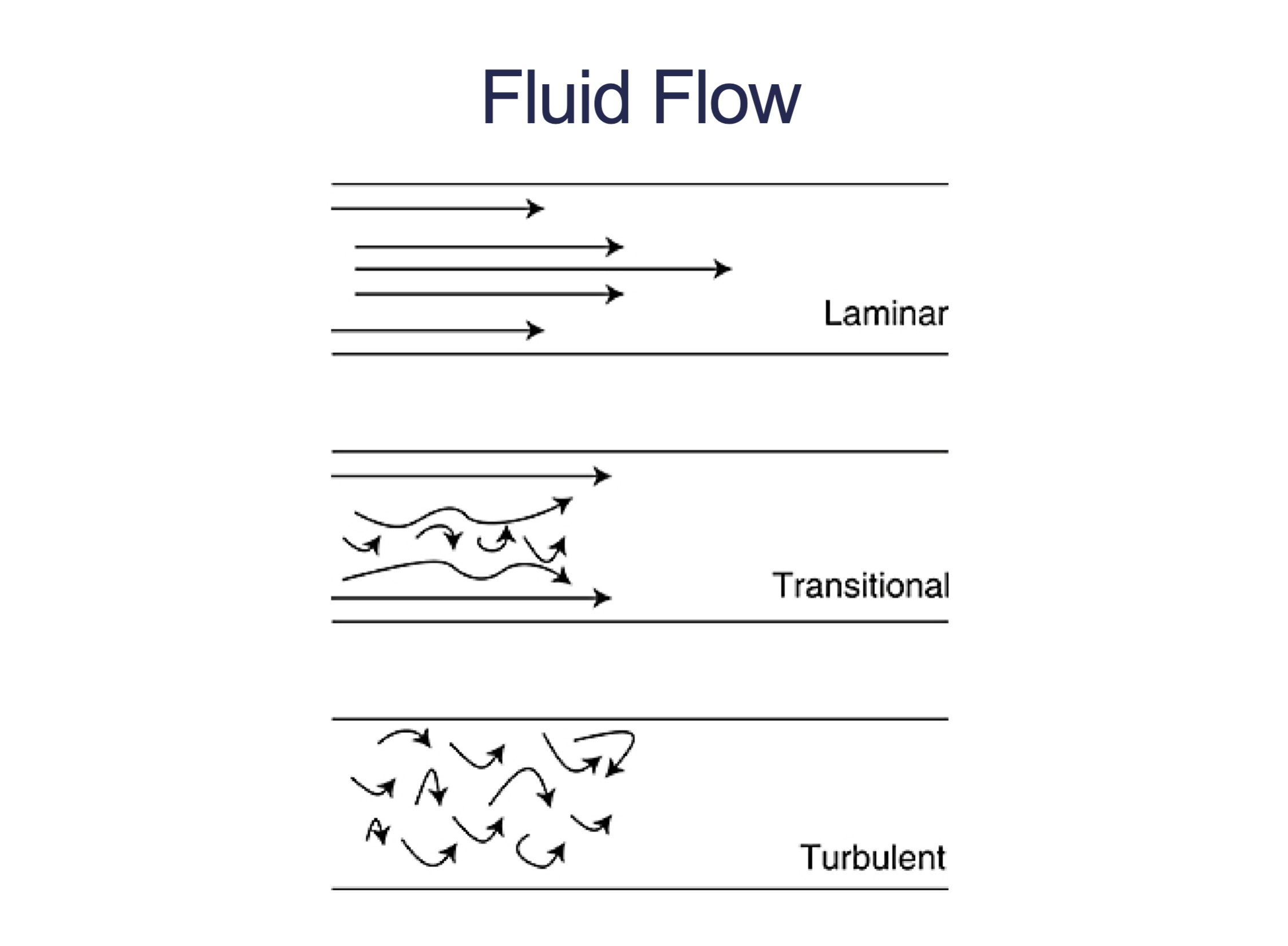
fluid flow
What does Poiseuille’s Law describe?
flow
When is the formula for Poiseuille’s Law?
F =(πr4 x ∆P) / (8nL)
What are the variables for Poiseuille’s Law?
F = flow (sometimes written as Q)
R = radius
∆P = change in pressure
N = viscosity
L = length of tube
what does Poiseuille law show?
***Radius will have the greatest impact on flow***
Doubling the radius has a …
16 fold increase in flow (r4)
What are clinical applications of fluid flow?
IV gauges
RBCs
Pressure bags
Length of PIVs
What does Reynold’s Number use?
Poiseuille’s Law AND factors in the fluid’s density to determine if the flow is laminar or turbulent
What Reynold’s number is laminar flow?
<2000
In Reynold’s number, the higher the number…
the more turbulent the flow.
What is the formula for Reynold’s Number?
(vpd)/n
What is the variable for Reynold’s Number?
(vpd)/n
V = linear velocity of the fluid
P = density of the fluid (**density=mass/volume)
D = diameter of the tube
N = viscosity
What is velocity?
the rate at which an object changes
What is Bernoulli’s principle?
describes the effect of fluid flow through a constriction in a tube (narrowed area in the tube)
What does Bernoulli’s principle explain?
as flow passes through the narrowing, the velocity of that flow increases and the pressure in the are decreases
Bernoulli’s Principle: the pressure must …
drop when velocity increases due to the conversation of energy
When is Bernoulli’s principle useful?
with metered dose inhalers
What does the venturi effect utilize?
the pressure drop across a narrowing in a tube → concept of Bernoulli’s Principle
Venturi Effect
When a hole is put in the narrowed area of a tube, air is allowed to be entrained and enter the flow
Clinical application of the venturi effect?
nebulizers, venturi masks
What is the Coanda effect?
explains that fluid flow tends to follow a curved surface upon exiting the narrowed area in a tube
What is the Coanda effect the opposite of?
Bernoulli’s principle
What does Laplace’s Law describe?
the relationship of wall tension (T) to pressure (P) and radius in cylinders and spheres
What is tension?
a stress force exerted over a given area
What does Laplace’s Law explain clinically?
why smaller-diameter capillaries do not burst during periods of hypertension, but larger vessels/aneurysm may
Formula for cylinders (Laplace’s Law)
T = Pr
tension increases with an increase in pressure or radius
Why are aneurysm more likely to rupture?
abdominal aorta maintains a MAP along its length, including the aneurysm → greater radius + greater tension = rupture
Formula for spheres (Laplace’s Law)
2T = Pr or T = Pr/2
In spheres, wall tension is what compared to cylinders?
half as much
in Laplace’s law, what does the math show clincally?
greater tension (& risk of rupture) exists with large saccular aneurysms compared to smaller ones
Cardiac Ventricular application of Laplace’s Law
cardiac ventricle (sphere) of increasing size explains inotropic support but eventual failure to contract with increasing wall tension and pressure
frank-starling curve
Alveolar Application of Laplace’s Law
lower surface tension = lower pressure required in alveoli to stay open
surfactant lowers surface tension more in smaller alveoli (greater concentration present) than in larger alveoli
→ surfactant has the ability to equilibrate surface tension among different-sized alveoli and create stabilized alveolar pressures
What is solubility?
the maximum amount of one substance (solute) that is able to dissolve into another substance (solvent)
What are factors that affect solubility?***
intermolecular interactions
temperature
pressure
When is solubility increased between substances?
when they have similar electron configurations
salt and water have similar polarity
What is a saying to remember for solubility?
like dissolves like
What is temperature needed for in solubility?
to break the bonds of substances that are dissolving
What kind of reaction is temperature usually in solubility?
endothermic - requires more energy that it produces
usually when solids dissolve in liquids
What is an endothermic reaction?
consumes instead of produces heat
When there is an increase in temp, what happens to solubility?
it increases
b/c additional energy/heat promotes more dissolving
what is an exothermic reaction?
energy is released in excess of the energy required to break the bonds of the solute'
increased temp will decrease solubility
What has little influence on solubility of solids and liquids?
pressure
Temperature in relation to a Gas.
solubility in liquids is inversely r/t to temp
In the solubility of gases, increased temp means …
greater kinetic energy
What does greater kinetic energy of a gas allow?
dissolved gas molecules to escape and prevents further dissolving
What does lower temp do to a gas’ solubility?
slows the kinetic energy of gas molecules allowing them to dissolve into liquids
in gas solubility, as temp increases…
less gas is able to dissolve into a liquid
when the patient is cold, it is harder for patients to wakeup
Pressure in relation to Gas solubility.
gas solubility is directly proportional to pressure (partial pressure)
^^describes Henry’s Law
What is partial pressure?
the percent of a gas in terms of total atmospheric pressure
what is normal atm pressure?
760 mmHg
What is Henry’s law?
at constant temp the amount of gas dissolved in a liquid is directly proportional to the pressure of that gas above the liquid
Simple: more pressure pushes more gas into the liquid
ex: when you open a soda bottle, the pressure release and the gas escapes from the liquid
What is the formula for henry’s law?
p = kc
p = partial pressure of the solute above the solution
k = henry’s constant (different for different gases)
c = concentration of the solute in solution
For Henry’s Law just know …
gas solubility is directly related to partial pressure (think of soda)
How can you figure out the approximate partial pressure of a patient?
multiply the fiO2 by 5
O2 dissolved in blood =
PaO2 × 0.003
CO2 dissolved in blood =
PaCO2 × 0.067
What is entropy?
the universe’s trend to equilibrate all things
What direction is entropy in?
it is unidirectional: movement of energy from high concentration to lower concentration
Why does entropy move?
b/c of a gradient
In entropy, what influences the speed of flow?
the difference in the gradient
Entropy drives the …
universe
What is diffusion?
process of net movement of one type of molecule through space as a result of random motion intended to minimize a concentration gradient
passive
What is diffusion driven by?
entropy
Why does diffusion occur?
Browninan motion
What is Brownian motion?
the inherit kinetic energy of molecules
What does the kinetic energy of Brownian Motion allow?
molecules to move freely through fluid → mixtures in the fluid tends to be evenly distributed
What does molecular weight determine relative to diffusion?
velocity at which a molecule will distribute
What is temperature’s relationship to kinetic energy?
it is directly proportional to kinetic energy
What does greater velocity correlate to?
faster diffusion
In diffusion, molecules will smaller mass ….
will diffuse faster
Every molecule at a given temp will …, but its …. will be determined by ….
have the same kinetic energy (regardless of its size)
velocity
molecular weight
If a fluid is permeable through a membrane, then ….
diffusion is dependent on 5 factors
What are the 5 factors that diffusion through a membrane is dependent on?
concentration gradient
tissue area
fluid: tissue solubility
membrane thickness
molecular weight
1, 2, 3 = directly proportional
4, 5 = inversely proportional
What is Graham’s Law?
the rate of effusion (gas diffusion through an orifice) of a gas is directly proportional to the square root of its molecular weight
What is the formula for Graham’s Law?
r = 1/√mw
What is the bottom line of Graham’s Law?
the larger the molecule, the slower it diffuses
What is Fick’s Law?
the rate of transfer is directly proportional to the available surface area and pressure gradient, and inversely proportional to membrane thickness and molecular weight of gas
What is a clinical application of Fick’s Law?
diffusion hypoxia from nitrous oxide
What is osmosis?
movement of water across a semipermeable membrane to balance a concentration gradient
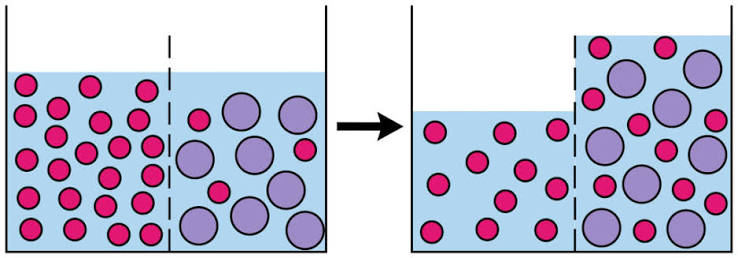
True or false. Semipermeable membranes are permeable to water and solutes.
false, to water only
what is osmotic pressure?
force needed to stop osmosis from occuring
What is oncotic pressure?
pulling force by large proteins in the blood that draws water into the circulatory system
What plasma protein is important for oncotic pressure?
albumin
Oncotic pressure is a type of …
osmotic pressure exerted by plasma proteins
Oncotic pressure opposes …
hydrostatic pressure (pushes water out of capillaries)
What is normal oncotic pressure?
25-30 mmHg
What kind of membrane is vasculature?
semipermeable