BIOL-540 M3 Protein Structure & Function
 Call Kai
 Learn
Learn Practice Test
 Spaced Repetition
 Match
Match Flashcards
 Knowt Play
1/258

There's no tags or description
Looks like no tags are added yet.
Name | Mastery | Learn | Test | Matching | Spaced | Call with Kai | Chat |
|---|
No analytics yet
Send a link to your students to track their progress
259 Terms
What are the 5 components of an amino acid?
alpha-C (chiral center) attached to:
- amino group
- carboxyl group
- R group
- H

Which part of an amino acid can act as base
amino group (-NH2)
Which part of an of amino acid can act as acid
carboxyl group (-COOH)
What decides the identity of an amino acid?
side chain (R group)
What is the part of an amino acid that determines where an amino acid is placed in a protein, if it is charged/polar/nonpolar and acidic/basic
R group
why is there an H on amino acid?
alpha-C needs 4 bonds
true or false: the alpha-C is always a chiral center.
False. Glycine is an exception because its side chain (R group) is a hydrogen atom and since its a-carbon is bonded to two hydrogen atoms, glycine lacks a chiral center and is achiral
Amino acids have 2 possible stereoisomers, called ____.
enantiomers, L and D

true or false: AA are optically active.
true; chiral, except glycine that isn't chiral
true or false: D/L enantiomers are mirror images.
true

enantiomer typically found in proteins?
L-enantiomer (L-amino acids)
What are the actions of L-amino acid sand D-amino acids?
During translation, biological systems exclusively utilize L-amino acids to synthesize proteins, whereas DD-amino acids are rarely found in nature, occurring mainly in bacterial cell walls and certain specialized peptide antibiotics
the peptide bond forms between...
carboxyl group of one AA
amino group of another AA

can polypeptide chains be symmetrical?
no; it has distinct N and C termini
true or false: polypeptide chains are polar.
true; N and C termini
What are nonpolar amino acids
Amino acids featuring hydrophobic side chains (e.g., alanine, valine, leucine, isoleucine, methionine, phenylalanine, proline) that interact via London dispersion forces and avoid interaction with water.
What are polar uncharged amino acids?
Amino acids with hydrophilic side chains (e.g., serine, threonine, cysteine, asparagine, glutamine, tyrosine) capable of hydrogen bonding that remain neutral at physiological pH 7.0pH 7.0.
Structural distribution of polar vs. nonpolar residues in globular proteins
Nonpolar residues cluster in the interior hydrophobic core to drive folding and provide structural stability, whereas polar and charged residues are situated on the outer surface to interact with the aqueous solvent.
the oldest (first added) AA is found at the __ terminus.
N (we count starting from N termini)
at physiological pH, R groups are almost always ____ and ____.
charged, ionizable (HB form)
____ is the pH at which the total population of any group exists in half the charged state and half the uncharged state.
pKa (half conj base, half conj acid)
if pH is below pKa, ...
solution can donate protons (acidic)
if pH is above pKa, ...
solution accepts protons (basic)
Which amino acid has a pKa around physiological pH, enabling it to both accept and donate protons
histidine
how does pH affect protein activity?
- if pH is low, acidic AA accept protons and become neutral, and ionic bonds and bridges that hold protein together fall apart
- if pH high, basic AA donate protons and become neutral, losing another set of ionic bonds and bridges, and proteins lose structure
- it change charge of active site, surface, etc.
____ is the pH at which the net charge of the total molecule is balanced.
pI (+ charges = - charges)
polar and ionizable AA (charged at physiological pH)

polar and non-ionizable AA

nonpolar R groups

how can we use UV light to differ between DNA and protein?
DNA absorbs at 260nm, proteins at 280nm
in order to stabilize the structure of the protein it is a part of, the hydroxyl of the R group of serine interacts with the amino group of asapagine. this is likely an example of a ____ bond.
hydrogen
histidine can form which chemical interactions through its side chain?
HB, ionic bonds, london dispersion

which AA have ionizable R groups?
negatively and positively-charged R groups
aspartate, glutamate, lysine, arginine, histidine
AA with negatively charged R groups
aspartate, glutamate
AA with positively charged R groups
lysine, arginine, histidine
ionizable acidic R groups have a net ____ charge at pH 7.0.
negative
true or false: Cys, Ser, Thr, and Tyr are ionizable.
false; though weakly acidic (pKa above physiological pH), usually not considered ionizable and would only donate protons in very basic solutions
when pH < pI, R group is ____ charged
when pH > pI, R group is ____ charged.
positively
negatively
What is an uncharged polar R group?
Uncharged polar R groups are amino‑acid side chains that contain electronegative atoms (like O, N, or S), can form hydrogen bonds, and remain neutral (no net charge) at physiological pH.
What is a charged polar R group?
Polar charged R groups are amino acid side chains that carry a net electrical charge (positive or negative) at physiological pH, making them hydrophilic and capable of strong electrostatic and hydrogen‑bonding interactions
polar uncharged R groups
serine, threonine, cysteine, asparagine, glutamine
AA that can form disulfide (S-S) bonds
Cysteine
nonpolar, aliphatic R groups
glycine, alanine, proline, valine, leucine, isoleucine, methionine
What are nonpolar, alipathetic R groups?
Nonpolar, aliphatic R groups are hydrophobic side chains composed only of carbon and hydrogen atoms
true or false: nonpolar, aliphatic R groups dissolve easily in water.
false; They are hydrophobic, causing a high ∆G requiring energy
aromatic R groups
phenylalanine, tyrosine, tryptophan
aromatic AA that is involved in HB
Tyr (polar)
aromatic AA involved in hydrophobic interactions
Phe, Trp
Positively charged vs negatively charged amino acids?
+ = AA has side chain that accepts protons
- = AA has side chain that donates protons
What describes the interaction surfaces of proteins
charged outer region, where charged AA are located
What region of protein provides stability and gives shape
hydrophobic core, where nonpolar AA are located
how does the hydrophobic core provide stability?
ionic bonds are hidden away from water to be stable and provide long-term structural stability (do not dissociate)
how does the hydrophobic core give shape?
- internal salt and disulfide (ionic) bridges
- hydrophobic AA pack closely together

What do transmembrane proteins have that differ from other proteins?
Hydrophobic outside, charged inside
true or false: all proteins have a hydrophobic core and charged outer region.
false; transmembrane proteins have hydrophobic outside, charged inside
true or false: all polar R groups are ionizable.
false; not all polar R groups can ionize, some are uncharged = unionizable
AA known to fit in just about everywhere
glycine (due to small size)

true or false: glycine is hydrophobic.
false; it can be either hydrophobic or hydrophilic
Wha is the only achiral AA
glutamate
AA known to make C-S-S-C bonds, linking different proteins and parts of one protein
cysteine

AA with side chain covalently bonded to amino group
proline

AA with nonlinear backbone (kinky)
proline

which AA would you expect to find in the interior of a globular, cytoplasmic protein?
Those that are primarily hydrophobic residues, such as:
Leucine (Leu)
Isoleucine (Ile)
Valine (Val)
Phenylalanine (Phe)
Methionine (Met)
Tryptophan (Trp)
a molecule that has both a positive and a negative charge, resulting in a net neutral charge is called?
zwitterion
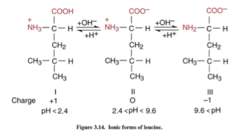
at physiological pH, AA is in ____ state.
zwitterion

zwitterion occurs at ____ pH.
neutral
if pH < pKa, group ____ protons to/from solution.
if pH > pKa, group ____ protons to/from solution.
accepts from solution
donates to solution
henderson-hasselbalch equation

—COOH has an ____ pKa (pK1)
acidic
—NH3+ has a ____ pKa (pK2)
basic
pH at which the net electric charge is 0
isoelectric point (pI)
true or false: the α-carboxyl group is generally more acidic than in other carboxylic acids.
true; also, α-amino group is generally less basic than in other amines

titration curve
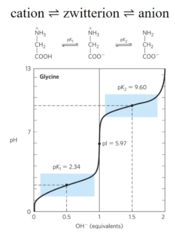
if pH > pI, net charge is ___ and molecule ____ protons.
negative, donates
if pH < pI, net charge is ____ and molecule ____ proteins.
positive, accepts
difference between pKa and pI?
pKa concerns one functional group, pI accounts for whole molecule
for amino acids without ionizable side chains, pI =

when pH = pI, net charge is 0, and the AA is ____ in water.
least soluble
why is AA least soluble in water when pH = pI?
net charge is 0, water wants to react with charged
at physiological pH, nonpolar groups remain uncharged. what type of bonding can form between the side groups of these types of AA?
induced dipole-dipole (london dispersion force)

is it possible to fully deprotonate AA?
no; all 20 AA have at least two oppositely charged groups
what types of R groups have pKa and can act as buffers?
ionizable
what types of R groups can be titrated?
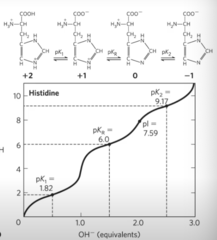
ionizable, with 3 ionization steps

at what pH will histidine have a net neutral charge? (based on titration curve)
between pKr and pK2
6.0-9.17

at what pH will AA be positively charged?
between pK1 and pKr

at what pH will AA be negatively charged?
above pK2
what type of reaction is used to create the peptide bond?
condensation

what type of reaction is used to break the peptide bond?
hydrolysis

a dipeptide has __ amino acid(s) and __ peptide bond(s).
2, 1
a tripeptide has __ amino acid(s) and __ peptide bond(s).
3, 2
difference between oligopeptide, polypeptide, and protein?
oligopeptide = a few amino acids (typically < 20 AA)
polypeptide = many AA with MW < kDa
protein = hundreds/thousands of AA with MW > 10 kDa (OR 1+ polypeptides)
how can we estimate the number of AA residues in a protein, given molecular weight?
# resides = MW/final total
average MW of AA?
~128 Da
what is a multisubunit protein?
2+ polypeptides associated noncovalently
- homo = same subunits
- hetero = different subunits

what is an oligomeric protein?
multisubunit protein with at least 2 identical subunits, called protomers
what are conjugated proteins?
contain permanently associated prosthetic groups, non-AA components
proteins with lipid prosthetic groups
lipoproteins
proteins with sugar prosthetic groups
glycoproteins
proteins with metal prosthetic groups
metalloproteins
proteins with phosphate group prosthetic groups
phosphoproteins