anp exam 2
 Call Kai
 Learn
Learn Practice Test
 Spaced Repetition
 Match
Match Flashcards
 Knowt Play
1/119

There's no tags or description
Looks like no tags are added yet.
Name | Mastery | Learn | Test | Matching | Spaced | Call with Kai | Chat |
|---|
No analytics yet
Send a link to your students to track their progress
120 Terms
receives lymph from right side of body superior to diaphragm
right lymphatic duct
right lymphatic duct
receives lymph from right side of body superior to diaphragm
single cell thin wall vessels collecting interstitial fluid
initial lymphatics or lymphatic capillaries
initial lymphatics or lymphatic capillaries
single cell thin wall vessels collecting interstitial fluid
large lymphoid nodules in the posterior superior wall of nasopharynx
pharyngeal tonsils
pharyngeal tonsils
large lymphoid nodules in the posterior superior wall of nasopharynx
small lymphoid organs monitoring lymph drained from lower limbs
inguinal lymph nodes
inguinal lymph nodes
small lymphoid organs monitoring lymph drained from lower limbs
lymphatic vessel delivering lymph to a lymph node
afferent lymphatic vessel
afferent lymphatic vessel
lymphatic vessel delivering lymph to a lymph node
collects lymph from the left side superior to diaphragm and both sides inferior to the diaphragm
thoracic duct
thoracic duct
collects lymph from the left side superior to diaphragm and both sides inferior to the diaphragm
represent base of thoracic duct and collects lymph from the left lumbar and intestinal trunks
cisterna chyli
cisterna chyli
represent base of thoracic duct and collects lymph from the left lumbar and intestinal trunks
small lymphoid organs filtering lymph drained from upper limbs
axillary lymph nodes
axillary lymph nodes
small lymphoid organs filtering lymph drained from upper limbs
lymphatic vessel exiting a lymph node
efferent lymphatic vessel
efferent lymphatic vessel
lymphatic vessel exiting a lymph node
lymphoid nodules at the posterior margin of the oral cavity, between pharynx and soft palate
palatine tonsil
palatine tonsil
lymphoid nodules at the posterior margin of the oral cavity, between pharynx and soft palate
What is lymph
Fluid primarily composed of white blood cells, especially lymphocytes. It is composed of plasma that has leaked into those vessels.
Define lymphoid tissue
specialized form of reticular CT that contains a lot of lymphocytes
Name primary lymphoid organs
Bone marrow and thymus
Name secondary lymphoid organs
lymph nodes, spleen, tonsils, peyer’s patches, appendix, MALT
Describe role and location of spleen
located in upper left abdomen that acts as body’s blood filter
Describe role and location of thymus
located in upper chest, behind breast bone in front of heart; produces mature T-cells
Describe role and location of liver
located in upper right quadrant of abdomen beneath diaphragm, filters blood and neutralizing toxins while regulating blood sugar
Describe role and location of lymph nodes
filter lymph fluid, removing bacteria and viruses. Cervical nodes located in neck, axillary nodes in armpit, inguinal nodes located in groin, lumbar located in torso
Which is NOT a part of the lymphatic system?:
Spleen, thymus, liver, lymph nodes
liver
Put following in order of pathway of lymph from stomach to blood
1. thoracic duct
2. collecting lymphatics
3. initial lymphatics
4. interstitial fluid
5. left subclavian vein
6. lymph nodes
4, 3, 2, 6, 1, 5
interstitial fluid → initial lymphatics → collecting lymphatics → lymph nodes → thoracic duct → left subclavian vein
Which of following is NOT a major site of lymphatic tissue?:
a. tonsils
b. thymus
c. kidneys
d. spleen
e. collecting lymphatics
c. kidneys
Which of following is important function of the lymphatic system?
a. controlling body temp by evap of sweat
b. manufacturing all white blood cells
c. returning fluid and proteins to cardiovascular system
d. producing red blood cells during stressful times
e. transporting fluids out to and back from the body tissues
c. returning fluid and proteins to cardiovascular system
The spleen:
a. serves as a storage site for blood platelets
b. is an organ in which phagocytosis of aged red blood cells occurs
c. is a site of blood formation in the fetus
d. all of the above
d. all of the above
Both the thoracic duct and right lymphatic duct empty directly into the:
a. axillary lymph nodes
b. superior vena cava
c. subclavian arteries
d. junction of internal jugular and subclavian veins
d. junction of internal jugular and subclavian veins
Describe exact location and what it drains: cervical lymph nodes
along cervical (neck) region, along internal jugular vein and sides of neck;
drain head and neck
Describe exact location and what it drains: axillary lymph nodes
in armpit (axilla);
drain upper limb, breast, and chest wall
Describe exact location and what it drains: supraclavicular lymph nodes
above clavicle in supraclavicular fossa;
drain areas of head, neck, thorax, and abdomen
Describe exact location and what it drains: mediastinal lymph nodes
in mediastinum between lungs around trachea, bronchi, and heart;
drain thoracic organs
Describe exact location and what it drains: mesenteric lymph nodes
in mesentery of small intestine;
drains much of the intestines
Describe exact location and what it drains: inguinal lymph nodes
groin region, along inguinal ligament;
drain lower limbs, external genitalia, and lower abdominal wall
Describe exact location and what it drains: femoral lymph nodes
along femoral veins in upper thigh;
drain lower limb
Describe exact location and what it drains: popliteal lymph nodes
behind knee in popliteal fossa;
drain lower leg and foot
carry blood away from heart to capillaries
arteries
arteries
carry blood away from heart to capillaries
allow for the exchange of materials between the blood and tissues.
capillaries
capillaries
allow for the exchange of materials between the blood and tissues.
deliver blood from capillaries back to heart
veins
veins
deliver blood from capillaries to heart
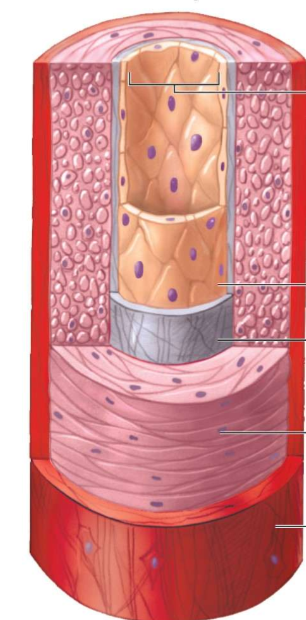
what kind of vessel is this? how do you know?
artery because of the small lumen, no valve, thicker tunica media (wall)
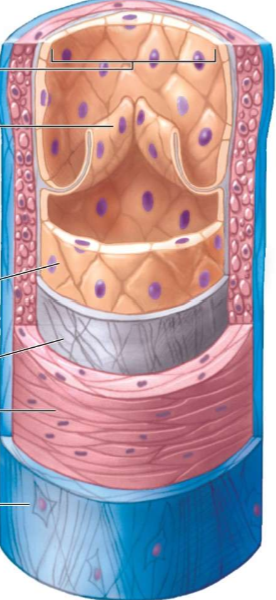
what type of vessel is this? how do you know?
vein; bigger lumen, valves, thinner tunica media (wall)
_______ have a thicker ______ _______ due to the higher pressure this type of vessel deals with.
Arteries; tunica media (OR wall)
What are some characteristics of a conducting arterty?
Largest arteries, withstand high pressure, most muscle and elastic fibers
Characteristics of distributing arteries
medium sized arteries; distribute blood from conducting arteries to organs; have some elastic fibers in walls but do not have as much as conducting because dont deal with high pressure
Characteristics of resistance arteries
smallest arteries; deliver blood to capillaries; little if any elastic fibers
smallest arteries
resistance arteries
medium sized arteries
distributing arteries
biggest arteries
conducting arteries
How does blood flow back through veins (sizes)?
Blood flow from capillaries into venules → venules unite to form medium veins → medium unite to form large veins
Typical systemic route
Heart → arteries → capillaries → veins → heart
What type of route is this
Heart → arteries → capillaries → veins → heart
systemic route
Where does pulmonary blood flow go
Lungs and heart
What kind of route is this?:
Heart -> arteries -> capillaries -> intervening vessels -> capillaries -> veins -> heart
portal route
What kind of route skips capillary bed and is often called a shunt?
arteriovenous anastamoses
Arterial anastomoses
two arteries provied collateral routes to same area
venous anastomoses
merging veins to drain in organ
Five mechanisms of returning blood to heart are?
pressure gradient, gravity, thoracic pump, cardiac suction, skeletal muscle pump
What is blood flow?
Amount of blood flowing to an area in a given amt of time
What is blood pressure?
the force of blood against vessel walls
what is blood pressure dependent on?
cardiac output, blood volume, and resistance
Three factors in resistance:
blood viscosity (thickness), vessel length, vessel radius
blood viscosity (thickness), vessel length, vessel radius are all what?
The three factors of resistance
Pulse pressure =
systolic - diastolic
Difference between systole and diastole
Systole is phase of heartbeat when heart muscle contract to pump blood into circulation
Diastole is resting phase when chambers relax and fill with blood
resting phase when chambers relax and fill with blood
Diastole
phase of heartbeat when heart muscle contract to pump blood into circulation
systole
blood pressure measured how
with sphygmomanometer
when do you hear heart sounds?
lub during systole - closing of av valves
dub directly after - closing of semilunar valves
Characteristics of local control of regulation of blood pressure and flow
open and close and precapillary sphincters, inflammation, reactive hyperemia, angiogenesis
characteristics of hormonal of regulation of blood pressure and flow
ADH, aldosterone, angiotensin II, epinephrine
characteristics of neural control of regulation of blood pressure and flow
baroreflex, chemoreflex, medullary ischemic reflex
fx of exercise on cardiac output
increase cardiac output by raising heart rate and stroke volume; heart muscle becomes stronger; stroke volume is higher at rest; heart rate is slower at rest
fx of aging on cardiovascular system
increase vascular resistance, decrease stroke volume, thicker less elastic vessels
what happens when blood flow stops going through coronary arteries
heart attack
lack of blood flow
ischemia
low oxygen in blood
hypoxemia
unprogrammed tissue death
necrosis
immune system recognize what? what happens when it does
foreign bodies, “not self”; production of immune cells and proteins
innate immunity
present before any exposure to pathogens (skin [sweat, keratin]), NON SPECIFIC
present before any exposure to pathogens (skin [sweat, keratin]), NON SPECIFIC
innate immunity
acquired immunity
adaptive immunity, develop after exposure, very specific and slower
adaptive immunity, develop after exposure, very specific and slower
acquired immunity
what is endocytosis
microbe comes into contact with something - it engulfs it
exocytosis
the breakdown of microbe and then releasing it
external barriers
skin (low pH, makes pathogen ineffective), mucous membranes (ability to produce mucous make pathogen ineffective)
internal defenses
phagocytic cells, antimicrobial proteins, inflammatory response
fever vs septic shock
fever is a systemic inflammatory response triggered by pyrogens
septic shock is life threatening caused by overwhelming inflammatory response
how do some pathogens avoid destruction
modifying their surface to prevent recognition
role of t helper cells
t helper cells help activate T and B cells
cells that mature in thymus
t cells
cells that mature in bone marrow
b cells