Classic mendelian genetics II
 Studied by 1 person
 Call Kai
 Learn
Learn Practice Test
 Spaced Repetition
 Match
Match Flashcards
 Knowt Play
1/38

Earn XP
Description and Tags
» Explain sex-linked inheritance. » Be aware of the use of pedigree analysis. » Give examples of various forms of inheritance in animals. » Understand the difference between gain-of-function and loss-of function mutations. » Appreciate the range between Mendelian and polygenic inheritance. » Explain the difference between Mendelian, population and quantitative genetics. » Be able to summarise the genetic fundaments of animal breeding strategie
Name | Mastery | Learn | Test | Matching | Spaced |
|---|
No study sessions yet.
39 Terms
what are chromosomes?
» Homologous pairs- the same genes in the same order – but may carry different versions of those genes, 23 pairs in humans and 39 in dogs.
» Two sex chromosomes, the X and the Y. Unlike the autosomes (non-sex chromosomes), the X and Y don’t carry the same genes and aren’t considered homologous
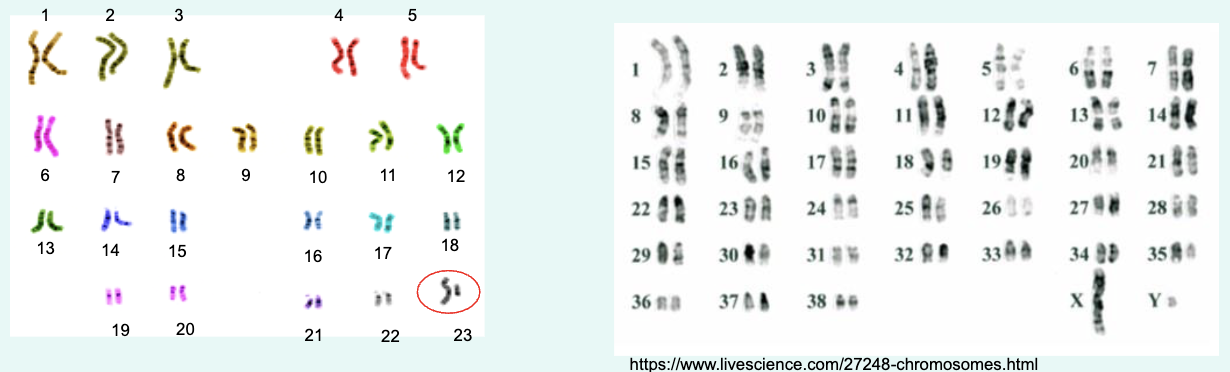
sex determination in mammals
» In vertebrates (any animal with skeleton and backbone): The gonad has the potential to develop in either direction; to develop into either a testis or an ovary.
» Some traits are said to be sex-linked because they are carried on the X or Y chromosomes, which are involved in determining the sex of animals.
» The female has the genotype XX (homomorphic), while the male has genotype XY (heteromorphic).
» The X chromosome is larger and longer than the Y chromosome. The chromosomes form a pair, but they have no paired genes between the
sex determination in other vertebrates - birds?
the sex chromosomes are designated Z and W with the male being homomorphic (ZZ) and female being heteromorphic (ZW)
sex determination in reptiles - for interest (dont think u have to learn)
can be genotypic sex determination or temperature dependent sex determination and some evidence to suggest both
some species have X and Y like mammals - like many turtles and lizards e.g. green iguana
some species have Z and W like birds - all snakes and lizards
some turtles are temperature dependent with cooler nests hatching males and warmer nests hatching females
crocodiles are temp dependent with cool and warm nests hatching females and intermediate nests hatching males
An Australian skink has X an Y and temperature determination with XX and XY males and only XX females.
Australian dragon lizard has Z and W and temperature determination with ZZ and ZW females and only ZZ males
» Amphibians and fish very complex but essentially a mix of both XX/XY and ZW/ZZ but sex chromosomes much more similar to each other and some species can switch sexes
genes on mammalian sex chromosomes
» The X chromosome contains several thousand genes, whereas the Y chromosome only has 53 protein-coding genes.
» Genetic sex is determined by the presence or absence of the Y chromosome.
» Sry = sex-determining region of the Y chromosome (a single gene).
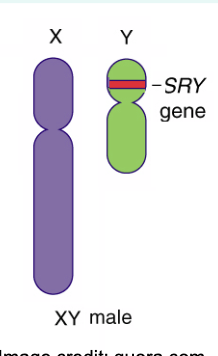
what is the SRY gene?
sex determining region of the Y chromosome (single gene)
encodes a protein also called testis-determining factor (TDF)
Sry expression → testes → testosterone → masculine brain
phenotype.
No Sry expression → ovaries → relatively low testosterone →
feminine brain phenotype.
further info on the sry gene on sex determination
» An individual with a Y chromosome carrying the Sry gene develops into a male even in the case of
too few or too many sex chromosomes.
» Thus, an individual with X or XXX become female, whilst XXY or XXXY becomes male.
» However, XY with a defective Sry gene becomes female.
» An XX mouse where the Sry gene has been transgenically added to another chromosome becomes male.
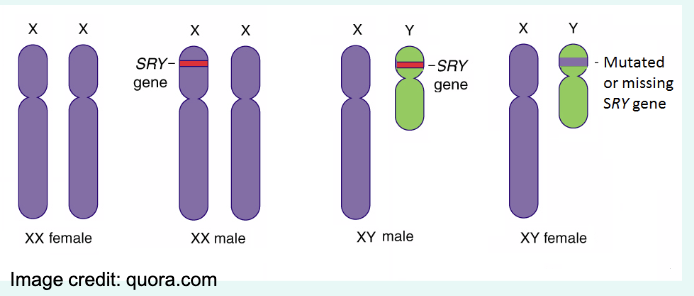
Sex Determination and Sex-Linked Inheritance
» Because females have two X chromosomes, they may have heterozygous X chromosome alleles.
» Males with XY have only one copy of a gene — they are hemizygous.
» This difference generates a special type of inheritance called sex-linked inheritance.
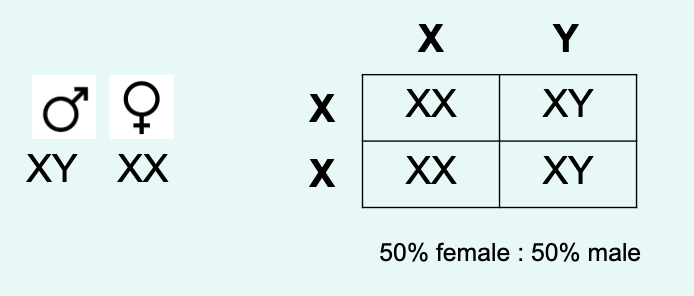
what is haemophilia A?
a disease where an X-linked recessive trait that is non-functional so no Factor VIII is produced resulting in impaired blood clotting - in simple terms - blood doesnt clot properly - so excessive bleeding
blood clotting because the gene for factor VIII involved in the blood clotting cascade is X-linked - the gene locus is on the X chromsome
so considering that:
• Functional Factor VIII allele: XH
• Non-functional Factor VIII allele: Xh
• Y chromosome has no gene:
if a carrier female and haemophiliac male have a daughter, what is the percentage chance he daugter will have haemophilia? 50%

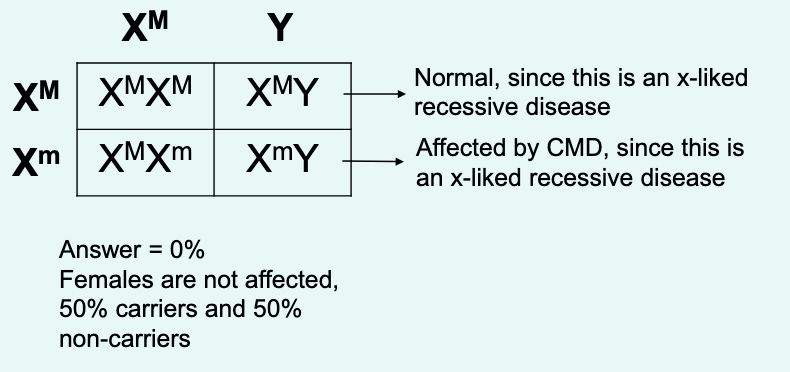
what trait is canine muscular dystrophy (CMD) of golden retrievers?
X- linked recessive
so if male is normal but female is carrier, how many kids affected?
when u revise you need to go over this and rpactice the gene allele prediction tables
X chromosome inactivation in female mammals
» Each female carries one X chromosome from each parent (Xm and Xp).
» (The male, by definition, carries only one from his mother)-yeah cos only has one X right.
» During embryonal development, one of each X chromosomes is randomly inactivated in female cells (“Lyonisation”), so that half of them have an active Xm chromosome and half an active Xp chromosome.
» This means that only the genes of one X chromosome are expressed in each cell, just as in males (dosage compensation).
» The inactive X chromosome in a female somatic cells known as a Barr body.
» All cells derived from those embryonal cells will have the same X chromosome inactivated forming a mosaic like pattern.
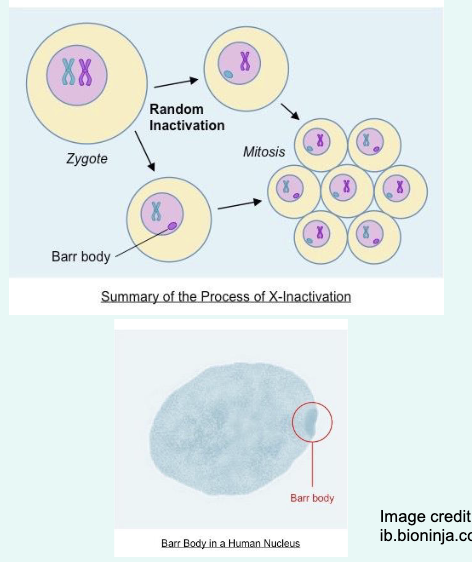
mosaicism of X Inactivation in Female Mammal
use vid to explain
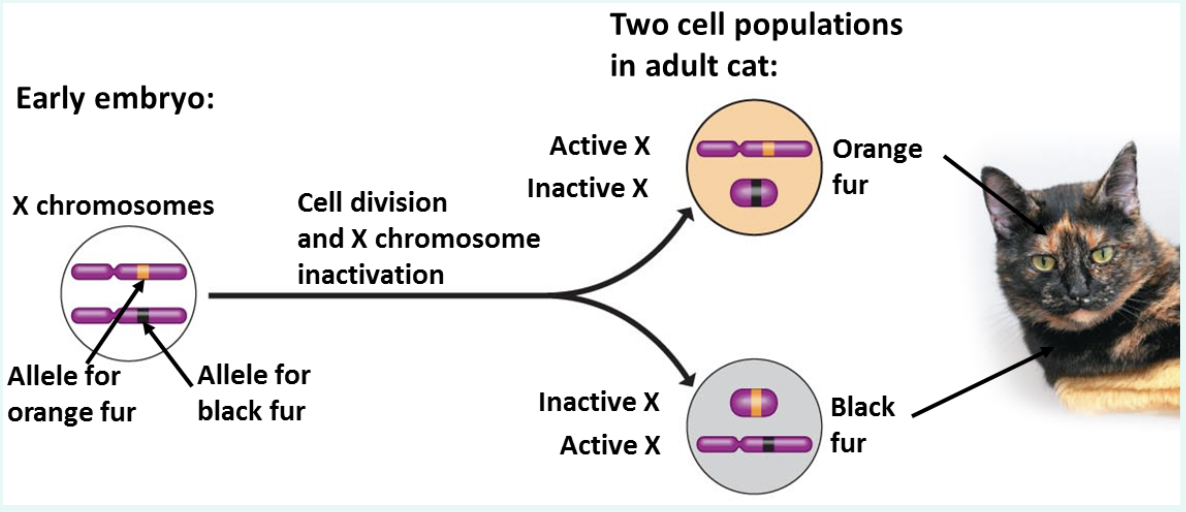
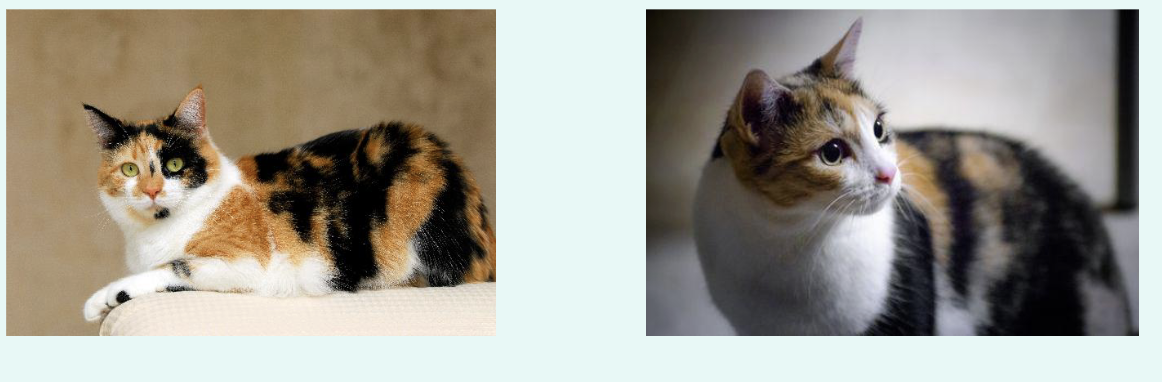
explain how Fur Colour in Domestic Cats: Tortoiseshell Cats form
remember, Barr body (Lyonisation) occurs randomly (switching off female cells during embryonic development)
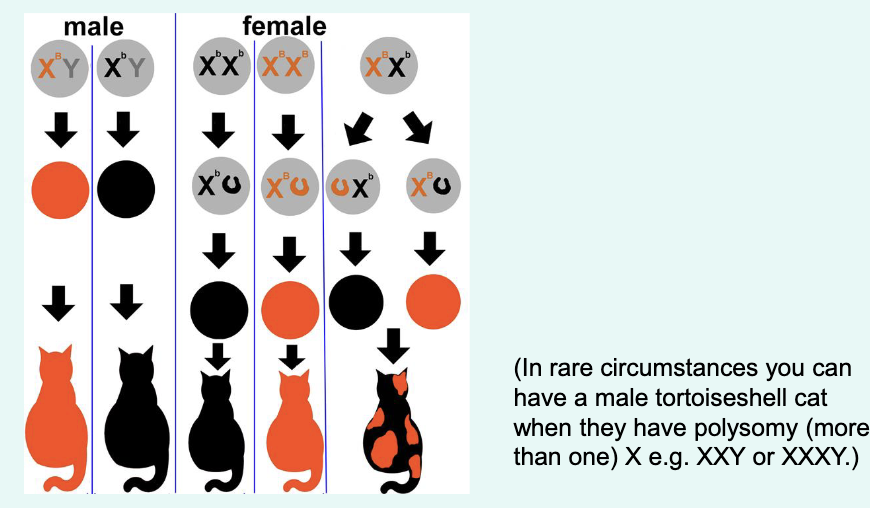
whatabout calicos?
» Additional gene called the Spotting gene in cats at a different locus that is a co-dominant trait resulting in a lack of pigment in certain patches (also responsible for “tuxedo” cats).
» Different gene in other species called the Piebalding gene e.g. in dogs, cattle, small mammals.
» Horses have several (Tobiano, frame overo (fatal white syndrome) and sabino)
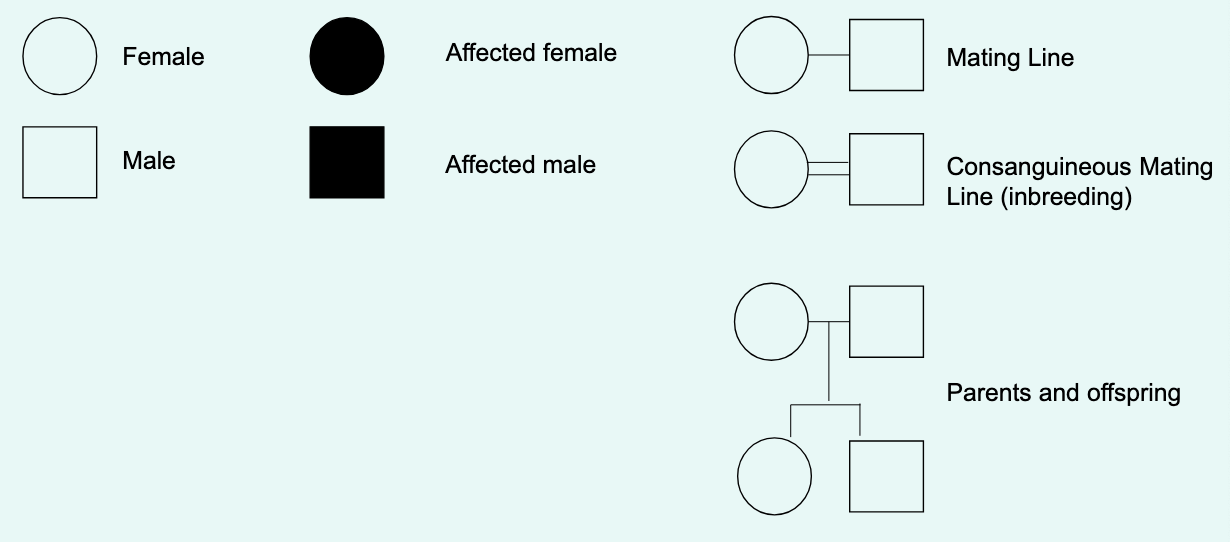
study the symbols of pedigree analysis
what is autosomal dominant inheritance?
a pattern of genetic transmission where only one altered copy of a gene on an autosome (non-sex chromosome) is needed to cause a condition
» Every affected individual has at least one affected parent.
» An affected individual has at least a 50% chance of transmitting the trait.
» Males and females should be affected with equal frequency.
» Two affected individuals may have unaffected offspring
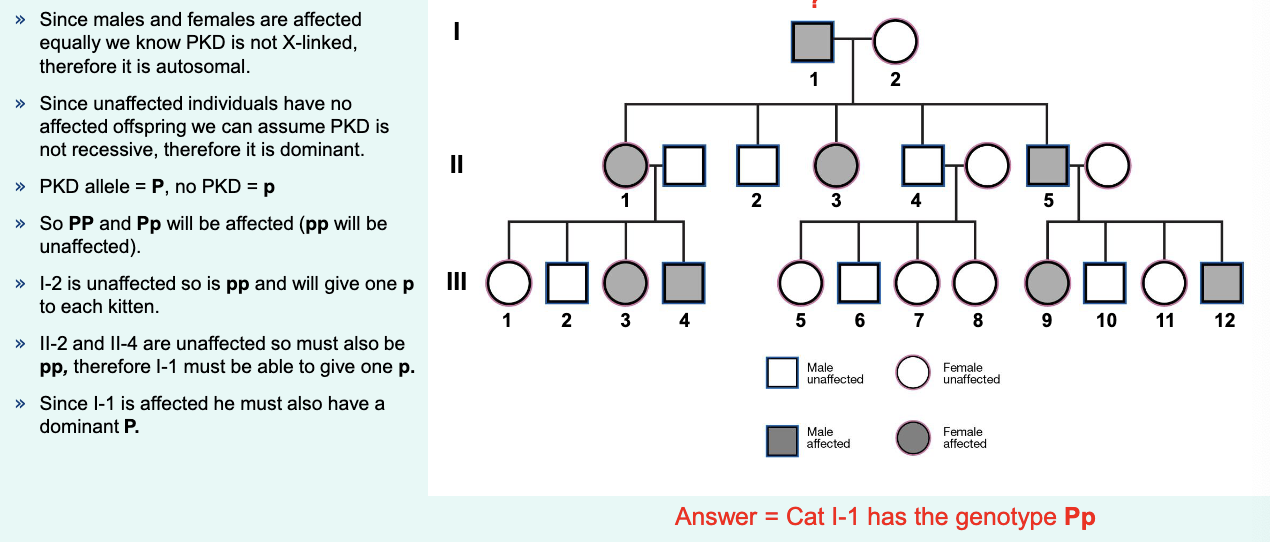
what is polycystic kidney disease (PKD)
it is an autosomal dominant inheritance
genetic disease of persion cats
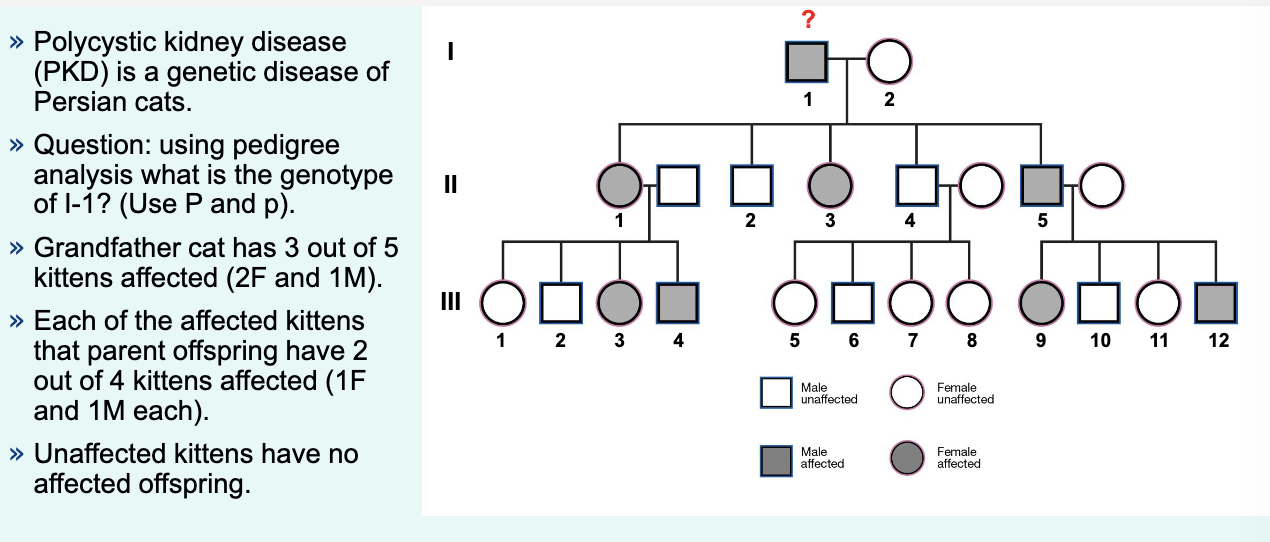
read the slide as a quesiton
you will break this down in revision dw
what do you need to know about pedigrees and autosomal recessive inheritance?
» For rare traits, the pedigree usually involves mating between two unaffected heterozygotes resulting in one or more homozygous offspring.
» The probability of an affected individual from a mating of two heterozygotes is 25% (remember the wrinkled pea analogy from last lecture - heh???)
» Heterozygotes are carriers as they are unaffected but can still pass the trait on to offspring.
» Recessive traits often skip generations.
» Two affected individuals produce 100% affected offspring.
» Males and females are at equal risk, since the trait is autosomal.
» In pedigrees involving rare traits, consanguinity is often involved.
what is a pedigree?
a family tree that uses standardized symbols to map the relationships between family members and track how a specific trait, genetic condition, or disease is inherited across generations
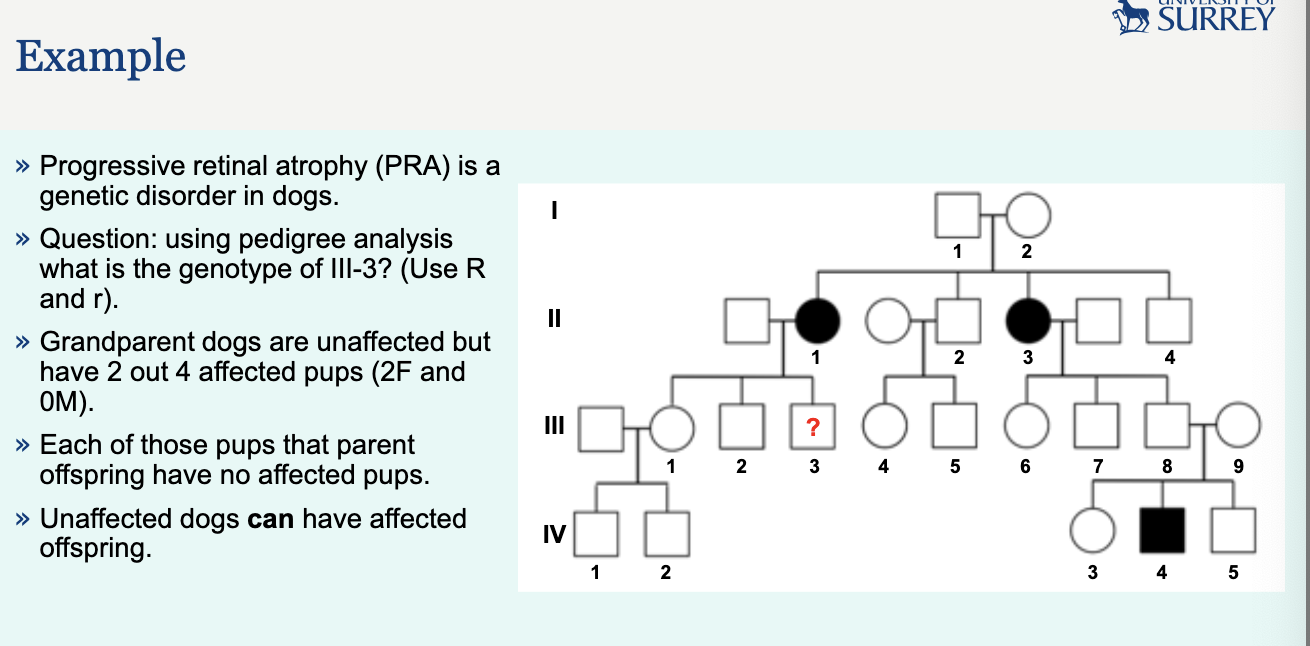
study this case study - im guessing exam questions are like this - not necessarily the condition but the type of Q
u will practice these kind of questions
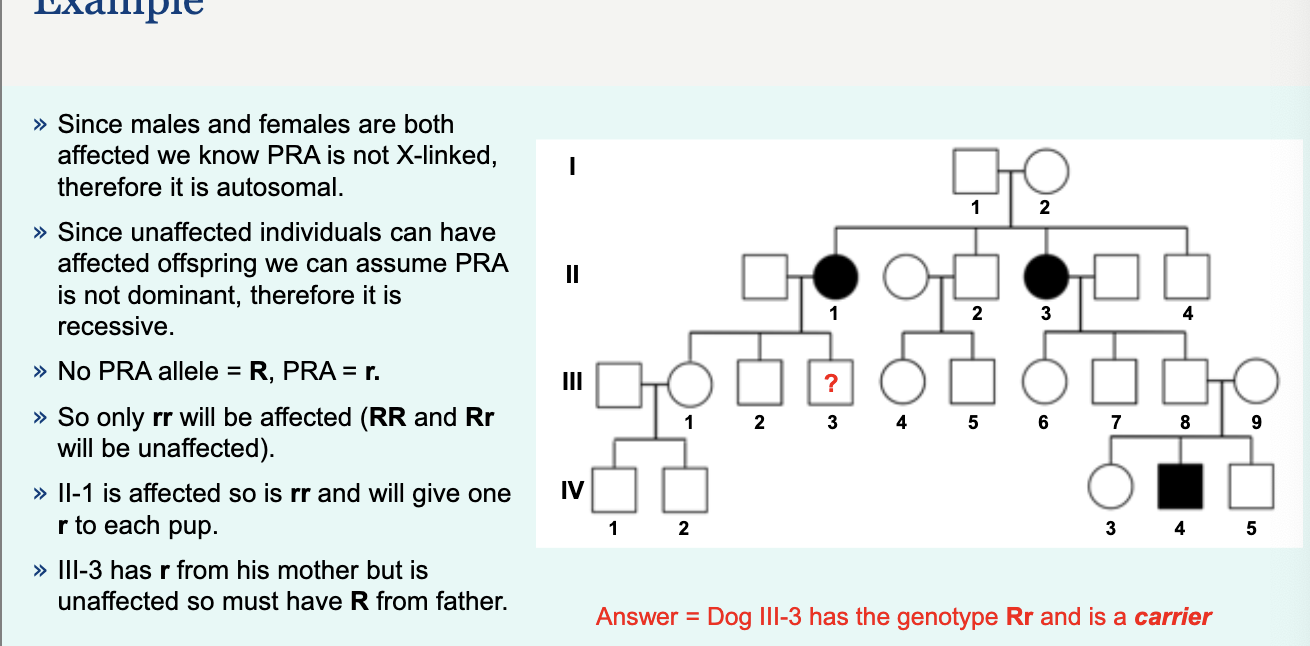
how does autosomal recessive inheritance work in a pedigree
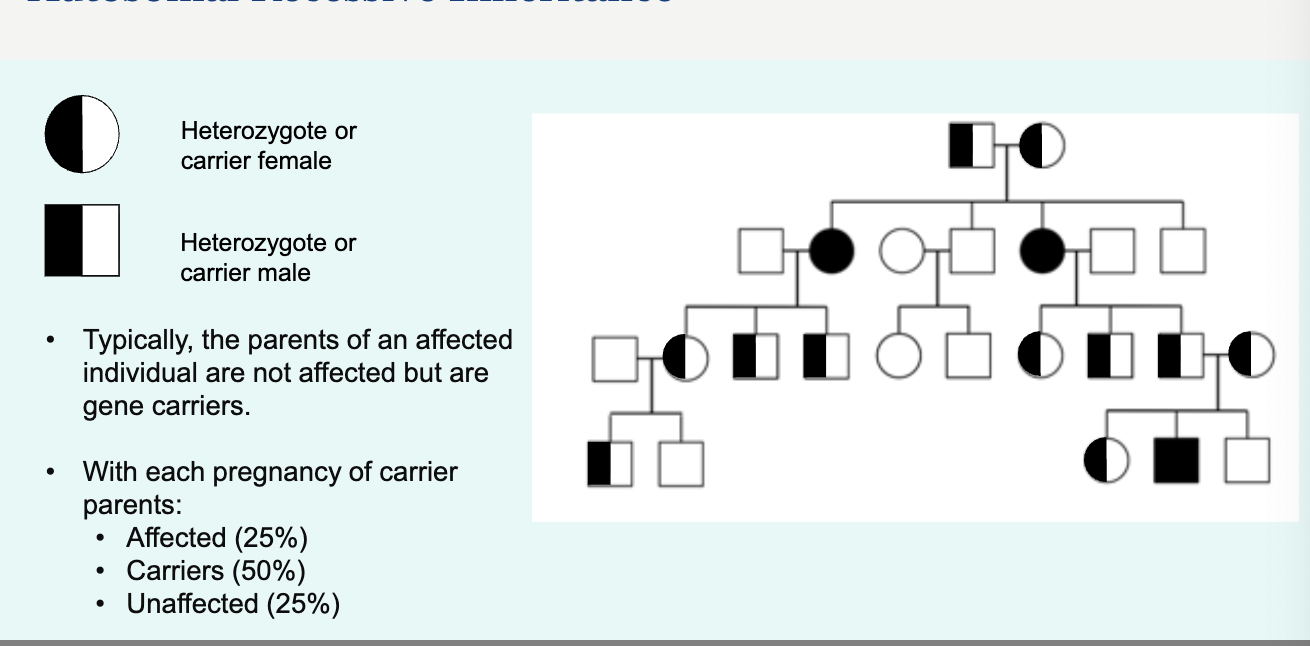
what is X-linked recessive inheritance?
» Hemizygous males (XY) and homozygous females are affected.
» Typically, males are almost exclusively affected due to rarity of an affected male mating with a female carrier.
» Daughters of affected males will be heterozygous and therefore unaffected but carriers.
» Sons of affected males will be unaffected.
» Sons of heterozygous females have a 50% chance of receiving the recessive gene, therefore being affected
makes sense cos it’s passed through X chromosome init and it’s recessive so means needs both xx to make it happen
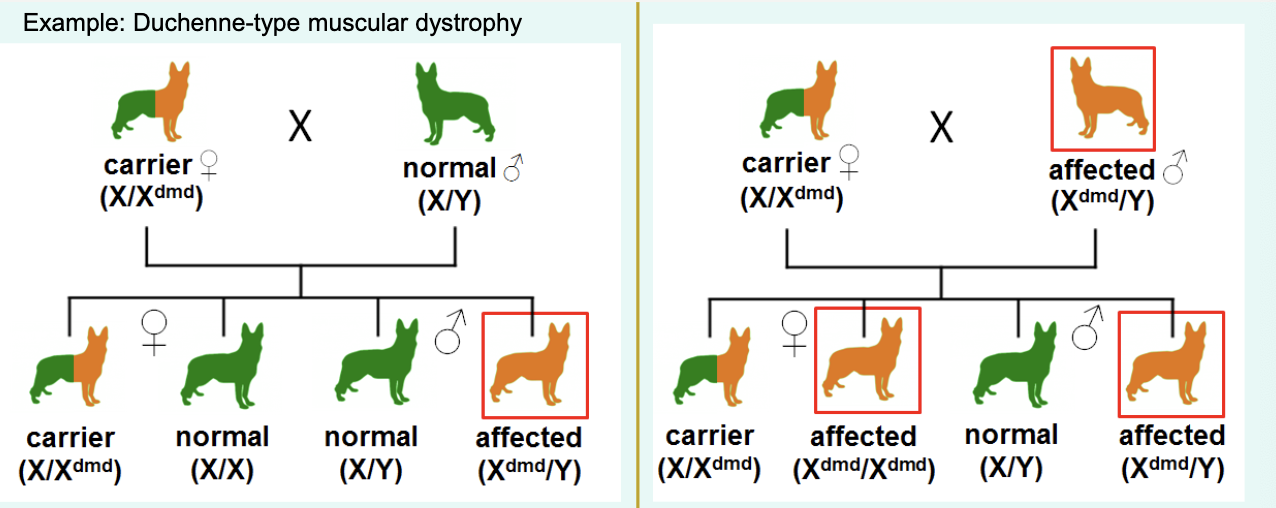
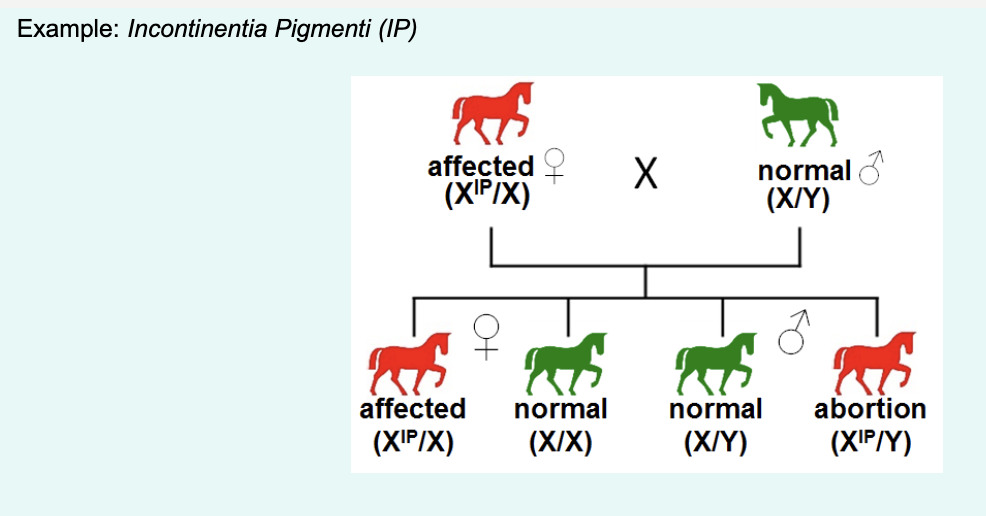
what is X-linked dominance inheritance?
watch video for this context..
» Heterozygous females are affected, males not usually viable and aborted during pregnancy.
» Because males not viable, homozygous females do not exist.
» Daughters of affected females will have a 50% chance of being unaffected and 50% chance of being affected.
» Sons have a 50% chance of being unaffected or 50% of being affected and not usually viable.
» Affected offspring will have an affected mother (as with autosomal dominant).
» Pedigree will show affected female
what is Loss-of-Function versus Gain-of-Function?
» Loss-of-function (inactivating mutations).
• The gene product has reduced or no function.
• Most commonly seen in recessive alleles, typically those that cause disease.
• In these instances, one normal wildtype allele is sufficient to produce enough gene product to ensure normal or near normal cellular function.
• The disease only becomes apparent in individuals with mutations in both alleles.
» Gain-of-function (activating mutations).
• The gene product has an abnormal function.
• A mutation that increases the activity of an allele, adds a new function, or makes the gene product available in new locations inside or outside of the cell.
• Could be positive, but may also be negative, as in dominant disease alleles, where the presence of one wildtype allele does not protect against the disease phenotype
what is chrondodysplasia in dogs an example of?
loss-of-function mutation in collagen binding protein ITGA10
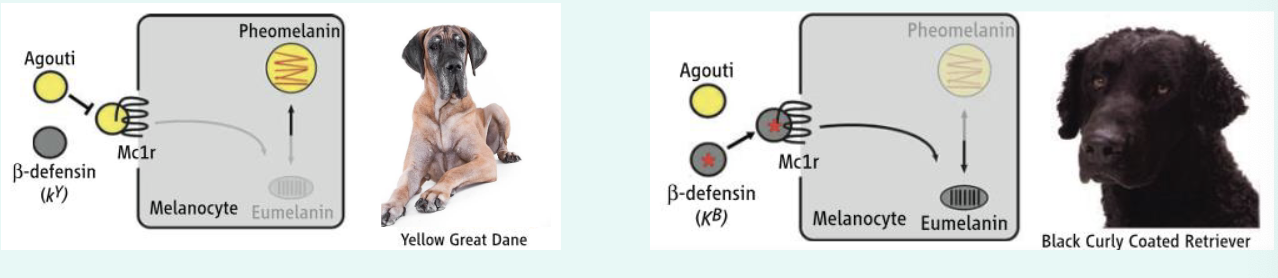
what is gain of function example?
A gain of function mutation allows ß-defensin to cause black coat colour by enabling a
novel membrane protein interactio
what is heterosis?
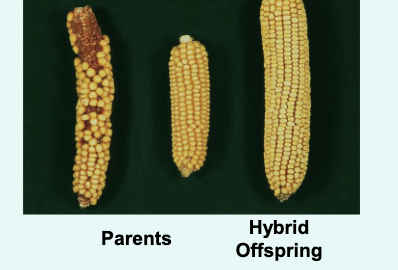
when 2 homozygous strains of plants or animals are crossed , the offspring are often phenotypically stronger, larger, and more vigorous than either parent
this phenomenon is called hybrid vigor or heterosis
hybridisation is now common agricultural practice used to increase production in plants and animals
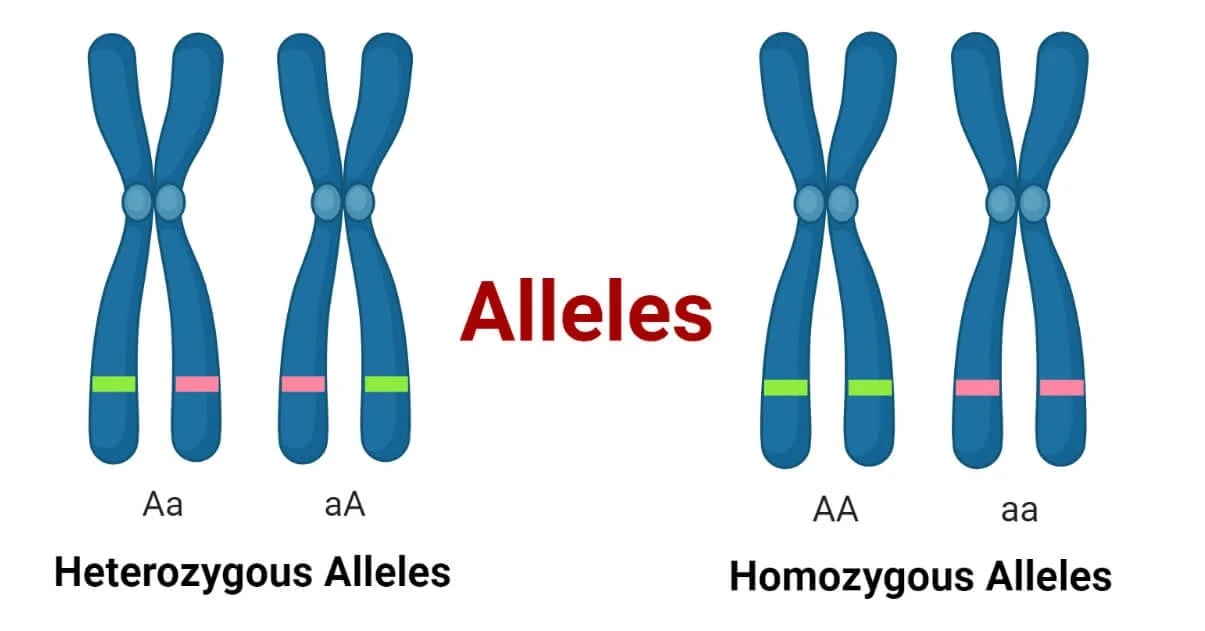
homozygote vs heterozygote allele
what is overdominance?
heterozygotes in certain genes makes them superior to either homozygote (2 identical alleles) - e.g. sickle cell anaemia where heterozygotes have resistance to malaria
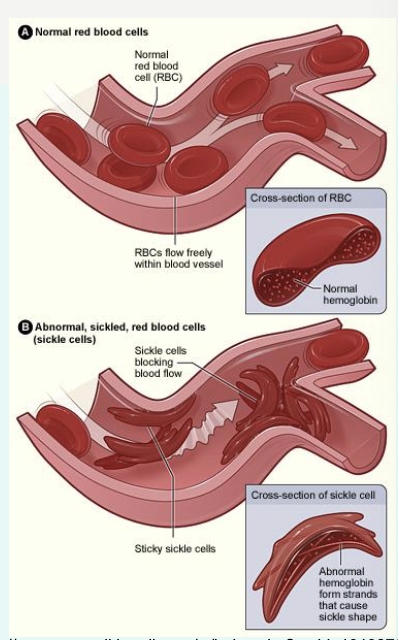
inherit the mutation for a gene encoding haemoglobin
mutation leads to a haemoglobin that forms chains instead of globular shape
this distorts the cells making them “sickle” shaped and fragile
the sickle cells can occlude vessels and break impairing O2 carrying capacity
HbA - normal, HbS- sickle
sickle cell anaemia is autosomal recessive
affected homozygotes often have a decreased life expectancy
» Heterozygotes are affected but to a lesser degree – “sickle cell trait”.
• Have enough production of HbA to offset HbS.
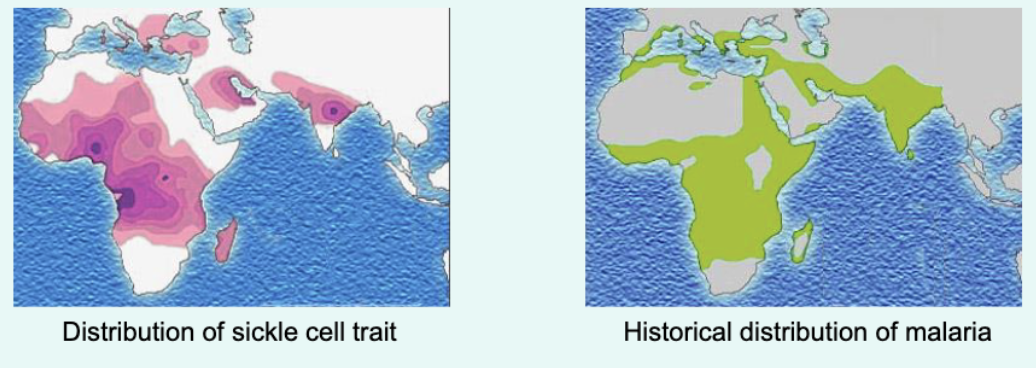
why are people with sickle cell anaemia resistant to malaria?
the sickle cell trait is more prevalent in areas of endemic malaria
red cells with HbS more fragile and prone to rupture when infected with the plasmodium parasite (causing malaira), which impairs the parasite’s ability to reproduce
HbS less digestible for the parasite than HbA
what is polygenic inheritance?
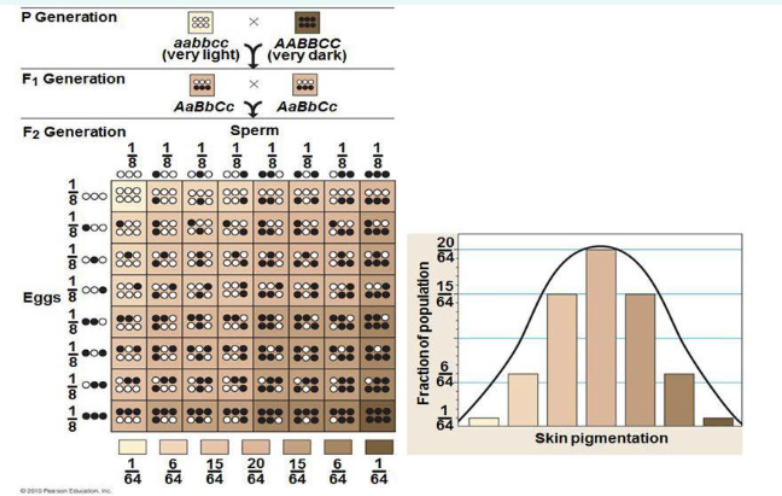
when a single phenotypic trait is controlled by the combined effects of two or more genes, often located on different chromosomes, which typically results in continuous variation within a population
quantitative characters are those that vary in the population along a continuum
» Quantitative variation usually indicates polygenic inheritance, an additive effect of
two or more genes on a single phenotype.
• NOT epistasis where one gene modifies another rather than additive (remember the
golden Labradors from last lecture).
» Skin colour, height, eye colour and hair colour in humans are examples of polygenic
inheritance
environmental impact on phenotype
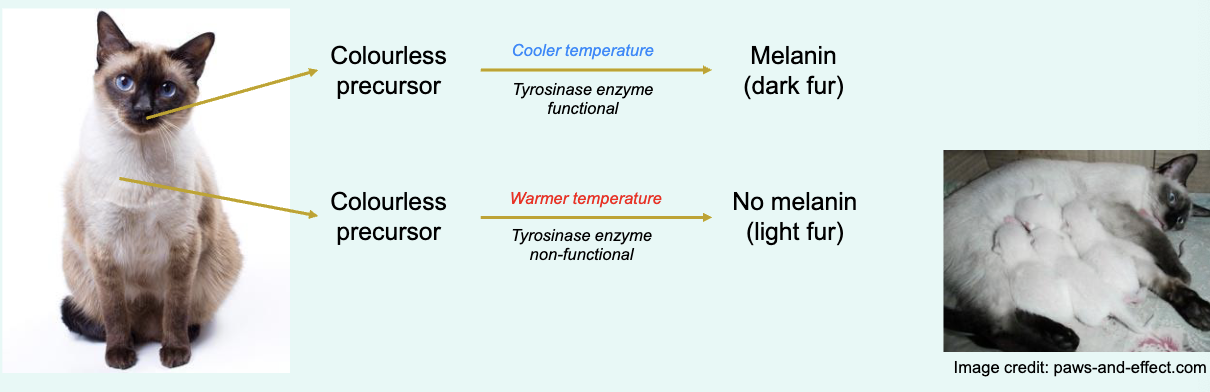
phenotype for a character depends on environment as well as the genotype
modifying environment: the enviironment may influence the effect of a genotype on the phenotype
siamese cats - temp depends colour of coat
what does an organism’s phenotype include?
physical appearance
internal anatomy
physiology
behaviour
an organism’s phenotype reflects its overall genotype and unique environmental history
environment like light, temp and nutrition
what is penetrance?
the proportion of individuals in a group with a given genotype that express the corresponding phenotype
the expressivity of the genotype is the degree to which its expressed in given individual
compare qualitative (mendelian) vs quantitative genetics
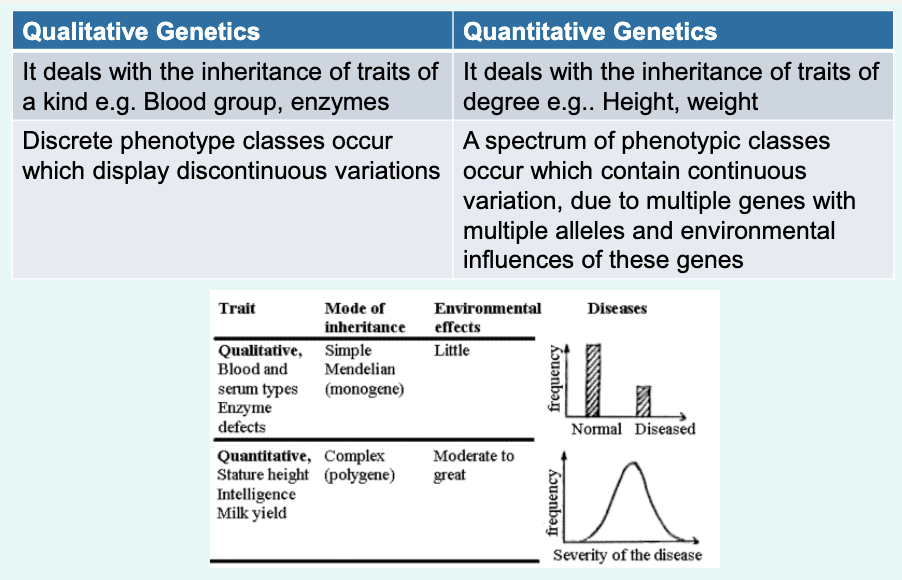
what is population (statistical) genetics?
» Examines genetic differences within and between populations i.e. larger scale than individuals.
• E.g. comparing one breed to another.
what are the 4 processes in population genetics?
1. Selection – natural (including sexual) or artificial.
• Relies on genetic variation and selection based upon fitness.
• Fitness – given symbol w.
• s = 1-w (where s is the selection co-efficient).
• When s>0 there is a fitness advantage, when s<0 there is a fitness disadvantage.
• Chosen based on phenotype (as animals and breeders can only see what’s in front of them!).
• Ultimately changes allele frequency and guides evolution
Mutation - new alleles - leading to loss or gain of function effects conferring fitness advantages or disadvantages
genetic drift - change in allele frequency based upon random sampling effectts since passing on alleles to offspring is a probabilistic event
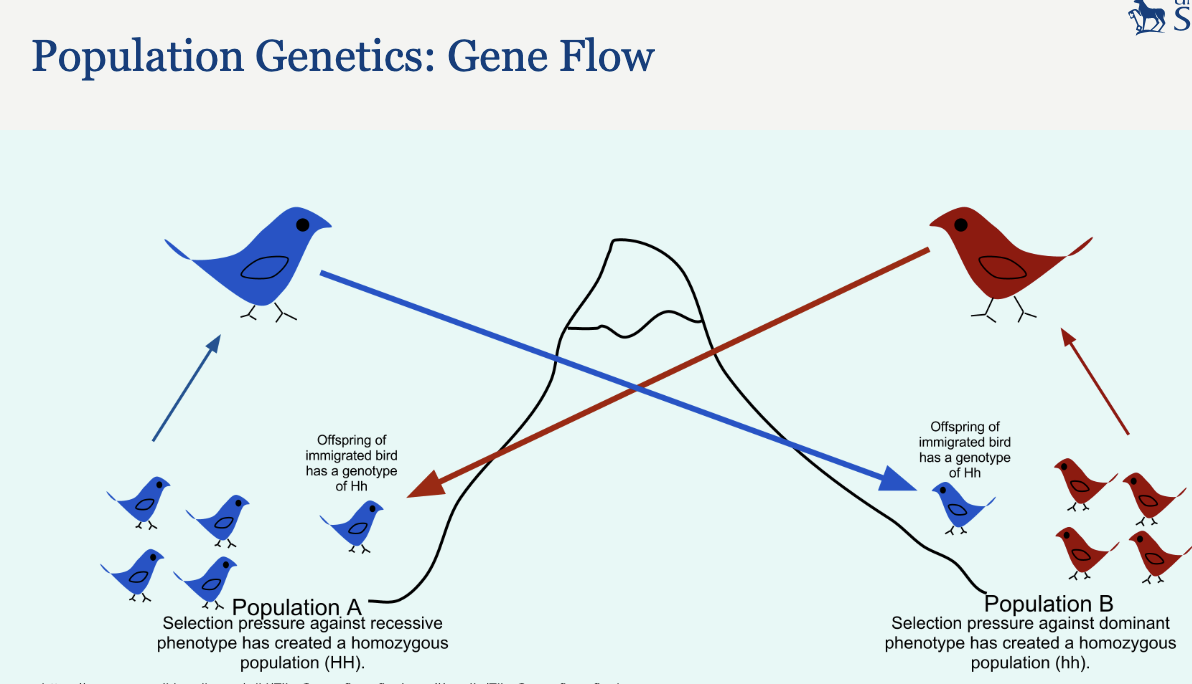
gene flow
often due to physical bariers (oceans, mountain ranges etc)
pops either side begin to differ
intro of alleles from one pop to another through immigration
what are the genetic fundaments of animal breeding strategies?
the application of the principles of animal genetics with the goal of improvement of the population based upon a desired trait.
• Quantity of a product.
• Efficiency in producing that product.
• Quality.
• Aesthetic value.
• Behavioural traits.
Based on:
• Mendelian genetics (single or few genes, qualitative and discrete effects).
• Population genetics (fitness for purpose and similarity to others, e.g. breeds).
• Quantitative genetics (polygenic traits that add or subtract from a phenotyp