Otolaryngology, Written State Exam 2024
 Call Kai
 Learn
Learn Practice Test
 Spaced Repetition
 Match
Match Flashcards
 Knowt Play
1/67

There's no tags or description
Looks like no tags are added yet.
Name | Mastery | Learn | Test | Matching | Spaced | Call with Kai | Chat |
|---|
No analytics yet
Send a link to your students to track their progress
68 Terms
The term "acoustic impedance" refers to the
A) pressure in the middle ear.
B) resonancy of the external ear.
C) hearing loss of inner ear origin.
D) acoustic resistance.
E) spatial hearing.
D) acoustic resistance.
EXPLANATION
The part of the middle ear (tympanic membrane and ossicular chain) create an acoustic resistance against the sound wave pressure.
About the function of the outer hair cells we can get objective information on
A) tympanometry
B) BERA
C) otoacoustic emission
D) investigation of stapedial reflex
C) otoacoustic emission
EXPLANATION
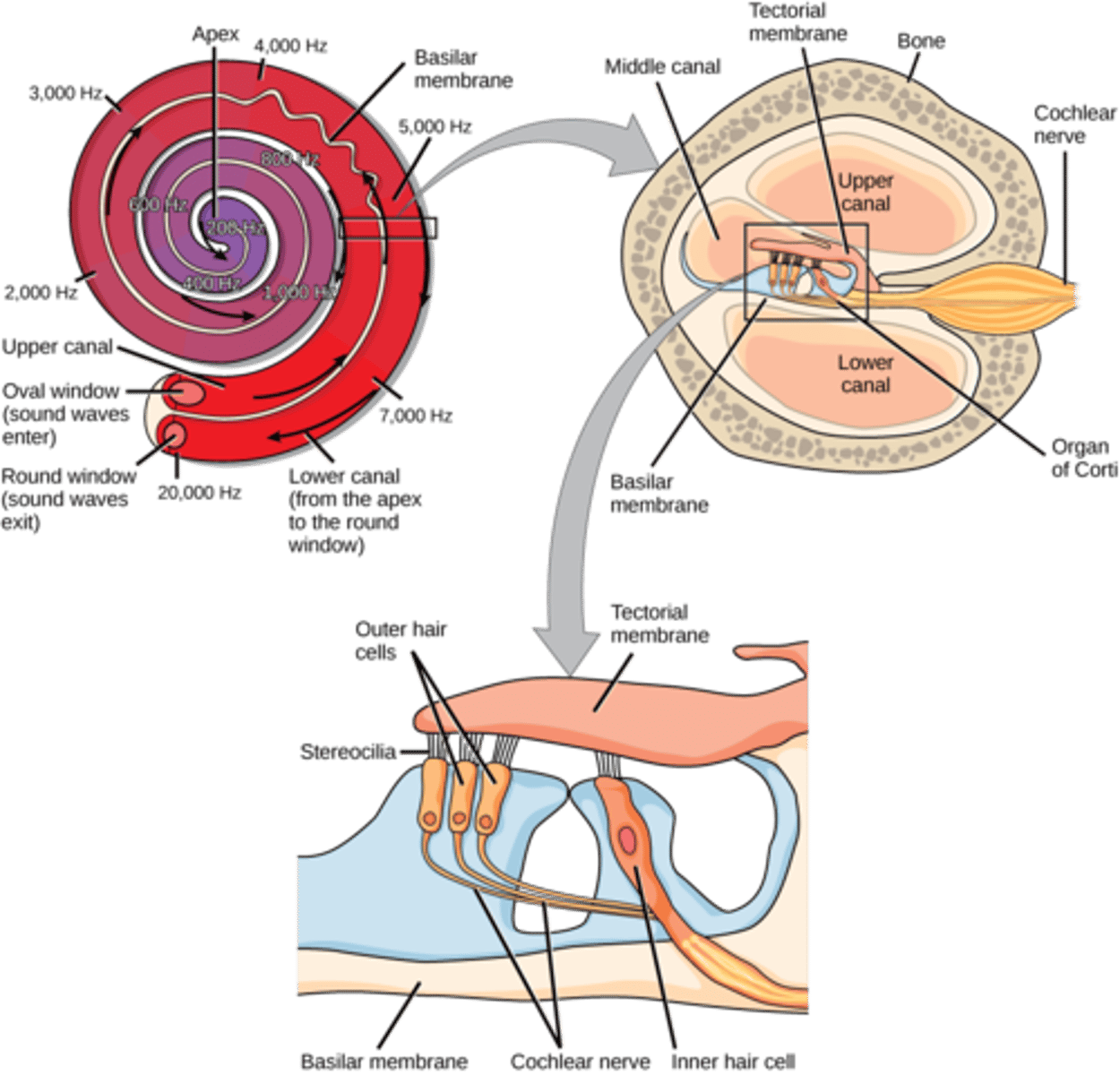
The otoacoustic emission objectively registers the low intensity sounds at the external ear canal, that have been produced by the outer hair cells.
The patients has no ear pain in:
A) perichondritis of the ear
B) herpes zoster oticus
C) angina
D) otosclerosis
E) lymphadenitis of the neck
D) otosclerosis
EXPLANATION
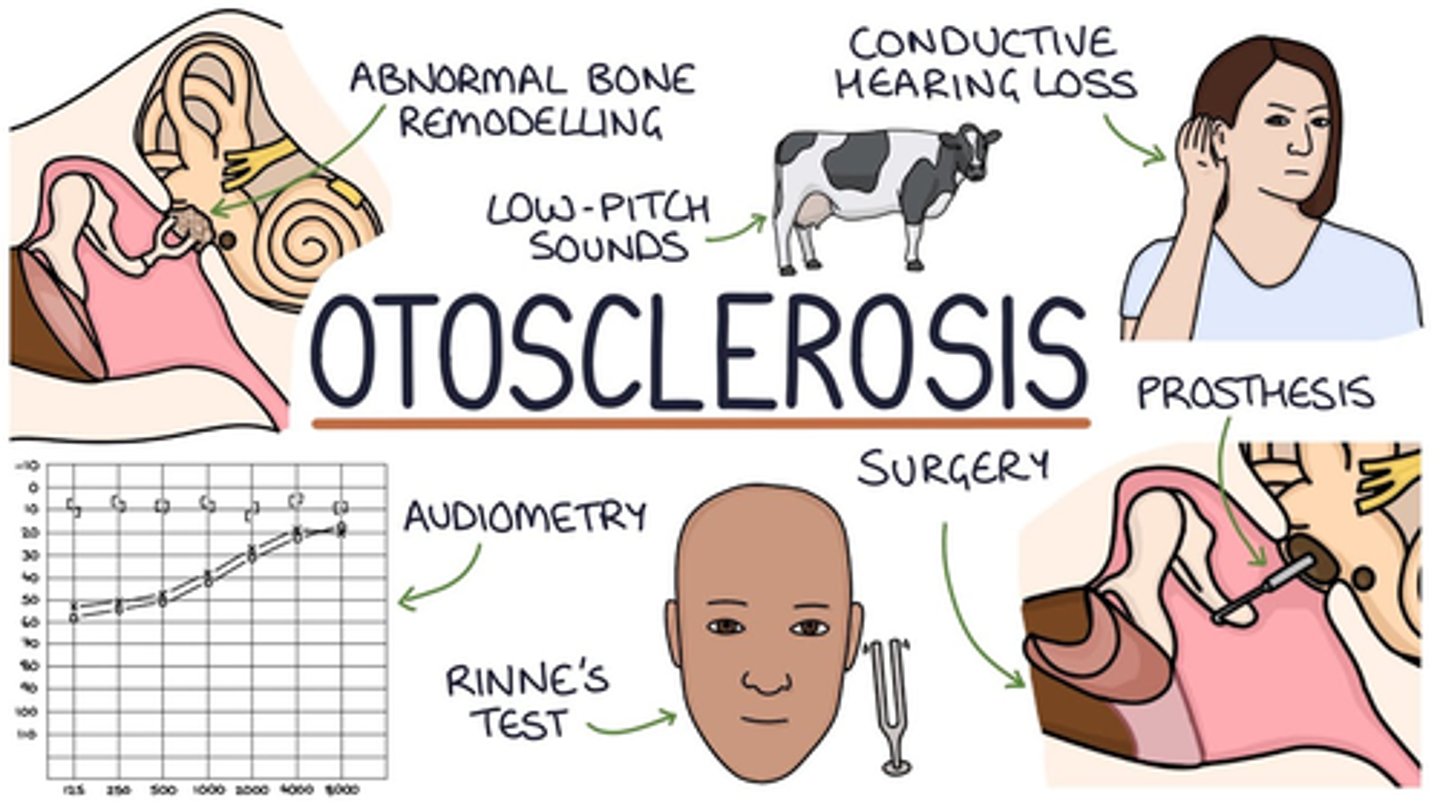
In the case of otosclerosis, there is no pain but only hearing loss.
Rinne's test is informative in:
A) conductive hearing loss
B) sensorineural hearing loss
C) perforation of the tympanic membrane
D) sudden hearing loss
A) conductive hearing loss
EXPLANATION
In Rinne test the patient hears the transmitted sound better on the bone due to bone conductivity, rather than in the air. This indicates a conductive hearing loss.
Tenderness with pressure on the tragus or traction on the auricle is typical in:
A) othematoma
B) external otitis
C) mastoiditis
D) otosclerosis
B) external otitis
EXPLANATION
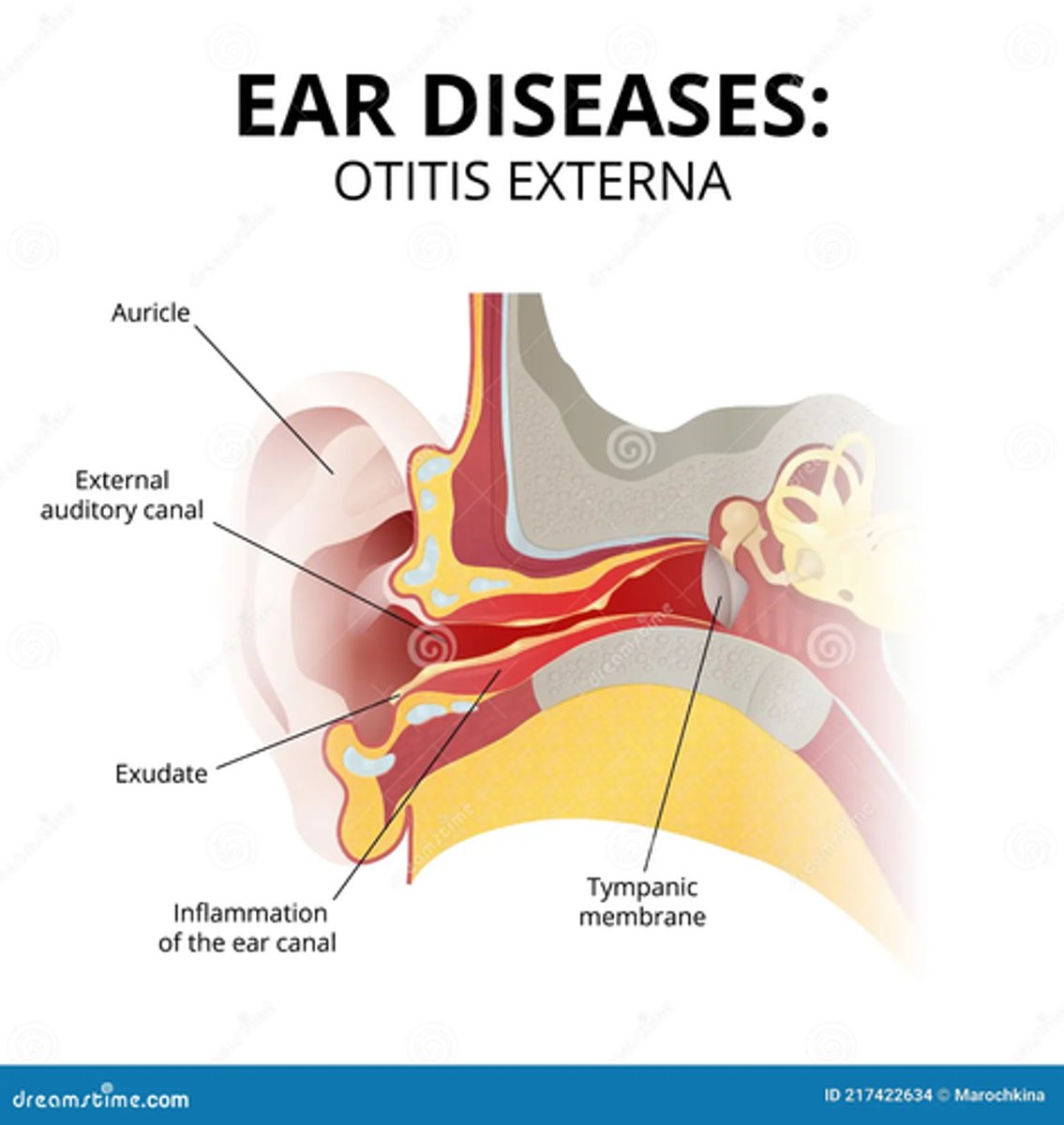
Tenderness with pressure on the tragus or traction on the auricle is characteristic in cases of external ear infections.
The patient suffers from vertigo and unilateral hearing loss and tinnitus for 1 hour. The probable diagnosis is:
A) acoustic neurinoma
B) neuronitis vestibularis
C) vertebrobasilar insufficiency
D) Ménière's disease
D) Ménière's disease
EXPLANATION
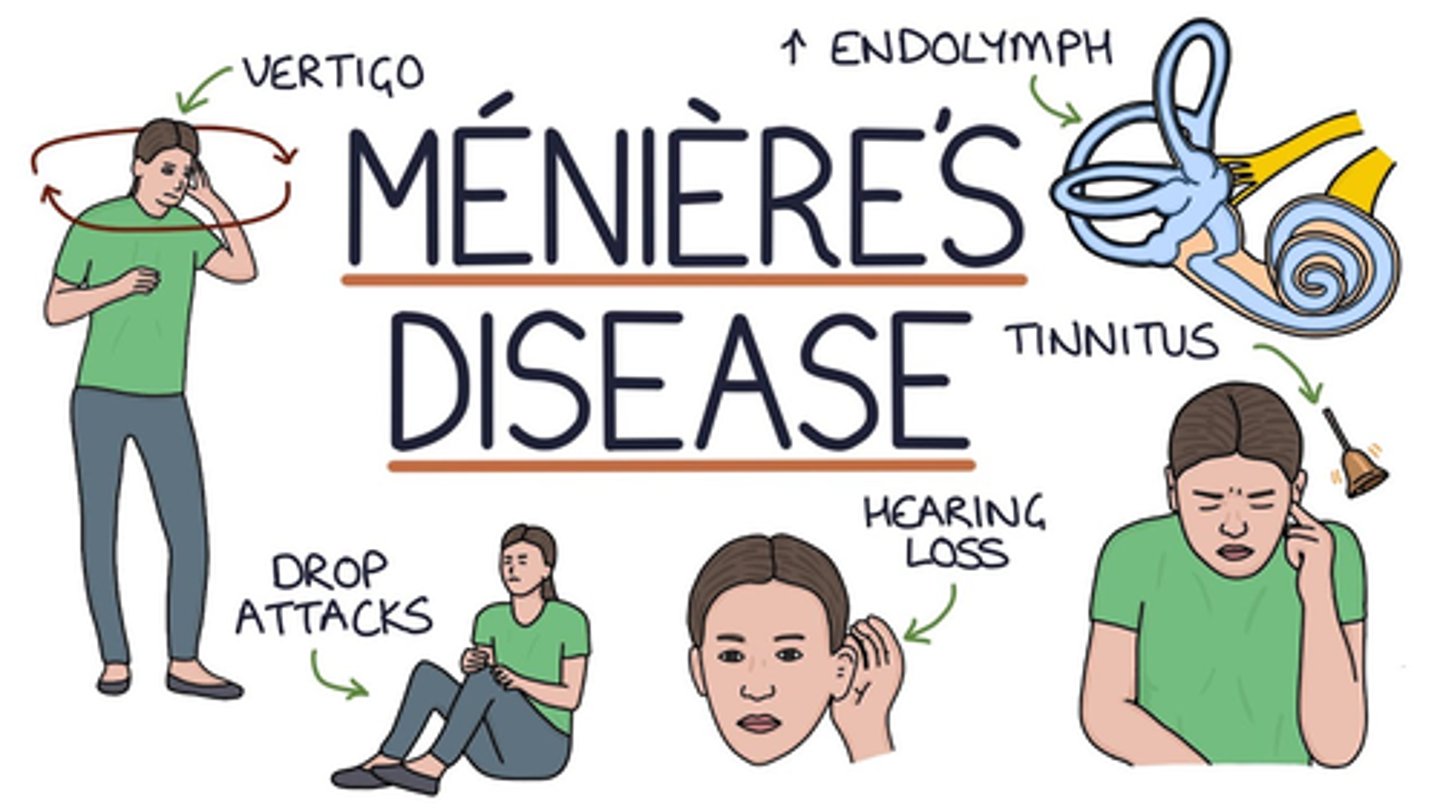
The Ménière disease is characterized by a continues spinning vertigo, lasting for at least 1-2 hours, accompanied by tinnitus and unilateral hearing loss. In later phase the tinnitus and hearing loss can be permanent.
The patient suffers from hearing loss on the right side. Weber test is lateralized to the right side. Probable cause of the hearing loss is:
A) otosclerosis on the left side
B) cerumen on the right side
C) Ménière's disease on the right side
D) sensorineural hearing loss on the right side
B) cerumen on the right side
EXPLANATION
Weber test is heard louder to the affected side due to conductive hearing loss in the defective ear. The reason of conductive hearing loss most of the times is the existence of earwax.
By the help of Valsalva maneuver we can
A) diagnose otosclerosis
B) ventilate the middle ear
C) detect nystagmus
D) exclude conductive hearing loss
E) evaluate the respiratory function of the nose
B) ventilate the middle ear
EXPLANATION
By applying the Valsalva maneuver, we can ventilate the ear. The air goes from the nostrils to the middle ear.
Which part of the tympanic membrane should be preferred when doing a paracentesis?
A) antero-inferior quadrant
B) antero-superior quadrant
C) postero-superior quadrant
D) postero-inferior quadrant
A) antero-inferior quadrant
EXPLANATION
In paracentesis the preferred quadrant is the anterior inferior since there is no structure behind it that we can damage, and the fluid easily flows out from there.
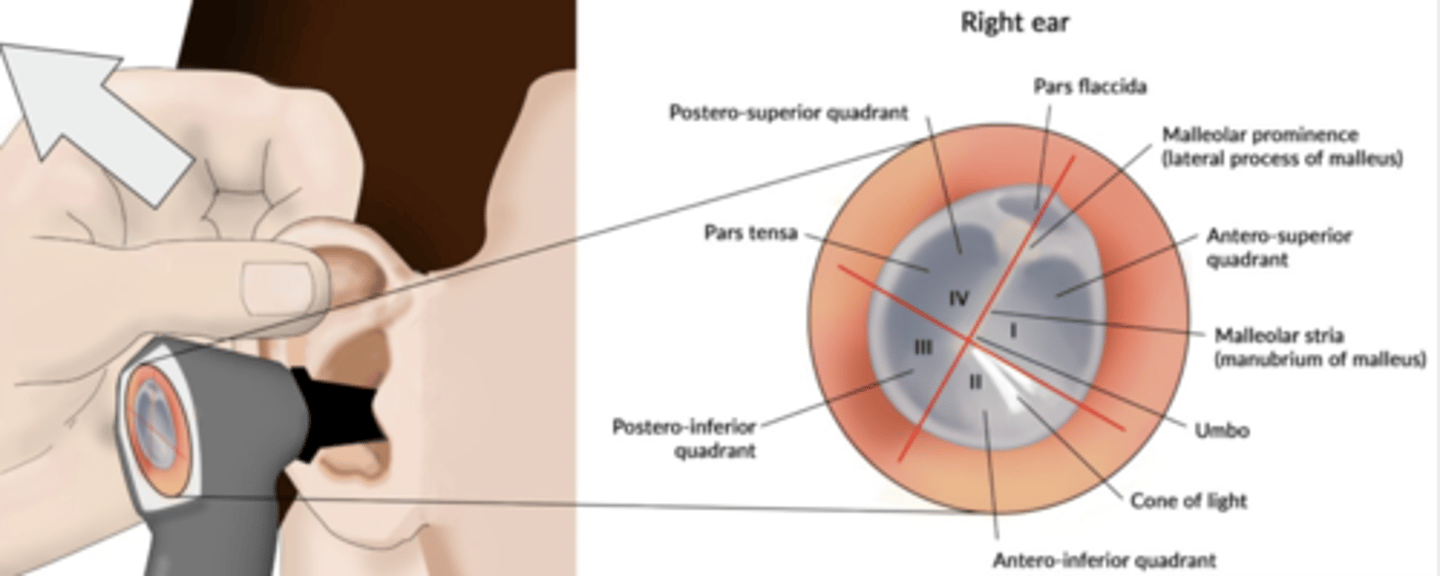
What can develop in the middle ear due to short-term obstruction of the Eustachian tube?
A) transsudate
B) haematoma
C) tympanosclerosis
D) acute inflammation
E) exudate
A) transsudate
EXPLANATION
Obstruction of the Eustachian tube frequently causes transudation in the tympanic cavity.
In adult patients with unilateral, recurring catarrh of the Eustachian tube you should exclude:
A) peritonsillar abscess
B) adenoid hypertrophy
C) malignant tumor in the epipharynx
D) deviated septum
C) malignant tumor in the epipharynx
EXPLANATION
Adult patients with unilateral, recurring catarrhal inflammation of the Eustachian tube should be examined for epipharyngeal tumors that obstruct the opening of the tube.
Possible complications of mastoiditis do not include:
A) meningitis
B) subperiosteal abscess
C) cavernous sinus trombosis
D) Bezold-abscess
E) otogenic hidrocephalus
E) otogenic hydrocephalus
EXPLANATION
Mastoiditis can cause a variety of different complication, but otogenic hydrocephalus is not one of them.
Adequate therapy of a confirmed otosclerosis is
A) mastoidectomy
B) paracentesis
C) transnasal Eustachian tube inflation
D) stapedectomy or stapedotomy
D) stapedectomy or stapedotomy
EXPLANATION
A choice of treatment in otosclerosis is removal of the sclerotic stapes and replacement by a prosthetic one: stapedectomy. Another type of operation is stapedotomy, when only the stapes superstructure is removed and replaced by a prosthesis.
Peripheral facial palsy cannot be caused by:
A) polyomyelitis
B) herpes zoster oticus
C) mastoiditis
D) chronic otitis media with cholesteatoma
E) otosclerosis
E) otosclerosis
EXPLANATION
Peripheral facial palsy cannot be caused by otosclerosis. Though it can be caused by poliomyelitis, Herpes Zoster oticus, mastoiditis, chronic otitis media with cholesteatoma.
The anatomic structure(s) opening into the middle nose cavity is/are:
A) nasofrontal and nasolacrimal ducts
B) sphenoidal sinus and Eustachian tube
C) maxillary sinus, frontal sinus and anterior and middle ethmoid cells
D) posterior ethmoid cells
E) only the maxillary sinus
C) maxillary sinus, frontal sinus and anterior and middle ethmoid cells
EXPLANATION
The middle nasal cavity includes the openings for the maxillary sinuses, frontal sinus and anterior and middle ethmoid cells.
During the treatment of a nasal furuncle always avoid
A) hospitalization and bed rest
B) incision and pressing (squeezing) of the lesion
C) parenteral antibiotic therapy
D) application of warm compresses
B) incision and pressing (squeezing) of the lesion
EXPLANATION
Nasal furuncle should not be incised or squeezed. Aggressive treatment on it can cause thrombophlebitis and further infection. Recommended treatment is antibiotics.
For the treatment of a simple rhinitis we recommend
A) nasal drops for 5 to 7 days
B) antibiotics
C) NSAIDs
D) corticosteroids
A) nasal drops for 5 to 7 days
EXPLANATION
The simple rhinitis is treatable with 5 to 7 days of nasal drop usage. Other treatment is unnecessary.
Most relevant therapy of allergic rhinitis consists of:
A) vasoconstrictor agents
B) antibiotics
C) NSAIDs
D) elimination of the allergen
D) elimination of the allergen
EXPLANATION
Most relevant therapy of allergic rhinitis is the elimination of the allergen.
Oezena
A) is a form of atrophic rhinitis
B) involves foul-smelling lesion of the mucosa
C) has unknown etiology
D) becomes better with aging
E) is characterized by all the above statements
E) is characterized by all the above statements
EXPLANATION
Atrophic oezema is characterized by a foul smelling fluid, where it’s etiology is unknown and is shown to be improving with aging.
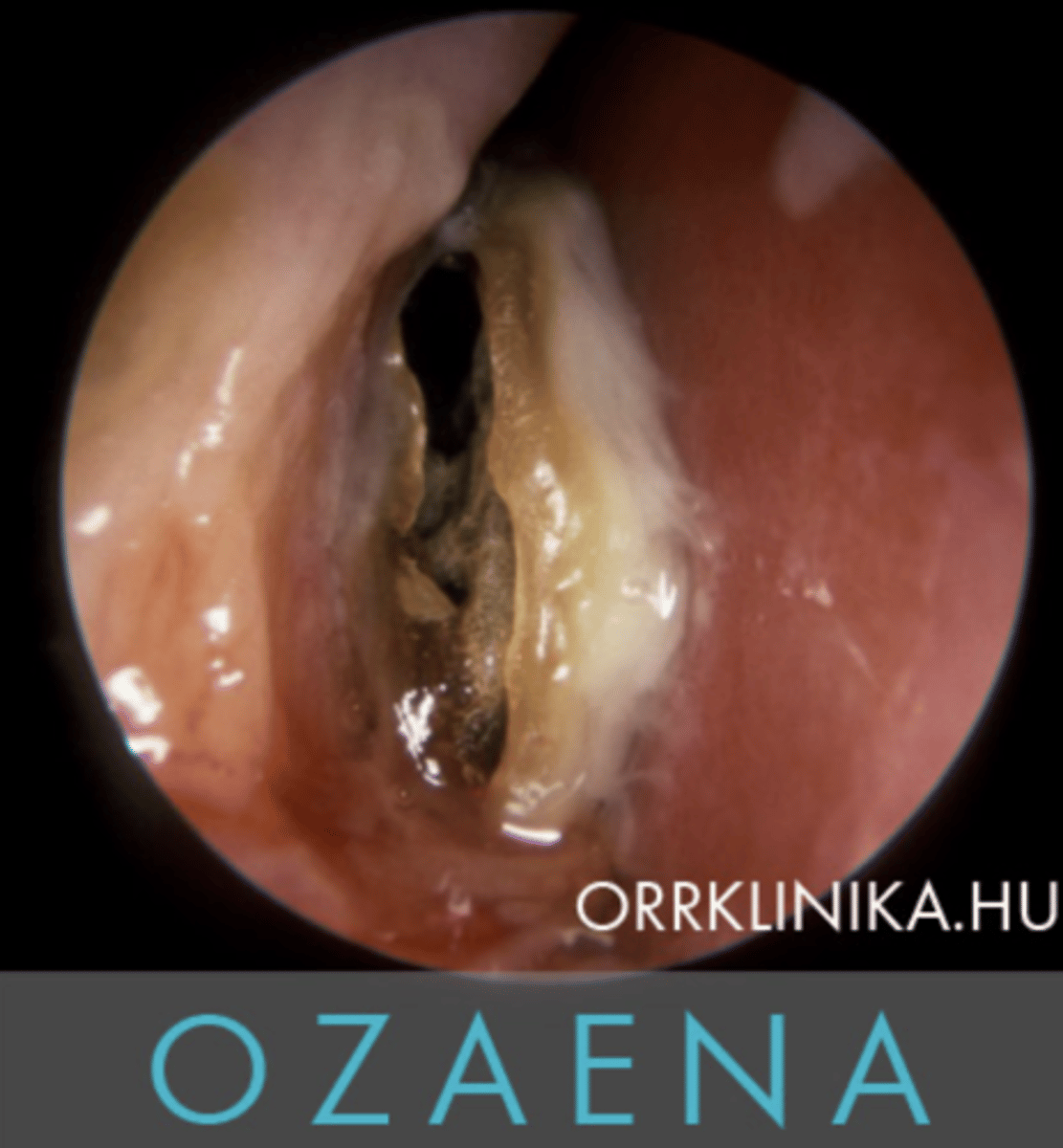
An elder patient presents with unilateral sanguinous, purulent, foul-smelling nasal discharge. You think of:
A) frontal sinusitis
B) malignant tumor of the nose or a paranasal sinus
C) ozaena
D) infected dental cyst
E) angiofibroma
B) malignant tumor of the nose or a paranasal sinus
EXPLANATION
Unilateral sanguinous, purulent, foul-smelling nasal discharge indicates us to a possibility of malignant tumor in the nose or paranasal sinuses.
Most common location of nasal bleeding:
A) nasopharynx
B) middle turbinate
C) superior meatus
D) anterior part of nasal septum
E) posterior part of the nasal septum
D) anterior part of nasal septum
EXPLANATION
Most common location of nasal bleeding is the anterior part of the nasal cavity, most specifically at the Kisselbach area, whereas the mucosa is thinner and has a rich vascularity.
In acute upper airway infection of an infant, one-sided swelling of the upper and lower eyelid appears. Which condition would you think of?
A) acute rhinitis
B) acute maxillary sinusitis
C) acute ethmoiditis
D) allergic reaction
C) acute ethmoiditis
EXPLANATION
In acute upper respiratory infection of an infant, one sided swelling of the upper and lower eyelid is an indication of an acute ethmoiditis. In this age the rest of the sinuses are either not fully developed or cannot cause eyelid swelling. In case of allergy, there is a symmetric swelling.
Adenotomy is indicated in
A) chronic sinusitis
B) otitis media
C) sleep apnoe
D) adenoid hypertrophy
E) each of the above conditions
E) each of the above conditions
EXPLANATION
Adenotomy is indicated in chronic sinusitis, frequent otitis media, sleep apnoe, adenoid hypertrophy. In these cases, the nose breathing and the Eustachian tube function improve.
The term "blow-out fracture" refers to a(n)
A) frontobasal fracture.
B) zygomatic fracture.
C) cheekbone fracture.
D) orbital floor fracture.
E) frontal bone fracture.
D) orbital floor fracture.
EXPLANATION
Blow-out fracture is a traumatic deformity of the orbital floor.
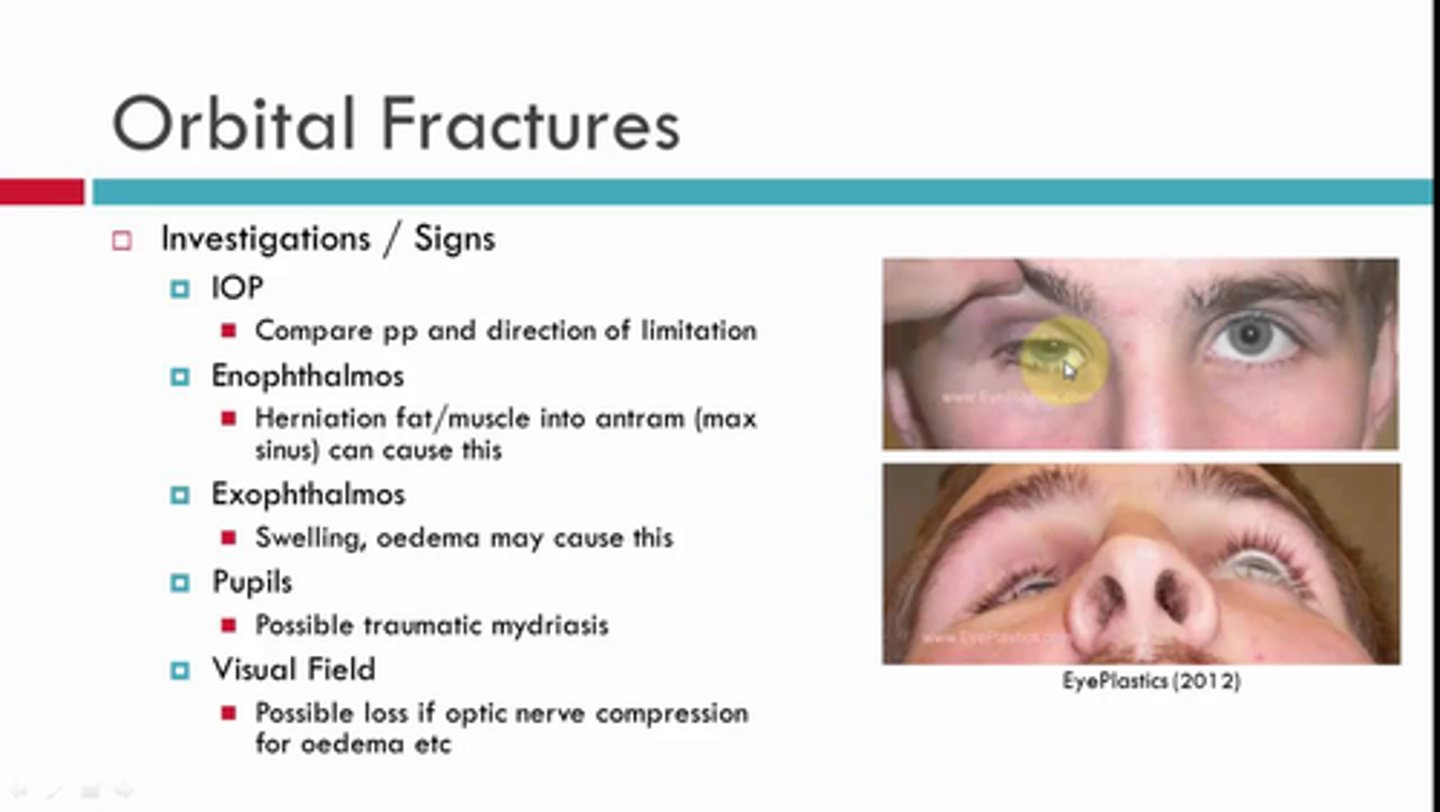
Osteoma of a paranasal sinus
A) metastatizes to the bones
B) is a congenital lesion
C) most commonly affects swimmers
D) should be surgically removed
E) can be treated with radiotherapy
D) should be surgically removed
EXPLANATION
Paranasal sinus osteoma is removed after a surgical intervention. Pain, obstruction of the sinus openings and the aesthetic deformation is resolved.
A middle-aged male patient has a painless, freely mobile mass of about 30 mm in one parotid gland for 5 years. Facial nerve funtion is intact. The probable diagnose is
A) osteoma in the external acoustic meatus
B) glomus caroticum tumor
C) pleomorph adenoma
D) salivary stone in the parotid gland
E) malignant tumor of the parotid gland
C) pleomorph adenoma
EXPLANATION
Pleiomorphic adenoma is the most frequent benign parotid tumor, accessible to remove surgically and does not give metastasis. The diagnosis is made by fine needle aspiration.
Necrotic, coated lesion of the tonsils suggests a(n)
A) scarlatina-associated tonsillitis
B) mononucleosis
C) agranulocytic angina
D) tonsillitis follicularis
E) herpangina
C) agranulocytic angina
EXPLANATION
Necrotic, coated lesion of the tonsils suggest agranulocytic angina. Treatment of the haematological status is recommended.
Adequate therapy of chronic tonsillitis includes
A) suction of the tonsils
B) squeezing the detritus out of the tonsils
C) high doses of antibiotics
D) tonsillectomy
D) tonsillectomy
EXPLANATION
The treatment for chronic tonsillitis is tonsillectomy.
After tonsillectomy, urgent hospitalization is needed if the patient presents with
A) oedema of the soft palate and uvula
B) tenderness of cervical lymph nodes
C) haemoptoe
D) intense pain irradiating into the ears
E) swallowing difficulties
C) haemoptoe
EXPLANATION
After tonsillectomy, haemoptoe indicates an urgent hospitalization.
The patient ate fish and has a stiching sensation upon swallowing. First you'll search for the fishbone
A) on the tonsils and root of the tongue
B) in the piriform sinus
C) in the epipharynx
D) in the laryngeal vestibule
A) on the tonsils and root of the tongue
EXPLANATION
Fish bone usually gets trapped on the tonsils and the root of the tongue.
Treatment of tonsillogenic sepsis requires
A) immediate tonsillectomy performed with antibiotic protection
B) application of broad-spectrum antibiotics
C) cryotherapy of the tonsils performed with antibiotic protection
D) therapeutic punction of cerebrospinal liquor
E) splenectomy
A) immediate tonsillectomy performed with antibiotic protection
EXPLANATION
Tonsillogenic sepsis requires an immediate tonsillectomy and antibiotic treatment.
In a patient with prolonged hoarseness (dysphonia) you have to perform a laryngoscopy, or even a histological test after
A) 8 days
B) 3 weeks
C) 8 weeks
D) 3 months
E) 1 year
B) 3 weeks
EXPLANATION
Persistent hoarseness of more than 3 weeks suggest a visit to the ENT for a laryngoscopy, whereupon small alteration on the area can be manageable.
Reinke-oedema is located on/in the
A) epiglottis
B) uvula
C) piriform sinus
D) vallecules
E) vocal chords
E) vocal chords
EXPLANATION
Reinke oedema is located at the vocal cords, and is prominent in heavy smokers.
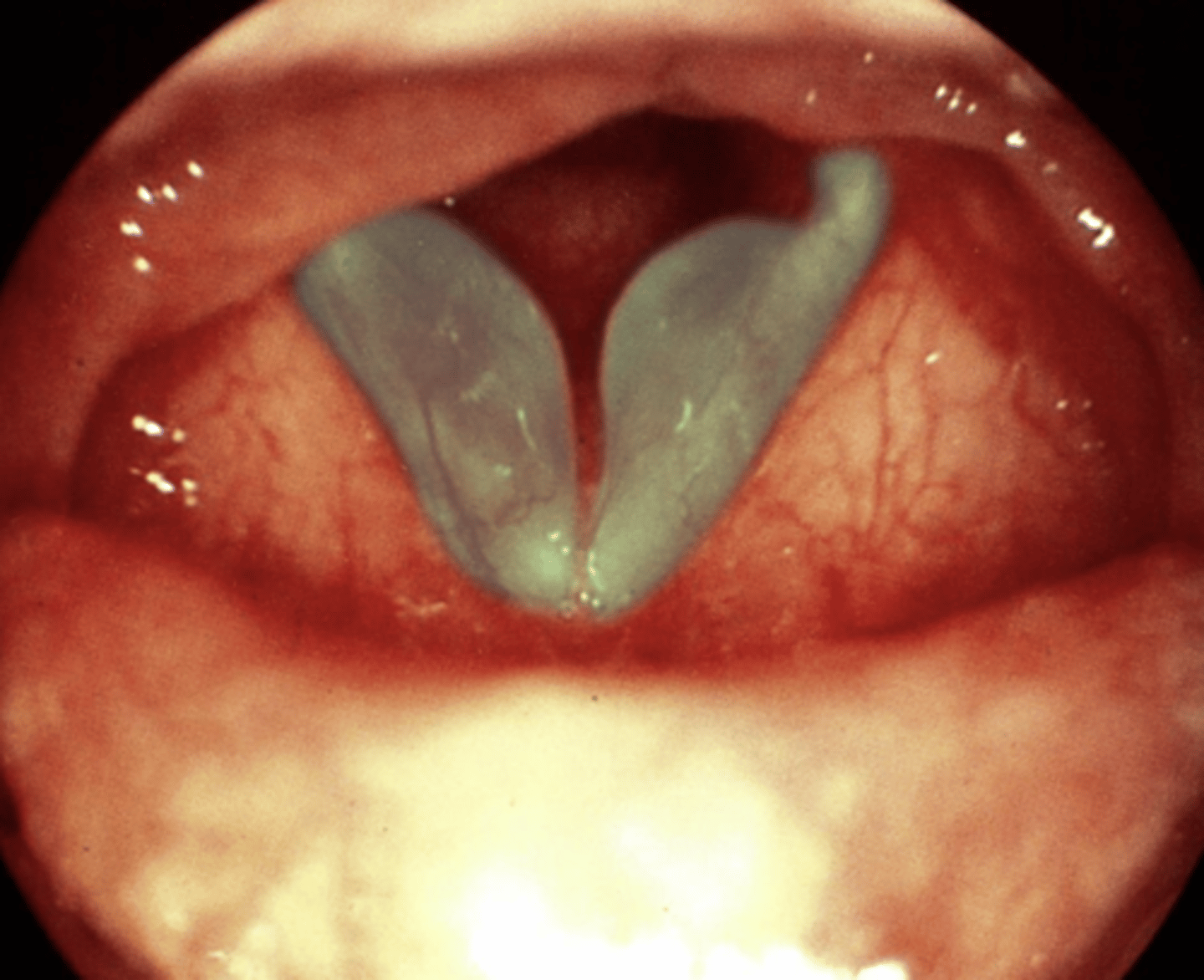
Symptoms of acute laryngitis do not include
A) haemoptoe
B) hoarseness
C) laryngeal pain
D) coughing
E) hiperaemic vocal chords
A) haemoptoe
EXPLANATION
Acute laryngitis symptoms does not usually include haemoptoe.
The most common malignant tumor of the larynx is:
A) adenocarcinoma
B) chondrosarcoma
C) adenocystic carcinoma
D) squamous cell carcinoma
D) squamous cell carcinoma
EXPLANATION
The most common malignant tumor of the larynx is the squamous cell carcinoma.
Surgical treatment of T1a vocal chord cancer is
A) laryngectomy
B) horizontal resection of the larynx
C) vertical resection of the larynx
D) chordectomy
E) arytenoidectomy
D) chordectomy
EXPLANATION
Surgical treatment of T1a vocal chord cancer is chordectomy.
Intratracheal intubation should be replaced by tracheostomy after
A) 6 hours
B) 48 hours
C) 8 days
D) 4 weeks
E) it should not be replaced at all
B) 48 hours
EXPLANATION
Tracheostomy is indicated 48 hours after intratracheal intubation. Longer waiting then the suggested can cause laryngeal damage.
Inspiratory dyspnea is a typical symptom of
A) cardiac insufficiency
B) bronchial asthma
C) upper airway dyspnea
D) psychogenic dyspnea
C) upper airway dyspnea
EXPLANATION
Inspiratory dyspnea is a typical symptom of upper airway system. In this case intubation or tracheotomy must be considered.
A patient living with tracheostomy cannula suddenly begins to suffocate. The first thing you do is to
A) suction the trachea through the cannula
B) refer the patient to a specialist
C) remove the cannula immediately and dilate the stoma with a nasal speculum
D) force the patient to cough
C) remove the cannula immediately and dilate the stoma with a nasal speculum
EXPLANATION
When a patient with tracheostomy cannula starts to suffocate, immediate removal of the cannula is recommended and dilation of the stoma with a nasal speculum
Swallowed foreign bodies most commonly get stuck
A) in the hypopharynx
B) at the first isthmus of the esophagus
C) at the second isthmus of the esophagus
D) where the esophagus opens into the stomach
E) at the pylorus
B) at the first isthmus of the esophagus
EXPLANATION
Swallowed foreign bodies usually get stuck at the first isthmus of the esophagus. These are usually easy to remove.
Esophageal varicosity is a concomitant disease of
A) cardiac decompensation
B) stricture of the cardia
C) esophageal tumor
D) hepatic cirrhosis
E) malignant struma
D) hepatic cirrhosis
EXPLANATION
Esophageal varicosity is a concomitant disease of hepatic cirrhosis. The varicose veins are firstly found in this territory.
The condition in which the cause of dysphagia cannot be detected on swallow radiography is
A) esophageal diverticulum
B) cervical spondylarthrosis
C) esophageal carcinoma
D) globus hystericus
E) esophageal spasm
D) globus hystericus
EXPLANATION
If dysphagia is not detected by swallow radiography. Patients most of the times suffers out of globus hystericus. (functional disorder - no underlying pathology)
The best radiographic modality for the diagnosis of an esophageal foreign body is
A) chest X-ray
B) barium swallow test
C) swallow radiography without contrast media
D) swallow radiography with absorbable contrast media
D) swallow radiography with absorbable contrast media
EXPLANATION
The esophageal foreign body is best detectable by swallow radiography with absorbable contrast media.
Etiology of median cervical cyst or fistule is a
A) remaining thoracic duct
B) remaining thyroglossal duct
C) laryngocele
D) struma
B) remaining thyroglossal duct
EXPLANATION
The median cervical cyst or fistula is a remnant of the thyroglossal duct, and so during surgery the removal of the middle part of the hyoid bone is suggested in order to avoid remnants.
Surgical solution of a median cervical cyst or fistule is
A) extirpation of the fistule together with the hyoid bone
B) extirpation of the fistule and the cyst together with the middle section of the hyoid bone
C) extirpation of the fistule up to the root of the tongue
B) extirpation of the fistule and the cyst together with the middle section of the hyoid bone
EXPLANATION
Surgical solution of the median cervical cyst or fistula is the extirpation of it together with the middle section of the hyoid bone, to prevent the recurrence of it.
The most frequently injured nerve during thyroid surgery is
A) hypoglossal nerve
B) accessory nerve
C) superior laryngeal nerve
D) recurrent laryngeal nerve
E) brachial plexus
D) recurrent laryngeal nerve
EXPLANATION
The recurrent laryngeal nerve is the nerve that most frequently gets injured during thyroid surgery, due to its localization.
A pulsating tumor palpable on one side of the neck probably indicates a
A) thyreioditis
B) mediastinitis
C) tumor adjoining to the carotid artery
D) foreign body in the hypopharynx
C) tumor adjoining to the carotid artery
EXPLANATION
A pulsating tumor palpable on one side of the neck probably indicates a tumor adjoining to the carotid artery.
The term "unilateral radical neck dissection" means
A) removal of the metastatic-suspect lymph nodes on one side of the neck
B) removal of all cervical lymph nodes together with sternocleidomastoid muscle and internal jugular vein and nervus accessorius on one side
C) removal of jugular lymph nodes together with the larynx
D) removal of cervical fat tissues and cervical lymph nodes
B) removal of all cervical lymph nodes together with sternocleidomastoid muscle and internal jugular vein and nervus accessorius on one side
EXPLANATION
Unilateral radical neck dissection indicates removal of all cervical lymph nodes together with SCM muscle and internal jugular vein and nervus accessorius on the same side.
Sialolithiasis
A) is most common in the parotid gland
B) affects most frequently the submandibular gland
C) is detected mostly in the sublingual gland
D) can be effectively treated with a special diet
B) affects most frequently the submandibular gland
EXPLANATION
Sialolithiasis affects most commonly the submandibular gland, and the resolution is the removal of the gland in most of the cases.
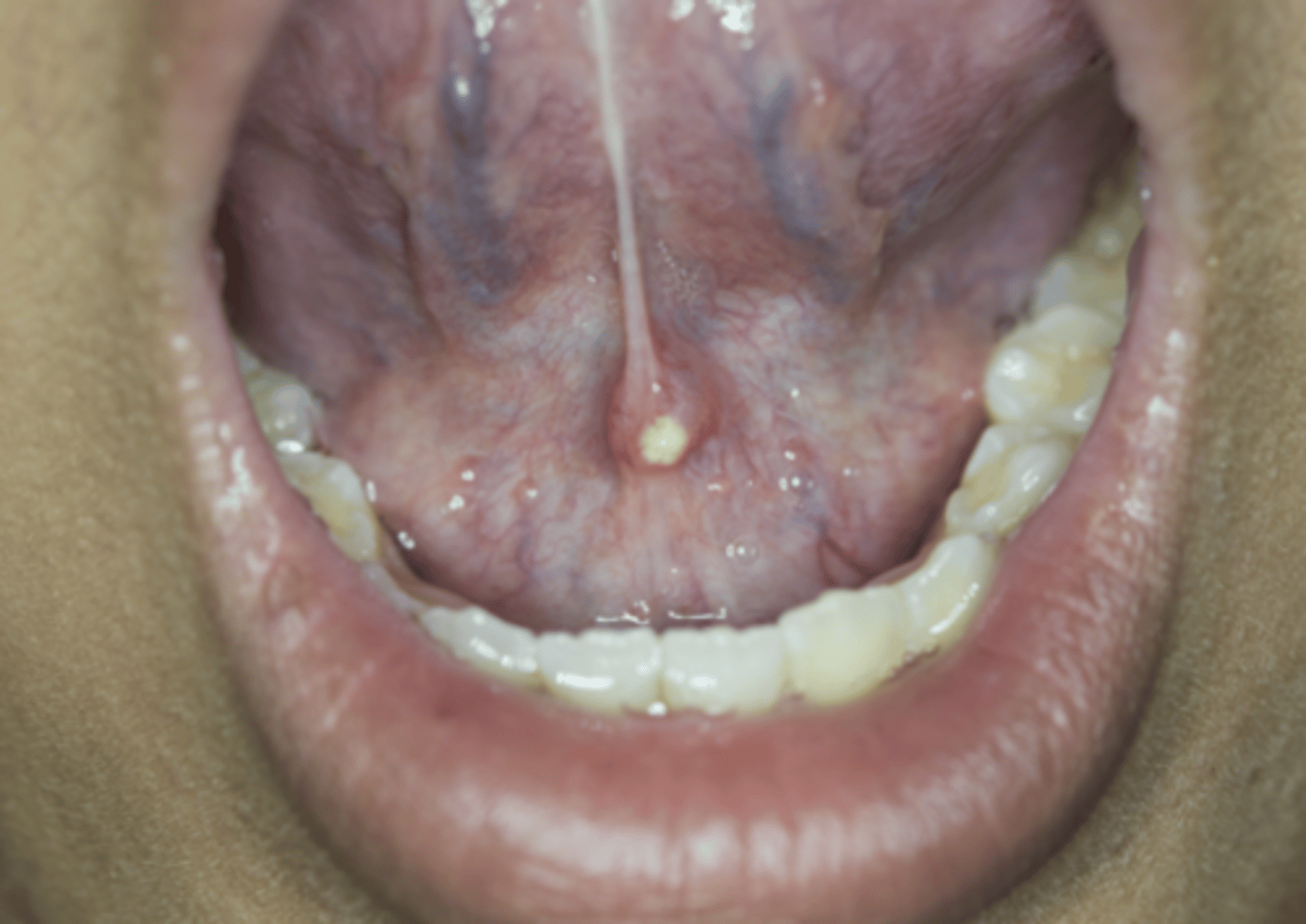
Tongue burn is not present in
A) pernicious anemia
B) vitamin deficiency
C) glossitis
D) Plummer–Vinson syndrome
E) lingua nigra pilosa (black hairy tongue)
E) lingua nigra pilosa (black hairy tongue)
EXPLANATION
Tongue burn is not present in lingua nigra pilosa.
Follicular tonsillitis should be treated with
A) penicillin for 10 days
B) doxycycline for 1 week
C) prompt removal of the tonsils
D) local administration of medicines (with a swab) on the tonsils and systemic painkillers
A) penicillin for 10 days
EXPLANATION
Follicular tonsillitis is treated with the usage of penicillin for 10 days, to prevent secondary infections.
Persistance of a broncial foreign body may lead to
A) pneumonia
B) bronchiectasia
C) pulmonary abscess
D) all the above conditions
D) all the above conditions
Holzknecht–Jacobson sign indicates that
A) both sides of the lung functions equally
B) an unilateral bronchial foreign body causes the mediastinum move towards the affected side
C) a pulmonary emphysema is present
D) a pulmonary tumor giving radiography signs is detected
E) radiographic contour of the mediastinum is widened
B) an unilateral bronchial foreign body causes the mediastinum move towards the affected side
EXPLANATION
A unilateral bronchial foreign body causes the mediastinum move towards the affected side, whereas this sign is called Holzknecht-Jacobson.
Adequate measures in case of an esophageal foreign body
A) radiography with absorbable contrast media and esophagoscopy
B) introduction of an esophageal tube
C) dilation of the cardia
D) administration of painkillers, spasmolitics
A) radiography with absorbable contrast media and esophagoscopy
EXPLANATION
In case of esophageal foreign body a radiography with absorbable contrast media and esophagoscope must be done.
Disorders of voice formation
A) dysphonia
B) lisping
C) sputtering
D) stuttering
E) aphasia
A) dysphonia
EXPLANATION
Disorders of voice information are collectively called dysphonia.
Stroboscopy is used in otorhinolaryngology for the evaluation of
A) vocal fold vibration
B) paranasal sinuses
C) esophageal motions
D) nasal breathing
A) vocal fold vibration
EXPLANATION
Stroboscope is used for the evaluation of the vocal fold vibration.
Complications of a middle ear choleoksteatoma may be
1) labyrinthitis
2) cavernous sinus thrombosis
3) facial nerve palsy
4) recurrent laryngeal nerve palsy
5) subperiosteal abscess
A) the 1st, 2nd, 3rd and 5th answers are correct
B) the 2nd, 3rd and 4th answers are correct
C) the 1st, 2nd and 5th answers are correct
D) the 1st and 3rd answers are correct
E) the 4th and 5th answers are correct
A) the 1st, 2nd, 3rd and 5th answers are correct
1) labyrinthitis
2) cavernous sinus thrombosis
3) facial nerve palsy
4) recurrent laryngeal nerve palsy
5) subperiosteal abscess
EXPLANATION
Middle ear cholesteatoma complications are labyrinthitis, cavernous sinus thrombosis, facial nerve palsy, and subperiosteal abscess.
Ototoxic antibiotics include
1) chloramphenicol
2) streptomycin
3) tetracyclin
4) gentamycin
5) neomycin
A) the 1st, 2nd and 3rd answers are correct
B) the 2nd, 3rd and 4th answers are correct
C) the 1st, 4th and 5th answers are correct
D) the 1st, 3rd and 5th answers are correct
E) the 2nd, 4th and 5th answers are correct
E) the 2nd, 4th and 5th answers are correct
1) chloramphenicol
2) streptomycin
3) tetracyclin
4) gentamycin
5) neomycin
EXPLANATION
Ototoxic antibiotics include streptomycin, gentamycin and neomycin, and so must be administrated carefully.
Sensorineural hearing loss may develop after the following viral infections
1) mumps
2) chickenpox
3) rubeola
4) measles
5) serous meningitis
A) the 1st, 2nd and 3rd answers are correct
B) the 1st and 3rd answers are correct
C) the 1st, 4th and 5th answers are correct
D) the 2nd, 3rd and 4th answers are correct
E) the 4th and 5th answers are correct
C) the 1st, 4th and 5th answers are correct
1) mumps
2) chickenpox
3) rubeola
4) measles
5) serous meningitis
EXPLANATION
Mumps, measles and serous meningitis can cause sensorineural hearing loss.
Conservative therapy of paranasal sinusitis involves
1) decongestion nosedropp usement
2) tamponade of the middle meatus
3) punction and rinsing of the paranasal sinus
4) X-ray radiation therapy
5) adminstration of antibiotics
A) the 1st, 2nd and 3rd answers are correct
B) the 2nd, 4th and 5th answers are correct
C) the 1st, 3rd and 5th answers are correct
D) the 3rd, 4th and 5th answers are correct
E) all of the answers are correct
C) the 1st, 3rd and 5th answers are correct
1) decongestion nosedropp usement
2) tamponade of the middle meatus
3) punction and rinsing of the paranasal sinus
4) X-ray radiation therapy
5) adminstration of antibiotics
EXPLANATION
Conservative therapy of paranasal sinusitis includes decongestion nosedropp usement, punction and rinsing of the sinus, administration of antibiotics.
Nasal congestion (obstructed nadal breathing) can be caused by
1) nasal polyposis
2) deviated septum
3) perforated septum
4) choanal atresia
5) laryngeal recurrent nerve palsy
A) the 1st, 2nd and 3rd answers are correct
B) the 2nd, 4th and 5th answers are correct
C) the 3rd, 4th and 5th answers are correct
D) the 1st, 2nd and 4th answers are correct
E) all of the answers are correct
D) the 1st, 2nd and 4th answers are correct
1) nasal polyposis
2) deviated septum
3) perforated septum
4) choanal atresia
5) laryngeal recurrent nerve palsy
EXPLANATION
Nasal congestion can be caused by nasal polyposis, deviated septum, and chia all atresia.
Underlying cause of epistaxis may be
1) thrombocytopenia
2) morbus Osler
3) vasomotor rhinitis
4) lacrimal gland obstruction
5) hypertension
A) the 1st, 2nd and 3rd answers are correct
B) the 2nd, 3rd and 4th answers are correct
C) the 1st, 2nd and 5th answers are correct
D) the 3rd, 4th and 5th answers are correct
E) all of the answers are correct
C) the 1st, 2nd and 5th answers are correct
1) thrombocytopenia
2) morbus Osler
3) vasomotor rhinitis
4) lacrimal gland obstruction
5) hypertension
EXPLANATION
Underlying cause of epistaxis are thrombocytopenia, morbus Osler, and hypertension.
Indications of tonsillectomy are
1) chronic tonsillitis
2) tonsillar hypertrophy in sleep apnoe syndrome
3) peritonsillar abscess
4) tonsillogenic sepsis
5) suspected focus of tonsillogenic origin
A) the 1st and 5th answers are correct
B) the 1st, 3rd and 5th answers are correct
C) the 2nd, 3rd and 5th answers are correct
D) the 3rd, 4th and 5th answers are correct
E) all of the answers are correct
E) all of the answers are correct
1) chronic tonsillitis
2) tonsillar hypertrophy in sleep apnoe syndrome
3) peritonsillar abscess
4) tonsillogenic sepsis
5) suspected focus of tonsillogenic origin
EXPLANATION
Indications for tonsillectomy includes chronic tonsillitis, peritonsillar abscess, tonsillar hypertrophy in sleep apnoe syndrome, tonsillogenic sepsis, suspected focus of tonsillogenic origin.
The patient reports a foreign body in the esophagus. In addition to laryngoscopy we
1) make him/her eat bread immediately
2) give him/her antibiotics and spasmolytics
3) perform radiography of the esophagus with absorbable contrast nedia
4) oesophagoscopy
5) scintigraphy
A) the 1st, 4th and 5th answers are correct
B) the 2nd and 5th answers are correct
C) the 3rd and 4th answers are correct
D) the 2nd, 4th and 5th answers are correct
E) all of the answers are correct
C) the 3rd and 4th answers are correct
1) make him/her eat bread immediately
2) give him/her antibiotics and spasmolytics
3) perform radiography of the esophagus with absorbable contrast nedia
4) oesophagoscopy
5) scintigraphy
EXPLANATION
In the case of foreign body in the esophagus, we must perform radiography of the esophagus with an absorbable contrast media, and an oesophagoscopy along with laryngoscopy.
Tonsillar carcinoma
1) more common in females than in males
2) patient's medical history often includes alcohol and/ or nicotine abuse
3) gives lymphogenic metastases in 60% of the cases
4) appears together with clinical metasases in 25% of the cases
5) results in a 5 year postoperative survival in 35% of the patients
A) the 1st, 2nd and 3rd answers are correct
B) the 2nd, 3rd and 5th answers are correct
C) the 1st and 4th answers are correct
D) the 1st, 4th and 5th answers are correct
E) all of the answers are correct
B) the 2nd, 3rd and 5th answers are correct
1) more common in females than in males
2) patient's medical history often includes alcohol and/ or nicotine abuse
3) gives lymphogenic metastases in 60% of the cases
4) appears together with clinical metasases in 25% of the cases
5) results in a 5 year postoperative survival in 35% of the patients
EXPLANATION
Tonsillar carcinoma is seen in patients with medical history of HPV infection, alcohol and/or nicotine abuse. It gives lymphogenic metastasis in 60% of the cases. And results in 5 year survival in 35% of the patients.
Symptom of bilateral recurrent laryngeal nerve palsy is
1) dysphagia
2) inspiratory stridor
3) changes in voice
A) the 1st, 2nd and 3rd answers are correct
B) the 2nd and 3rd answers are correct
C) none of the above is correct
B) the 2nd and 3rd answers are correct
1) dysphagia
2) inspiratory stridor
3) changes in voice
EXPLANATION
Inspiratory stridor and changes in voice are symptoms indicating bilateral recurrent nerve palsy.
Pre-cancerotic lesions of the larynx include
1) Sjögren's syndrome
2) adult form of laryngeal papilloma
3) Quincke oedema
4) leukoplakia
5) pachydermia
A) the 1st and 2nd answers are correct
B) the 2nd, 4th and 5th answers are correct
C) the 3rd and 4th answers are correct
D) the 1st and 4th answers are correct
E) all of the answers are correct
B) the 2nd, 4th and 5th answers are correct
1) Sjögren's syndrome
2) adult form of laryngeal papilloma
3) Quincke oedema
4) leukoplakia
5) pachydermia
EXPLANATION
Paracancerotic lesions of the larynx include adult form of laryngeal papilloma, leukoplakia and pachydermia.
Slow-growing lump on the neck may be the sign of
1) cervical metastasis
2) non-Hodgkin-lymphoma
3) struma
4) pulsion diverticulum
5) cervical cyst
A) the 1st, 2nd, 3rd and 5th answers are correct
B) the 2nd, 3rd and 4th answers are correct
C) the 3rd, 4th and 5th answers are correct
D) the 1st and 4th answers are correct
A) the 1st, 2nd, 3rd and 5th answers are correct
1) cervical metastasis
2) non-Hodgkin-lymphoma
3) struma
4) pulsion diverticulum
5) cervical cyst
EXPLANATION
Slow growing lump on the neck may be a sign of cervical metastasis, non-Hodgkin lymphoma, struma or cervical cyst.