11 - Integumentary System
 Call Kai
 Learn
Learn Practice Test
 Spaced Repetition
 Match
Match Flashcards
 Knowt Play
1/51

There's no tags or description
Looks like no tags are added yet.
Name | Mastery | Learn | Test | Matching | Spaced | Call with Kai | Chat |
|---|
No analytics yet
Send a link to your students to track their progress
52 Terms
skin
Largest organ in the body based on bulk
-Largest organ in the body based on bulk
-Protects from desiccation and the environment
-Communicates with environment
What are the major functions of the skin?
epidermis & dermis
What are the 2 major components of the skin, that are mutually dependent?
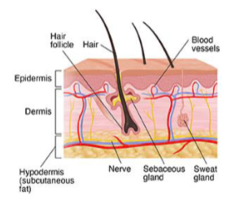
1. breed
2. age
3. sex (for different species)
Structure and thickness of skin vary based on what 3 main things?
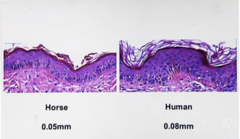
Mechanical stress
Body location
Species adaptions
Why does thickness vary?
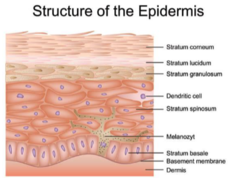
Skin layer- corneum
Which layer of the epidermis serves as the barrier to water loss and pathogens?
Skin layer:stratum lucidum
Which layer of the epidermis is the thin hyaline layer? Provides extra protection in specialized regions
Skin layer:stratum granulosum
Which layer of the epidermis is the transitional zone between viable cells below and keratinized cells above? Keratinization transition
Skin layer: spinosum
Which layer of the epidermis is known as the prickle-cell layer, where the cell junctions look like spines? Mechanical strength
skin layer: basale
Which layer of the epidermis has keratinocytes and is in contact with the basement membrane of the dermis below? Stem cell layer
reviewed
Review
Keratinocyte
Epidermal cell type: what is the cell type responsible for barrier formation
melanocytes
Which cell type of the epidermis is associated with the following?
-Melanin pigment in the cytoplasm
-Dendritic processes
UV protection: Prevents sunburn and DNA damage
mast cells
Which cell type of the epidermis is associated with the following?
-Anticoagulation
-Stimulate local inflammatory reactions to dispose of antigens
langerhans cells
Which cell type of the epidermis is associated with the following?
-Take up antigens and present to T cells
-Why several bovine species have immune modulated resistance to ticks
-Particularly important in ruminants
-Produce lymphokines (IL-1)
merkel cells
Which cell type of the epidermis is associated with the following?
-Found in epidermis with hairy surface, nail matrix, palms, subepidermal mesenchyme
-Sensory receptors
Touch sensation
basal
The basal lamina of the basement membrane is secreted by _____ cells of the epidermis
Basement membrane
What is the layer of skin that is the barrier against pathogens that also regulates the passage of nutrients and waste? Is the interface between the dermis and the epidermis
dermis
The _____ is fibrous connective tissue of skin
Support and protect epidermis→ strength and flexibility
Regulate body temp by utilizing blood vessels and sweat glands
Facilitate sensation by using nerve endings
what are the dermis characteristics
nourishment
Epidermis grows on the dermis and obtains _____ from it
Apart of the dermis
Maintain skin health and structure. Can control electrolytes and water leading to skin hydration
Mucopolysaccharides are associated with the [dermis/epidermis] and do what
hypodermis
-Loose fibrous connective tissue plus adipose tissue
-Connects skin to muscles and bone
-Insulation and fat storage
-protection, fat gives cushion
Thermoregulation
Protection- physical barrier from sun
sensory perception- tactile hair
communication
The body hair of animals serves what purposes?
true
The body hair of animals is fibrous and bulky. True or false?
tactile hair
-Thick hair above lips, close to nose
are very sensitive
-Hair follicle → outer and inner dermal sheaths connected by trabeculae
thin; thick
The stratum corneum is [thick/thin] in animals with thick, dense fur or hair, but [thin/thick] in humans
stratum corneum
The permeability of substance determined by _____
transepidermal
Barrier between stratum corneum and uppermost living layers associated with substance penetration to skin
transappendageal
Pilosebaceous apparatus (sebaceous gland, sebaceous gland duct, follicular epithelium) is associated with _______ substance penetration to skin
Transepidermal route: Intercellular
Is how a substance passes through lipid matrix around cells and this route is favored by drugs
Transepidermal route: Transcellular
What is the skin permeability route by which a substance can pass through the cell?
1. transepidermal (has 2 sub routes)
2. transappendageal
How do substances penetrate skin (2 methods)?
lipid
_____-soluble substances penetrate cell walls easil
cell membrane proteins
Water-soluble substances enter the skin via _____
-increasing temperature and increasing blood flow
-mechanical trauma
-Age → younger skin more permeable
-persistent hydration
How can we promote absorption of substances into the skin?
Size- small molecules penetrate easily
Lipid soluability→ Lipid soluable substances penetrate easily
Charge→ non-ionized substances penetrate easily
Contact time→ longer contact time may increase penetration
What are drug factors in regards to skin permeability
Aging
In regards to effects of sunlight on the skin what does UVA cause?
Sunburn + vitamin D
In regards to effects of sunlight what does UVB cause→
Filtered by atmosphere
In regards to effects of sunlight what happens to UVC
Opens into the hair follicle and secretes protein/ lipid rich
Structure and function of the sweat glands: Appocrine what does it open into and what does it secreate
function is phermones + or - cooling
distribution is in most domestic animals
structure and function of the sweat glands: Appocrine what does is its function and distribution
Opens into the skin surface
Secreation is watery
Function is cooling
Distribution is limited in many domestic species
structure and function of the sweat glands:In Eccrine what does it open into? what does it secreate? what is the Function? What is the distribution
Water, Na, K, Cl, urea, ammonia, lactic acid
Bacterial action on sweat creates odor
What does sweat contain?
Warmed blood from the periphery arrives at the brain and then stimulates the hypothalamic thermoregulatory center
Then the afferent nerve impulses from the periphery stimulate the thermoreregulatory center in the brain via a reflex mechanism
how does themoregulatory sweating work
Hair follicles
What are sebaceous glands associated with
Sebum and fatty lubricant
What does the sebaceous gland secreat
It is a modified sebaceous gland that has no defined duct. The substance that is produced is used as a territorial marker
What is the perianal/ circumanal glands of dogs
Wool and hair follicles
In sheep what is the sebaceous gland associated with
highly developed glands in the perianal region, horn, hoof, and muzzle margins
In cattle sebaceous glands are associated with
Stimulate testotrone and androgens
secreation is continuous
Phermone odors
waterproofing
luster to hair coat
antimicrobial activity
What are the functions of sebum
true
Sweat helps remove body heat. True or false?