Axillary Region & Brachial Plexus
 Call Kai
 Learn
Learn Practice Test
 Spaced Repetition
 Match
Match Flashcards
 Knowt Play
1/60

Earn XP
Description and Tags
Functional Anatomy 2
Name | Mastery | Learn | Test | Matching | Spaced | Call with Kai | Chat |
|---|
No analytics yet
Send a link to your students to track their progress
61 Terms
axilla
a region of transition
pyramid shaped area between the pectoral region and the brachium
provides a channel by which the axillary a/v and brachial plexus pass through to get to the upper extremity
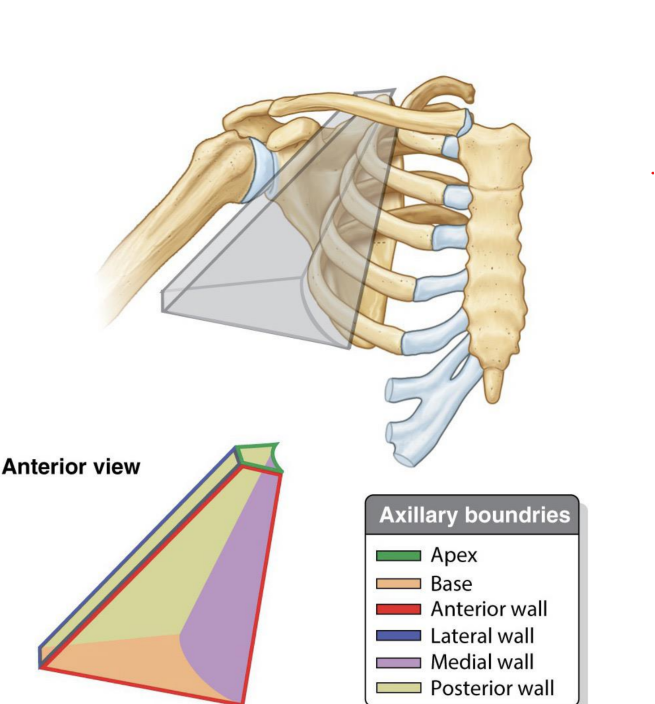
apex
between the clavicle, 1st rib and scapula
base
axillary skin fold, armpit
anterior wall
pectoralis major and pectoralis minor muscles
lateral wall
humerus
medial wall
serratus anterior muscle
posterior wall
subscapularis, teres major, latissimus dorsi muscles
contents of axilla
axillary artery
axillary vein
brachial plexus
lymphatics
lots of variability in this region
suprascapular notch/foramen borders
inferior: suprascapular notch
superior: superior transverse scapular ligament (suprascapular ligament)
converts the notch into a foramen
suprascapular notch/foramen contents
suprascapular n.
through the foramen, inferior to the ligament
to supraspinatus and infraspinatus muscles
suprascapular a.
superior to the ligament
quadrangular space borders
superior: inferior margin teres minor/subscapularis
inferior: superior margin teres major
lateral: surgical neck of humerus
medial: lateral margin long-head triceps brachii
quadrangular space contents
axillary nerve (to deltoid and teres minor muscles)
posterior humeral circumflex a.
triangular space borders
superior: inferior margin teres minor/subscapularis
inferior: superior margin teres major
lateral: medial margin long-head triceps brachii
triangular space contents
circumflex scapular a.
triangular interval borders
superior: inferior margin teres major
medial: lateral margin of long-head triceps brachii
lateral: shaft of humerus
triangular interval contents
radial n. (to posterior brachium and posterior antebrachium)
deep brachial a. (profunda brachii a.)
quadrangular space
teres minor, teres major, humerus, triceps brachii
axillary nerve, posterior humeral circumflex artery
triangular space
teres minor, teres major, triceps brachii
circumflex scapular artery
triangular interval
teres major, triceps brachii, humerus
radial nerve, deep brachial artery
blood supply upper extremity
heart (left ventricle)
aorta (aortic arch)
brachiocephalic trunk/artery
subclavian artery
axillary artery
brachial artery
subclavian artery
begins:
R: division of brachiocephalic trunk into R subclavian a. and R common carotid a.
L: third branch of aortic arch
three parts:
origin to medial edge anterior scalene
vertebral a.
internal thoracic a.
thyrocervical trunk → suprascapular a.
posterior to anterior scalene
no branches
lateral edge anterior scalene to lateral edge 1st rib
dorsal scapular a.
ends:
lateral edge of 1st rib (both)
axillary artery
divided into 3 parts by pectoralis minor muscle
part 1: lateral border of 1st rib to superior/medial border of pectoralis minor muscle
part 2: deep to pectoralis minor muscle
part 3: between inferior/lateral border of pectoralis minor muscle and inferior border of teres major muscle
axillary artery 1st part
1 branch, superior thoracic artery
axillary artery 2nd part
2 branches
thoracoacromial trunk (with branches)
acromial, clavicular, pectoral, deltoid
lateral thoracic artery
axillary artery 3rd part
3 branches
subscapular artery (with branches)
circumflex scapular a.
thoracodorsal a.
anterior circumflex humeral a.
posterior circumflex humeral a.
anterior humeral circumflex artery
smaller than posterior humeral circumflex artery
passes anterior to the surgical neck of the humerus
anastomoses with the posterior humeral circumflex artery
posterior humeral circumflex artery
larger than anterior humeral circumflex artery
travels through quadrangular space with the axillary nerve
anastomoses with anterior humeral circumflex artery
scapular anastamoses
from subclavian artery
suprascapular artery → superior to transverse scapular ligament
dorsal scapular artery → medial border of scapula
from axillary artery (subscapular branch)
circumflex scapular artery → lateral border of scapula
veins
generally matched with arteries
axillary, subclavian
superficial upper extremity veins
basilic, cephalic, median cubital, dorsal venous network (arch)
basilic vein
travels medial to biceps brachii, joins with brachial to form axillary
cephalic vein
travels lateral to biceps brachii, between anterior deltoid and pectoralis major, drains into axillary
median cubital vein
oblique segment of vein that connects basilic and cephalic veins at anterior elbow
dorsal venous network (arch)
joining of cephalic and basilic veins on dorsal hand
brachial plexus
all muscles of the upper extremity are supplied by nerves from the
variability
_______ in specific organization and branching of the nerves
C5-T1
ventral rami of spinal segments
roots pass between the middle and anterior scalene
brachial plexus trunks
roots/rami come together, superior to clavicle
upper trunk: C5 and C6
middle trunk: C7
lower trunk: C8-T1
brachial plexus divisions
separation of each trunk into anterior and posterior “divisions”
divisions are posterior to the clavicle
no named nerves/branches come off the divisions directly
brachial plexus cords
anterior divisions from the upper and middle trunks come together to form the lateral cord
anterior division from the lower trunk forms the medial cord
all three posterior divisions come together to form the posterior cord
named by their location in relation to the axillary artery
brachial plexus (terminal) branches
5 terminal branches (nerves) from the cords
lateral cord
musculocutaneous n.
lateral root of median n.
posterior cord
axillary n.
radial n.
medial cord
ulnar n.
medial root of median n.
other nerves branch from other parts of the plexus
musculocutaneous nerve
C5, C6, C7
from lateral cord
pierces coracobrachialis muscle
travels deep to biceps brachii, superficial to brachialis muscle
emerges superficially at distal lateral biceps as lateral antebrachial cutaneous n.
median nerve
C6-T1
travels medial/deep to biceps brachii, medial to distal tendon of biceps brachii
medial and lateral cord
innervates anterior compartment of the forearm except 2 muscles
flexor carpi ulnaris and medial half of flexor digitorum profundus
innervates 5 intrinsic muscles of the hand
ulnar nerve
C8-T1
medial cord
travels medial to biceps brachii, posterior to medial epicondyle of humerus
innervates the other two muscles of the anterior forearm
flexor carpi ulnaris and medial half of flexor digitorum profundus
innervates hypothenar muscles of the hand, adductor pollicis, lumbricals 3 and 4, dorsal/palmar interossei
axillary nerve
C5-C6
posterior cord
travels to posterior arm through the quadrangular space, wraps around surgical neck of humerus with the posterior humeral circumflex artery
innervates deltoid and teres minor muscles, cutaneous to upper lateral brachium
radial nerve
C5-T1
posterior cord (largest branch!)
travels to posterior arm through the triangular interval with the deep brachial artery, continues along posterior humerus in the radial groove (deep to triceps brachii)
innervates (including its more distal branches) all muscles of the posterior brachium and posterior antebrachium (extensors)
supraclavicular branches of brachial plexus
dorsal scapular nerve, suprascapular nerve, nerve to subclavius, long thoracic nerve
dorsal scapular nerve
off C5 nerve root
travels posterior to levator scapulae and rhomboids
suprascapular nerve
off superior trunk (C5-C6)
travels posteriorly through the suprascapular foramen to supraspinatus and infraspinatus
travels with suprascapular artery
nerve to subclavius
off superior trunk (C5-C6)
long thoracic nerve
C5-C7 roots
descends inferior along the lateral thorax to serratus anterior muscle
infraclavicular branches of brachial plexus
lateral cord, medial cord, posterior cord
lateral pectoral nerve
C5-C7
travels superior to pectoralis minor with the pectoral branch of the thoracoacromial artery, then to pectoralis major
medial brachial cutaneous nerve
C8-T1
innervate the medial skin of the arm
medial antebrachial cutaneous nerve
C8-T1
innervate the medial skin of the arm
medial pectoral n.
C8-T1
travels through pectoralis minor to innervate pectoralis minor and pectoralis major
upper subscapular nerve
C5
innervates subscapularis muscle
lower subscapular nerve
C6
innervates subscapularis and teres major
thoracodorsal nerve
C6-C8
travels interiorly to innervate latissimus dorsi muscle
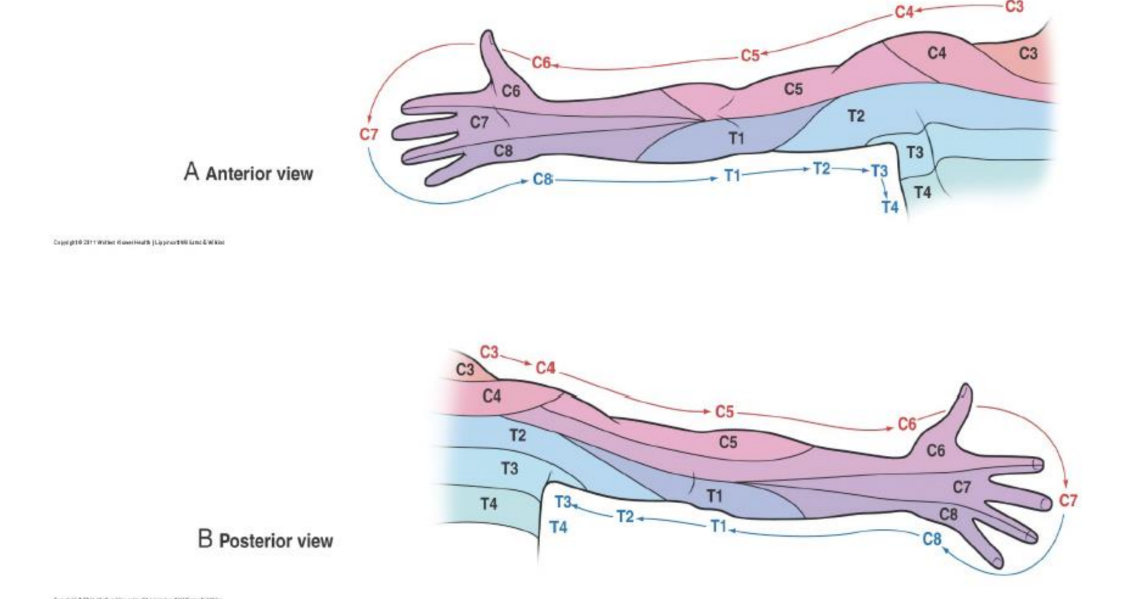
upper extremity cutaneous innervation map

upper extremity dermatome innervation map