Motivation and Leading
 View linked note
 Call Kai
 Learn
Learn Practice Test
 Spaced Repetition
 Match
Match Flashcards
 Knowt Play
1/28

There's no tags or description
Looks like no tags are added yet.
Name | Mastery | Learn | Test | Matching | Spaced | Call with Kai | Chat |
|---|
No analytics yet
Send a link to your students to track their progress
29 Terms
Motivation
Set of forces that initiates, directs and makes people persist in their efforts to accomplish a goal.
Self Determination Theory
Motivation lies on a continuum of self determination from intrinsic to extrinsic motivation.
Intrinsic Motivation
Better outcomes for people when driven by internal factors rather than external rewards.
Maslow's Hierarchy of Needs
A satisfied need is not a motivator; people are motivated by deprived needs.
Progression Principle - maslow
The five needs exist in a hierarchy; a need only activates once the next-lower-level need is satisfied.
Goal Setting Theory
People will be motivated when they accept specific, challenging goals and receive feedback on progress.
Equity Theory
People are motivated to seek social equity in rewards for their performance; inequities lead to demotivation.
Distributive Justice
Perceived fairness of the outcome and rewards distribution.
Procedural Justice
Perceived fairness of the processes used to make reward allocation decisions.
Power Definition
Power refers to the potential ability to influence the behaviours of others.
Hard Power
Involves coercive methods and authority.
Soft Power
Relies on influence and persuasion.
Legitimate Power
Authority derived from position.
Coercive Power
Ability to enforce compliance through threats.
Reward Power
Providing incentives to motivate.
Referent Power
Influence based on respect and admiration.
Expert Power
Power based on skills and knowledge.
Resistance, Compliance, Commitment
Responses from employees to sources of power.
Great Person Theory
Suggests that leaders are born, not made.
Trait Theory
Focuses on certain intrinsic traits that leaders have, knowledge alone does not guarantee effective leadership.
Strengths-Based Leadership
Natural talents reinforced with knowledge and skills define effective leadership.
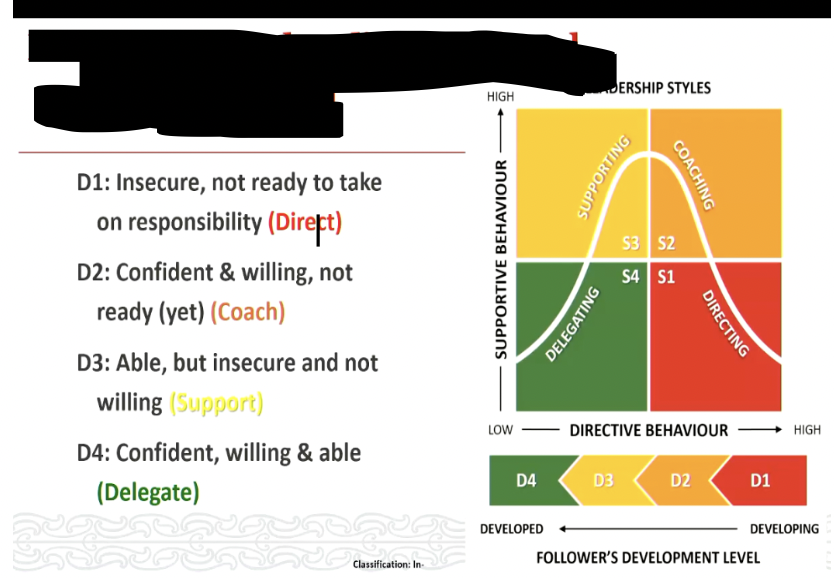
Situational Theory
Leaders must adjust their styles based on the readiness of their followers.
Servant Leadership
Leaders prioritize serving others and the community over self-interest.
Authentic Leadership
Leaders understand themselves and act consistently with their ethical values.
Path-Goal Theory
Leaders can increase subordinate satisfaction by clarifying paths to goals and increasing rewards.
Initiating Structure
The degree to which a leader structures the roles of followers by setting goals and tasks.
Consideration
Extent to which a leader is friendly, approachable, and supportive.
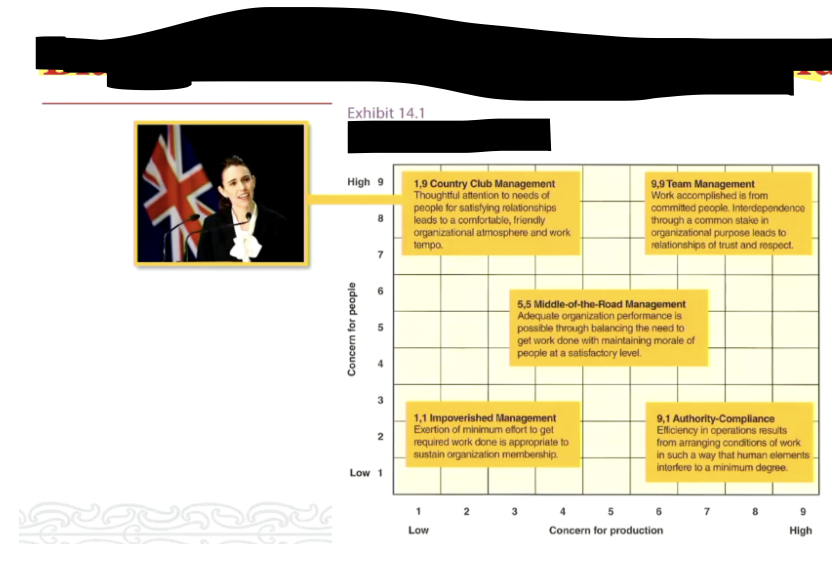
Blake and Mouton leadership grid
5 styles of leadeship (concern for production vs concern for people)
Hershey and blancard situational leadership model
4 stages (directing, coaching, supporting, delegating