Motivation and Leading
What is motivation
Set of forces that initiates, directs and make people persist in their efforts to accomplish a goal
Ability x motivation x situation = performance
Need to direct motivation in right area in order to obtain optimal performance
Self determination theory
Motivation lies on a continuum of self determination from intrinsic to extrinsic motivation
Better outcomes for people when driven by intrinsic motivation
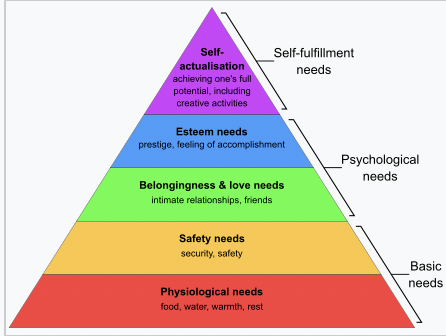
Maslow's hierarchy of needs
A satisfied need in not a motivator of behavior
People act to satisfy 'deprived' needs, those for which a satisfaction 'deficit'
exists.
Progression principle
The five needs exist in a hierarchy of 'prepotency'
A need at any level only becomes activated once the next-lower-level need has
been satisfied.
Safety of job, creates laziness and a decrease in performance
Employees needs change overtime
People will be motivated if you help them achieve their needs
Goal setting theory
Goal-setting theory, the theory that people will be motivated to the extent to which they accept specific, challenging goals and receive feedback that indicates their
progress toward goal achievement
Motivation can be increased & performance enhanced by setting specific and challenging goals
and giving timely feedback
Making progress towards goals is key to motivation
Employees regular feedback
Employees participate in goal setting and determining how to achieve them
Specific goals to keep people focused
Equity theory
Based on the principle of social comparison
People motivated to seek social equity in the rewards they expect for performance
People become demotivated and reduce input when their inputs are not being fairly rewarded.
Managers need to correct inequities
People will be motivated when they believe they are being treated fairly
Distributive justice the perceived degree to which outcome and rewards are fairly distributed or allocated
Procedural justice the perceived fairness of the process used to make reward allocation decisions
The Process of Leading
Definition: Leadership is described as the process of influencing others to achieve group or organizational goals.
Key Functions of Management: Leadership is one of the four main functions of management alongside Planning, Organizing, and Controlling.
Power theory
Power Definition: Power refers to the potential ability to influence the behaviours of others. Influence is the resultant change in attitudes, values, beliefs, or behaviours.
Types of Power:
Hard Power: Involves coercive methods and authority.
Soft Power: Relies on influence and persuasion.
Sources of Power and Employee Reactions
Sources of Power:
Hard power
Legitimate Power: Authority derived from position.
Coercive Power: Ability to enforce compliance through threats. - negative environment
Reward Power: Providing incentives to motivate.
Soft power
Referent Power: Influence based on respect and admiration.
Expert Power: Power based on skills and knowledge.
Employee Reactions: Responses can include Resistance, Compliance, or Commitment.
Traits and Characteristics of Effective Leaders
Leadership Traits: Include personal characteristics such as intelligence, honesty, and self-confidence.
Great Person Theory: Suggests that leaders are born, not made.
Trait Theory: Focuses on certain intrinsic traits that leaders have but acknowledges that traits alone do not guarantee effective leadership.
Strengths-Based Leadership
Natural Strengths: Natural talents reinforced with knowledge and skills define effective leadership.
Effective Leadership Focus: It is crucial to recognize, develop, and apply strengths rather than merely identifying traits.
Important Traits: Drive, integrity, and cognitive ability are key, but do not by themselves ensure leadership effectiveness.
Leadership Behaviour Insights
Leadership Behaviours: The discussion shifts from 'who leaders are' to 'what leaders do'.
Leadership Style Dimensions: Concern for Production vs. Concern for People determines leadership style effectiveness.
Contingency Theories of Leadership
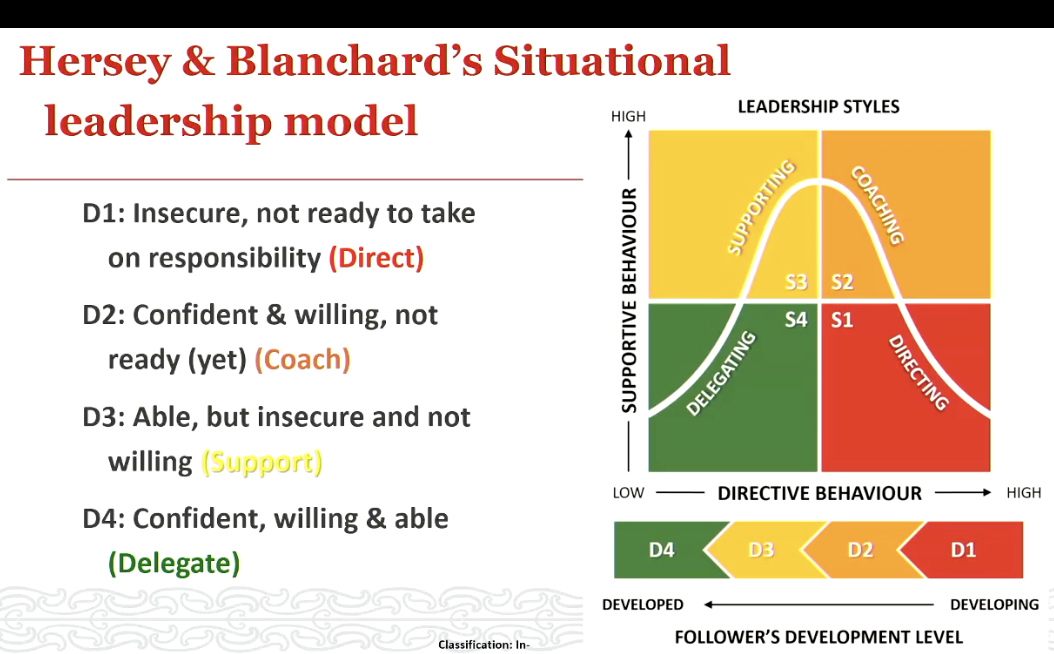
Leadership Adjustment: Leaders must adjust their styles based on how ready their followers are to perform tasks.
Performance Readiness: Consider both ability and psychological readiness (motivation, confidence).
Situational theory: Developed by Hersey & Blanchard, it categorizes readiness levels into four dimensions (D1 to D4) based on follower confidence and capability.
Leaders need to adjust their styles to match employee readiness
Servant Leadership
Servant Leadership Definition: Leaders who prioritize serving others and the community, transcending self-interest.
Key Benefits: A focus on employee recognition and empowerment fosters a positive organizational culture.
Authentic Leadership
Authentic Leadership
People who understand themselves, act consistently with their ethical values
This helps to create trust with employees as leader knows what they stand for
Empower and inspire others with authenticity
path-goal theory states that leaders can increase subordinate satisfaction and performance by clarifying and clearing the paths to goals and by increasing the number and kinds of rewards available for goal attainment.
Initiating structure is the degree to which a leader structures the roles of followers by setting goals, giving directions, setting deadlines, and assigning tasks.
Consideration is the extent to which a leader is friendly, approachable, and supportive and shows concern for employees
Hershey and blanchards situational leadership model
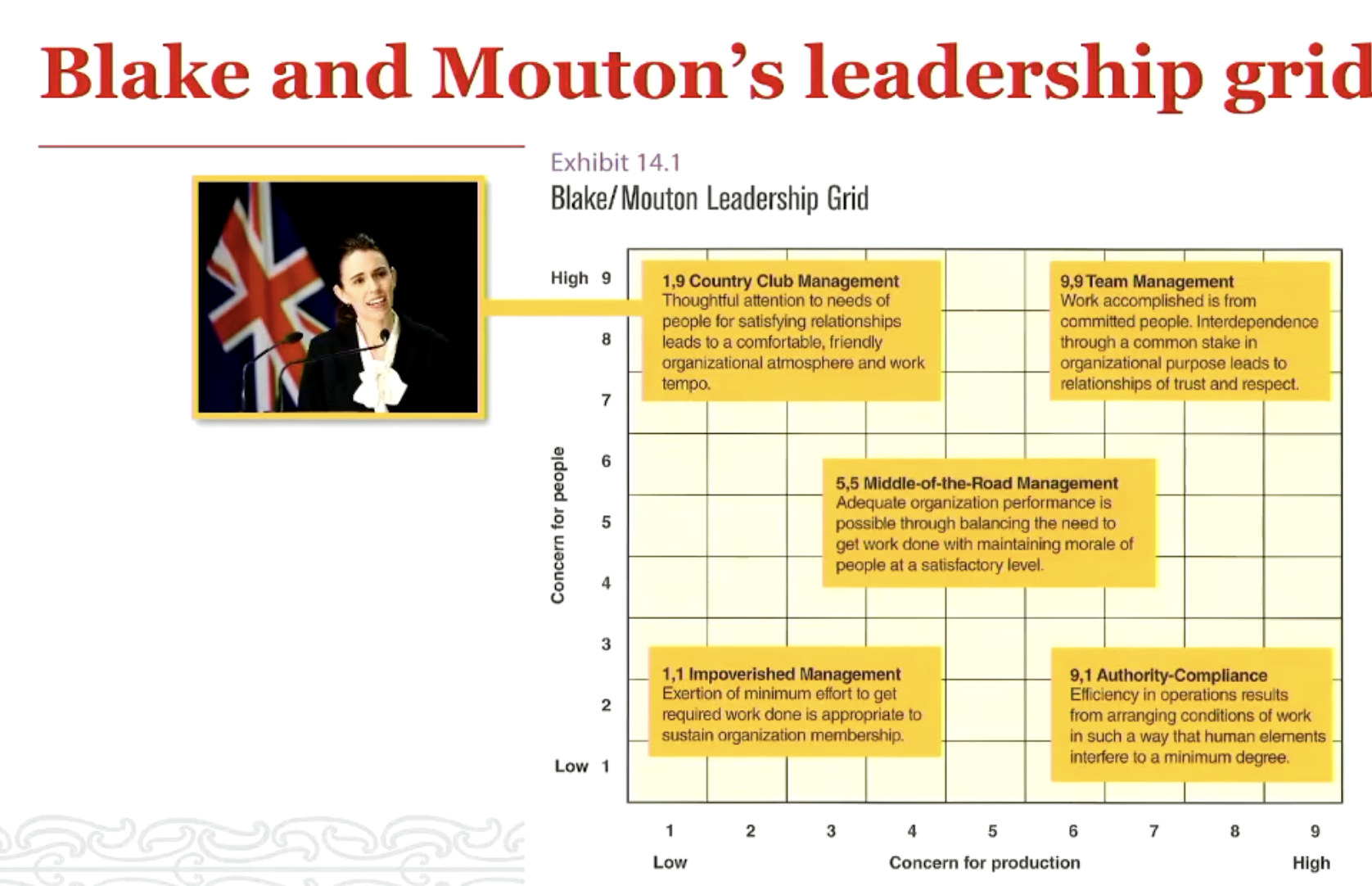
Blake moutons leadership grid