Corporate Finance
 Call Kai
 Learn
Learn Practice Test
 Spaced Repetition
 Match
Match Flashcards
 Knowt Play
1/105

There's no tags or description
Looks like no tags are added yet.
Name | Mastery | Learn | Test | Matching | Spaced | Call with Kai | Chat |
|---|
No analytics yet
Send a link to your students to track their progress
106 Terms
What is a firm according to corporate finance?
collection of investment projects → use of the company’s capital with the expectation of generating future returns
business unit
product line
new factory
research & development initiative
How should capital be allocated?
flow to uses where it generates the highest return relative to the level of risk involved
Why does capital allocation reflect an imperfect reality?
irrational decision-making → emotions, incomplete analysis, cognitive bias
uncertainty about the future
market frictions
information asymmetries → overstating potential returns
limited investor capabilities → lack of expertise, time, or resources
transaction costs → cost of gathering information, due diligence & executing investments
agency problems → intermediaries may not act in the investor’s best interest
What is financial analysis?
systematic process of examining a company's financial statements to evaluate its financial health, performance, and potential for creating shareholder value
profitability of the company
risk of investment
efficiency of using resources
meeting financial obligations
worth of investing
What is a financial statement?
comprehensive reports about a company’s past financial performance
serve as source for shareholders, creditors, employees, customers, suppliers, regulatory authorities
What are the four main types of financial statements?
balance sheet
income statement
statement of cash flows
statement of changes in shareholders’ equity
What are the steps of an investment cycle?
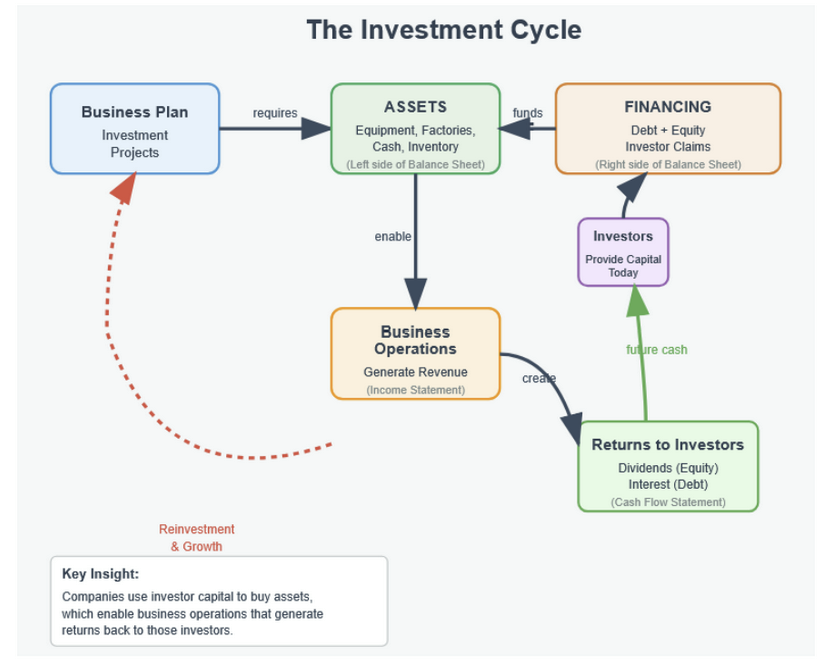
What is the balance sheet (statement of financial position)?
snapshot of the firm’s financial position (assets, liabilities, and shareholders’ equity) at a given point in time
assets = liabilities + shareholders’ equity
shareholders’ equity = difference between the value of the firm’s assets & liabilities
What are non-current assets?
assets for long-term use (operational)
net property, plant & equipment (PPE)
goodwill & intangible assets
other non-current assets
What are current assets?
cash or expected to be turned into cash within the next year
cash
marketable securities (short-term investments, e.x. in other companies’ stocks)
accounts receivable (money customers owe)
inventories
other current assets (e.x. pre-paid expenses)
What are current liabilities?
due to be paid within one year
accounts payable
short-term debt/notes payable
current maturities of non-current debt
other current liabilities
What are non-current liabilities?
to be paid beyond one year
long-term debt
capital leases
deferred taxes
How is net working capital calculated?
net working capital = current assets - current liabilities
How is the book value of equity calculated?
book value of equity = book value of assets - book value of liabilities
could be negative
many of the firms valuable assets may not be captured on the balance sheet (e.x. brand reputation, innovative culture, customer relationships)
How is the market value of equity calculated?
market value of equity = market price per share * no. of shares outstanding
cannot be negative
often differs from book value
How is the market-to-book ratio (price-to-book ratio) calculated?
market-to-book ratio = market value of equity / book value of equity
success → ratio >1
mature companies with stable earnings → low M/B ratio
growth stocks → high M/B ratio
shows how the market perceives a company’s future prospects
What is enterprise value?
total value of a company’s assets, regardless of how it is financed
value of a firm’s underlying business operations/assets
debt: sum of interest-bearing liabilities
net debt = total debt - cash & short-term investments
enterprise value = market value of equity + debt - cash = market value of equity + net debt
What is net income?
total earnings of the firm’s equity holders
profit belonging to the shareholders after everyone else has been paid
How is earnings per share calculated?
earnings per share = net income / shares outstanding
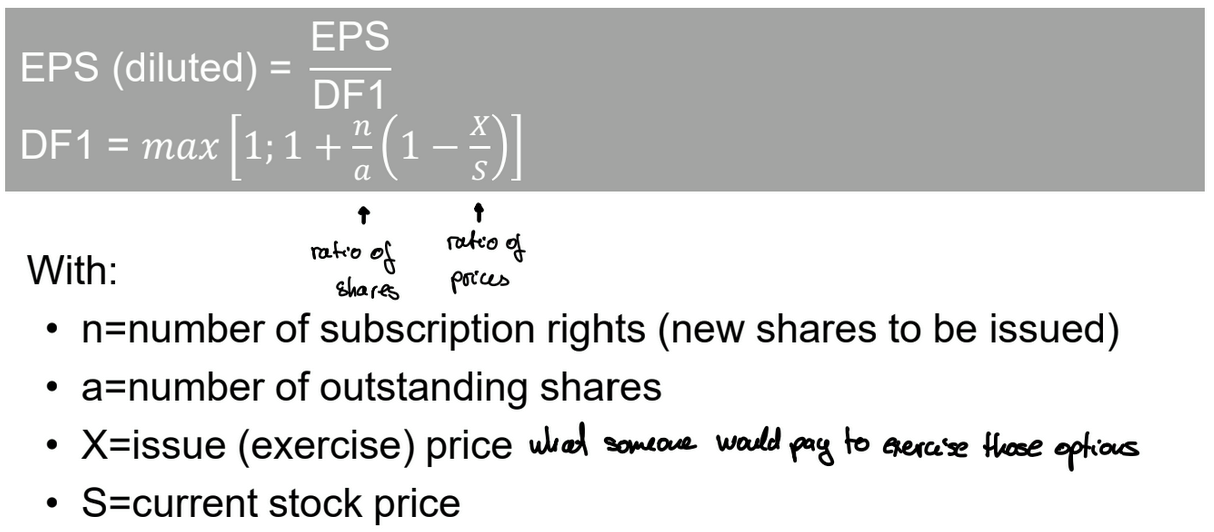
What is the diluted earnings per share?
future EPS could be diluted by in-the-money share (stock) options, convertible bonds, or warrants → diluted EPS takes these into account
how much profit each share would earn if all possible shares that could exist in the future were actually issue
assumes warrants & convertible bonds have been used → lowers EPS
What does the statement of cash flows show?
record of the sources and uses of the firm’s cash over a given period of time
derived from income statement & changes in the balance sheet
3 sections
cash flow from operating activities
cash flow from investing activities (e.x. buying machines)
cash flow from financing activities
What is free cash flow?
cash generated by a firm from its operational & investment activities → used to meet its obligations to its capital providers
What are profitability ratios?
Measures of a firm’s ability to generate profits as a percentage of the sales generated (margin ratios; margin = portion of sales that is a profit)
How is gross margin calculated?

How is operating margin calculated?

How is EBIT margin calculated?

How is net profit margin calculated?

What are liquidity ratios?
Measures of a firm’s ability to meet short-term debt obligations
Help to assess a firm’s liquidity / financial solvency from information of the balance sheet / statement of financial position
How is the current ratio calculated?

How is quick ratio calculated?

How is cash ratio calculated?

What do interest coverage ratios show?
Measures of a firm’s ability to meet its interest payments by comparing its earnings with its interest expenses
A higher ratio means a firm is earning much more than necessary to meet its obligations (High-quality borrowers > 5x EBIT / Interest coverage; Low-quality borrowers < 1.5 EBIT / Interest coverage)
How is EBIT/interest coverage calculated?

How is EBITDA/interest coverage calculated?

What do leverage ratios show?
Measures of a firm’s reliance on debt as a source of financing
Can be measured using book or market values
How is debt-equity ratio calculated?

How is debt-to-capital ratio calculated?

How is debt-to-EV ratio calculated?

How is equity multiplier calculated?

What do valuation ratios show?
Measures to help investors assess the market value of a firm
Make intra-industry comparisons of firm valuations
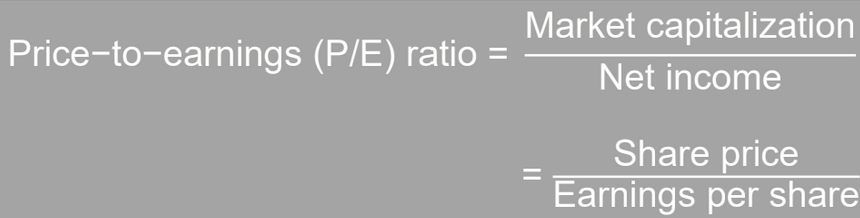
How is price-to-earning (P/E) ratio calculated?
How is EV to EBIT calculated?

How is EV to sales calculated?

What do operating/investment returns show?
Measures of a firm’s returns on investment
Compare its income to its investment using financial information from the balance sheet / statement of financial position
How is return on equity calculated?

How is return on assets calculated?

How is return on investment capital calculated?

How is asset turnover calculated?

What is expected return?
probability weighted average of all potential outcomes
sum of outcomes x probability
What is risk?
dispersion / variation of possible outcomes around the expected return
What is risk tolerance?
willingness to accept potential losses in exchange for higher potential gains
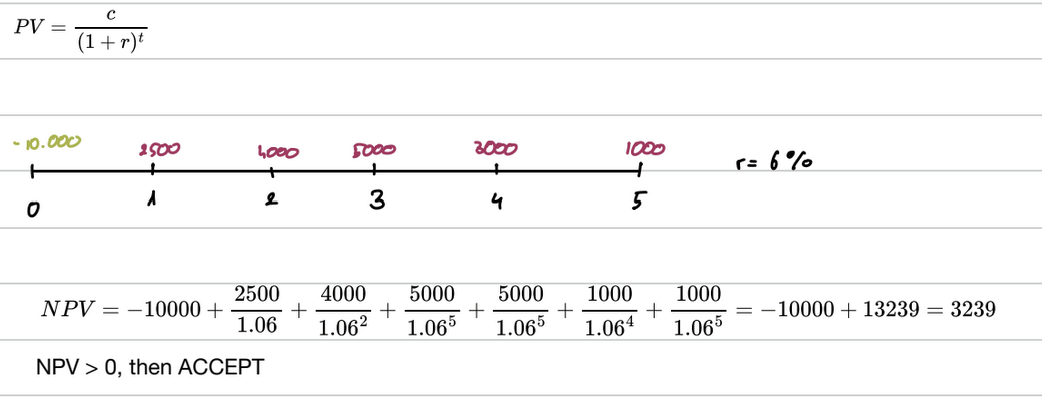
What is net present value?
over time net cash inflows & outflows accounting for the time value of money → discounting
current value of a future stream of cash flows minus the initial investment
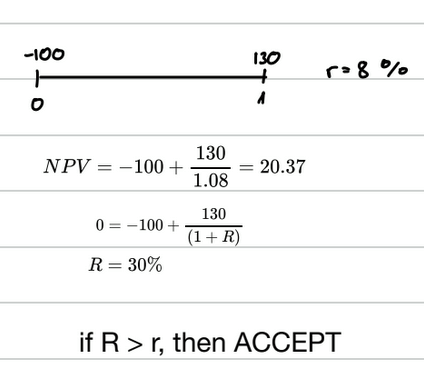
What is the internal rate of return?
discount rate that makes NPV = 0
What is the terminal value?
present value of all future cash flows → contribution of future cash flows approaches 0
the estimated value of a business or asset at a specific point in the future

When should an investment be delayed?
when expected rate of return > required rate of return (r>R)
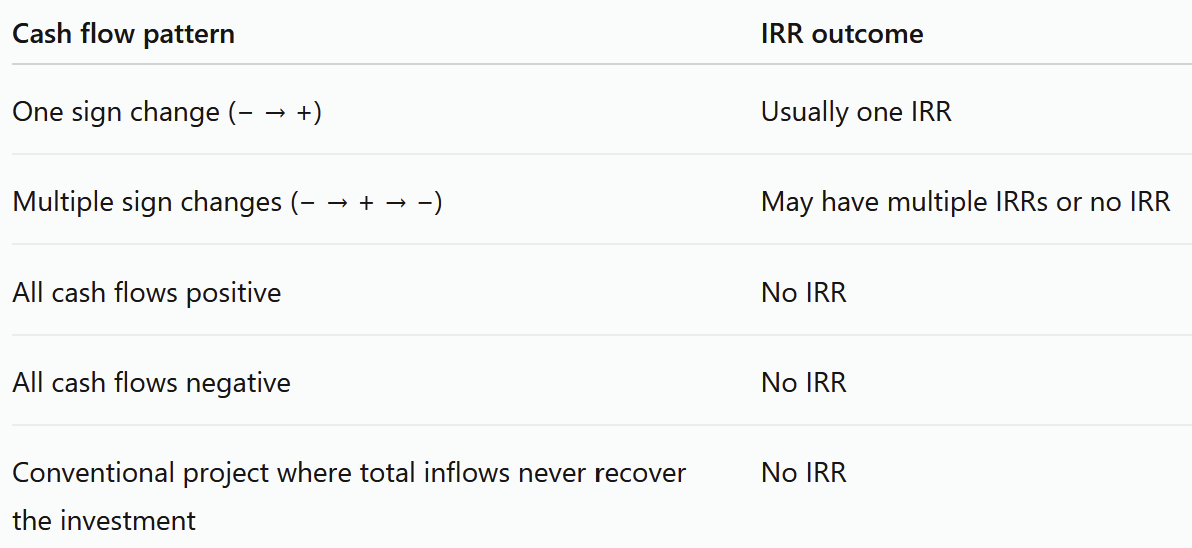
What happens when there are multiple IRRs?
happens due to non-conventional cash flows → when cash flow switches from positive to negative
NPV is positive at very low & very high discount rates, but negative in between
present due to multiple positive cash flows separated by negative cash flows
there can be as many IRRs as prefix changes
e.x. projects with repeated investments & withdrawals, building a factory that later requires large demolition costs
When is there no existent IRR?
benefits are so significant that there is no discount rate that makes the NPV negative
at low discount rates later positive cash flows offset the costs, at high discount rates the early cash flow offsets the later occurring costs
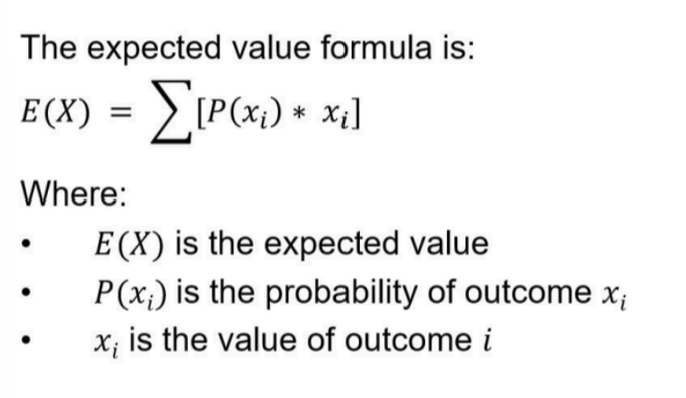
What is risk?
measurable uncertainty
probabilities & possible outcomes can be calculated
can calculate expected values
What is uncertainty?
unmeasurable → probabilities & outcomes cannot be known
most of future in reality is mostly uncertain
What is the difference between expected values and actual outcomes?
expected values: theoretical averages
in reality only one scenario will actually occur → may not be a match to the calculated expected value
What is the capital budget?
List of investments a company plans to undertake
What is capital budgeting?
Process used to analyze alternate investments & decide which ones to accept
What are incremental earnings?
Amount by which the firm's earnings are expected to change as a result of the investment decision
What is free cash flow?
actual cash a company generates after covering its operating expenses and capital expenditures (such as equipment or property maintenance)
represents the remaining money a business can use to pay dividends, reduce debt, or reinvest into growth
How is free cash flow calculated?
FCF = EBIT × (1-t) + depreciation - capital expenditures - increase in net working capital = EBIT × (1-t) - increase in net fixed assets - increase in net working capital = (revenue-cost-depreciation) × (1-t) + depreciation - capital expenditure - change in net working capital
capital expenditures: funds invested long-term
net working capital: additional cash tied up in operations; non-cash current assets - non-interest-bearing current liabilities
net fixed assets: gross financial assets - accumulated depreciation
unlevered net income: after-tax earnings without considering financing effects; revenue-cost-depreciation
depreciation: reduces corporate tax that has to be paid
How does free cash flow to the firm and flow to equity differ?
FCF: cash available to all providers of capital
FCFE: cash available only to common stakeholders after debt holders have been paid
debt holders paid first → affects risk of shareholders (residual claim)
lending money to firms is less risky than investing
What is business/asset risk?
risk that a company will not be successful with its products/services
asset side of the balance sheet is determined by what the business needs
determines the total economic value the firm generates before any distribution to claimholders
What is financial risk?
possibility that, if a company uses a lot of debt, there might not be anything left for shareholders after servicing the debt
arises from the capital structure decisions made by management
exists solely because of the presence of debt in the capital structure
What is the difference between retained earnings and dividends?
retained earnings: reinvested in the company
dividends: free to spend anywhere
What is net working capital?
current assets - current liabilities
measure of liquidity
What is the cost of capital?
minimum rate of return a company must earn on its existing assets to satisfy its creditors, owners and other providers of capital
interest expense already included
used as a discounting rate for FCF
What is break-even analysis?
Computes the level of a parameter that makes the project’s NPV equal to zero
What is sensitivity analysis?
Shows how the NPV varies with a change in one of the assumptions, holding the other assumptions constant
Helps rank the most impactful parameters of the investment project based on their effect on NPV
What is scenario analysis?
Considers the effect on the NPV of simultaneously changing multiple
assumptions → more realistic
Why is debt called leverage?
debt amplifies the variability of equity returns in both directions
What does the capital asset pricing model show?
What return should investors expect for taking on risk
How much compensation is fair
What is systematic (market risk)?
affects the entire market (e.x. economic recession, inflation, political instability)
can’t eliminate this risk through diversification
What is unsystematic (specific) risk?
specific to individual companies or industries (e.x. CEO scandal, product recall, new competition)
can be eliminated through diversification
What does beta show?
measure of systematic risk
to what extent does a security’s return move together with the overall market return
β = 1: The security moves exactly with the market.
β > 1: The security is more volatile than the market.
β < 1: The security is less volatile than the market.
What does the efficient frontier diagram show?
best possible risk-return combinations available to investors
efficient frontier: all possible combination of risky assets that offer the highest expected return for each level of risk
capital market line (CML): for risk-free investments, tangent to efficient frontier line, and touches it at one point → market portfolio
Why in the market portfolio universal regardless of risk preference?
every rational investor should hold the same mix of risky assets, and only vary the overall risk by adjusting how much risk-free asset they own
How is expected return calculated?
ri = rf + βi × (E[rMkt] - rf)
What are real-world applications of CAPM?
Corporate Finance: Calculating the cost of equity capital
Investment Analysis: Determining if stocks are fairly priced
Portfolio Management: Constructing efficient portfolios
How is total risk measured?
by volatility
What is a market portfolio? What is the market index?
market portfolio: value-weighted portfolio of all securities traded in the market → proxy for market index
market index: report the value of a particular portfolio of securities
How can the expected market return be calculated?

How can you estimate a stock’s beta?
select a comparable stock
estimate the beta for the comparable stock from historical returns
unlever the beta → what would the company’s beta be if it was financed entirely through equity
βAsset= βEquity x (1 / [1 + (1-t) × D/E])
lever the beta for the project’s financial risk (use own debt/equity ratio)
βEquity= βAsset x (1 + [(1-t) × D/E])
![<ul><li><p>select a comparable stock</p></li><li><p>estimate the beta for the comparable stock from historical returns</p></li><li><p>unlever the beta → what would the company’s beta be if it was financed entirely through equity</p><ul><li><p>β<sub>Asset</sub>= β<sub>Equity</sub> x (1 / [1 + (1-t) × D/E])</p></li></ul></li><li><p>lever the beta for the project’s financial risk (use own debt/equity ratio)</p><ul><li><p>β<sub>Equity</sub>= β<sub>Asset </sub>x (1 + [(1-t) × D/E])</p></li></ul></li></ul><p></p>](https://assets.knowt.com/user-attachments/fd36760c-3ac8-4929-81e6-de554241ab47.png)
How can the debt cost of capital be calculated?
yield-to-maturity
debt cost of capital = yield to maturity on a firm’s outstanding debt
debt-rating
debt cost of capital = yield based on similarly rated debt (bonds) with similar maturity
for when the firm’s bonds aren’t frequently traded
beta-CAPM
debt cost of capital = expected return for debt based on its beta using CAPM
difficult to estimate beta for debt as corporate bonds are traded infrequently → use indices by rating category
for calculations: market risk premium = expected rate of market return
cost of capital → choose an alternative if you can guarantee higher returns → NPV with a discounting rate of the cost of capital
What are bonds?
tradable debt securities
at issuance the issuer determines the terms
principal (face/par value)
coupon rate (periodic interest payments)
maturity date
other features (callability, convertibility, covenants)
the terms of the bond don’t change, only market price, reflecting changing risk perceptions
if yield increases, price must fall since payout is the same → capital loss if selling
What is yield-to-maturity?
IRR an investor will earn from holding the bond to maturity and receiving its promised payments
expected rate of return only if risk is very low or 0
accuracy depends on the risk of firm default
low risk: YTM is a reasonable estimate
high risk: YTM will overstate investors’ expected return
e.x. return is 8%, but average loss is 60%, and probability of default is 5.5% → expected annual loss: 0.055 × 0.60 = 0.033 → expected return: 8% - 3.3% = 4.7%

How is the weighted average cost of capital calculated?
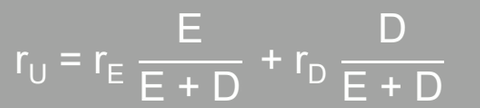
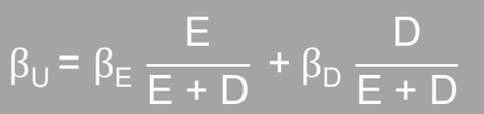
How is asset (unlevered) beta calculated?
How is the effective after-tax interest rate calculated?

How does taking tax into account influence WACC and the target leverage ratio?
WACC with taxes decreases as debt increases
benefit of cheap debt is amplified by the tax shield, while cost of equity is not → bet benefit to leverage → favor debt
include tax benefit to the discount rate to avoid double counting
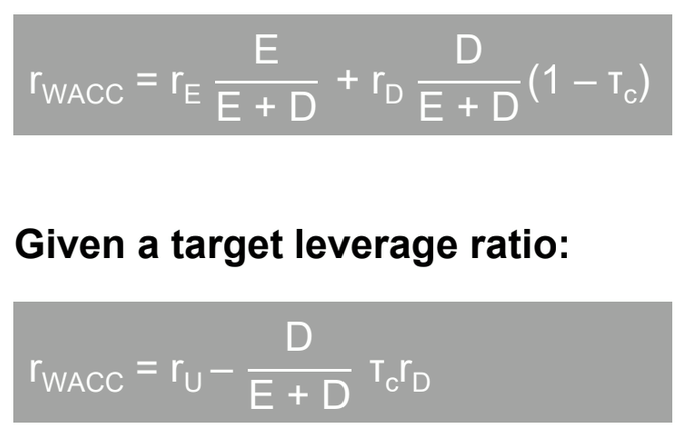
What is the use of the unlevered cost of capital and WACC?
unlevered cost of capital (pre-tax WACC)
expected return investors will earn by holding the firm’s assets
can be used to evaluate an all-equity project with the same risk as the firm
WACC
evaluate a project with the same risk and the same financing as the firm
What are the assumptions of the Modigliani-Miller model?
homogeneous expectations → all investors have identical beliefs about future cash flows & returns
homogeneous business risk classes (same class → same asset risk)
perpetual cash flows
perfect capital markets
price of securities at a competitive market = present value of their future cash flows → efficient markets → prices immediately reflect all available price-relevant information
no taxes, transaction costs, issuance costs, or agency costs associated with security trading → no friction
a firm’s financing decisions do not change the cash flows generated by its investments, nor do they reveal new information about them → investment & financing decisions are independent of each other → financing method doesn’t affect the revenue generated
What is the argument made by Modigliani and Miller (proposition I)?
In a perfect capital market, the total value of a firm is equal to the market value of the total cash flows generated by its assets and is not affected by its choice of capital structure.
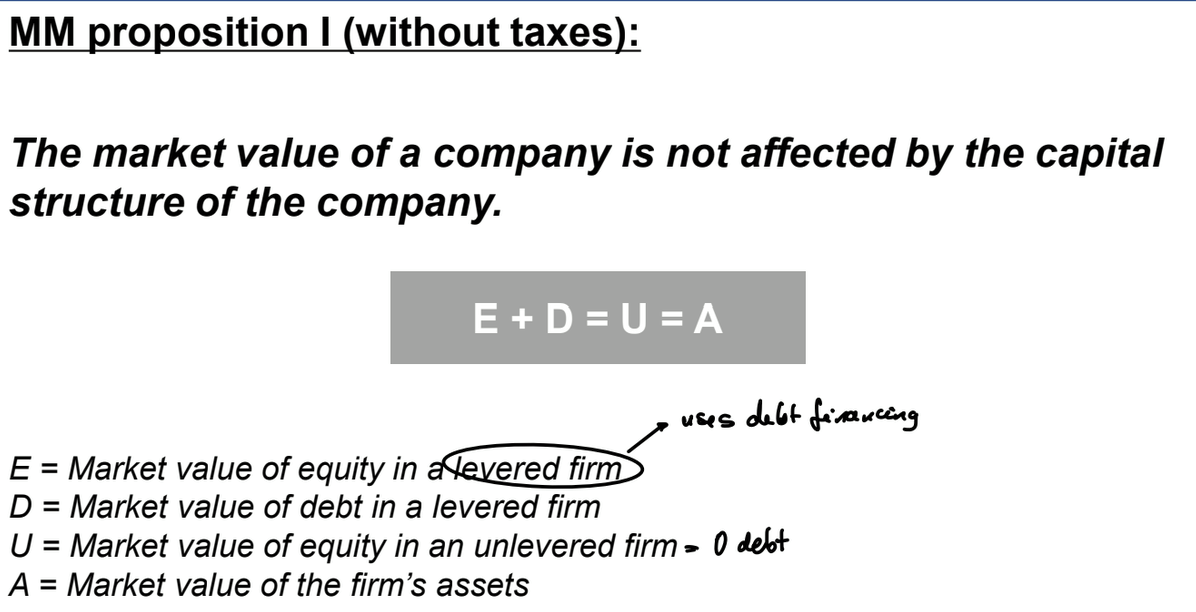
What is the law of one price?
a firm’s securities and assets need to have the same total market value → otherwise arbitrage opportunity would exist
if one would be worth then the other, investors could make riskless profits by buying the cheap & selling the expensive one
What is homemade leverage?
investors in the capital market can take out loans themselves → use leverage in their own portfolios to adjust the leverage choice made by the firm
perfect substitute for corporate leverage
to increase payoff, take personal debt & buy shares of an unlevered firm → get charged the same cost of capital as the firm would
the MM model does not consider interest paid on debt!
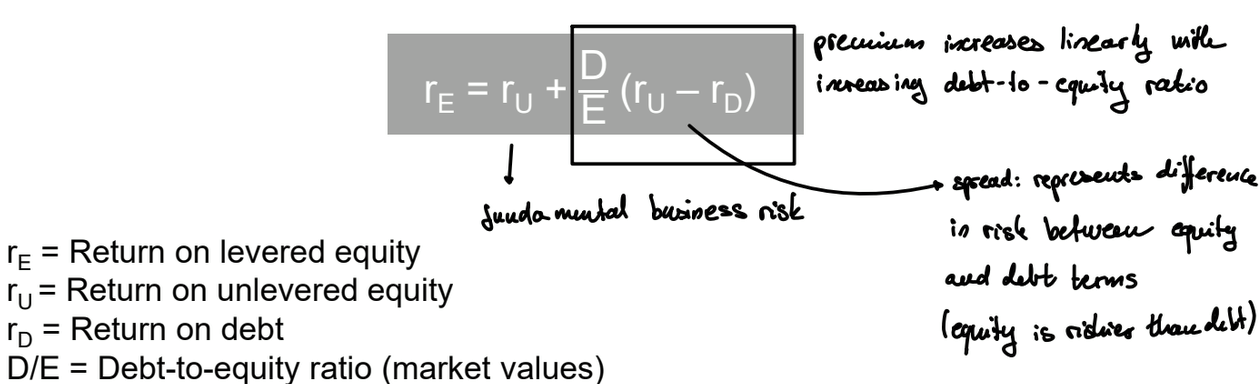
What is the MM proposition II about?
The cost of capital of levered equity is equal to the cost of capital of unlevered equity plus a premium that is proportional to the market value of the debt-to-equity ratio.
the more debt you add, the more amplified the risk premium, the higher the cost of equity → adding cheap debt is offset by the increasing cost of equity