Adaptive Immunity 3: B cells
 Studied by 0 people
 Call Kai
 Learn
Learn Practice Test
 Spaced Repetition
 Match
Match Flashcards
 Knowt Play
1/82

There's no tags or description
Looks like no tags are added yet.
Name | Mastery | Learn | Test | Matching | Spaced |
|---|
No study sessions yet.
83 Terms
Recall the structure of immunoglobin
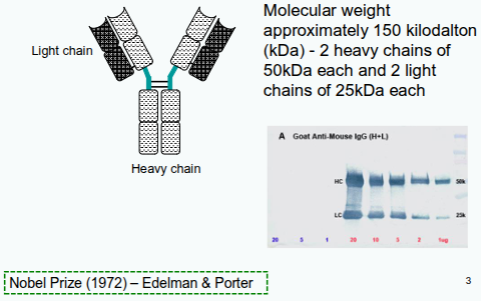
Which cells produce antibodies (immunoglobulins)?
Antibodies are produced by B cells.
What is the difference between the secreted and membrane-bound forms of immunoglobulins?
The secreted form acts as circulating antibodies (Ab), while the membrane-bound form functions as the B cell receptor (BCR).
Do individual B cells produce antibodies with multiple specificities?
No, each B cell produces immunoglobulins/antibodies with a single antigen specificity.
What is notable about antibodies in terms of immune recognition structures?
Antibodies were the first specific immune recognition structures to be characterised.
What enables B cells collectively to recognise a vast range of antigens?
B cells produce a diverse array of immunoglobulins/antibodies with many different antigen specificities.
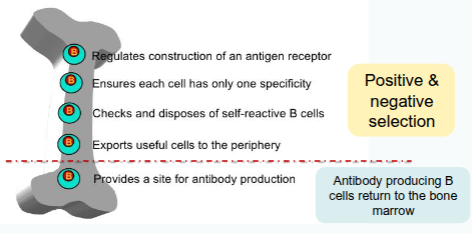
Where do B cells develop?
B cells develop in the bone marrow.
What role do bone marrow stromal cells play in B cell development?
They signal the development of lymphocyte progenitors from haematopoietic stem cells and support their differentiation into B cells.
Which immunoglobulins are expressed on the surface of immature B cells?
Immature B cells express surface Immunoglobulin M (IgM) and Immunoglobulin D (IgD).
What happens to immature B cells before they leave the bone marrow?
They are screened for autoreactivity through positive and negative selection, a process known as central tolerance.
Where do B cells mature to become antibody-producing cells?
B cells mature in the periphery to become antibody-producing cells
What mechanism removes self-reactive B cells that escape the bone marrow?
Peripheral tolerance removes self-reactive B cells that escape central tolerance and leave the bone marrow.
Describe B cell development
How is immunological diversity generated in antibodies and T cell receptors (TCRs)?
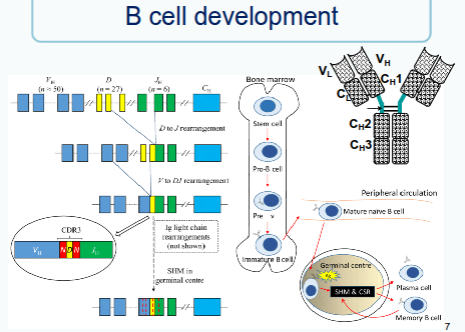
Diversity is generated by gene rearrangement of gene segments inherited from biological parents.
Does gene rearrangement for diversity occur in all proteins?
No, it only occurs for antibodies and T cell receptors (TCRs).
Which gene families contribute to TCR diversity?
The variable (V), diversity (D), and joining (J) gene families.
How are individual gene segments selected during TCR gene rearrangement?
They are randomly selected from the inherited V, D, and J gene families
What causes hypervariability in the TCR?
Hypervariability arises from differences in the amino acid sequences within the MHC/peptide binding region of the TCR
How likely is it for the same αβ TCR pairing to be generated in an individual?
It is highly unlikely that the exact same αβ TCR pairing will be generated more than once in an individual
How many amino acids are found in each immunoglobulin domain?
Each domain contains around 110 amino acids.
How many immunoglobulin domains are found in the heavy and light chains?
There are four domains in each heavy chain and two in each light chain.
What are the two types of light chains found in immunoglobulins?
The two types are lambda (λ) and kappa (κ) light chains
What is the typical ratio of kappa to lambda light chains in humans?
The κ:λ ratio is approximately 2:1 in humans.
How are the heavy and light chains connected in an antibody molecule?
The heavy chains are linked to each other by disulphide bonds, and each heavy chain is linked to a light chain by another disulphide bond.
Are the heavy and light chains in a single antibody identical or different?
In any given antibody, the two heavy chains and the two light chains are identical.
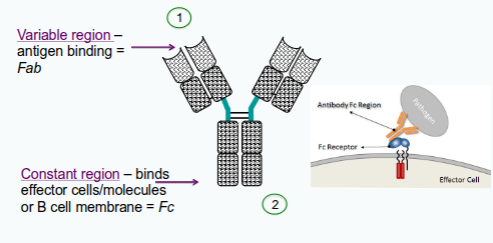
How many identical antigen-binding regions does an antibody have?
Each antibody has two identical antigen-binding regions
Which part of the heavy and light chains shows the greatest variation in amino acid sequence?
The N-terminal end of the heavy and light chains, known as the Variable (V) region or domain
What forms the Constant (C) region of an antibody?
The remaining domains of the heavy and light chains that do not vary form the Constant (C) region.
What determines the antigen specificity of an antibody?
The unique amino acid sequences in the V regions of the heavy and light chains determine antigen specificity.
Where is sequence variability concentrated within the V regions?
It is clustered in hypervariable regions known as HV1, HV2, and HV3.
Which hypervariable region shows the greatest variability?
HV3 is the most variable of the hypervariable regions.
What are the regions between the hypervariable regions called, and how variable are they?
They are called framework regions, and they show much less variability than the hypervariable regions
What do the abbreviations VL, VH, CL, CH1, CH2, and CH3 represent?
VL: Variable region of the light chain
VH: Variable region of the heavy chain
CL: Constant region of the light chain
CH1, CH2, CH3: Constant regions of the heavy chain
What happens when the VH and VL domains of an antibody pair together?
Their hypervariable sites are brought together at the tip of each arm to form the antigen-binding site.
How many hypervariable regions are there in each VH and VL domain?
There are three hypervariable regions in each VH and VL domain.
What do the hypervariable regions of VH and VL together form?
They form a surface that is complementary to the antigen.
Why are the hypervariable regions also called complementarity-determining regions (CDRs)?
Because they determine the precise shape and chemical complementarity of the antigen-binding site.
What is the relationship between hypervariable regions (HV) and complementarity-determining regions (CDR)?
CDR1 = HV1, CDR2 = HV2, and CDR3 = HV3
Where is the antigen-binding site located on the antibody molecule?
At the tip of each arm, where the VH and VL domains meet.
Which parts of an antibody form the antigen-binding site?
The hypervariable (HV) regions, also known as complementarity-determining regions (CDRs), form the antigen-binding site.
Do the amino acid sequences of the HV/CDRs vary between different antibodies?
Yes, the amino acid sequences of the HV/CDRs in the heavy and light chains differ between antibodies, giving each its unique antigen specificity.
What part of an antigen does an antibody recognise and bind to?
An antibody recognises and binds to a small specific region of an antigen called the antigenic determinant or epitope
What determines the specificity of antibody binding to an antigen?
The precise amino acid sequence and structure of the HV/CDR regions determine antigen-binding specificity
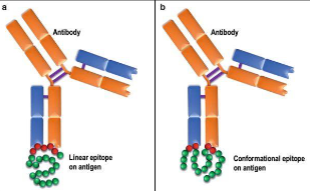
What is the difference between conformational (discontinuous) and linear (continuous) epitopes?
Conformational epitopes are formed by amino acid residues that come together when a protein folds, whereas linear epitopes consist of a single, continuous segment of the protein’s amino acid sequence.
What are the 2 main roles for antibodies?
1. bind specifically to the pathogen/products that elicited response
2. recruit other cells and molecules to destroy the pathogen
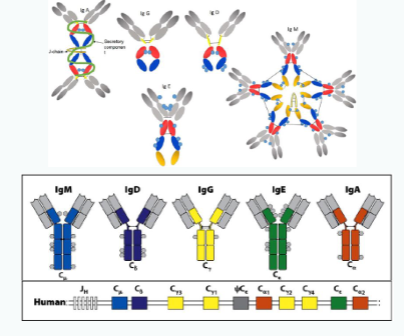
Each function – recognition and effector activity - are structurally separated in the molecule
What activates T helper cells before they assist B cells?
T helper cells are activated by dendritic cells.
Where do activated T helper cells first migrate to interact with B cells?
They migrate to the margins of B cell follicles to interact with B cells
What happens to B cells after they interact with T helper cells at the follicle margins?
The B cells move deeper into the follicle, forming the germinal centre
Which cells do B cells interact with in the germinal centre to enhance their response?
They interact with T follicular helper (Tfh) cells and follicular dendritic cells.
What is the purpose of B cell interaction with Tfh and follicular dendritic cells in the germinal centre?
These interactions optimise B cell memory formation and antibody production.
How do naïve B cells become activated?
Naïve B cells test their B cell receptors (BCRs) on whole antigens or intact proteins, which triggers activation.
What changes occur in B cells once they are activated?
Activated B cells leave their quiescent state, undergo cell signalling and metabolic reprogramming, and experience extensive transcriptional, epigenetic, and translational changes.
How does activation affect B cell surface and secretory activity?
It alters cell surface protein expression and cytokine secretion
Where do activated B cells and CD4⁺ T cells meet?
They meet at the T–B border within lymphoid tissues
How do B cells and T cells interact at the T–B border?
B cells present peptide–MHC (pMHC) complexes to T cells, and T cells provide ‘help’ via ligand–receptor interactions and cytokine secretion
What is the outcome of T cell ‘help’ to B cells?
It promotes B cell differentiation into antibody-producing and memory B cells.
What are the three signals required for a T-dependent B cell response?
Signal 1: Antigen binds and cross-links the B cell’s membrane immunoglobulin; peptides from the same antigen are presented on MHC Class II after antigen drainage to the lymph node.
Signal 2: Interaction between CD40 on B cells and CD40L on T cells.
Signal 3: Cytokines produced by T cells that promote B cell activation and differentiation.
What roles do T follicular helper (Tfh) cells play in B cell responses?
Tfh cells help B cells produce antibodies, support rapid B cell proliferation and diversification, promote the production of different antibody types, and increase antibody affinity.
Somatic hypermutation and class switching
What happens to B cells during proliferation in the germinal centre?
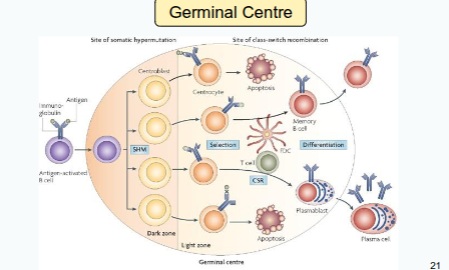
As B cells divide, they copy their DNA and introduce mutations, including in the genes encoding the variable (V) regions of the heavy and light chains.
What is the functional significance of mutations introduced during B cell proliferation?
Some mutations improve the affinity of the antibody for its antigen.
What is the name of the process where B cells introduce mutations in their V region genes during proliferation?
Somatic hypermutation
Class/isotype switching
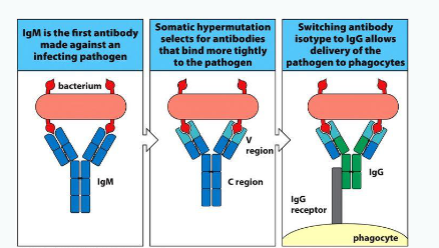
What are the initial fates of activated B cells?
Some B cells become short-lived antibody-producing cells called plasmablasts, while others enter the germinal centre
What occurs to B cells within germinal centres?
Somatic hypermutation diversifies the B cell receptor (BCR) and tweaks specificity through mutations, followed by re-testing on CD4⁺ T cells to ensure antigen specificity is retained.
What are the two possible fates of B cells within the germinal centre?
Some B cells become long-lived memory cells, while others become long-lived antibody-producing plasma cells, mostly residing in the bone marrow.
How productive can a fully activated plasma cell be?
A single plasma cell can produce and secrete thousands of antibodies per second.
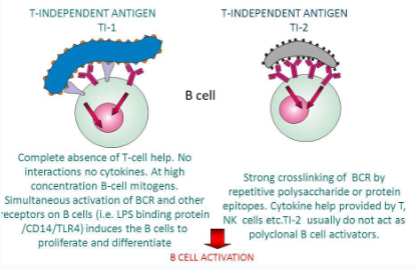
T-independent response
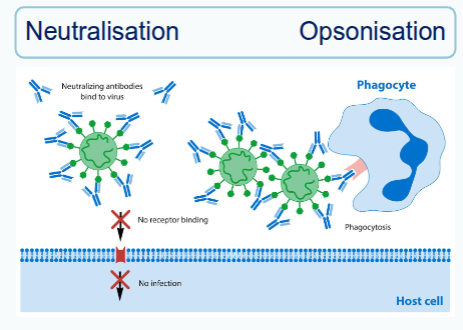
What is opsonisation and how do antibodies contribute to it?
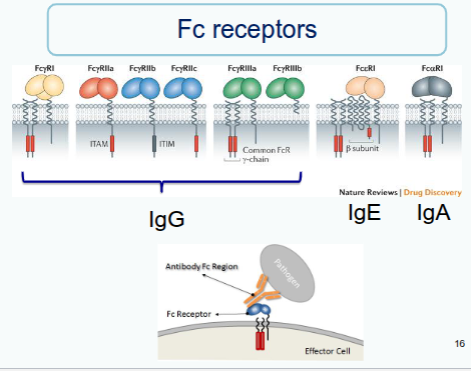
Opsonisation occurs when phagocytic cells bind the constant region (Fc) of antibodies on pathogens, securing the pathogen to the phagocyte and activating it to destroy the pathogen.
Which antibodies can activate the complement system, and what is the outcome?
IgM and IgG can activate the complement system, a collection of serum glycoproteins, leading to inactivation and removal of antigens or pathogens.
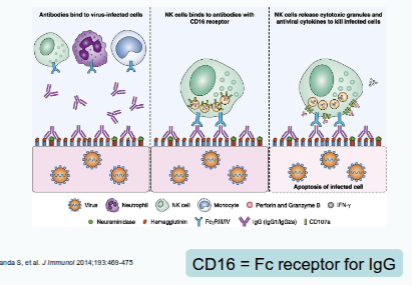
What is antibody-dependent cell-mediated cytotoxicity (ADCC)?
ADCC occurs when antibodies link target cells (e.g., virus-infected cells) to Fc receptors on effector cells such as NK cells, signalling them to attack and kill the target.
How do antibodies mediate agglutination?
Antibodies, especially IgA and IgM, cross-link epitopes on multiple cells or particles, limiting their movement and flagging them for destruction.
What is neutralisation in the context of antibody function?
Neutralisation occurs when antibodies bind soluble antigens or microbes, preventing them from binding to cells and blocking their harmful effects.
Antibody dependent cellular toxicity (ADCC)
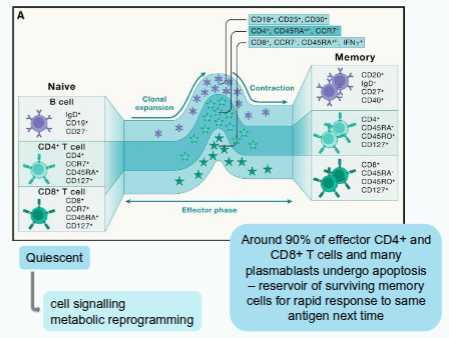
What happens during a secondary encounter with a previously encountered antigen?
The immune system utilises immunological memory to respond more rapidly and effectively.
How are memory T cells different from naïve T cells?
Memory T cells have an increased frequency of antigen-specific cells and possess intrinsically enhanced function compared to naïve T cells.
What role do long-lived plasma cells play in immunological memory?
Long-lived plasma cells continuously produce serum antibodies.
How do memory B cells contribute during a secondary immune response?
Memory B cells can be rapidly re-activated upon re-encountering antigen, producing expanded populations of antibody-secreting cells.