Chapter 2: Chemical Principles
 Call Kai
 Learn
Learn Practice Test
 Spaced Repetition
 Match
Match Flashcards
 Knowt Play
1/31

There's no tags or description
Looks like no tags are added yet.
Name | Mastery | Learn | Test | Matching | Spaced | Call with Kai |
|---|
No analytics yet
Send a link to your students to track their progress
32 Terms
inorganic compounds
small, simple molecules (no C)
ex. H2O, O2, salts, acid & bases
organic compounds
large, structurally complex (yes C)
covalent bonds
CHON
carbo skeleton + functional group
alcohol/hydroxyl
—OH
lipids, carbs
amino
—NH2 (has N)
proteins
carboxyl
—COOH
organic acids, lipids, proteins
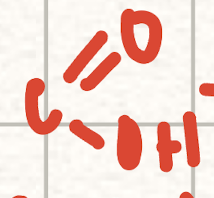
phosphate
has P
ATP, DNA
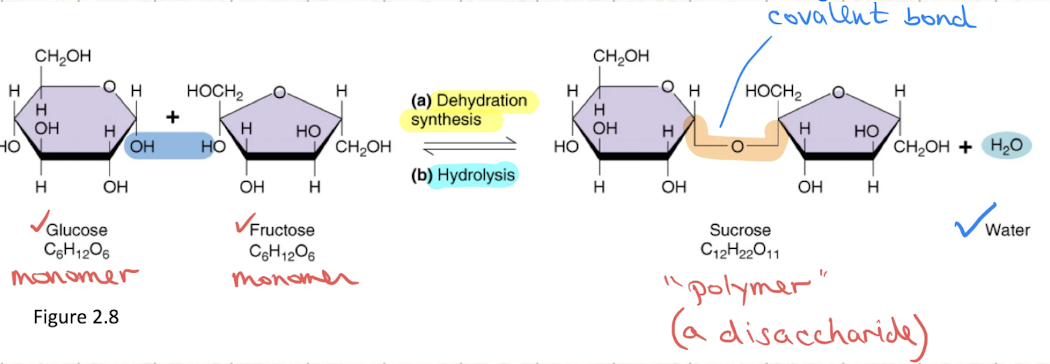
dehydration synthesis
build-up of molecules (compound)
small monomers → one large polymer
MAKE covalent bonds + H2O (released)
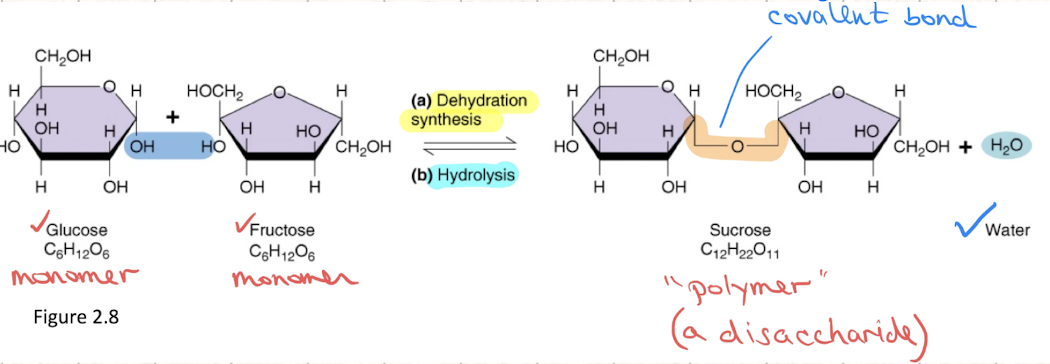
hydrolysis
breakdown of molecules
one large polymer → small monomers
BREAK COVALENT bonds + H2O (input)
major organic compounds
carbs, lipids, proteins, nucleic acids
carbohydrate
aka sugars (C,H,O) “-ose”
monosaccharides = building blocks
monosaccharides
“simple sugars” 3-7 C (building blocks)
fxn: quick source of energy (glucose→humans)
ex: fructose, glucose, deoxyribose (DNA)
sweet-taste, water-soluble
disaccharaides
2 monosaccharides form glycosidic (covalent) bonds via dehydration syn.
fxn: structural component for bacterial cell walls
ex: sucrose, lactose
glucose + fructose → sucrose + H2O
polysaccharides
tens/hundreds of monosaccharides joined via dehydration syn.
fxn: long-term energy source; structure for plant cell walls
ex: starch (plant), glycogen (human), cellulose (plant cell wall)
all polymers of glucose
proteins
CHON (sometimes S)
cell structure → function (most diverse)
ex & fxn:
structural protein: keratin (reinforce skin against infection)
transporter protein: proteins in cell membrane (channels/carriers)
enzymes: speed up chem rxns
antibodies: involved in immune response
bacterial toxins: poisonous proteins made by some bacteria
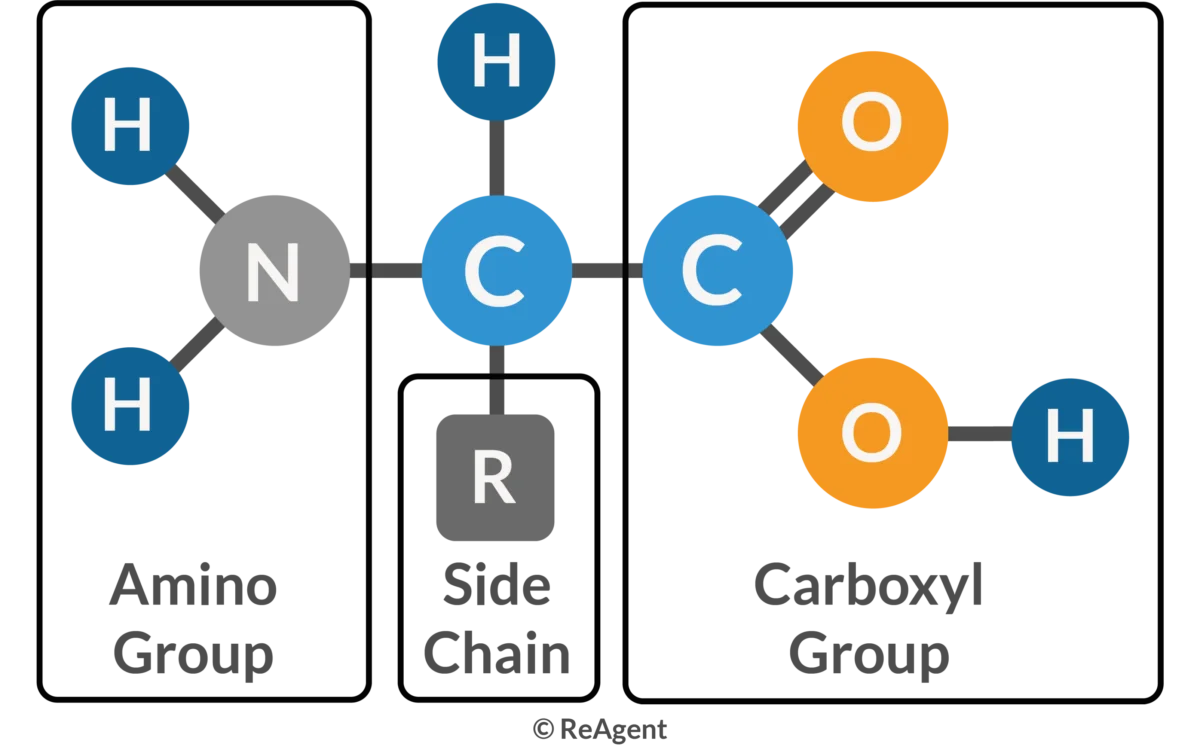
amino acids
proteins’ subunits (20 types)
central carbon attached to:
amino group, carboxyl group, hydrogen, side (R) group
two groups contain sulfur
peptide bonds
covalent bond between amino acids (via dehydration syn.)
denaturation
protein loses/changes shape → loses/changes function
d/t harsh/hostile environments (↑ temp/ ↓ pH) may be permanent
primary
sequence of a.a. in linear structure (simple fxn)
secondary
a.a. chain folds/coils in helix/pleated sheet
d/t H bonds (weak bonds)
ex. hair protein (helix); skin protein (pleated sheet)
tertiary
helix/pleated sheet irregularly (forms disulfide bridges, H bonds, ionic bonds between a.a.)
quaternary
two or more polypeptide (protein) chains bound to each other (2 or more 3° subunits)
ex. hemoglobin, antibodies, enzymes
what are the building blocks of enzymes?
amino acids (protein)
lipids
CHO
triglycerides = subunits
primary part of cell membranes
simple lipids (fats or triglycerides)
1 glycerol + 3 fatty acid chains
ester bond = covalent bond (via dehydration syn.)
saturated fatty acids: no double bonds
unsaturated fatty acids: one or more double bonds
key fxn: alt. source energy when no carbs
complex lipids
cell membranes made of phospholipids (1 glycerol, 2 fatty acid chains, 1 phosphate group)
polar head = charged
non-polar tail = uncharged
fxn:
structural components: form phospholipid bilayer of cell membrane
regulation of transport: controls what enters & leaves cell → homeostasis
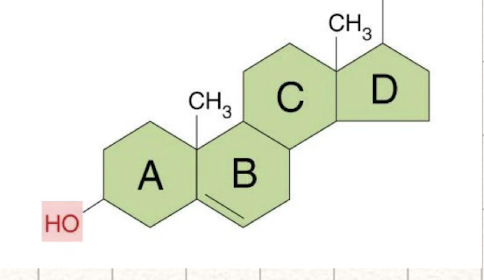
steroids
three 6-carbon rings + one 5-carbon ring
key fxn: structural in cell membrane of eukaryotic cells
cholesterol, hormones, some vitamins
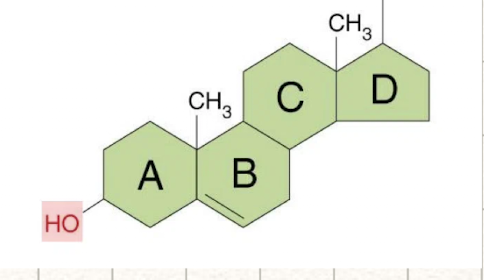
sterol
“—OH” attach to one 6-carbon
cholesterol: sterol in animal cell
phytosterol: sterol in plant cell
ergosterol: sterol in fungi cell
nucleic acids
CHON
nucleotides (building blocks)
phosphodiester bond (covalent bond)
nucleotide
sugar (5-carbon pentose)
phosphate group
base: nitrogen-containing base
purine bases: A & G
pyrimidine: C, U, T
DNA
double-stranded molecule (double helix)
sugar-phosphate backbone
A-T, C-G base pairing
fxn: store genetic info
RNA
usually single-stranded molecule
sugar-phosphate backbone
no base pairing
mRNA, tRNA, rRNA
fxn: protein synthesis
ATP
adenosine triphosphate
nitrogenous base (A) + sugar (ribose) + 3 phosphate groups
remains “single nucleotide”
high energy compound
released by hydrolysis of phosphate groups