137 Chapter 1 Theorems and Proofs
 Call Kai
 Learn
Learn Practice Test
 Spaced Repetition
 Match
Match Flashcards
 Knowt Play
1/36

There's no tags or description
Looks like no tags are added yet.
Name | Mastery | Learn | Test | Matching | Spaced | Call with Kai | Chat |
|---|
No analytics yet
Send a link to your students to track their progress
37 Terms
State the Triangle Inequality #1

State 1st case of Triangle Inequality #1 with a diagram
| x − y |<| z − y | and therefore | x - y | ≤ | x − z | + | z − y |
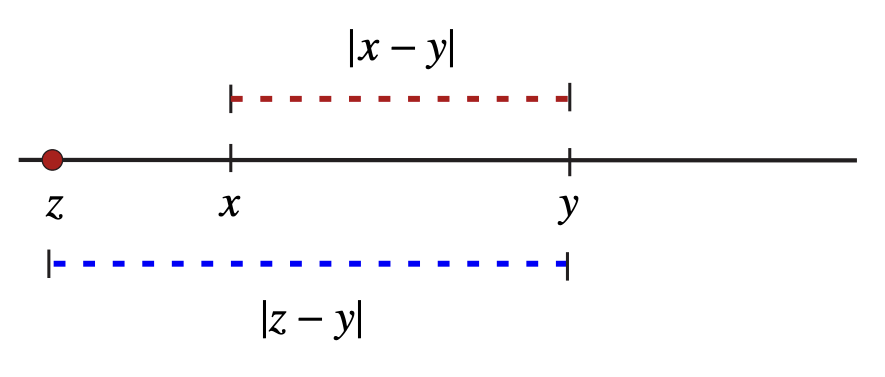
State 2nd case of Triangle Inequality #1 with a diagram
| x − y |=| x − z | + | z − y |
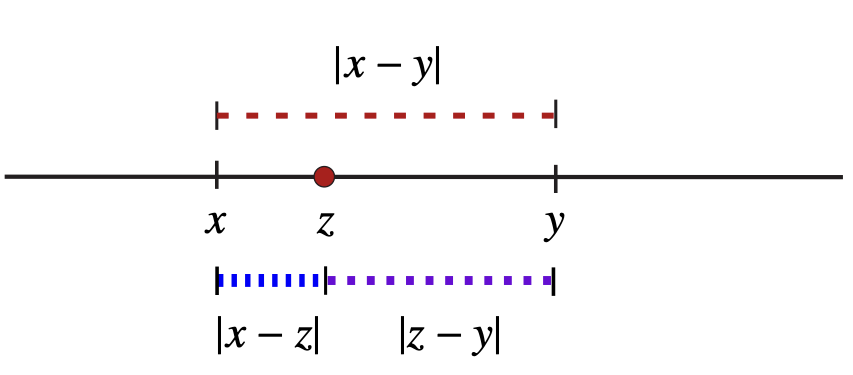
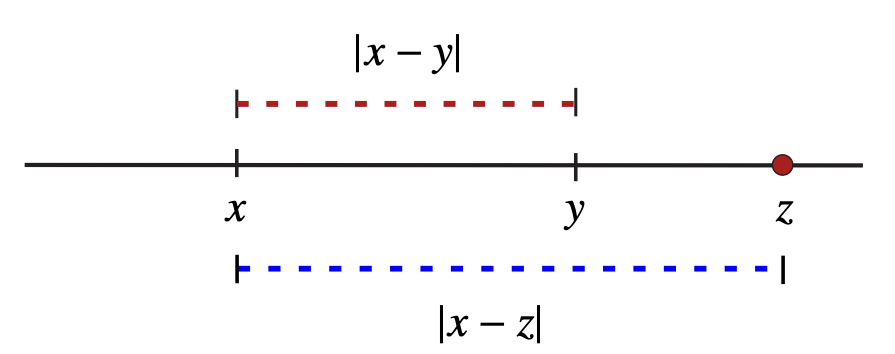
State 3rd case of Triangle Inequality #1 with a diagram
| x − y |<| x − z | therefore | x − y |≤| x − z | + | z − y |
Show how you can derive the Triangle Inequality #2 from #1

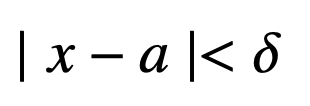
What is the solution (set) to the following inequality


What is the solution (set) to the following inequality
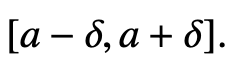

What is the solution (set) to the following inequality


Do this question

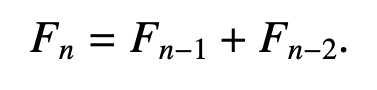
How would you find primes of the Fibonacci Sequence?
What is a subsequence?

What is the tail of a sequence?
a subsequence with a cutoff

What is the first Heuristic Definition of a Sequence’s Limit?

What flaw is associated with the first Heuristic Definition of a Sequence’s Limit?

What is the second Heuristic Definition of a Sequence’s Limit?
As n grows to infinity and we say that L is the limit, we are able to find a cutoff out of the Natural Numbers for every Epsilon given so that A_n approximates the L well but is still smaller than Epsilon.

What is the first Formal Definition of a Sequence’s Limit?
As n grows to infinity and we say that L is the limit, we are always able to find a cutoff, for every n being bigger or equal to cutoff, where the magnitude between A_n and L will be smaller than Epsilon.
If such a cutoff exists, we say the sequence is convergent as n grows to infinity. Otherwise, divergent.


Do this question

Explain the game regarding cutoff and epsilon
1) Guess what the limit approximately looks like
2) Oponnent gives you an epsilon
3) Find a cutoff that approximates the limit but is less than the given Epsilon
4) If the cutoff succeeds, you’re in the game where you continue to find smaller cut offs with more difficult given epsilons. If you fail, you just lose.
What is the second formal definition of a Sequence’s Limit?

What is Theorem 4 “ Uniqueness of Limits for Sequences”

What is the Divergence to Positive Infinity definition?

What is the Divergence to Negative Infinity definition?


How does the following theorem help us understand divergence to positive and negative infinity?

Provide proof for the third arithmetic rule


Then what?
Then as n approaches infinity, A_n equals 0 too.

= 1

= 3

= 3/4

= 0

infinity
What’s the Squeeze Theorem?

Provide a proof for the Squeeze Theorem


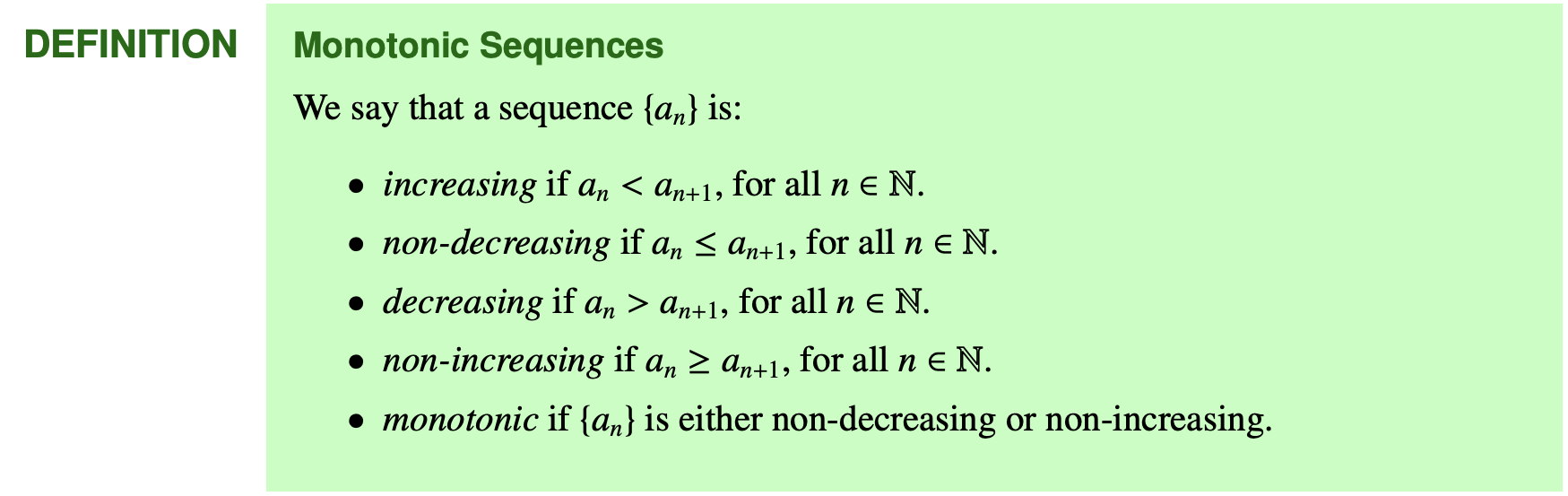
What is the Monotonic Sequence definition?

if x is smaller or equal to bound and so we say S is bounded above
Same for definition of lower bound.