BIO 112 Metabolism (Chapter 8)
 Call Kai
 Learn
Learn Practice Test
 Spaced Repetition
 Match
Match Flashcards
 Knowt Play
1/36

There's no tags or description
Looks like no tags are added yet.
Name | Mastery | Learn | Test | Matching | Spaced | Call with Kai | Chat |
|---|
No analytics yet
Send a link to your students to track their progress
37 Terms

Define metabolism and identify its major components
totality of an organism’s chemical reactions
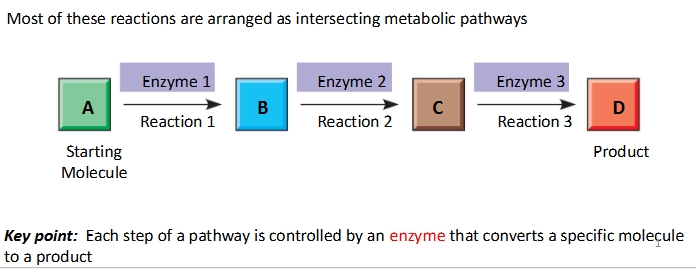
most reactions arranged as intersecting pathways; each step of pathway is controlled by an enzyme that converts a specific molecule to a product
consist of two pathways: catabolic and anabolic
Ex: Bioluminescence in mushrooms, which have thousands of chemical reactions occurring within their cells
Catabolic (Breakdown) Pathway
break down complex molecules into simpler ones
release energy
“downhill” (high to low)
Ex: Hydrolysis reactions: Proteins to AAs, Polysaccharides to monosaccharides
Anabolic (Biosynthetic) Pathways
build complex molecules from simpler ones
consume energy
“uphill” (low to high)
Ex: Dehydration reactions, AAs to Proteins, Monosaccharides to Polysaccharides
What can energy released from catabolic pathways be used for?
can be stored and used to drive anabolic pathways (endogonic) in cells
Define Bioenergetics and its relevance to metabolic processes
the study of how organisms transform energy (important in metabolism)
What is Energy?
the capacity to cause change

What is Kinetic Energy?
energy associated with the relative motion of objects. Moving matter can perform work by imparting motion to other objects
Ex: Heat - random motion of atoms or molecules in a body of matter

What is Potential Energy?
energy that is the capacity of the matter to cause change due to its location or arrangement
Ex: Chemical energy is the potential energy available for release in chemical reactions
Thermodynamics
study of energy transformation
1st Law: Energy can be transferred or transformed, but it cannot be created or destroyed
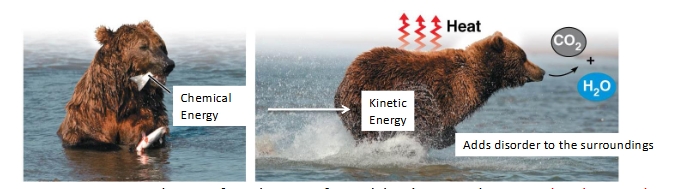
Ex: Chemical reactions in a brown bear will convert the chemical (potential) energy in food to the kinetic energy of the brown bear’s environment.
2nd Law: Every energy transfer or transformation increases the disorder (entropy) of the universe
Ex: As a brown bear runs, disorder is increased around the brown bear by the release of heat and small molecules that are products of cellular respiration
For a process to occur in an energetically favorable manner (spontaneously), it must increase the entropy of the universe

Open Systems vs IsolatedSystems— Thermodynamics
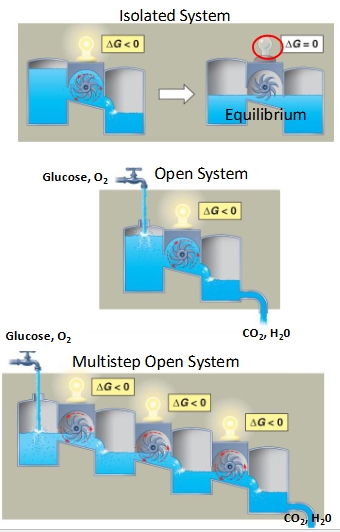
In open systems, energy and matter can be exchanged between the system and the surroundings
In Isolated system, systems cannot do work when equilibrium is reached
Cells exist in open system where metabolic reactions never reach equilibrium as reactants and products are constantly moving in and out of cells
What can cellular respiration be described as?
A catabolic pathway where glucose is broken down in a series of reactions that power work of cell, releases energy.
Multistep Open System: products of reactions do not build up, they become reactants in the next step. Equilibrium is not reached and cells keep living
According to the second law of thermodynamics, what happens to the entropy of the universe during a spontaneous process?
It increases
What is true of exergonic reactions?
They release free energy
Define free energy change (ΔG), calculate it, and interpret positive versus negative ΔG values.
Free Energy Change (ΔG): A living system’s free energy is the energy that can do work under cellular conditions
ΔG=ΔH - TΔS
ΔH = Change in Enthalpy (total energy)
T = Absolute Temp in Kelvin (K = C+273)
ΔS = Change in Entropy
Spontaneous processes have a -ΔG (<0)

High Free Energy (G) vs Less Free Energy (G)
ΔG= Gfinal - Ginitial (measures systems instability)
High Free Energy (G) —> Less Stable —> Great Work Capacity
Less Free Energy (G) —> More Stable —> Less Work Capacity
Once at equilibrium, a system is at a minimum of free energy and will not change spontaneously
Exergonic Reactions (-ΔG)
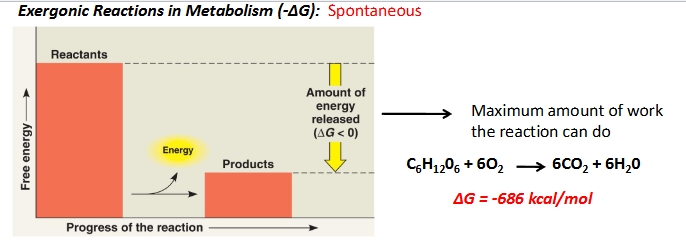
Spontaneous
Reactants have more free energy than products
Amount of energy released (ΔG<0) represents maximum amount of work reaction can do
Ex: Cellular respiration (C6H1206 + 6O2 —> 6CO2 + 6H2O) has -686 kcal/mol of free energy (releases a lot of energy)

Endergonic Reactions (+ΔG)
Not Spontaneous
Must absorb free energy from surroundings:
6CO2 + 6H2O —> C6H1206 + 6O2
ΔG = 686 kcal/mol
Key Point: Energy released by exergonic reaction is equal to energy required by the reverse endergonic reaction
Why it is essential that metabolic reactions do not reach equilibrium?
. At equilibrium, ΔG = 0 → No free energy is available to do work
Cells rely on exergonic reactions (-ΔG) to power reactions, however at equilibrium:
ΔG = 0
No net reaction occurs
No energy released
A cell with no usable free energy is a cell that cannot function.

What does ATP consist of? What does it do?
Adenine Triphosphate: Consists of 3 phosphate groups attached to a ribose sugar, which is attached to a base of adenine
ATP powers cellular work by coupling exergonic reactions endergonic reactions, used as immediate source of energy for:
Mechanical Work: Ex: contraction of muscle
Transport Work: Ex: active transport of molecules against their concentration gradient
Chemical Work: Ex: pushing endergonic reactions such as the synthesis of proteins from AAs

Describe how ATP couples exergonic and endergonic reactions to power cellular work
Energy produce by hydrolysis of ATP would be in form of heat (insufficient energy for cells)
Instead, cells use energy produced by hydrolysis of ATP to do cellular work:
Free energy is released from the hydrolysis of ATP is used to transfer a phosphate group to another molecule, producing a phosphorylated molecule that is more reactive (less stable)


Mechanical Work— Cellular work powered by ATP
Indirect Effect: ATP binds noncovalently to motor protein
Hydrolysis of ATP changes shape of motor protein and allows it to interact with cytoskeleton
Ex: Dynein/microtubule

Transport Work— Cellular work powered by ATP
Direct Effect: Hydrolysis of ATP phosphorylates membrane protein
Changes its shape and often its ability to bind another molecule (binding affinity)
Ex: Na+/K+ pump

Chemical Work— Cellular work powered by ATP
Synthesis of amino acid Glutamine:
Glutamic Acid + Ammonia —> Glutamine (ΔG = 3.4 kcal/mol) —> Endergonic reaction - not spontaneous
Reaction occurs in 2 steps: Glutamic Acid + ATP —> Phosphorylated (less stable intermediate) of Glutamic Acid + ADP —> Ammonia is added to produce Glutamine + ADP + Pi

Explain the ATP cycle and how ATP is regenerated
ATP is a renewable resource and can be synthesized from ADP and Pi but requires energy (ΔG = +7.3 kcal/mol)
Energy comes from energy yielding processes (catabolic processes)
ATP hydrolysis to ADP and Pi yields energy (ΔG = -7.3 kcal/mol)
Energy is used for cellular work (anabolic processes)
Key Points:
Chemical potential energy stored in ATP drives most cellular work
ATP cycle moves at astonishing pace
Ex: A working muscle cell recycles its entire pool of ATP in less than one minute

How do enzymes speed up metabolic reactions?
Enzymes speed up metabolic reactions by lowering energy barriers, rate of chemical reactions important
Some spontaneous reactions do not require energy but occur at very slow rates
Ex: Hydrolysis of Sucrose (ΔG= -7 kcal/mol)
Solution of sucrose takes years to break down
If enzyme, Sucrase, added then sucrose will be hydrolyzed in seconds
Key Point: An enzyme is a macromolecule that acts as a catalyst which speeds up reactions without being consumed by the reaction

Activation Energy Barrier
Reaction: AB + CD —> AC + BD
Every reaction must overcome activation energy (EA); the minimum amount of energy required to push reactant molecules into a highly unstable, contorted state called the transition state.
Reactants must absorb energy to reach transition state, uphill process (highly unstable)
Once transition state reached, bonds can be broken and new bonds can form, releasing energy to surroundings
-ΔG indicates reaction is spontaneous
However, EA provided the barrier that determines the rate of the reaction
Heat can speed up reactions

Enzymes lower EA barrier
Most macromolecules in cells are high in free energy and have potential to decompose spontaneously
However, they persist in cells because few molecules can make it over the hump of activation energy
Key Points: Enzymes catalyze reactions by lowering the EA
However, Enzymes do not change the ΔG OR turn an endergonic reaction into an exergonic reaction
Why would it be inappropriate to speed up reactions by applying heat?
Heat will denature proteins and kill cells
Heat would also speed up all reactions, not just needed ones

Substrate Specificity of Enzymes
Substrates: reactants that enzymes act on
Enzyme + Substrate ⇆ Enzyme - Substrate Complex ⇆ Enzyme + Product
Example:
Sucrase + Sucrose +H2O ⇆ Sucrase - Sucrose-H2O Complex ⇆ Sucrase + Glucose + Fructose
A reaction catalyzed by an enzyme is very specific
Enzymes can differentiate closely related molecules and isomers due to their specific shape that dictate their unique functions
Example: Sucrase is specific for sucrose but not maltose

Active Site
Where an enzyme binds to its substrate
Contains only a few AAs, rest of protein molecule provides framework that determines configuration of active site
In active site, chemical groups on substrate interact with R-groups of amino acids
This interaction causes the enzyme to change shape slightly, so the active site fits more snuggly around the substrate (induced fit)
Induced fit increases the catalytic ability of the enzyme

Catalytic Cycle of an Enzyme
Active site is available for two new substrates in Enzyme
Substrate bind to enzyme at active site - “Induce Fit”
New shape where Substrates are held in active site by weak interactions (ionic bonds, hydrogen bonds, hydrophobic interactions), forms Enzyme-substrate complex
Various Mechanisms function within active site to lower EA and speed up reactions
Substrates are converted to products
Key Points: Single enzyme can act on thousand substrate molecules/sec
Identify and describe mechanisms used at the active site to accelerate reactions (lower EA)
Active site provides a template for substrate orientation
Active site stress the substrates towards their transition state by stretching and bending critical chemical bonds that must be broken during the reaction
Active site provides a favorable microenvironment for the reaction (e.g. active site may be more acidic than the neutral cell)
Active site can participate directly in the catalytic reaction by forming brief covalent bonds with the substrate
Most metabolic reactions are reversible
Enzymes can catalyze both forward and reverse reactions - depends on which direction has a -ΔG
Direction of reaction depends on relative concentration of reactants and products
Net effect is always direction of equilibrium
Rate of a reaction will increase with increasing substrate concentration
Sucrose + H2O ⇆ Glucose +Fructose (Rate of reaction increases with Sucrase)
Saturated:
When all enzyme molecules are saturated with substrate molecules and working at full speed
To increase rate of reaction further, more enzyme needed
Enzyme activity: how efficient an enzyme functions
Depends on optimal conditions: Temperature, pH, Specific chemicals
Optimal conditions are significant because they favor the most catalytically active shape of enzyme

Why do reaction rates drop quickly at temperatures greater than the optimal temperature?
Higher temperatures will disrupt the hydrogen, ionic, and hydrophobic interactions that stabilize the active site (denatures proteins)
Most enzymes have an optimal pH between 6-8
Explain the role of cofactors and differentiate between the two major types
Cofactors: a non-protein molecule that aids catalytic activity of enzymes
Inorganic ions such as magnesium, zinc, iron, and copper
Example: Enzyme Glucose 6 - phosphatase requires Mg2+ as a cofactor
Organic Molecules (Coenzyme): Most vitamins are important nutritional factors because they act as coenzymes and aid in chemical reactions in body
Example: NAD+ (an electron carrier) is a coenzyme derived from vitamin niacin

Irreversible and Reversible Enzyme Inhibitors (Attach to enzymes)
Irreversible Inhibitions: inhibitors bind covalently to the enzyme and block activity
Reversible Inhibition: when inhibitors bind to an enzyme via weak interaction and block activity
Types of Reversible Inhibition:
Competitive Inhibitors: Blocks substrates from binding to active site, can overcome inhibition if: [substrate] > [inhibitor]
Noncompetitive Inhibitors: Impede (slow down) enzyme activity by binding to another part of the enzyme, changes shape so active site is less catalytic

Feedback Inhibition: Example Isoleucine synthesis
The end product isoleucine, binds to the allosteric site on Enzyme 1
Binding changes Enzyme 1 shape and prevents it from binding threonine
Pathway is turned off until isoleucine levels are low again
Isoleucine leaves allosteric site of Enzyme 1
Enzyme 1 active again, more isoleucine is synthesized
Key Point: Inhibition prevents the cell from wasting chemical resources by making more isoleucine than is necessary