Infection Prevention & Control: Nursing Fundamentals and Safety Protocols Study Guide | Quizlet
 Call Kai
 Learn
Learn Practice Test
 Spaced Repetition
 Match
Match Flashcards
 Knowt Play
1/47

There's no tags or description
Looks like no tags are added yet.
Name | Mastery | Learn | Test | Matching | Spaced | Call with Kai | Chat |
|---|
No analytics yet
Send a link to your students to track their progress
48 Terms
What is an infection?
An infection occurs when a pathogen (e.g., bacteria or virus) invades tissues and begins growing in a host.
What is a communicable disease?
A communicable disease is one that can spread from one person to another.
What are the components of the chain of infection?
Infectious agent, reservoir, portal of exit, mode of transmission, portal of entry, susceptible host.

What is the most effective way to break the chain of infection?
Hand hygiene.

Define 'infectious agent.'
An infectious agent is a germ (microorganism or pathogen) that can cause disease.
What is a reservoir in the context of infection?
A reservoir is where germs live and grow before spreading again, such as people, animals, water, food, hospital equipment, and soil.
What is the portal of exit?
The portal of exit is how the germ leaves its reservoir, typically through bodily fluids like blood, respiratory secretions, or urine.
What are the two types of contact transmission?
Direct contact (person to person) and indirect contact (person to contaminated object).
What is a vehicle in the context of transmission?
A vehicle is an object that carries germs from one person to another, such as a stethoscope.
What is a vector in terms of disease transmission?
A vector is an animal or insect that carries germs, such as a tick transmitting Lyme disease.
What is the portal of entry?
The portal of entry is how organisms enter the body, typically through the same routes they used to exit.
Who is considered a susceptible host?
A susceptible host is a person who is becoming infected.
What factors increase a patient's susceptibility to infection?
Age, nutritional status, immune system diseases, chronic diseases, recent surgery, and presence of indwelling devices.
What are healthcare-associated infections (HAIs)?
Infections that patients acquire while receiving treatment for medical or surgical conditions.
What are multidrug-resistant organisms?
Organisms that have developed resistance to one or more broad-spectrum antibiotics, such as MRSA and VRE.
What are signs and symptoms of a localized infection?
Redness, warmth, swelling, and pain at the site of infection.
What are signs and symptoms of a systemic infection?
Fever, chills, fatigue, and widespread muscle aches.
What is the role of normal flora in infection prevention?
Normal flora are helpful microorganisms present on skin and GI tracts that help prevent infections.
What is the importance of personal protective equipment (PPE)?
PPE is used to protect healthcare personnel and clients from exposure to infectious agents.
What is the significance of engineering and work practice controls?
They are designed to minimize exposure to potentially infectious bloodborne pathogens.
What ethical-legal implications are associated with infection control?
Interventions must maintain and promote protective functions while adhering to legal and ethical standards.
What is the purpose of the ATI Skills Module 4.0?
To provide training on infection control and hygiene practices.
What is the recommended reading for infection prevention and control?
Perry & Potter, Chapter 28 and ATI Fundamentals Book, Chapters 10 and 11.
What is the significance of lab evaluations in infection assessment?
Lab evaluations help determine the presence of infection through specific tests.
What is a common assessment finding in a generalized infection?
Fever and widespread muscle aches.
What is the incubation period?
The time between exposure to an infection and the appearance of symptoms.
What is the convalescence stage?
The recovery phase after an illness when symptoms begin to diminish.
What occurs during the prodromal stage?
Initial symptoms appear, often mild and nonspecific, before the full onset of the illness.
What characterizes the illness stage?
The period when the disease is at its peak, with pronounced symptoms.
What action should a nurse take first if a patient has a red incision with purulent drainage?
Notify the primary health care provider.
What are the increased risks for infection in a patient with a positive MRSA culture?
Age, history of hypertension, and elevated WBC count.
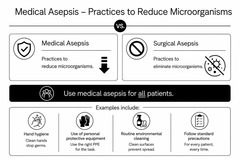
What is medical asepsis?
Practices aimed at reducing the number of microorganisms.
What are standard precautions?
CDC guidelines assuming every person is potentially infected and requiring hand hygiene and protective measures.

When must soap and water be used for hand hygiene?
When hands are visibly soiled or when caring for patients with certain infections.
What is cough etiquette?
Practices to prevent the spread of respiratory infections, including covering the mouth when coughing.
What should be done with soiled dressings?
Change them if they become wet and place them in fluid-resistant bags.
What is the purpose of Personal Protective Equipment (PPE)?
To protect healthcare workers from exposure to infectious agents.
When should gloves be worn?
When there is a chance of contact with blood or bodily fluids.
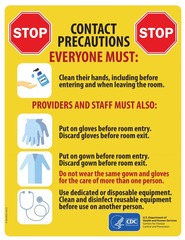
What are contact precautions?
Measures taken to prevent the spread of diseases through direct or indirect contact.
What are droplet precautions?
Precautions for diseases spread by larger droplets, requiring masks within 3 feet of the patient.

What are airborne precautions?
Precautions for diseases transmitted by smaller droplets that remain in the air, requiring N95 respirators.

What is a protective environment?
An environment designed for patients highly susceptible to infection, featuring positive airflow.

What should be done when transporting patients on isolation precautions?
Patients should wear masks and be covered appropriately.
What nursing interventions can help with the psychological implications of isolation?
Keep the room clean, listen to concerns, and provide recreational activities.
What indicates correct understanding of managing contaminated dressings?
Placing used dressings in a plastic bag.
What action indicates correct understanding of standard precautions?
Wearing gloves when emptying the urinary drainage bag.
When should disposable examination gloves be put on for contact precautions?
As soon as the nurse enters the client's room.
What should a nurse do if their surgical mask becomes moist?
Apply a new mask.