Lab Instrumentation
 Call Kai
 Learn
Learn Practice Test
 Spaced Repetition
 Match
Match Flashcards
 Knowt Play
1/28

There's no tags or description
Looks like no tags are added yet.
Name | Mastery | Learn | Test | Matching | Spaced | Call with Kai | Chat |
|---|
No analytics yet
Send a link to your students to track their progress
29 Terms
What do spectrochemical methods of instrumentation in the lab measure?
light absorbed by an analyte
light emitted by an analyte
light refracted by an analyte
in terms of energy, short wavelengths result in high ___ and ___
frequencies and energy
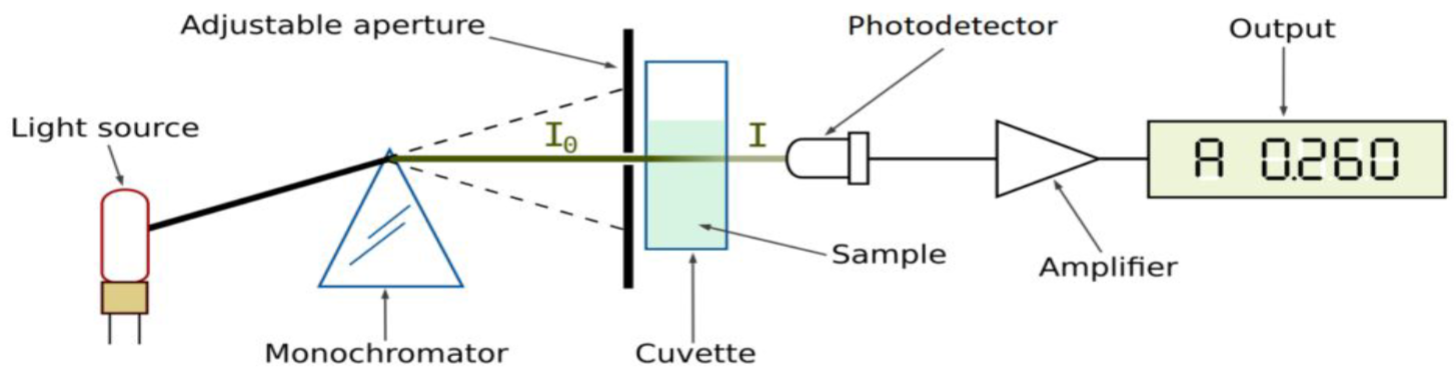
How does a spectrophotometer work?
light absorption is used to quantify the concentration of an analyte in a solution
What are the 6 parts of a spectrophotometer?
light source
monochromator
isolates individual wavelengths of light (like a prism)
cuvette
contains the patient sample or QC
photodetector
converts light energy into electrical energy
amplifier
amplifies low electrical energy readings
output
energy value (result)
Urine dipstick tests utilize what test method?
reflectometry
What does fluorimetry measure?
the intensity of fluorescent light emitted by a substance when it is excited by light
What does chemiluminescence measure?
the emission of light produced by a chemical reaction
does not require external light
reagent probes enter the sample —> reaction occurs —> a photomultiplier tube amplifies the signal —> output
potentiometry
measures potential (aka voltage) between two electrodes in a solution
used for determining electrolyte concentrations
a reference electrode delivers a constant voltage and an indicator electrode measures
How do the separation techniques electrophoresis and densitometry work?
charged particles migrate through a gel or liquid medium in response to an electric field
densitometry analyzes the concentration of substances by measuring the amount of light transmitted through or reflected by the sample
How does chromatography work?
complex mixtures are separated on the basis of different physical interactions between the individual compounds and the stationary phase (part) of the system
the mobile phase carries the mixture through the stationary phase, allowing for separation based on properties like polarity and size
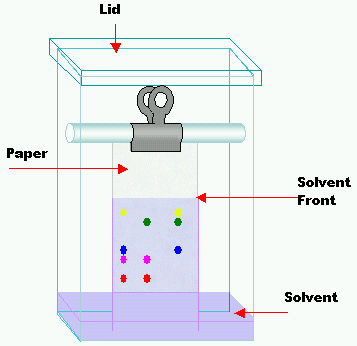
3 parts of a chromatography system
mobile phase (solvent in pic)
holds the patient sample
stationary phase (paper in pic)
held in a column, phase thru which the mobile phase flows
eluate (colorful dots in pic)
the separated components of the mixture
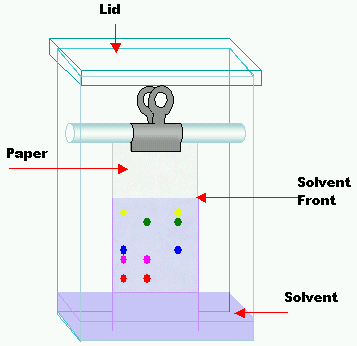
thin layer chromatography
a filter paper is used in the stationary phase, the mobile phase moves onto the paper
high performance liquid chromatography (HPLC)
an extremely high pressure environment separates the sample in the mobile phase
How are analytes identified in mass spectrometry and what are the 5 steps of this technique?
analytes are identified and quantified based on their structure and mass
steps:
sample is introduced
sample is vaporized
sample is ionized
sample passes through a strong magnetic field to separate particles based on charge
ions reach a detector at different rates, depending on the compound
immunoassays can be used to identify:
proteins, hormones, metabolites, therapeutic drugs, and drugs of abuse in specimens
epitope
specific part of an antigen that binds to the corresponding antibody
affinity
the strength of binding of an antigen at a single site to its corresponding antibody
avidity
the cumulative strength of all binding sites between an antibody and an antigen
nephelometry
used in immunoassays
immune complexes form and increase turbidity, affecting absorbance and transmittance through the specimen
What is the difference between heterogenous and homogenous immunoassays?
heterogenous
test requires separation of bound immune complexes from free antibody or antigen
homogenous
test does not require separation, the expression of labels depends on whether or not it is bound to its target AB or Ag
competitive immunoassays
labeled reagent antigens compete with patient antigens in a sample
reagent AB + reagent labeled Ag + patient Ag
more patient antigens = less labeled immune complexes
noncompetitive/sandwich immunoassays
patient antigen binds to reagent antibody and a labeled reagent antibody binds to the immune complex
patient Ag + reagent AB + reagent labeled AB
more patient antigen = more labeled immune complexes
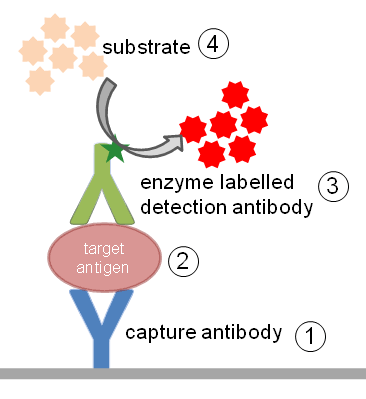
Is ELISA a heterogenous or homogenous immunoassay?
heterogenous
competitive ELISA
utilizes:
bound reagent AB and a reagent labeled Ag (that competes with patient Ag)
OR bound reagent Ag and a labeled reagent AB (that competes with patient AB)
noncompetitive (sandwich) ELISA
utilizes:
bound AB and labeled reagent ABs
OR bound Ag and labeled reagent AB (specific to patient AB)
fluorescence polarization immunoassay (FPIA)
homogenous, competitive assay
patient antigen competes with reagent antigen labeled with fluorescein
amount of patient antigen is indirectly proportional to the light produced
less light produced = more patient antigen present
more light produced = less patient antigen present
chemiluminescent magnetic immunoassay (CMIA)
chemiluminescent labels produce light when combined with a trigger reagent
heterogenous, non-competitive assay (magnet is used for separation)
How does CMIA work?
reagent AB with a magnetic component + patient Ag = bound immune complex
magnet is applied
excess reagent and specimen is washed away
labeled AB is added and light is emitted when combined with the complexes
proportional relationship between the amount of light emitted and the concentration of patient antigen
What are 3 possible limitations to immunoassays?
human anti-mouse AB in patient specimen
results in false positives in sandwich assays
heterophile ABs in patient specimen
ABs formed in patients with autoimmune disorders, ABs interfere with testing
hook effect
prozone effect
excess Ag in patient samples overwhelms the binding ability of reagent AB, resulting in low or negative results