Lecture Notes on Platyhelminthes (Flatworms) and Related Classes
 Studied by 0 people
 Call with Kai
 Learn
Learn Practice Test
 Spaced Repetition
 Match
Match Flashcards
 Knowt Play
1/17

Earn XP
Description and Tags
These flashcards cover key vocabulary terms and definitions related to the Phylum Platyhelminthes and its classes, including characteristics of flatworms, their biology, and examples of species.
Name | Mastery | Learn | Test | Matching | Spaced | Call with Kai |
|---|
No study sessions yet.
18 Terms
Platyhelminthes
A phylum that means 'flat worms' and includes about 15,000 living species.
Acoelomate
An organism without a coelomic cavity, where the gut wall is directly continuous with the mesoderm.
Turbellaria
A class within Platyhelminthes that includes free-living flatworms.
Carnivore
An organism that feeds on other animals.
Planaria
A genus of free-living flatworms known for living in freshwater ponds and having a protruding pharynx.
Chemoreceptors
Sensory receptors that detect chemical substances; found in the auricles of planarians.
Dorsal
The upper side or back of an organism.
Ventral
The lower side or belly of an organism.
Trematoda
A class of parasitic flatworms commonly known as flukes.
Opisthorchis
Also called Clonorchis, it is a liver fluke that is a human parasite.
Miracidium
The hatchling stage of trematodes that emerges from eggs after being eaten by freshwater snails.
Cestoda
A class of parasitic tapeworms known for their segmented bodies and lack of a digestive system.
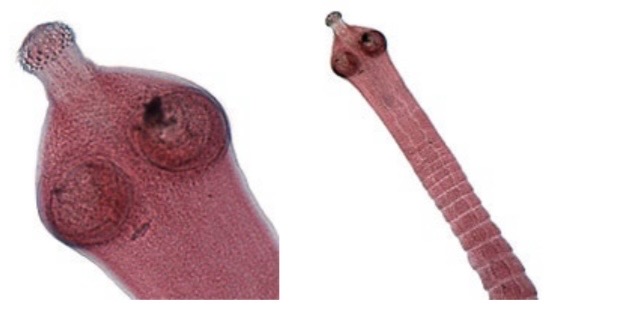
Scolex
The head region of a tapeworm, equipped with hooks and suckers for attachment to the host.
Proglottids
Segments of a tapeworm's body that contain reproductive organs.
Intermediate host
An organism that harbors the larval stage of a parasite.
Reproductive capacity
The ability to produce a large number of offspring to ensure the survival of a species; crucial for parasites like tapeworms.
Gastrovascular cavity
A digestive cavity that serves both digestion and circulation in organisms like flatworms.
what does platyhelminthes mean
Flatworms