Language disorders ~ Exam 1
 Call Kai
 Learn
Learn Practice Test
 Spaced Repetition
 Match
Match Flashcards
 Knowt Play
1/74

There's no tags or description
Looks like no tags are added yet.
Name | Mastery | Learn | Test | Matching | Spaced | Call with Kai | Chat |
|---|
No analytics yet
Send a link to your students to track their progress
75 Terms
Language
a complex and dynamic system of symbols used to express thoughts
-oral, written, or signed
Speech
process of expressing meaning through sounds
Communication
exchange of meaning between a sender and receiver
-includes speech and langauge
Language disorder
impaired comprehension and/or use of spoken, written, or other symbol systems
-can affect expressive, receptive, or both
Receptive language
ability to understand and process langauge
Expressive language
ability to produce and use language
Language difference
variation in communication used by a group and reflects shared regional, social, or ethnic factors
-no therapy for differences, only address disorders
CLD ~ cultural and linguistic diversity
includes ELL and language difference
DLD is a _____ of langauge _____
type, disorder
DLD developmental language disorder
difficulty understanding and using language which is not related to any other disorder
Language disorders often ______ with other diagnosis
co-occur
LLE ~ Late language emergence
delay in language development in children under 3
-”late talkers”
-20-40% later diagnosed with DLD
Descriptive developmental approach
-focuses on what child can/cant do rather than diagnosis
-describing childs functional communication in a natural environment
-figure out their developmental level and support child in their development
-description of functioning is more important than a label
List the 5 parts of the speech chain
speaker formulates thoughts into message
then motor plan is sent to articulators
sound waves then travel through the air
listener receives sound waves
listener processes message
What are the building blocks of langauge
form, content, use
Form
language structure
includes phonology, morphology, syntax
Phonology ~ phonemes
sound system of language and rules that govern sound combinations
Morphology ~ morphemes
rules for structure of words
Syntax
rules that govern word order and combinations to create sentences
deals with grammar
Content
language meaning
includes semantics
Semantics
meanings of words and sentences ~ vocabulary
Use
language function
includes pragmatics
Pragmatics ~ social skills
functional and socially appropriate use of language to interact and achieve goals of communication
Evidence based practice (EBP)
guides treatment and ensures best practices
three-legged stool approach
What are the 3 legged stool approach in EBP?
clinical expertise, client perspective, external and internal evidence
Clinical expertise ~ EBP
clinical judgement gained through time and experience
External and internal evidence ~ EBP
external: high quality research evidence, research literature
internal: data from sessions, what has previously worked or not worked
Client perspectives ~ EBP
unique personal and cultural circumstances, values, priorties, and expectations of the client and caregiver
Levels of Evidence
not all evidence has equal quality
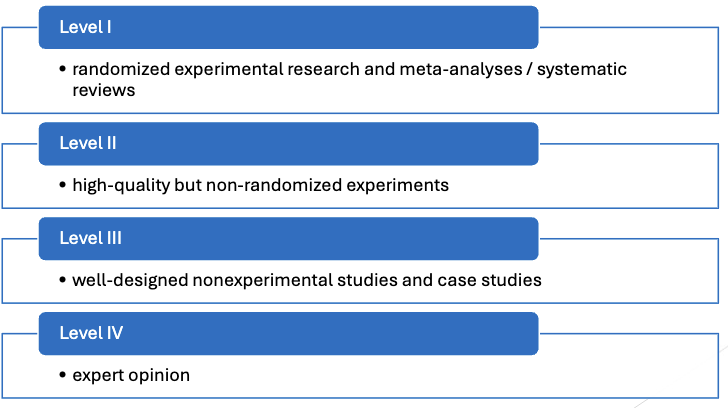
3 factors in research quality?
randomization, research bias, fidelity
Randomization ~ research quality
participants in study are randomly assigned to a treatment group or control group
Research bias ~ research quality
when researcher unconsciously inflates date
Fidelity ~ research quality
how faithfully the research was carried out
was the treatment aplied consistently to all participants?
Nature
language skills are innate, biological, and present from birth
Nurture
infants are blank slates who learn language through environment
Nature + Nurture
language capacity is innate but requires environmental influence to be activated and to develop
Behaviorism theory
learning occurs when environmental stimulus triggers response
positive and negative reinforcement
Who established behaviorism theory
B.F Skinner
Behaviorism clinical implications
discrete trial training, major component of ABA, prompts and prompt fading
What are limitations of behaviorism theory
doesnt account for novel utterances
drilling is less natural and results in poorer carryover
Antecedent
a stimulus that comes before a behaviors triggering the behavior
Extinction
when behavior is ignored instead of reinforces, it will decrease or disappear
Cognitive constructivist theory
development of cognitive skills, emphasis on reasoning and problem solving
playing and interacting with environment is how children learn and develop cognition
Who established cognitive constructivist theory
Jean Piaget
Schema
cognitive structures that help child interpret and understand the world
Assimilation
process of taking new info into pre-existing schemas
Accomodation
changing existing schema in light of new info
Disequilibrium
feeling when two schemas are contradictory and motivates child to higher levels of thinking
Clinical implications of cognitive constructivist theory
symbolic play, object permanence, means- end
Symbolic play
language is symbolic and representational
Object permanence
realizing an object still exists even when you cant see it
Means-end
identifying problem and making plan to solve it
I have to say something to get something
Limitations to cognitive constructivist theory
development through stages isn’t always linear
cant always account for why language doesn’t develop
Social interactionist theory
language is a means of making social connections
children develop language as they interact with adults and more developed peers
What is the main idea within social interactionist theory?
Zone of proximal development ZPD
Zone of proximal development
level just beyond what the child is able to do on their own
needs help from an adult to succeed
goldilocks zone
Who established social interactionist theory?
Lev Vygotsky
Clinical implications of social interactionist theory
incorporation of caregivers in therapy
focus on pragmatics and social interaction
Limitations of social interactionist theory
some cultures are less child-directed and those children still develop language
Emergentist Theory
language is a complex, interconnect system where the child’s innate language capacities interact with their environment
nature + nurture
children must be actively engaged in their environment
Clinical implications of emergentist theory
focus on specific language features to lead to broader language improvements
recasting
helps to understand L2 learning
What are the 5 communication subdomains
early pragmatics,
vocabulary development,
early word combinations,
morphosyntax development,
discourse (later pragmatics)
Subdomain 1: Early pragmatics skills (use)
social interaction
developing communicative intention
Subdomain 2: vocab development (content)
developing lexicon
receptive first, then expressive
Subdomain 3: early word combinations (form)
emergence of syntax
increasing meaning
Subdomain 4: morphosyntax development (form)
increasing language complexity
Subdomain 5: advanced pragmatics and discourse development (use)
discourse skills
3 types of assessment
static, dynamic, and naturalistic
Static assessments
results are just a snapshot in time
testing situation is not natural
what are the two types of static assessments
norm-referenced and criterion-referenced
Advantages to norm-referenced tests
objective,
easy to administer,
quantifiable results,
can compare child to norms
Disadvantages to norm-referenced tests
unfamiliar context
may not be true representation of abilities
often culturally biased
not helpful with significant language impairments