EU 6 - Council of the European Union
 Call Kai
 Learn
Learn Practice Test
 Spaced Repetition
 Match
Match Flashcards
 Knowt Play
1/7

There's no tags or description
Looks like no tags are added yet.
Name | Mastery | Learn | Test | Matching | Spaced | Call with Kai | Chat |
|---|
No analytics yet
Send a link to your students to track their progress
8 Terms
Council Presidency
Rotating-Presidency: 6-months once; Presidencies arranged into groupings of 3 states: „trio“
Current trio (Jul 2026 - Dec 2027): Ireland, Lithuania & Greece
Tasks of Presidency
Arrange & chair meetings at all levels
Compromise-building
Political leadership, but cannot openly pursue only national interests
Ensure continuity & consistency
Represent the Council
In relations with other EU institutions
In relations with third (non-member) countries
Council: Powers & Functions 1
Legislative: Negotiates & adopts EU laws (co-legislator with the European Parliament)
Budgetary: Adopts the EU budget, together with the European Parliament
Executive: Committees that work with the Commission; Declarations on foreign policy matters
Coordinating: Responsible for coordinating member states‘ policies in specific fields (economic & fiscal, education, employment, …) & co-operation between the national courts & co-operation between the national courts & police forces in criminal matters
Policy Development: Defines & implements EU foreign & security policy on the basis of guidelines set by the European Council
Council: Powers & Functions 2 - Role in International Agreements
provides the mandate to the Commission to negotiate international agreements on behalf of the EU
at the end of negotiations, the Council decides on the signature & conclusion of the agreement
adopts the final decision to conclude the agreement, once the Parliament has given its consent (required in areas subject to co-decision)
Can also adopt a decision to suspend the application of an international agreement or to terminate an agreement
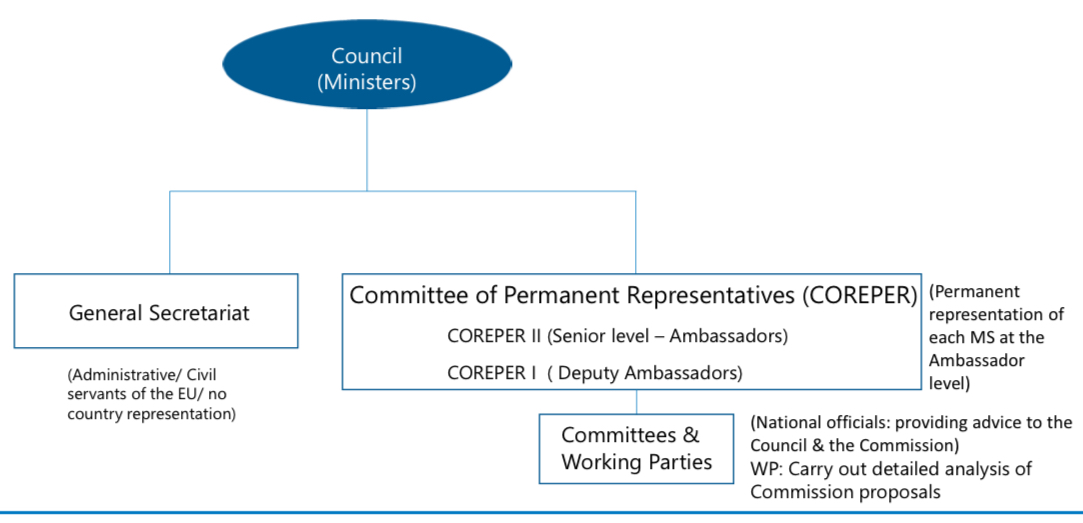
Council of the European Union
Council (Ministers)
Below:
General Secretariat (Administrative/Civil servants of the EU/no country representation)
Committee of Permanent Representatives (COREPER): Permanent representation of each MS at the Ambassador level; COREPER II (Senior level - Ambassadors); COREPER I (Deputy Ambassadors)
Below COREPER:
Committees & Working Parties: National officials - providing advice to the Council & the Commission; WP - Carry out detailed analysis of Commission proposals
How does the Council work?
Commission proposal at level: Working parties - experts from the member states
Coreper ambassadors
Decision adoption at level: Council ministers

Council Configurations/Formations
Agriculture and fisheries
Foreign affairs!
Economic and financial affairs
Education, youth, culture and sport
Employment, social policy, health and consumer affairs
Environment
General affairs!
Competitiveness
Justice and home affairs
Transport, telecommunications and energy
→ Ministers differ by policy expertise; different policy areas require different national ministers
→ Foreign Affairs Council (FAC) is chaired by the High Representative of the Union for Foreign Affairs & Security Policy (HR/VP) & General Affairs Council (GAC) coordinates different policy areas, institutional & administrative matters; preparing & following up on European Council meetings
Voting Procedure
Simple majority: for procedural questions (rarely used)
Unanimity: Tax harmonization, anti-discrimination legislation, amendments to treaties, launching a new common policy, accession to the EU
QMV: Majority of the decision-making happens through QMV (based on „double majority“) → approval of 55% of member states ( at least 15 states); approval of states that represent 65% of the Union‘s population; Blocking minority - at least 4 member states (35% of the population)
Critical Evaluation
Why might decision-making among 27 governments become difficult? → Different national interests, economy, migration, domestic politics, ideology…
Which countries usually cooperate more closely? → France-Germany, Nordics, Visegrad, Southern states…
Basis for coalition-building in the Council → For or against integration, big states (financial contribution) vs small, strong national parliaments vs weak, politicization of policy issue, left-right axis, issue-based interests
What happens if states cannot agree? → Delays, weaker laws, compromise, no-decision…
Ways to resolve gridlock → Bilateral meetings, package deals, limiting the scope of EU legislation, extending the transition period, coalition-buidling…