Study Guide K (test 2)
 Call Kai
 Learn
Learn Practice Test
 Spaced Repetition
 Match
Match Flashcards
 Knowt Play
1/167

There's no tags or description
Looks like no tags are added yet.
Name | Mastery | Learn | Test | Matching | Spaced | Call with Kai | Chat |
|---|
No analytics yet
Send a link to your students to track their progress
168 Terms
Is there enough blood to fill all capillaries?
no
Where must blood be delivered?
to organs and tissues where it is most needed and away from areas where it is not
What is local blood flow?
the blood delivery locally to the capillaries of a specific tissue and is measured in milliliters per minute
What is perfusion?
specific amount of blood entering capillaries per unit per gram of tissue
What is the degree of vascularization?
extent of blood vessel distribution within a tissue = the potential ability of blood delivery
What are some tissues that are well vascularized?
the brain, skeletal muscle, heart, liver
What are some tissues that are poorly vascularized?
tendons, ligaments
What are some tissues that are avascular?
mature cartilage, epithelial tissue
What is angiogenesis?
formation of new blood vessels in tissues that require them
Why is angiogenesis an active area of cancer reasearch?
to try and deprive it of oxygen and nutrients needed for growth
What is the myogenic response?
the contraction and relaxation of smooth tissue within blood vessels in response to changes in stretch of the blood vessel wall
What is the myogenic response to increase in blood pressure?
additional volume of blood to enter the blood vessel = increase in stretch of wall vasoconstriction
What is the myogenic response to decrease in blood pressure?
causes lower blood volume to enter blood vessel = decrease in stretch of wall = vasodilation
What are vasodilators?
substances that cause smooth muscle relaxation
which results in both vasodilation of arteriole and opening of precapillary sphincters
What are vasoconstrictors?
substances that cause smooth muscle contraction
both arterioles vasoconstriction and precapillary sphincters closing
= blood flow decreases into a capillary bed
What is autoregulation?
a tissue regulates or controls its local blood flow in response to its changing metabolic needs
What are some local substances that lead to vasodilation?
increase in CO2, lactate, H+, K+
What are some that lead to vasoconstriction?
decrease in CO2, lactate, H+, K+
What is an example of reactive hyperemia?
entering a warm room after being outside in the cold and your checks turn bright red
due to the increased blood flow in the dermis and the normal blood flow in the skin resumes
What is the role of histamine?
inflammatory mediators
response to trauma, allergic reaction, infection exercise → cause vasodilation
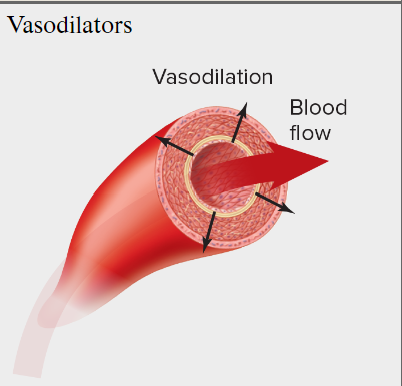
What are Local substances of vasodilators?
decreased oxygen levels
decreased nutrient levels
increased CO2, H+, K+, lactate levels
histamine, bradykinin, Nitric oxide, prostaglandins
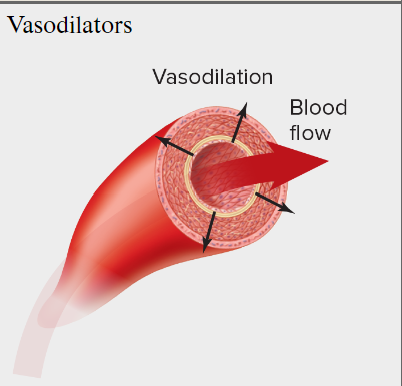
What are hormones and neurotransmitters of Vasodilators?
ANP, EPI
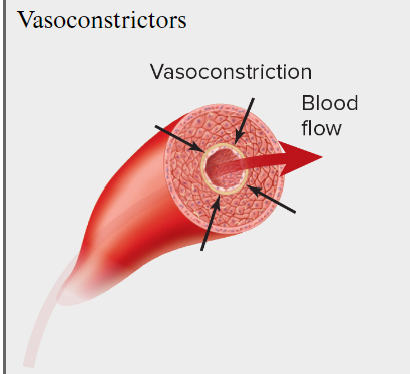
What are Local substances of Vasocontrictors’’?
increased O2 levels
increased nutrient levels
Decreased CO2, H+, K+, lactate levels
leukotrienes, thromboxanes, endothelins
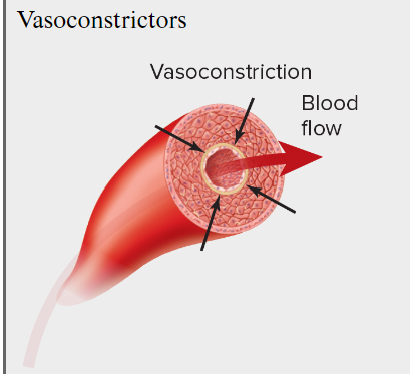
What are hormones and neurotransmitters of Vasoconstrictors?
Angiotensin II, aldosterone, ADH, Norepinephrine
Maintaining local blood flow depends on having _________ _________ blood flow
adequate total
What is total blood flow?
the amount of blood transported throughout the entire vasculature in a given period of time
What does total blood equal?
Cardiac output
What is blood pressure?
force per unit area that blood exerts against the inside wall of a vessel
What is the driving force that propels blood through the vessels?
blood pressure gradient
Why is blood flow pulsatile in arteries?
consequence of the ventricles contracting and relaxing
What is the systolic pressure?
contraction = max stretch
What is diastolic pressure?
relaxation = no more stretch
The average blood pressure is 201/80 mm Hg, what does each number represent?
201= systolic ( pulse pressure)
80= diastolic ( mean arterial pressure)
What is pulse pressure?
the additional pressure placed on the arteries from when the heart is resting to when its contracting
How is pulse pressure calculated?
difference btwn systolic ad diastolic
What is a pulse?
a rhythmic throbbing of an arterial wall as blood is being pumped through the vessel
How is a pulse detected?
across the body where an artery may be compressed against a bone or solid structure
What is the mean arterial pressure?
average of blood pressure on the arteries
How is the mean arterial pressure estimated?
diastolic pressure + 1/3 pulse pressure
Is the flow in capillaries pulsatile?
no
How does the blood pressure at the beginning of a capillary compare to the flow at the end of the capillary?
higher BP = filtration of arterial end abt 40
low BP = reabsorption of venous end below 20
Can you take a pulse using a vein? Why or why not?
no b/c blood is far removed from the pumping action of the heart
What are the two “pumps” that aid in the venous return of blood?
1. Skeletal muscle pump
2. Respiratory pump
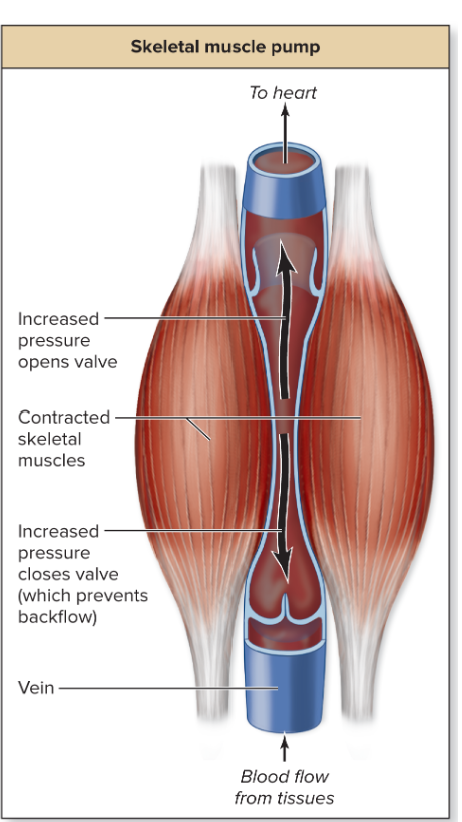
How does the Skeletal muscle pump work?
as skeletal muscles contract veins are squeezed to help propel blood toward the heart and valves prevent blood backflow
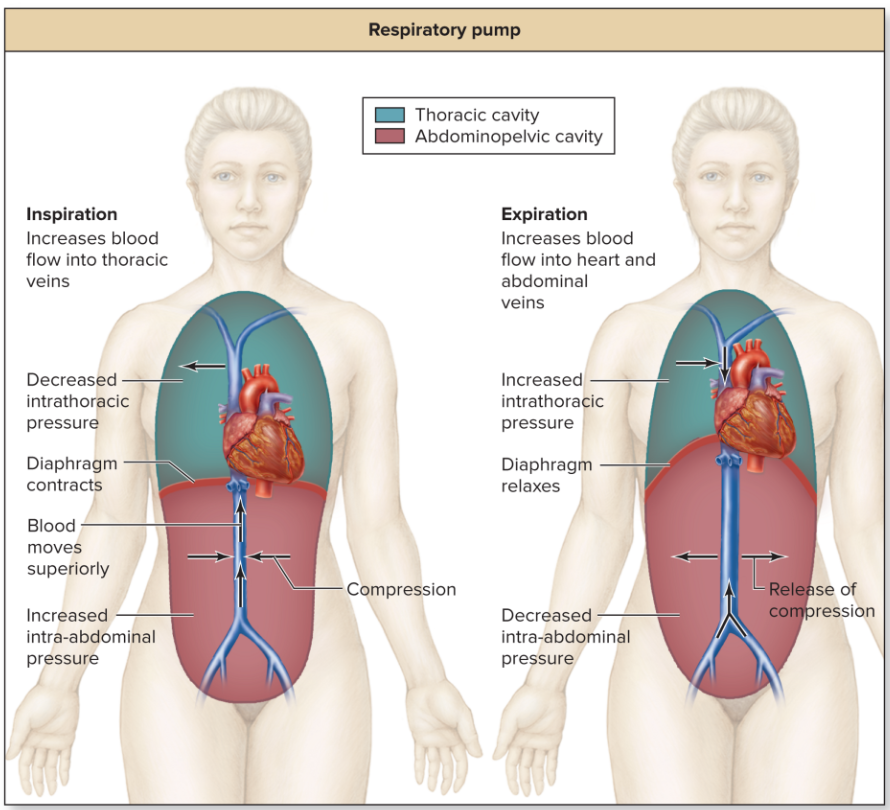
How does the Respiratory pump work?
inhale: diaphragm contracts and flattens, intra-abdominal pressure increases and places pressure on the vessels within the abdominal cavity as the thoracic cavity volume increases and intrathoracic pressure decreases and blood is propelled from vessels in abdominopelvic cavity into the vessels in the thoracic cavity
exhale: diaphragm relaxes and returns to its dome shape, thoracic cavity volume decreases and intrathoracic pressure increases which places pressure on vessels within the thoracic cavity. Blood moves from the vessels in the thoracic cavity back into the heart. As intra-abdominal pressure decreases allows blood to move from the lower limbs into the abdominal vessels
What are varicose veins?
dilated and tortuous
valves in these veins have become dysfunctional causing blood to pool to one area and the vein begins to swell and bulge
What structure in veins are nonfunctional in varicose veins?
valves
What is resistance?
amount of friction the blood experiences as it is transported through the blood vessels
How does resistance influence blood flow?
determines how fast or slow blood flows
What are three factors that impact peripheral resistance?
blood viscosity, blood vessel length, size of lumen blood vessels
What is viscosity?
resistance of fluid to its flow → “thickness” of a fluid
thicker the fluid = more viscous = greater its resistance to flow
thinner the fluid = less viscous = less resistance to flow
How does an increased viscosity impact resistance?
causes greater its resistance to flow
How does a decreased viscosity impact resistance?
causes less resistance to flow
What examples of anemia?
a lower than normal number of RBC and blood has less resistance to flow
What are examples of dehydration?
greater than normal RBC and blood has more resistance to flow
How does increasing vessel length impact resistance?
Describe an example of this.
longer vessels result in greater friction
ex: when a person gains a large amount of wright the body must produce miles of additional vessel length by angiogenesis for blood to be transported thus vessel resistance increases
What is the major way resistance is regulated by the body?
vessel radius
Write an equation to relate blood flow and the blood vessel radius.
f ~ r^4
(flow) ~ (radius)
Why does vasodilation and vasoconstriction have such a dramatic impact on blood flow?
dilation = greater flow
constriction = less flow
What is the equation for total blood flow?
flow ~ (P1-P2)/R
How is the blood pressure gradient related to blood flow?
directly proportional
What would lead to an increased blood pressure gradient flow?
increase total blood flow
What would lead to decreased blood pressure flow?
decrease blood flow
How is resistance related to blood flow?
inversely related
How would increased resistance impact flow?
decrease in blood flow
How would decreased resistance impact flow?
increase in blood flow
Explain why individuals with significant weight gain or atherosclerosis often have high blood pressure.
because a greater pressure gradient must be produced to overcome the higher resistance and ensure normal blood flow and adequate perfusion of all tissues
Why is it important to regulate blood pressure?
to maintain homeostasis
What part of the brain contains nuclei for ANS reflexes that regulate BP?
medulla oblongata
The cardioacceleratory center is associated with which ANS division?
sympathetic nervous system
What neurotransmitter does the cardioaccelerator center release?
norepinephrine
How does impact HR?
increases HR
How does impact stroke volume?
increases SV
What is impact on CO?
greater CO
The cardioinhibitory center is associated with which ANS division?
parasympathetic nervous system
What neurotransmitter does the cardioinhibitory center release?
acetylcholine
How does impact HR?
decrease HR
How does impact CO?
decreases CO
What is regulated by the vasomotor center?
degree of vasoconstriction and vasodilation of blood vessels
Do blood vessels have dual innervation? Explain.
no b/c only innervated by sympathetic division w/no innervation by parasympathetic division
What ANS division innervates blood vessels?
sympathetic division
When the SNS (and adrenal medulla) is activated how is Peripheral Resistance, circulating blood volume, and blood flow impacted?
increased PR, larger circulating BV, redistribution of blood flow
A barometer measures atmospheric pressure, a baroreceptor detects pressure where?
stretch of the blood vessel wall
Name two locations where baroreceptors are found.
aortic arch and carotid sinuses
Baroreceptors send signals to the ________________ _____________ in the ____________ ________________
cardiovascular center
medulla oblongata.
What are the ANS reflexes that involve blood pressure regulation?
baroreceptor reflexes
If BP decreases:
1. _______ stretch in aorta + carotid sinus
2. _______ signals sent to cardiovascular center
3. _________ sympathetic signals to heart; __________ parasympathetic. HR & SV __________. CO _________.
4. ___________ sympathetic signals to blood vessels. Vasoconstriction __________. PR ____________.
5. BP _____________ as a result.
1. less
2. fewer
3. increase, decrease, increase, increases
4. increase, increases, increases
5. increase
If BP increases:
1. ______ stretch in aorta + carotid sinus
2. ______ signals sent to cardiovascular center
3. ___________ sympathetic signals to heart; ____________ parasympathetic. HR, SV, CO _________.
4. ___________ sympathetic signals to blood vessels. Vasodilation _____________. PR ____________.
BP ____________ as a result.
1. increase
2. increase
3. decreases, increases, decrease
4. decrease, decrease, decrease
5. decrease
Where are chemoreceptors located?
What do they detect?
located: within the brain
detect: chemicals in fluids
Why would high CO2, and low oxygen levels stimulate vasoconstriction?
the levels would stimulate chemoreceptors and their increased firing would stimulate vasomotor center = constriction in this case to decrease the levels and return to homeostasis
The medulla has reflexes that regulate quick changes in BP. Other parts of the brain are involved as well. Give some examples.
increase in body temp, flight or fight result in hypothalamus increasing CO and resistance
anxiety = increase BP
limbic system = alters blood pressure in response to emotions or emotional memories
What are the three effects of angiotensin II.
vasoconstriction, stimulating thirst center, decreasing urine formation
How does aldosterone help maintain blood volume and blood pressure?
increasing absorption of Na+ and water in kidney
How does ADH help maintain blood volume and blood pressure?
increases absorption of water in kidney decreasing its loss in the urine
What is the source of ANP?
atrium
What is its stimulus for release?
stretch of the atrial walls due to increased BV and venous return
What is the effect of ANP?
stimulates vasodilation = decreases peripheral resistance
increase urine output = decreases BV
What are the three primary variables that influence blood pressure?
CO, resistance, BV
What instrument is used to measure BP?
sphygmomanometer
What is hypertension?
chronically elevated blood pressure