Brain and Behaviour - Chapter 1: The Cellular Foundations of behaviour
 Call Kai
 Learn
Learn Practice Test
 Spaced Repetition
 Match
Match Flashcards
 Knowt Play
1/93

There's no tags or description
Looks like no tags are added yet.
Name | Mastery | Learn | Test | Matching | Spaced | Call with Kai | Chat |
|---|
No analytics yet
Send a link to your students to track their progress
94 Terms
The mind–brain problem (mind–body) problem
The question of how and why certain types of brain activity are conscious.
Biological psychology
The study of the physiological, evolutionary, and developmental mechanisms of behavior and experience
Biological psychology (con’t)
Emphasizes that the goal is to relate biology to issues of psychology
Biological psychology (III)
Is also a point of view in that we think and act as we do because of brain mechanisms, and that we evolved those brain mechanisms because ancient animals built this way survived because of them
Where does perception occur?
Perception occurs solely in the brain
The thing about the bond between mental activity and certain types of brain activity
Both types of activity are inseparable
Monism
The idea that the universe consists of only one type of being.
Physiological explanation
Understanding and relating to the activity and behaviour of the brain and other organs
e.g. Exploring the chemical reactions that enable hormones to influence brain activity and the routes by which brain activity controls muscle contractions
Ontogenetic explanation
Describes how something develops
e.g. Examing behaviour at various ages and relating it to changes in the nervous system if we want to explain why males and females differ on average in some regard
Evolutionary explanation
Understanding and reconstructing in terms of the evolutionary history of a structure or behaviour
e.g. Bat wings are modified arms, and porcupine quills are modified hairs
Functional explanation
Describes and understands why a structure or behaviour evolved as it did
e.g. A dominant male with many offspring spreads all his genes, including some that may have been irrelevant or even disadvantageous
Why are biological psychologists and neuroscientists interested in nonhuman test subjects?
Many of the mechanisms of behavior are similar across species, and sometimes they are easier to study in a nonhuman species
We would like to understand how animals function in the dark
What we learn about animals sheds light on human evolution
Legal or ethical restrictions prevent certain kinds of research on humans
Minimalists
Those who accept certain types of animal research but not others depending on the probable value of the research, the amount of distress to the animal, and the type of animal
The three Rs
Reduction of animal numbers (using fewer animals)
Replacement (using computer models or other substitutes for animals, when possible)
Refinement (modifying the procedures to reduce pain and discomfort)
Abolitionists
Those who maintain that all animals have the same rights as humans and that it is wrong to use animals for research, as they can’t give consent
e.g. killing an animal as murder, keeping an animal in a cage is slavery, etc
Potential issues with human reseach
Obtaining informed consent
The economic status and diversity of the test subjects
Any behavioural changes from the experiments or treatment(s)
Dualism
The belief that mind and body are different kinds of substance that exist independently
Neurons
Cells varying in function and shape that receive information and transmit it to other cells, muscles, and glands
Who pioneered the field of neuroscience in the late 1800s and early 1900s
Charles Sherrington, and Santiago Ramón y Cajal
Cajal’s contribution
He combined art and medicine to make detailed drawings of the nervous system that are still considered definitive today.
Cajal’s contribution (con’)
Concluded that nerve cells remain separate instead of merging into one another, and that the brain does indeed consist of individual cells
Membrane
A structure that separates the inside of the cell from the outside environment and blocks the entry of chemicals
Nucleus
The cell’s core structure that contains the chromosomes
Ribosome
Structures that synthesize new protein molecules
Endoplasmic reticulum
A network of thin tubes that transport newly synthesized proteins to other locations.
Mitochondria
The powerhouse of the cell
Mitochondria (con’t)
Has its own own genes separate from those in the nucleus of a cell and is inheritable
Mitochondria and brain activity
Healthy mitochondria promote health, brain activity, and cognition as brain activity requires more energy than the activity of any other organ
Mitochondria and brain activity (con’t)
Impairments of mitochondria have also been linked to increased severity of epilepsy, Alzheimer’s disease, Parkinson’s disease, and Huntington’s disease
Motor neuron
A neuron that receives excitation from other neurons and conducts impulses to a muscle
Motor neuron (con’t)
Its soma is in the spinal cord
Sensory neuron
A neuron that is highly sensitive to a specific type of stimulation
e.g. Conducting sensory and perceptual information from a touch
Dendrites
The branching fibres (i.e tree branches) of the neuron that gather and receive communication from other neurons by
Dendritic spines
Short outgrowths that increase the surface area available for synapses
Soma (cell body)
Contains the nucleus, ribosomes, cell body and mitochondria of the neuron
Axon
A long structure that gives length to the neuron and carries information away from the neuron
Myelin sheath
A type of glial cell that insulates the axon to speed up communication and allow for faster reflexes.
Nodes of ranvier
Interruptions in the myelin sheath of vertebrate axons
Presynaptic terminal
The end point where an axon releases chemicals
Afferent axon
Brings information into a structure
e.g. Sensory neurons
Efferent axon
Carries information away from a structure
e.g. Motor neurons
Interneuron
A neuron whose axons and dendrites are all confined within a given structure (in this case the brain)
Intrinsic neuron
A neuron whose axons and dendrites are all confined within a given structure
Glia (nueroglia)
A type of cell in the nervous system that doesn’t conduct impulses over long distances
Astrocytes
Star-shaped glia that synchronize the activity of the axons and serve as a barrier to chemicals
e.g Breathing and nutrient distribution
Microglia
Cells that remove waste material, prune bad neurons, synapses and other microorganisms from the nervous system
Schwann cells
Glia cells in the periphery of the body that build myelin sheaths and supply nutrients to axons
Oligodendrocytes
Glia cells in the brain or spinal cord that build myelin sheaths and supply nutrients to axons
Oligodendrocytes and Schwann cells (con’t)
Oligodendrocytes respond to neural activity by altering the myelin sheaths, thereby altering the timing of axons’ responses
Radial glia
Guides the migration of neurons and their axons and dendrites during embryonic development.
Blood-Brain Barrier
The mechanism that excludes most chemicals from the vertebrate brain
How does the Blood-Brain Barrier work?
The body lines the brain’s blood vessels with tightly packed cells that keep out most viruses and bacteria
How does the Blood-Brain Barrier work? (con’t)
The brain’s microglia attack most viruses that enter the nervous system, mounting an inflammatory response that fights the virus without killing the neuron
How does the Blood-Brain Barrier work? (III)
It depends on the endothelial cells that form the walls of the capillaries
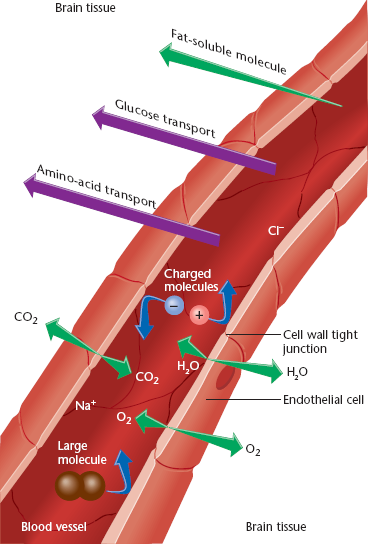
How does the Blood-Brain Barrier work? (IV)
Outside the brain, cells along the capillaries are separated by small gaps
Inside the brain, they join so tightly that they block almost anything from passing
Draw backs of the blood brain barrier
It can block useful chemicals in addition to harmful ones
Active transport
A protein-mediated process that expends energy to enable a molecule to cross a membrane and pass chemicals to the brain
Glucose
Simple sugar that’s relied on by vertebrate brain, cancer, and testis cells
How’s glucose made?
The liver makes glucose from many kinds of carbohydrates and amino acids, as well as from glycerol (a breakdown product from fats)
Thiamine
A B1 vitamin that’s necessary to use glucose
Consequences of thiamine deficiency
Can lead to death of neurons and a condition called Korsakoff’s syndrome (memory impairments)
Gut bacteria
Foreign cells that have many uses
e.g. Stimulating the vagus nerve (which runs from the intestines to the brain), releasing chemicals into the blood (e.g. vitamins and amino acids), and regulating moods
Electrical gradient (Polarization)
The difference in electrical charges between the inside and outside of the cell
Resting potential
The condition of a neuron’s membrane when it has not been stimulated or inhibited
Selectively permeable
A provided barrier that permits some chemicals to pass more readily than others
e.g. Oxygen and carbon dioxide freely pass through, while sodium and calcium pass through gates that are sometimes closed at rest

The sodium-potassium pump
A mechanism in the cell membrane that maintains resting potential by sending 3 sodium ions out for every potassium ion allowed in.
The sodium-potassium pump (con’t)
Sodium ions are more than 10 times more concentrated outside the membrane than inside, and potassium ions are more concentrated inside than outside
Concentration gradient
The difference in distribution of ions across the neuron’s membrane
The purpose of the resting potential
The resting potential prepares the neuron to respond rapidly
Action potential
A rapid, brief reversal of electrical charge across the membrane, shifting from −70 mV to +30 mV, which creates depolarization along the entire axon.
Hyperpolarization (inhibitory potential)
Increased polarization across a membrane
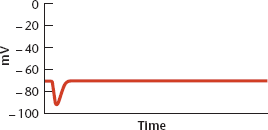
Depolarization (excitory potential)
To reduce polarization toward zero across a membrane

Depolarization (con’t)
With a slightly stronger depolarizing current, the potential rises slightly higher but again returns to the resting level
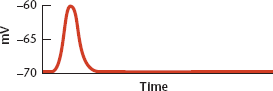
Threshold
When the membrane opens its sodium channels and permits sodium ions to flow into the cell, driving the membrane potential upward

Subthreshold
A stimulation that produces a small response that quickly decays
All-or-none law
The principle that if a neuron reaches the required threshold, an action potential will occur completely; if not, it will not fire at all.
The chemical events behind the action potential
At the start, sodium ions are mostly outside the neuron, and potassium ions are mostly inside.
Depolarizing the membrane opens the sodium and potassium channels.
At the peak of the action potential, the sodium channels close.
Voltage gated channels
A membrane channel whose permeability to sodium or potassium depends on the voltage difference across the membrane

Local anesthetic drugs
Drugs that attach to the sodium channels of the membrane, stopping action potentials
e.g. Novocain and Xylocaine
Propagation of the action potential
The transmission of an action potential down an axon
i.e. The action potential gives birth to a new action potential at each point along the axon
Refractory period
The time when the cell resists the production of further action potentials
Refractory period (con’t)
Depends on two facts:
The sodium channels are closed
Potassium is flowing out of the cell.
Absolute Refractory Period
The minimum length of time after an action potential during which another action potential cannot begin, allowing the cell to restore itself.
Relative refractory period
The time after the absolute refractory period that requires a stronger stimulus to initiate an action potential
Local neurons
Neurons without an axon and thus don’t produce action potentials nor follow the all-or-none law
Graded potential
A membrane potential that varies in magnitude in proportion to the intensity of the stimulus
Why are local neurons hard to study?
It’s almost impossible to insert an electrode into a tiny cell without damaging it
Myelin
An insulating material composed of fats and proteins that increases the speed of info passed along axons
Myelinated axons
Axons covered with myelin sheaths and are present only in vertebrates

Saltatory conduction
The jumping of action potentials from node to node

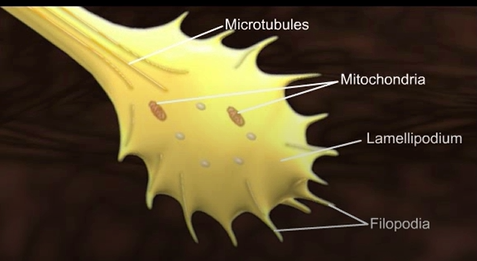
Growth cone
A swelling where developing axons and dendrites end
Growth cone (con’t)
Contains:
Mitochondria
Microtubules
Filopodia
Lamellipodium
Rising phase
The stage of an action potential characterized by massive depolarization as the membrane potential reaches 0 and becomes positive.
Falling phase
The part of the action potential associated with repolarization as potassium ions exit the neuron.