Lec 10 Inequality
 Call Kai
 Learn
Learn Practice Test
 Spaced Repetition
 Match
Match Flashcards
 Knowt Play
1/13

There's no tags or description
Looks like no tags are added yet.
Name | Mastery | Learn | Test | Matching | Spaced | Call with Kai | Chat |
|---|
No analytics yet
Send a link to your students to track their progress
14 Terms
measuring inequality
1 size distribution : share of total income received by different groups, ranked by their level of income
2 scalar measure of inequality : ratio of the share of income earned by the top 20% to share earned by bottom 20%
3 gini coeff
Gini coefficient
a measure of statistical dispersion : intended to represent the income or wealth distribution of a nation’s residents, is the most commonly used measure of inequality
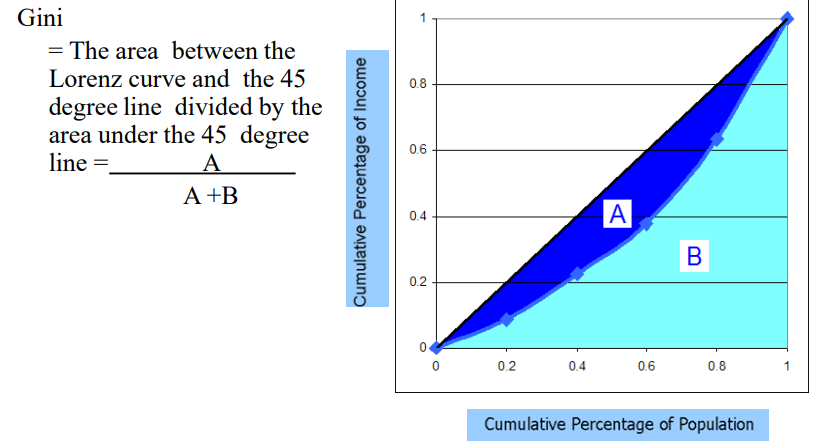
Gini low, medium and high inequality
low : < 0.4 → south and central asia, eastern europe and oecd economies
medium : 0.4<gini<0.5 → east asia,
high >0.5 → sount and central america, the caribbean, southern africa
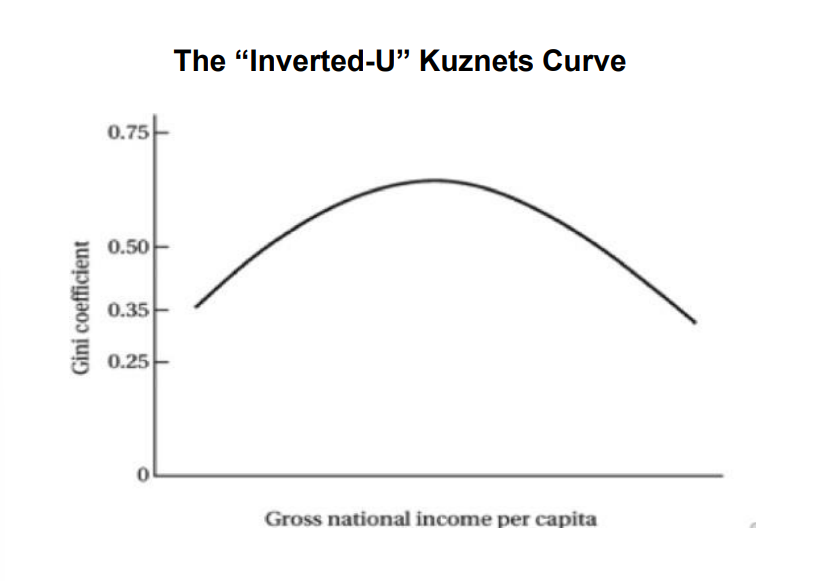
Kuznets hypothesis 1955
as a country develops, inequality will first rise and then fall
why
agriculture → industry
technological progress
income inequality first rises when new, higher productivity sectors emerge
but then decreases as more and more workers join the high-paying sectors
-mixed empirical evidence (inequality decline in us and other cuntries stopped almost immediatly after WW2)
poverty before reforms
there was considerable poverty in rural areas → ¼ rural population living below government-defined poverty line
→ majority of the poor located in the provinces situated in china’s western region
poverty post reforms
declined in rural and urban households
→ income growth reduces povertu, reduction in povertu is one of the greatest successes of china’s economic reform
international poverty line
the world bank internationally comparable poverty line
provide a common standard to evaluate povertu, “dollar a day” poverty line, → now 1.9 per day
the official chinese poverty line has evolved from one much lower than the world bank dollar a day line to an intermediate povertyy line to a more generous
why rural poverty declined considerably in the recent decades
rising agricultural incomes, → HRPS and technology
off-farm jobs and migration
agricultural policies → abolition of agricultural taxes + subsidies
welfare policies → basic minimum income support + medical assistance, elementary education
inequality patterns since the reforms
inequality has increased in rural and urban areas
→ income increases were more rapid for richer segments of the population
urban inequality pre reform era
people work in the traditional SOEs
compressed wage distributions, and a host of subsidies were publicly financed and allocated by work units
inequality urban area : what has changed
labor market changed :
more dispersed wage ladder,
the development of a vibrant private industrial and service sector → wage and labor determined by the market
food and housing subsidies were slashed in early 90s
restructuring of SOE’s → layoffs, unemployment ..
rural inequality pre reform
rural income distribution is determined by the people’s commune → income allocated by the production team on the basis of both household needs and accumulated work points
rural inequality what has changed
return to individual effort, talent and management skills
diversified sourced of incomes
development of off-farm opportunities TVE
migration
other business activitiues
policies in poverty reduction and reducing inequality
raising rural income → lower taxes, subsidizing
place-based poverty reduction programs
increasing transfers through the social welfare system