Women's health exam 2
 Call Kai
 Learn
Learn Practice Test
 Spaced Repetition
 Match
Match Flashcards
 Knowt Play
1/112

There's no tags or description
Looks like no tags are added yet.
Name | Mastery | Learn | Test | Matching | Spaced | Call with Kai | Chat |
|---|
No analytics yet
Send a link to your students to track their progress
113 Terms
started at vaginitis
vulvovaginitis
a spectrum of condition that cause vaginal or vulvar itching burning, irritation, and abnorm discharge
commonly caused by bacterial vaginosis, candida, and trichomoniasis
from the alteration of the normal flora
not currently consider a STI
risk factors: sex, other ST, douching, and smoking
presentation of bacterial vaginosis
presentation: mild vaginal irritation, thin white or yellow discharge
amine like fishy order = + whiff test
dx and tx of bacterial vaginosis
dx: gold standard is gram stain, more often done via KOH/wet prep
Amsel criteria: (needs 3 of the 4)
abnormal high pH over 4.5
abnormal think, grey white discharge
+ whiff test
presence of clue cells greater than 20% epithelial cells
tx= metronidazole, clindamycin, metronidazole gel
complications of bacterial vaginosis
increase risk of PROM, and preterm delivery
associated with PID and post op infection
increase risk of inquiring an STI
tx of partners does not always prevent recurrence
candidiasis presentation
often time the tissue is red and there is a orderless cotton cheese discharge
itching is the big sx but can also have burning, dysuria, dyspareunia
candidiasis dx and tx
NAAT
budding yeast, pseudohyphea under microscopy
pH 4-4.5
tx with one dose of fluconazole or topical imidazole’s (miconazole, clotrimazole) for seven days
if it severe three doses fluconazole three days apart
if reccurrent candidiasis
think autoimmune,DM get A1C
trichomonas vulvovaginitis
from the unicellular flagellate protozoan trichomonas vaginalis
can infect the urogenital tract in both men and women
most common nonviral STI in the world
presents with frothy, thin, green-yellow, can have vulvar pruritic burning can have vaginal or cervical erythema with small petechiae with strawberry spots
dx and tx of trichomal vulvovaginitis
pH less than 4.5
microscopy showing motile organism with flagella in saline or + NAAT
women diagnosed should be screened for other STI
tx: diagnoise both partners at the same time (sx or not) females get metronidazole 7 days and men get metronidazole one dose + no sex until both partners get treated and no longer have sx.
repeat testing 3wks to 3 months after treatment
atrophic vaginitis
atrophy of the vagina epithelium due to a decrease in estrogen
pH is less than 4.7
sx: decrease discharge, dryness, itch/burn, urinary urgency and increase frequency, incontinence
dx: clinical
tx: hyaluronic acid as vaginal moisturizer and lubricants like astroglide
subsequent tx can be low dose estrogen but CI in endometrial cancer
chlamydia
the most frequent reported STI in US
can be asymptomatic - annual screening for any women less than 24
mucopurulent discharge - green or yellow and can also have cervical friability causing vaginal bleeding
extragenital sx: reactive arthritis (cant see, pee, climb a tree) proctitis, conjunctivitis
sx: NAAT
can also have annually and orally
chlamydia tx
doxy if pregno azithromycin
repeat testing in 3 months unless they are pregno or concern for adherence than retest 4 wks
chlamydia complications
PID
ectopic pregnancy
salpingitis
transmission to fetus
conjunctivitis
Gonorrhea
mucopurulent discharge - that is green/yellow can also have vaginal bleeding due to cervical friability
can also have inflammation of Bartholin gland, rectal proctitis and pharyngitis
NAAT testing
tx: ceftriaxone single dose and repeat testing 3 months or TOC is sx persist, if there is an oropharyngeal infx
no sex until tx is complete and partners are treated
complication of gonorrhea
conjunctivitis, salpingitis (Inflammation of the fallopian tubes), PID, and infertility. Preterm delivery, PROM, spontaneous abortion
soutine screening sexually active acitive women
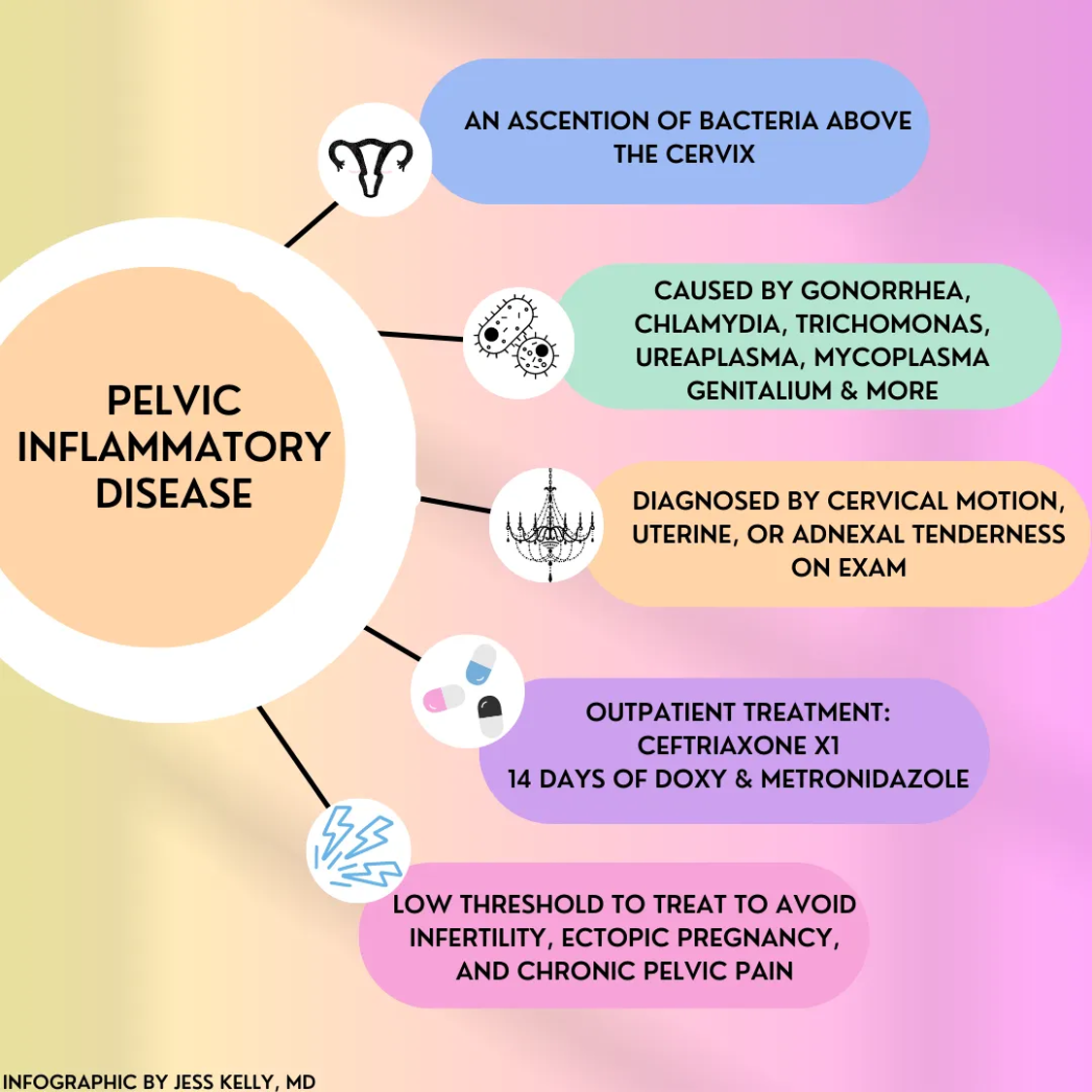
PID
upper genital tract infection (endometrium, tubes, ovaries, and pelvic peritoneum
presentation: lower abdominal pain, abnormal uterine bleeding, abnormal vaginal, fever many be subtle with postcoital bleeding and urinary frequency.
dx: cervical motion, uterine or adnexal tenderness
is patient presents with RUQ
could be possible perihepatitis (fitz-hugh-curtis syndrome)
w/u pelvic inflammatory dx
pregnancy test
microscopy of vaginal discharge (wet prep)
NAAT for gonohrea, chlamydia, syphilis, and mycoplasma genitalium
CBC, CRP, ESR
pelvic ultrasound
when to admit for PID
Suspected pelvic abscess
The patient is pregnant
The patient cannot follow or tolerate an outpatient regimen
The patient has not responded clinically to outpatient therapy within 72hrs
The patient has severe illness, nausea and vomiting, or high fever
Another surgical emergency, such as appendicitis, cannot be ruled out
tx for PID
IM ceftriaxone plus PO doxy plus PO metronidazole
close follow up within 42-72 hours needed
if prego 2 gen cephalosporin and azithro
make sure they have had testing for gonorrhea, syphilis, and HIV
complication of PID
infertility and ectopic pregnancy
Fitz hugh-curtis syndrome (involving inflammation of the liver capsule and surrounding peritoneum)
tubo-ovarian abcess
chronic pelvic pain, repeated infections, dyspareunia (recurrent pain with sex)
genital herpes
HSV -2 remains dormant in dorsal root ganglia
can still be spread during asymptomatic shedding
triggers for recurrence: stress, sun exposure, trauma, fever, viral infection, immunosuppression
lesions are tender, small grouped vesicles on an erythematous base and transition to ulcers
there will be pain and flu like sx with initial infection
genital herpes testing and tx
PCR testing
can do serological testing how has had neg HSV or PCR but hx of lesions
tx: valacyclovir ideally within 72 hrs of lesion appearance
suppressive th can decrease frequency only for severe or reduce risk to partner
Complications of herpes
aseptic meningitis, urinary retention, sacral radiculitis
when pt is pregno start suppressive therapy at 36 weeks if they have an active lesion or prodrome at tome of delivery they must have c section to prevent transmission
HPV
virus that only affects humans high risk 16 and 18
clinical presentation: condyloma acuminata- anogenital warts they are soft
there can also be cervical dysplasia/ cancer almost asymptomatic and not visible on speculum exam
dx: cytology on pap smear or clinical
tx: chemical tx like imiquimod, fluorouracil, cyro (preferred in pregnancy)
know NSAID
wet pt
pharm
HPV complications
progression to cancer
HPV vaccine important starting at age 11
syphilis
organism: treponema
primary: painless chancre at site of inoculation and reginal lymphadenopathy (avg 21 days after exposure)
secondary: 4-10 wks with constitutional sx sore throat, fever, weight loss, HA, rash, and more
early latent: within one year but no sx***
late tertiary syphilis (tertiary) 1-30 yrs and cause gummatous and aortitis, CNS affects
late latent sypohilis: no sx but present over one year**
syphilis dx
presumptive dx can be made with non-treponemal testing
VDRL and RPR test
start with RPR test and if positive then do the treponemal test for confirmation
tx of syphilis
for primary, secondary, and early latent: penicillin G Benzathine once
if tertiary or late latent do once weekly for three weeks
common reaction to tx= jarisch-herzheimer rxn that is fever, HA, and myalgias, diaphoresis, rigors within 24 hours
in responded to tx the titer should fourfold decline if not there is tx failure repeat RPR 6, 12months and again at 25 for late syphilis
syphilis screening
all pregno patients between 28-32 weeks
any symptomatic pt
asymptomatic pt if high risk:
•Sexual partner with syphilis
•MSM
•HIV+
•On PrEP
•High risk sexual activity
•Hx of incarceration or commercial sex work
•Age 15-44 living in county with syphilis rate > 4.6/100,000 females
what is a medication that can prevent syphilis
doxy-PEP
doxy one times dose within 72 hrs of sexual intercourse
Lymphogranuloma venereum
genital ulcer disease caused by chlamydia trachomatis (different strain than chlamydia so two different things)
painless small genital ulcer/papules and lymphadenopathy 206 weeks later
dx: clinical plus c. trachomatis NAAT
tx: doxy unless pregno than azithro
repeat testing in 3 months plus partners should be tx
complications of Lymphogranuloma venereum
anal fistulas and strictures
what diseases are reportable
•Gonorrhea
•Chlamydia
•Syphilis
•HIV
•Chancroid
•LGV Lymphogranuloma venereum
chancriod
bacteria that causes genital ulcer and is more common in developing countries
causes by Haemophilus ducreyi often coinfection with HSV or T. pallidum
painful genital ulcer plus or minus inguinal lymphadenopathy
dx: clinical most places can not test for H. ducreyi but can make a probable dx from having all of the following:
painful genital ulcer (one or many)
no evidence of syphilis
typical presentation
beg HSV-1 OR HSV-2 NAAT or culture
tx and complications of chancroid
tx single dose of azithromycin may have to drain nodes and tx partners if contact within 10 days of sx and no sex until ucler is dried and resolved
complications: easier to get or transmit HIV
Bartholin gland cyst and abscess
4 and 8 in the vulvar vestibule can be painful and can lead to secondary infection where there is an abcess formation
present as a soft non tender mass when it is a cyst
severe pain, dyspareunia, soft tender, warm, fluctuant, edema, and erythema when it has developed to an abscess
dx: clinical and if purulent drain and culture
tx of Bartholin gland and cyst
•Small cyst <3cm: sitz bath, warm compress
•Small abscess <3cm: I&D + sitz bath, warm compresses
•Large mass ≥ 3cm: I&D + placement of word catheter
•Role of antibiotics: NOT routinely recommended unless recurrent or large mass with risk factors (immunocompromised, DM, etc.)
•Biopsy recommended when:
•Solid component, fixed to surrounding tissue, persists despite tx, or if the pt is post-menopausal (increased malignancy risk!)
You are so
smart
review risk at beginning of power point
21-29 year old screening HPV
cytology alone
30-65 HPV
if low to normal risk do HPV every five years -recommended
or cytology every 3 years
can do a home collected method
over 65 years HPV screening
can stop if last three consecutive negative cytology in the past ten years
or two negative combined test in the last ten year
or if hysterectomy non related to malignancy( if it was you still get cells from that general area)
High risk patient for decrease clearance rates of HPV
HIV
immunosuppressant drugs
…
if they are high risk you can look up specific guidelines for their condition
screening for high risk patient
primary HPV testing is not approved for those who are immunocompromised
visual inspect of the anus, vaginia, and volva annually
must do cytology every year for three years before moving to every three year
co testing every three years
never stop screening, continue longer than 65
disparities in cervical cancer
black women are 60% more likely to die of cervical cancer
1 and 10 women have never had a Pap test or OBYGN
31,31,58 HPV
cause 30% of cervical cancer
who gets three doses of Gardasil 9 vaccine
older than 15 or immunosuppressed
colposcopy
to view to cervix, vagina, vulva, anus stains cells
used for gross lesions, producers, post tx surveillance
complications: bleeding, infection - do not due with anticoag or when there is an active infection
CI for colposcopy
…
what is used to treat abnormal cervical cells
cone biopsy, cold knife conization or LEEP or laser vaporiztion/ conization or cryo or D&C
remove part of the cervix with abnormal cells
done under anesthetia
cone biopsy, cold knife conization complications
bleeding
uterine perforation
infection
cervical insufficiency
cervical stenosis
what is the MC follow up to abnormal PAP result
colposcopy
LEEP
also used for warts. polyps
excisional procedure with a heated wired done in office
same complications as knife
CI: pregnancy, unless stronge suspicion of invasive cancer
laser vaporization/conization
…
cryo
use NO to freeze and destroy abnormal cells
in office
used in CIN and genital warts
comp: spotting, dizzy, infection, and post op cramping
CI: preg
Dilator and curettage D&C
anesthesia
cervical dilator
unable to tolerate biopsy, post menopausal bleed in, to exclude endometrial carcinoma, can be used to manage abnormal uterine bleeding, abortions, removal of molar pregnancy
Dilator and curettage D&C comps and CI
what is cervical intraepithelial neoplasia
prescurion lesion of the uterine cervix that may progress to cervical cancer
CIN refers to squamous abnormalities in the ectocervix
where do 90% of neoplasia arise from (what area)
squamocolumnar junction SCJ which is part of the transformation zone
risk factors for CIN
immunosuppressant chronic renal failure Hodgkin lymphoma
cig smoking multiple partners
chlamydia and oral contraceptives
CIN 1
low grade lesion
mildly atypical cellular changes in the lower third epithelium
HPV cytopathic effect often present
CIN 2
high grade lesion
mod atypical cellular changes confined to the basal two thirds of the epithelium with preservation of epithelial maturation considerable varability in this category
CIN 3
high grade lesion
atypical cellular changes encompassing greater than two thirds of the epithelial thickness and includes full thickness lesions
what system is used to classify cytology results
Bethesda
what is the lowest grade of cell abnormalities in bethesda scale
ASC-US
atypical cells of undetermined significance most common
ASC-H
atypical squamous cells, cannot exclude high grade squamous intraepithelial lesions
LSIL
low grade squamous intraepithelial lesions
HSIL
high grade squamous intraepithelial lesions
what is the highest grade you can get in PAP interpretation
squamous cell carcinoma
what are the endo cervix abnormalities
atypical glandular cells
endocervical adenocarcinoma in situ - glandular precursor lesion
adenocarcinoma
get the mobile app for when to the
the management for abnormal PAP is dependent on
patient risk of developing CIN 3+, adenocarcinoma in situ, and invasive cancer
there fives year risk will be calculated and based on % risk has different management options
•A patient's risk of developing CIN 3+ is determined by their current HPV and cytology results as well as past screening and clinical history, if known
means that the: •The same current screening results may lead to a different management recommendation for one patient versus another patient, depending on past testing results.
what does an unsatisfactory lab results mean
the lab can not provide conclusive result and requires repeat screening or colposcopy
if patient is under 25 years of age
very high rates of spontaneous HPV so it takes more to get colposcopy
acute cervicitis
can be infection and non ( non from trauma, condom, tampon, diaphragm, foreign object)
infectious with strawberry spots thick trichomanias
on PE mucopurulent discharge, friability, edema, and cervical motion tenderness and PID
Nabothian cyst
could be post trauma or birth is when columnar epithelial becomes covered with squamous cells and secrete mucoid material
On PE: translucent or opaque yellow cyst
tx: is symptomatic use ablation to tx or if dx is unclear excise to r/o cervical neoplasia
what confirms the presence and shows severity of CIN
colposcopy
CIN management for pt under 25
CIN 1 with preceding lesions (ASC-US, LSIL, ASC-H, HSIL): Observation >Treatment, f/u depends on preceding cytology
CIN 2: Observation preferred, treatment is acceptable
- 60% of lesions will regress by 24mths
- generally recommend f/u with cytology and colposcopy at 6 and 12 months
CIN 3: Treatment (CIN 3 is a direct precursor to cervical cancer)
DO CIN results affect when HPV vaccine should be offered
NO all pt who are candidates for vaccinations regardless of CIN hx the vaccine will not be therapeutic on preexisting HPV or CIN but associated with lower rates of recurrence
CIN management when 25 and older
New-onset CIN 1 and preceding ASCUS, LSIL, or ASC-H: Observation > treatment
- 90% will regress to negative or remain CIN1, generally recommend f/u HPV testing 12mths
Persistent CIN 1 (≥2yrs): observation preferred, treatment acceptable
CIN 1 and preceding HSIL, or CIN2: Treatment or observation acceptable, For most patients, sources recommend treatment.
*pts who desire future childbearing & w/ concerns for adverse obstetric outcomes, observation reasonable
CIN 3 – Treatment
tx for acute cervicitis
cover STI empirically
•Chlamydia – Doxycycline PO 100 mg BID x 7 days (tx sex partners!)
•Gonorrhea – Ceftriaxone 500 mg-1g (weight based) IM x 1 (treat sex partners!)
•M.genitalium – Doxycycline 100 mg PO BID x 7 days followed by Moxifloxacin 400 mg PO QD x 7 days
•Trichomoniasis – Metronidazole 500mg PO BID x 7 days (treat sex partners!)
•HSV – antiviral (Acyclovir, Famicyclovir, Valacyclovir) for 7-10 days
•BV- Metronidazole 500mg BID x 7dys or Metronidazole 0.75% gel daily x 5 days
cervical polyps
findings on cervix: single or multiple tear shaped or lobular pedunculated structures arising from the endocervical canal. Red, purple, or flesh colored that looks succulent and glistening.
tx: polypectomy is symptomatic (bleeding, discharge) larger than 3 cm, atypical , post menopausal with risk factors for endometrial cancer so like obesity, DM, tamoxifen use, fam hx. If removed always send to pathology for histology study
cervical stenosis
from , infx, menopause, cervical cancer, radiation trauma or prior surgery
pr: can obstruct mensural flow or sperm entering uterus
dx: inability to pass small cervical dilator through cervical os
tx: increase dilator weekly for 2-3 months can use ripening agents such as misoprostol (prostaglandins)
what organ disease is a risk factor for CIN
renal disease Uremia (the buildup of toxins in the blood) and nutritional deficits in CRF impair T-cell function and natural killer cell activity. This directly prevents the immune system from mounting an effective attack against HPV-infected cervical cells
What is the most common and most useful technique employed for evaluation of obstetric and gyneo condition
pelvic and transvaginal ultrasound
what are the harmful effects of transvaginal ultrasound
nor harmful effects when used appropriately
what is a endometrial biopsy
a catheter is inserted into the uterus through the vagina to remove cells from the uterine lining for examination
when to do an endometrial biopsy
AUB, abnormal pap, atypical glandular cells, adenocarcinoma in situ, endometrial hyperplasia, screening high risk pt, endometritis
CI for endometrial biopsy
pregnancy and acute infection/bleeding diathesis (high risk of bleeding)
what is the anesthesia for endometrial biopsy and when would you use a endometrial brush
NSAID 30-60 minutes prior can do a paracervical block or intrauterine instillation
and you use a brush in post menopausal pt can be used in combination with low pressure suction device
side effects of endometrial biopsy
cramping, vasovagal, reaction, uterine perforation
what are common indications of hysterectomy
leiomyomas, adenomyosis, AUB, endo, uterine prolaspse, maligancy
partial v complete hysterectomy
partial leaves the cervix and complete is cervix removed
what is the pre-op for hysterectomy
antibiotic prophylaxis and thromboprophylaxis (postoperative pelvic infections and deep vein blood clots they will have the injury, hypercoagulability (from surgery) and statis of the triad)
different approaches to the hysterectomy
-vaginal: preferred as it is shorter, faster recovery and low cost,\. C: hemorrhage, UTI, reoperation'
- laparoscopic: same day discharge of no complications but common comp is conversion to laparotomy, hemorrhage, urinary tract injury, vaginal cuff, and bowel injury
-open goes in supraumbilical complications are hem, urinary tract damage, bowel injury 2-4 hospital day stay
laparoscopy v. laparotomy
laparoscopy: min invasive using small incision and laparoscope to visualize abdominal organs and perform surgery
less post op pain, shorter or tome and perform a more extensive procedure
Laparotomy: larger incision to directly access abdomen and perform more extensive procedure
hysterospalpingography
outpatient fluoroscopy eval uterine cavity and fallopian tube patency, common with infertility evaluation, suspected congenital anomalies, preprocedural planning. CI are pregno, active undiagnosed bleeding, acute pelvic infection, hx of mod-severe rxn to iodinated contrast. SE mild cramps, leaking of contrast, mild bleeding