Chem 1 Test 1
 Call Kai
 Learn
Learn Practice Test
 Spaced Repetition
 Match
Match Flashcards
 Knowt Play
1/198

Earn XP
Description and Tags
Includes info on Mathematics in Chemistry, Matter Property, Atomic Theory & Subatomic Particles, Atomic Weight & Mole, Light & Photoelectric Effect, and Quantum Theory
Name | Mastery | Learn | Test | Matching | Spaced | Call with Kai | Chat |
|---|
No analytics yet
Send a link to your students to track their progress
199 Terms
All measurements consist of how many parts?
2
1st Part of Measurement
Numerical value
2nd Part of Measurement
Scalar or unit
1st Thing Numerical Values Reflect
The precision of the instrument used to make the measurement (Quantitatve)
2nd Thing Numerical Values Reflect
the type of data and measurements collected (Qualitative)
qualitative
observations
quantitative
Precision & Accurcay
In Scientific Notation, if the decimal is moved left
The exponent is positive
In Scientific Notation, if the decimal is moved to the right
The exponent is negative
Significant figures (S.F.)
Minimum number of digits needed to write a given values in scientific notation without loss of precision
How many significant figures in 0.0009205?
4
1st Type of Significant Values
Non-zero integers
2nd Type of Significant Values
Captive zeroes
3rd Type of Significant Values
Trailing zeros to the right of a decimal point
What type of trailing zeros are significant?
Trailing zeros to the right of the decimal point
Captive zeroes
A zero that us between 2 non-zero digits in a number
1st Type of Non-significant values
Leading zeroes
2nd Type of Non-significant values
Trailing zeroes to the left of the decimal can be nonsignificant
When are trailing zeroes significant?
Only if the decimal is at the right of the decimal point

When do you round up to find the correct number of SF?
If the number next to it is greater than 5

When do you round down to find the correct number of SF?
If the number next to it is less than 5

When your rounding for correct S.F., what do you do when the number next to it is 5?
You HAVE to round to the nearest even number
During calculations, when do you round?
ONLY at the final answer
For addition or subtraction, what place are answers rounded to?
The fewest number of decimal places
For multiplication or division, what place are answers rounded to?
Number of digits in the number with the fewest S.F.
What is the unit of length?
Meter (m)
What is the unit of mass?
Kilogram (kg)
What is the unit of time?
Second (s)
What is the unit of current?
Ampere (A)
What is the unit of temperature?
Kelvin(K)
What is the unit for amount substance?
Mole (mol)
What is the numerical value in scientific notation of a kilo?
10³
What is the numerical value in scientific notation of a mega?
10^6
What is the numerical value in scientific notation of a centi?
10^-2
What is the numerical value in scientific notation of a milli?
10^-3
What is the numerical value in scientific notation of a micro(µ)?
10^-6
What is the numerical value in scientific notation of a nano?
10^-9
100 cm=
1 m
2.54 cm=
1 in
I mol=
6.02 × 10²³
Accuracy
How close the measurement is to the accepted or “true values”
Precision
How similar/close the measured values are to each other
What is the precison of a measurement dependent on?
The device (i.e.. glassware, tape)
1st Type of Properties
Physical Properties
2nd Type of Properties
Chemical Properties
Physical Properties
characteristic of a substance that you can observe or measure without changing the identity of the substance
Examples of physical properties
Boiling point, density, mass, or volume
Chemical Properites
characteristic of a substance that can only be observed or measured when it undergoes a chemical change
Examples of chemical properties
Flammability, corrosiveness, or reactivity with acid
Density
The relationship between the mass of the substance and how much space it takes up (volume)
1st Type of Changes
Physical Changes
2nd Type of Changes
Chemical Changes
Physical Changes
Changes in matter that DON’T change the composition of a substance
Example of physical changes
Changes of shape, temperature, and volume
Chemical Changes
Result in new substances
Element
A pure substance made of only 1 type of atom
Can elements be broken down?
No
What are example of elements?
Gold (Au), oxygen (O2) and carbon (C)
Compound
Pure substance made of 2 or more elements chemically bonded
How can compounds be broken down?
Only by chemical reaction
What at are examples of compounds?
Water (H2O) and table salt (NaCl)
Homogenous Mixture
Physical combination of substances with a uniform composition throughout, look the same everywhere
Can you see the individual parts of a homogenous mixture?
No
What are homogenous mixtures also called?
Solutions
What are examples of homogenous mixtures?
Salt water, air, and brass
Heterogenous Micture
Physical combination of substances with non-uniform composition throughout
Can you see the layers in heterogenous mixtures?
Yes
Can heterogenous mixtures be seperated?
Yes, physically
What are examples of heterogenous mixtures?
Oil and Water, salad, and and mixed with water

What are the main ways we classify all matter?
Wether they are elements, compounds, homogenous mixtures, or heterogenous
Example of chemical changes
Combustion, oxidation, and decomposition
Dalton’s Atomic Theory of Matter (1803)
The first complete scientific attempt to explain all matter in terms of tiny, indivisible building blocks
1st “Rule” of Dalton’s Atomic Theory
Matter is made of small, discrete, indivisible pieces called atoms.
2nd “Rule” of Dalton’s Atomic Theory
All atoms of an element are identical
3rd “Rule” of Dalton’s Atomic Theory
Atoms combine in small whole-number ratios to form compounds
4th “Rule” of Dalton’s Atomic Theory
Atoms of one element cannot become atoms of another element. Chemical reactions rearrange atoms to form new substances
What does Micheal Faraday’s work suggest?
the electrical nature of matter and the existence of subatomic particles.
How did J.J. Thompson contribute to electron knowledge?
He identified Cathode Rays as electrons and established they carry a negative electrical charge.

What did J.J Thompson and Lord Kelvin propose about a atom?
Atoms are neutral, so the electrons must be suspended in a blob of positive charged “other bits”—plum pudding model

Rutherford’s Gold foil experiment (1911)
Rutherford Geiger and Marsden shoot alpha particles at gold foil and reimagine the inside of atoms as a empty space with dense nucleus
What did the Rutherford Gold foil experiment propose about the arrangement of atoms?
A solar system model
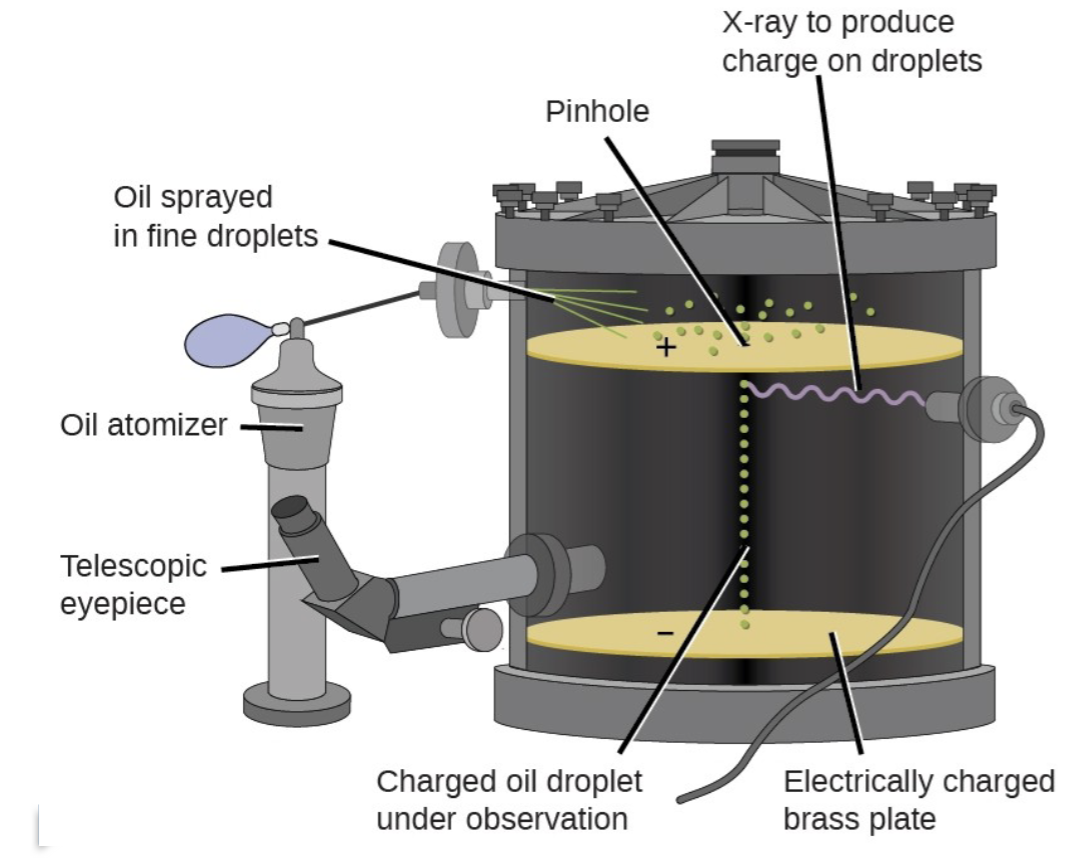
What did Robert Millikan’s work discover?
The mass of electrons and the smallest unit of electric charge
What is the smallest unit of electric charge?
9.107 × 10^-31 kg
1st “Rule” of Atomic Theory
Matter must have large regions of empty space dotted with small regions of very dense matter possessing a positive electrical charge (Proton in the nucleus)
2nd “Rule” of Atomic Theory
The nucleus of an atom is dense and contains most of the mass of the atom
3rd “Rule” of Atomic Theory
Negatively charged electrons surround the nucleus
4th “Rule” of Atomic Theory
positively charged subatomic particle, the PROTON is located in the nucleus.
Atomic Number (Z)
Number of protons or electrons
Mass Number (A)
Number of proton + number of neutrons
how do find the number of neutrons?
Subtract A from Z
Cation
More protons and electrons, giving it a positive charge
Anion
More electrons than protons, giving it a negative charge
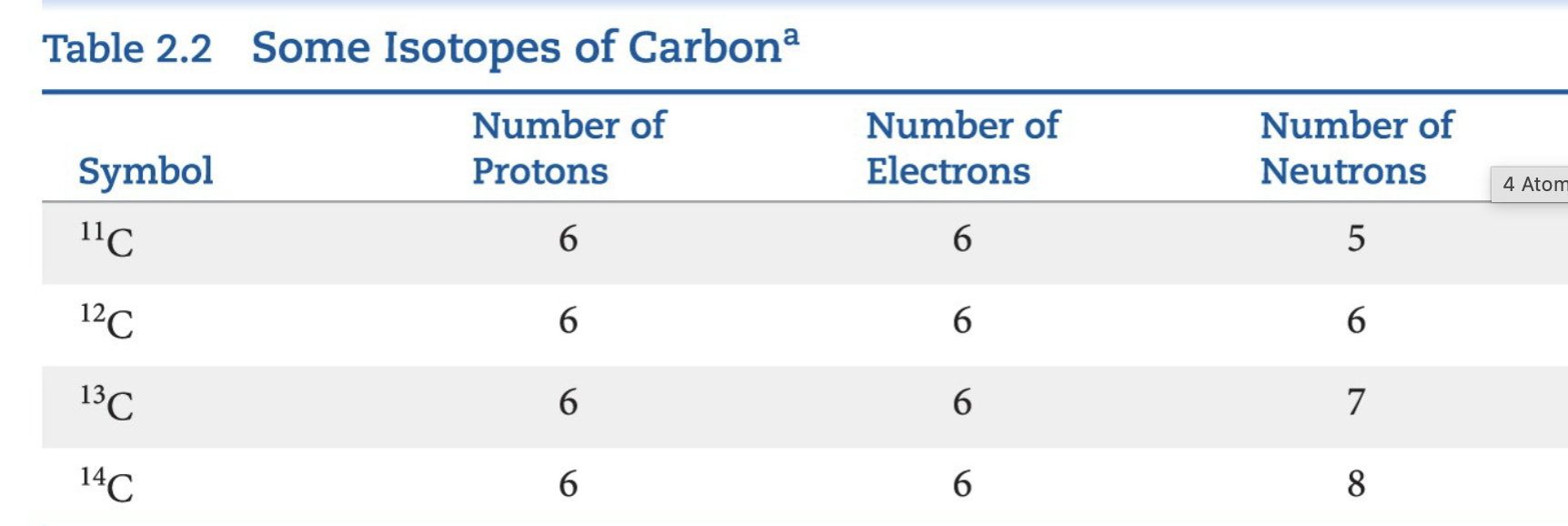
Isotopes
atoms of the same element with different masses
Do isotopes have the same number of neutrons?
No
Do isotopes have the same number of protons?
Yes
How are isotopes identified?
By their mass numbers
natural abundance
Percentage of an element that is a particular isotope
Average Mass
Atomic Weight (amu)
When a mass scale on the atomic level is used, what is the base unit?
Atomic Mass Unit (amu)
1 amu =
1.66054 × 10^-24 g