LECTURE 4
 Call Kai
 Learn
Learn Practice Test
 Spaced Repetition
 Match
Match Flashcards
 Knowt Play
1/13

There's no tags or description
Looks like no tags are added yet.
Name | Mastery | Learn | Test | Matching | Spaced | Call with Kai | Chat |
|---|
No analytics yet
Send a link to your students to track their progress
14 Terms
figure ground problem
challenge when brain has to decide which part of a visual/sensory scene is the main focus & which is the unimportant backdrop
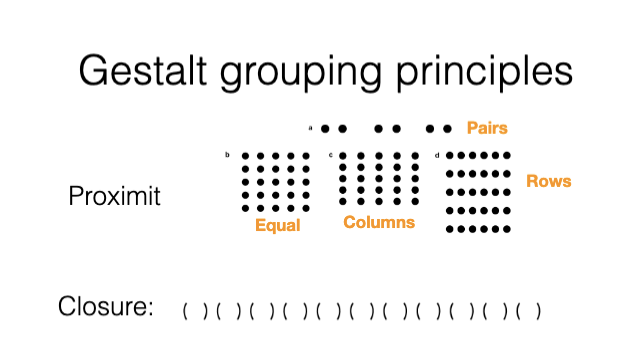
Gestalt grouping principles
brain naturally organizes individual visual elements into unified patterns, whole objects & meaningful groups → emerge from natural scene statistics (visual system encodes actual statistical regularities of the natural world)
edge detection isn’t enough, visual system has to group subsets of edges into meaningful chunks (Gestalt)
proximity
similarity
continuity
closure
connectedness
why are we so tuned to mirror symmetry?
a visual system that’s good at detecting symmetry is effectively good at detecting living things from asymmetric backgrounds
strong cue for figure-ground segmentation
humans are much better at detecting vertical mirror symmetry

why is object recognition so hard?
a 2D retinal image is a projection of a 3D world
image variability
image variability
differences & inconsistencies found across multiple images of the same subject, scene, or data type
identity-preserving transformations
viewer variables (position on retina, size)
object variables (pose, background)
lighting variables (luminance, shading)
within-class variability
new exemplars (instance within a class) of object (drawings, new type)

what did the computer classifier show?
recognition is easy when transformations are removed & only within-class shape variation remains as a clean signal, but becomes hard when real-world transformation variability is present
selectivity-invariance trade off
increasing a system’s tolerance to irrelevant changes reduces its ability to distinguish between fine-grained details
perceptual constancy
recognizing the same object but at a different size/scale
constancy using templates
each retina feeds into its own receptive field/template, tuned specifically to detect a spider at that particular size
each of these template neurons feeds into its own neuron, which fires if that specific template is matched
the outputs of these size-specific neurons are combined with an OR gate into a single downstream neuron

problems w/ constancy using templates
combinatorial explosion
no graded/parametric generalization
doesn’t scale to within-category variation
single parameter neurons
have different types of neurons containing info about different types of features (color cells, contrast cells, etc.)
binding problem
how do you attach (bind) the correct parameters to different objects?
still debated
perceptual grouping via attention
temporal synchrony
grandmother cell
hypothetical single neuron that responds selectively to one specific concept
one dedicated neuron per person, per object, per concept
recorded from single-cell recordings in the human brain in epilepsy patients
found neurons that responded very selectively to specific individuals
still inherits the same problems
the coding spectrum
how many neurons respond to a given stimulus & how many stimuli does each neuron respond to
local coding/representation: each individual stimulus/concept is represented by a single, dedicated neuron
distributed coding/rep: every stimulus is represented by a pattern of activity across the entire population of neurons; each individual neuron participates in representing many different stimuli (orientation tuning)
