Quiz 3 (L8 end - L
 Call Kai
 Learn
Learn Practice Test
 Spaced Repetition
 Match
Match Flashcards
 Knowt Play
1/21

There's no tags or description
Looks like no tags are added yet.
Name | Mastery | Learn | Test | Matching | Spaced | Call with Kai | Chat |
|---|
No analytics yet
Send a link to your students to track their progress
22 Terms
Distinguish between a multi-fold tertiary structure vs a quaternary structure (stable or transient)
Multi-fold tertiary structure: multiple folds within a single polypeptide chain
Quaternary structure: interaction between two or more polypeptide chains, which can be stable or transient.
Transient structure is significant for controlling signaling (turning things on/off).
Temporary Protein-Protein Association, useful for regulation/signaling
Stable: Good steric chemical “fit of surfaces” allows non-polar patches to match up, tied back to hydrophobic effect
Subunits remain associated as a protein complex

If a specific IV structure is described as BxZy then there are how many polypeptide chains of 2 different types are there
x+y
What are the 2 significance of quaternary
1) Needed for many tasks, including complex ones (e.g ribisome)
2) Protein regulation/modification (switching on/off between phosphorylated/non-phosphorylated)
Transitory quaternary structure “fell apart” when it wasn't needed
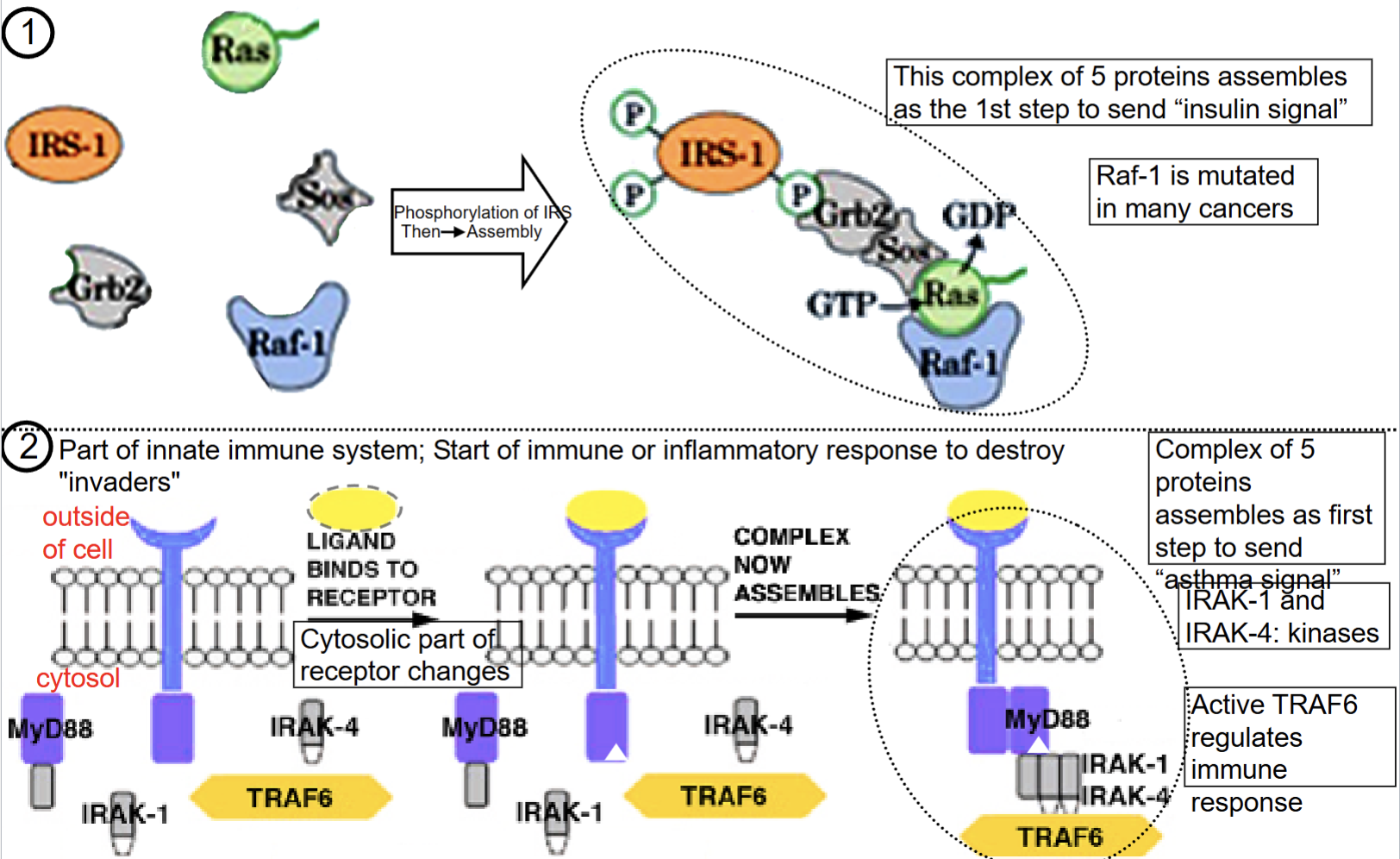
Identify the 5 classes of binding targets (binding/interaction domains)
Modified residue
Short peptide sequence
Nucleic acid
Domain/domain
Phospholipid

Quantitatively express protein stability (and get the signs right!): ΔG = ΔH – TΔS (know this equation!)
ΔGo: change in Gibbs free energy (overall stability)
(-) = favorable (protein unfolding)
(+) = not favorable
ΔHo: change in enthalpy (electrostatic, covalent, steric overlap, H-bonding, dipole moments)
Formation of Hydrogen Bonds, Waals, salt bridge (release energy = (-) = favorable
(+) = unfavorable (protein unfolding)
ΔSo: change in entropy (# of ways to have given energy/state)
Entropy of Protein fold = unfavorable
Entropy of water when protien fold = favorable
T: temperature of environment (in Kelvin)

Give the signs of the Gibbs Free Energy Formula in the following
Consider the process, UNFOLDED PROTEIN ⇌ FOLDED PROTEIN, as/after a specific protein comes off the ribosome.
This particular protein adopts a stable fold (it has a hydrophobic core of typical size), and the change in enthalpy is close to zero, but is slightly favorable
ΔG = (-) stated in the question
ΔH = (-) stated in the question
TΔS of protein only = (-) since protein is being folded so it’s more ordered
TΔS of water only = (+) since water is forming all the hydrogen bonds it can, so it’s favorable
TΔS Overall folding process = (+) think about the formula to get a favorable ΔG

Give the signs of the Gibbs Free Energy Formula in the following
Consider the process, UNFOLDED PROTEIN ⇌ FOLDED PROTEIN for an intrinscially disordered protein(its minimum energy state is the unfolded protein). It is composed of all polar and charged AA residues(i.e no hydrophobic residues). The change in enthalpy for the unfolding process is close to zero, but is slightly favorable
ΔG = (-) stated in the question
ΔH = (-) stated in the question
TΔS of protein only for the unfolding process = (+) since unfolded is more messy
TΔS of water only for the unfolding process = 0
TΔS unfolding process overall = (+) think about formula
Construct diagrams of Go vs structural coordinates for given cases and conditions

Denature vs. Renature
Denature: modify natural properties of protein to be lost
Renature: recover natural properties of protein
Deduce whether Poly-X, where X is a titratable AA, will form an alpha helix at various pH values and represent this on a Go vs structural coordinates plot.
Native state is neutral state of the AA(at the bottom)

Describe the 5 meanings of “reversible” in the context of chemical reactions, non-covalent binding, protein folding, and phosphorylation.
1) Forward and reverse reactions occur simultaneously multiple times during a given observation at equilibrium
2) Appreciable concentrations of both reactants and products are present at equilibrium
3) Non-covalent bonding
4) Remove additive group to return protein to original state (renature) → e.g. Urea
“5) Reversible phosphorylation”: Covalent bonding but can be phosphorylated or dephosphorylated multiple times (inactive and active).
What is Levinthal’s paradox
Assume (for simplicity)…
100 AA’s in a protein → each AA can only have 10 possible ɸ,Ѱ combinations → 10100 possible conformations
Likely that amino acid sequence has a particular “code” to select a protein folding pathway
An “unsolved” problem: Protein folding cannot be a random search of ɸ,Ѱ angles. Therefore, it would take too long to fold a single protein (longer than the universe existed).
Important takeaway: showed protein folding cannot be a random search of torsion angle space
What is Anfinsen’s experiment
Lower pH to 3.5 to partially denature and remove prosthetic group (e.g. iron heme group from myoglobin)
Add 8M Urea to fully denature.
Remove the 8M Urea through dialysis (separation of small, soluble molecules from larger molecules)
Raise pH back to physiological conditions (pH = 7)
Add prosthetic group back
Importance of experiment: All info for protein folding is contained in the amino acid sequence (primary structure).
Describe the roles of disulfide isomerases, prolyl isomerases and chaperones in protein folding
3 classes of protein in every cell required for protein folding: disulfide isomerases, prolyl isomerases, and chaperones
Prolyl cis-trans isomerase: interchange between cis and trans isomers for proline + lowers ΔGo barrier (activation energy) by 20 kJ/mol and speeds up isomerization by 3000 times
Disulfide isomerases: forms proper disulfide bonds
Chaperones (heat shock proteins): Prevention of protein aggregation, correction of misfolded proteins, deliberate unfolding of protein, make “molten” protein
How does Chaperones work
Barrel formed from 2 rings of 7 subunits: A protein machine that forms a chamber with non-polar helices binding misfolded protein. The protein requires a lot of ATP to function,
Explain why denatured insulin cannot be renatured
Insulin is processed from a larger polypeptide, where fragments are cleaved off. If final product is denatured, it is unlikely to re-form the fragments correctly
Important takeaway: Insulin refolding is irreversible
Apply the quantitative relationship between reaction rate and activation energy to calculate the change in either one (from given information) when an enzyme catalyst is present.
Formula for ratio of catalyzed/uncatalyzed rates (no units)
Formula for magnitude of free energy (unit: kJ/mol)
RT = 2.5

Describe the role of molecular chaperones Hsp70-like and Hsp60-like.
Hsp (heat shock protein): induced when bacteria are warmed (e.g to 42 degree celsius)
Hsp70: early stage that prevents premature hydrophobic effect/prevents aggregation of intermediates and bind early to exposed non-polar, hydrophobic regions
Hsp60: corrects misfolded proteins that have many hydrophobic residues
→ Increased heat = increased chance for misfolding
Describe the “folding funnel”:
What is being plotted?

Describe the “folding funnel”:
How is this framework useful for visualizing the meaning of folding pathways
Depiction of the free energy in relation to a given state of the folded protein and its process
Important takeaway: There are multiple ways in which a protein can fold that leads to the “bottom” of the funnel (a native structure in its lowest energy state)
Describe the differences between the molten globule state and the native folded
state
Molten globule state: transition state between the unfolded and folded, native protein → allows transport through membrane (a secondary structure with tertiary structure still forming and after hydrophobic collapse)
Native folded state: completely folded protein that is of highest stability (does not allow transport through the membrane)
Draw a sigmoidal binding curve for hemoglobin (know what is being plotted) and explain how this enables hemoglobin to carry out its function, and how this differs from myoglobin function.
Hemoglobin(sigmoidal) vs. Myoglobin(hyperbolic) Function
Hemoglobin: Oxygen transport throughout body tissues to metabolically-active tissues (it can deliver to oxygen-starving tissues and lower pH)
Cooperative binding: When one O2 molecule binds to tissue, increased affinity for next one
Myoglobin: Oxygen storage in body tissues, particularly muscle tissues
Shaped to fit heme, hold heme in crevice
