1.1 particles in the atom and atomic radius
 Studied by 0 people
 Call Kai
 Learn
Learn Practice Test
 Spaced Repetition
 Match
Match Flashcards
 Knowt Play
1/9

There's no tags or description
Looks like no tags are added yet.
Name | Mastery | Learn | Test | Matching | Spaced |
|---|
No study sessions yet.
10 Terms
1 describe the structure of an atom
Mostly empty space surrounding a very small, dense nucleus that contains protons and neutrons.
Electrons are found in shells in the empty space around the nucleus
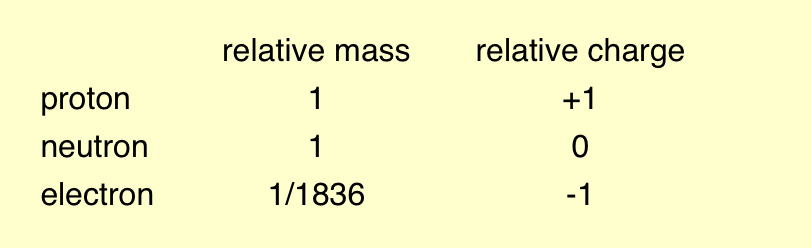
Identify and describe protons, neutrons and electrons in terms of their relative charges and relative masses
Define atomic number
Number of protons
Define mass number
Number of protons and neutrons
4 Describe the distribution of mass and charge within an atom
Mass of electrons are neglible compared with masses of protons and neutrons. Therefore almost all mass is concentrated in nucleus
In an electrically neutral atom, there must be same numbers of protons and electrons.
Describe the behaviour of beams of protons, neutrons and electrons present moving at the same velocity in an electrically neutral atom field.
Protons are deflected on a curving path towards the negative plate
Electrons are deflected on a curving path away from the negative plate towards the positive plate
Neutrons have no charge so continue in straight line
Explain the variations in atomic radius across a period
Atomic radius decreases across a period due to an increase in protons in the nucleus
Therefore an increase in nuclear charge which attracts outer electrons more strongly.
Explain the variations in ionic radius across a period
Decreases for positive ions but increases for negative ions
Positive ions have a decreasing ionic radius as although ions have same electron configuration, number of protons has increases so nuclear attraction increases.
Negative ions have an increasing ionic radius as ions have gained electrons meaning that there are more electrons that protons. Therefore, nuclear attraction decreases
Explain the variations in atomic radius down a group
Increases as there is an increases number of shells
Electrons in inner shells repel the electrons in the outermost shells, shielding them from the positive nuclear charge
Explain the variations in ionic radius down the group
Increases going down the group due to increased shielding