IB Biology Macromolecules | A1.2, B1.1, B1.2
 Call Kai
 Learn
Learn Practice Test
 Spaced Repetition
 Match
Match Flashcards
 Knowt Play
1/147

There's no tags or description
Looks like no tags are added yet.
Name | Mastery | Learn | Test | Matching | Spaced | Call with Kai | Chat |
|---|
No analytics yet
Send a link to your students to track their progress
148 Terms


Elements in nucleic acids?
C, H, O, N, P.
C
H
O
N
P
S
Carb & Lipid = First 4 Letters
Proteins = First 5 letters (and sometimes S)
Nucleic Acid = First 5 letters






Define condensation reaction
Reaction that joins two molecules and removes a small molecule (usually water). A new covalent bond forms. Needs an enzyme and energy.
COndensation = COmbining together + water Exit
joins molecule together & removes water


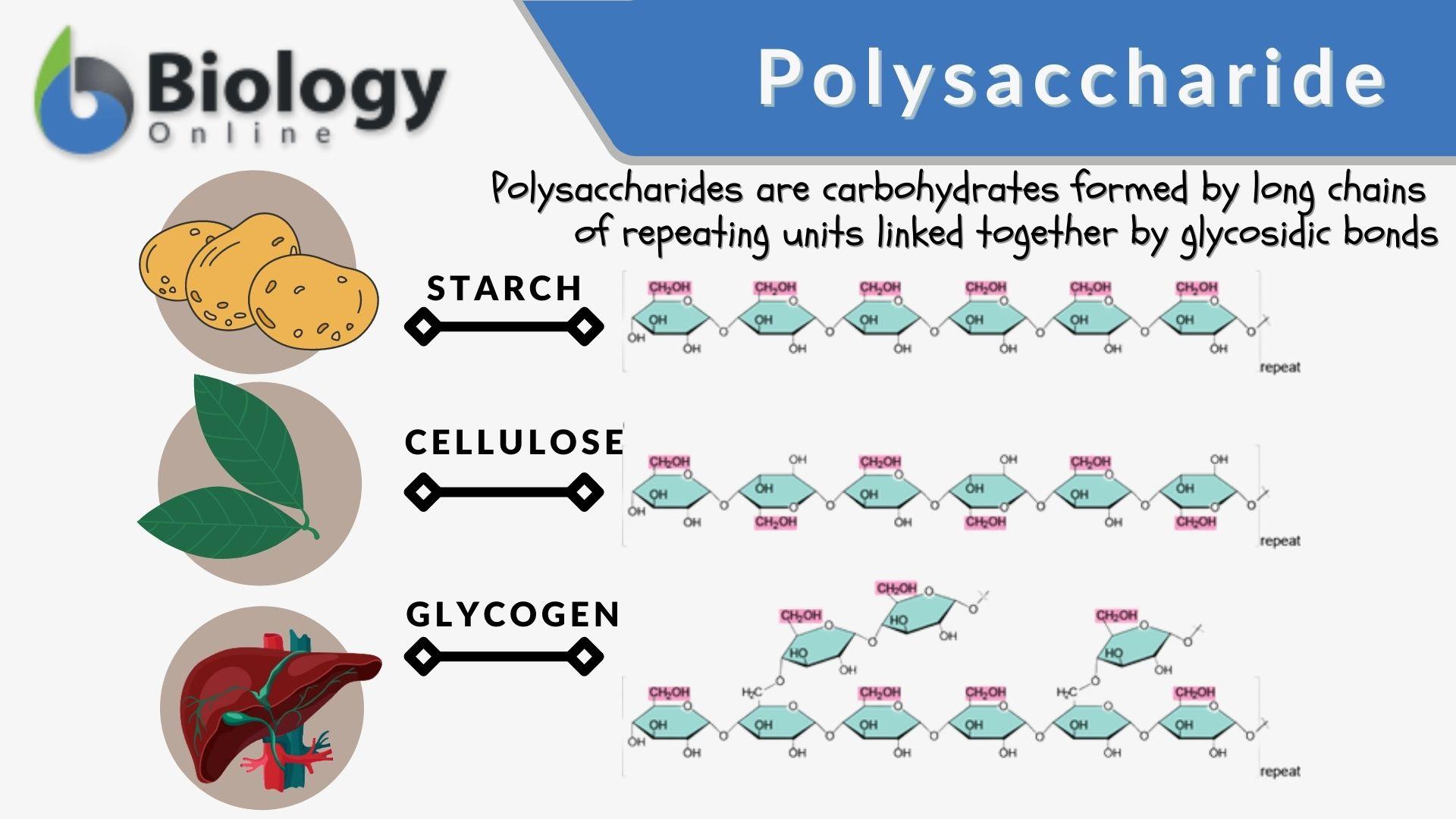

Difference between alpha and beta glucose
Only the -OH on carbon 1: alpha = OH points DOWN, beta = OH points UP. (They are isomers/anomers.)
ABBA: Alpha Below, Beta Above

Which glucose builds starch/glycogen and which builds cellulose?
Alpha glucose → starch and glycogen. Beta glucose → cellulose.
Alpha Animal store Glycogen
Beta builds a better wall
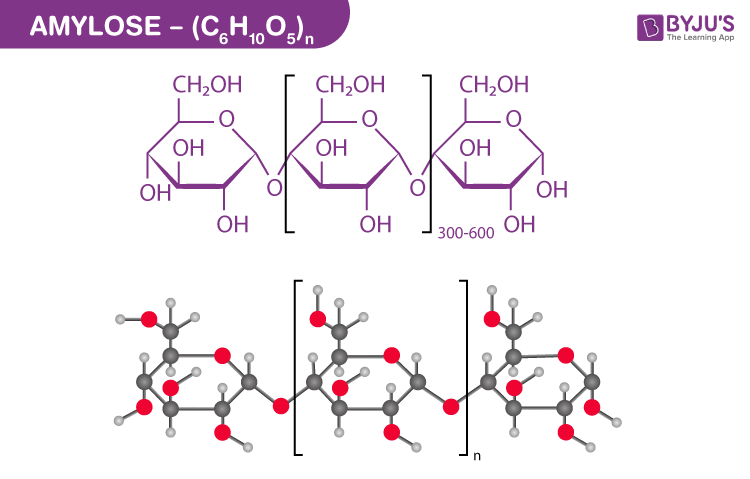
Amylopectin: structure
Alpha-glucose chains with 1,4 links plus 1,6 links at branch points (branched).

Generalized structure of a fatty acid
Carboxyl group (-COOH) at one end + a long hydrocarbon chain (typically 16 to 18 C). Carboxyl reacts with glycerol -OH to form an ester bond.

Define saturated fat / fatty acid
Fatty acid with no C=C double bonds (fully hydrogenated carbon chain). Straight chain, packs tightly, solid at room temp (butter, animal fat).
Saturated = Solid at room temperature. Saturated is bad for you.
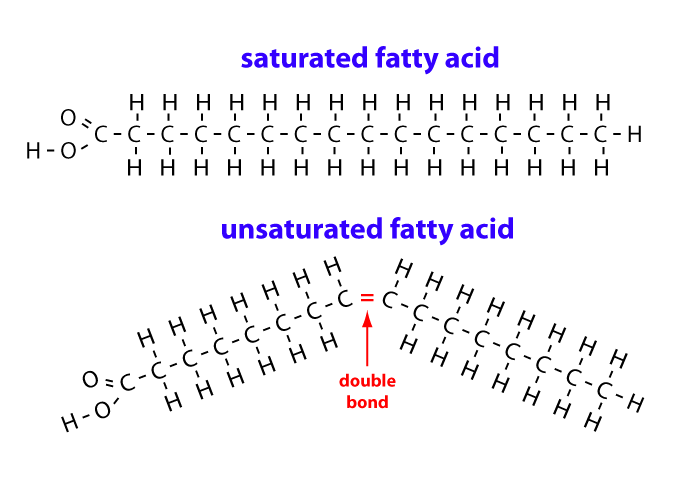

Define unsaturated fatty acid
Has one or more C=C double bonds, so one fewer H on each double-bonded carbon. Double bond bends the chain.
Unsaturated = Un-Solid at room temperature. Good for you.
Cis fatty acid
H atoms on the SAME side of the C=C double bond; chain is bent. Natural; liquid oil.
Cis = “C” Same

Trans fatty acid
H atoms on OPPOSITE sides of the C=C double bond; chain stays straight. Made in the lab (partially hydrogenated); serious health risk.
Trans = Transportation ACROSS


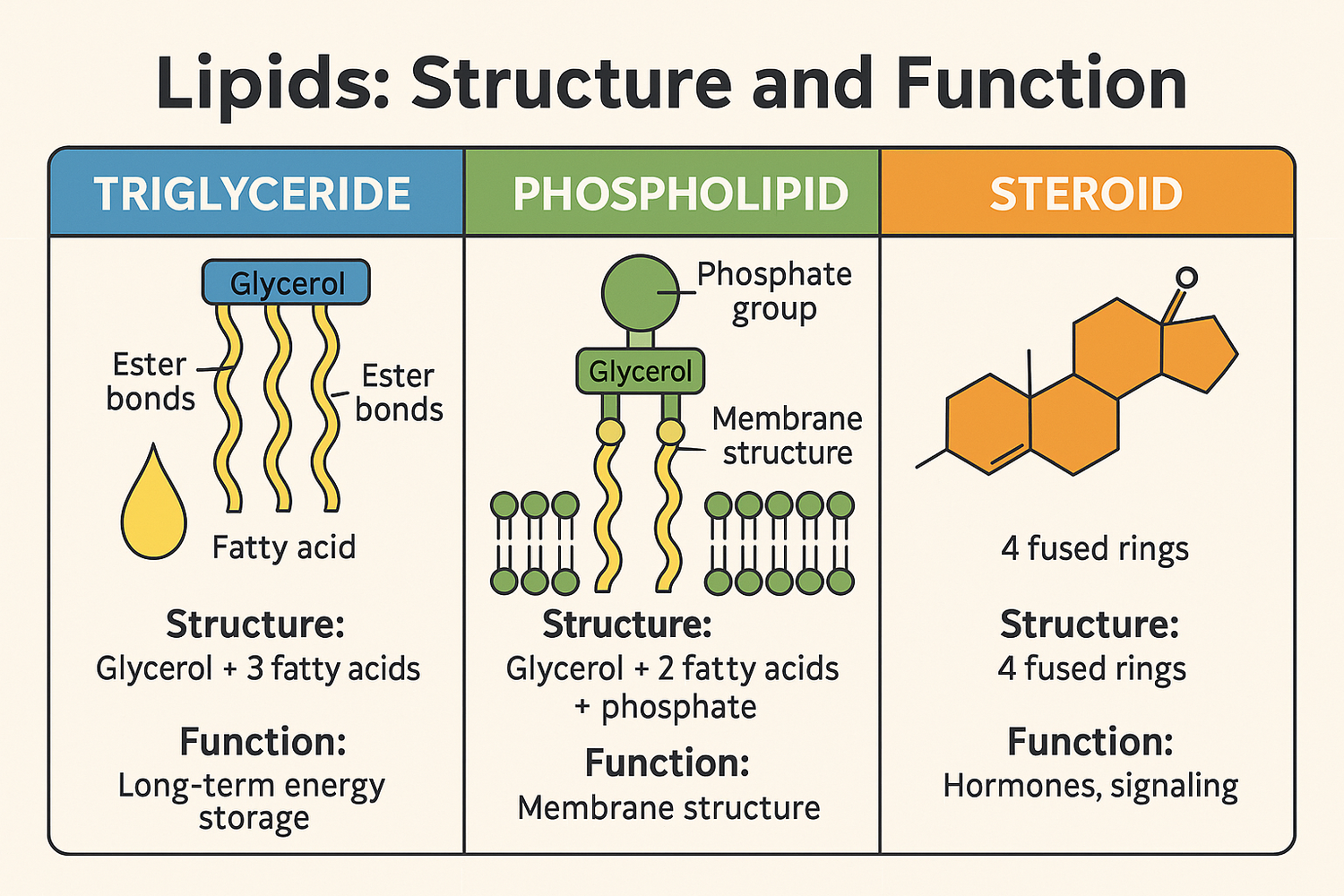
Triglyceride vs phospholipid vs cholesterol: components
Triglyceride: 3 fatty acids + glycerol. Phospholipid: 2 fatty acids + glycerol + phosphate. Cholesterol: four fused carbon rings, one hydroxyl, one hydrocarbon tail.
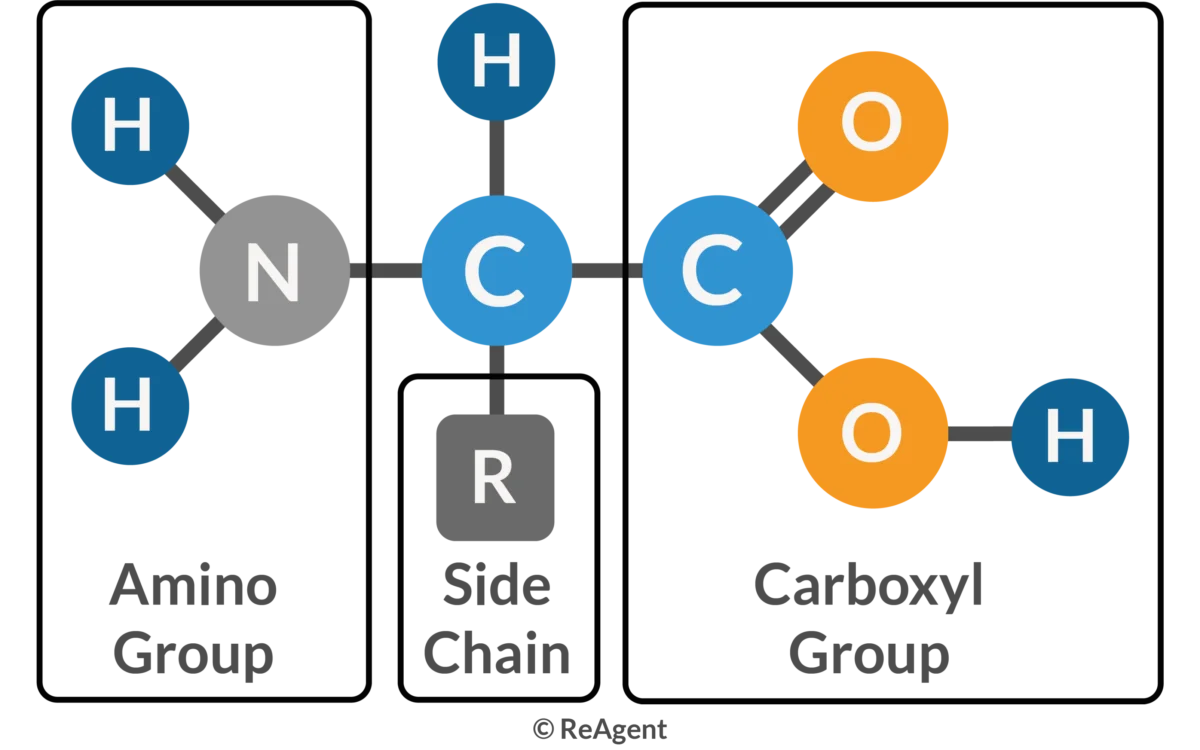
Generalized structure of an amino acid
Central alpha carbon bonded to: an amine group (-NH2), a carboxyl group (-COOH), a hydrogen atom, and an R group (side chain).


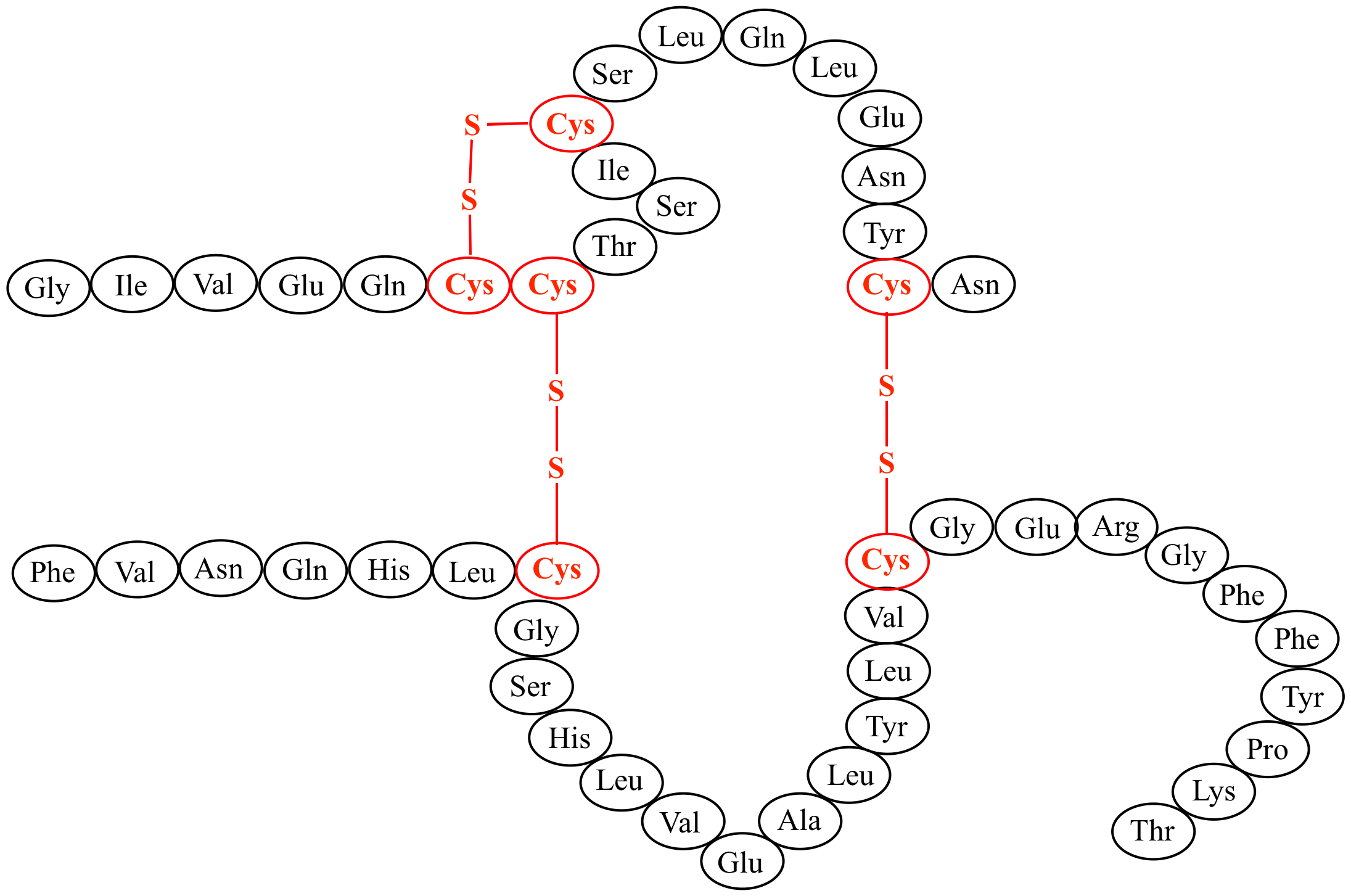
Disulfide bridge
Strong covalent bond between the sulfur atoms of two cysteine R groups. Strongest force stabilizing tertiary structure.


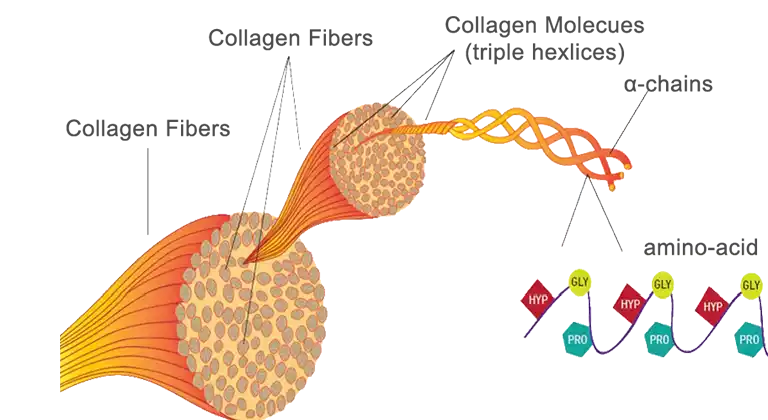
Collagen structure
Fibrous, non-conjugated. Three left-handed helices twisted into a right-handed triple helix; repeating Gly-X-Y (every 3rd amino acid is glycine); H bonds between chains.


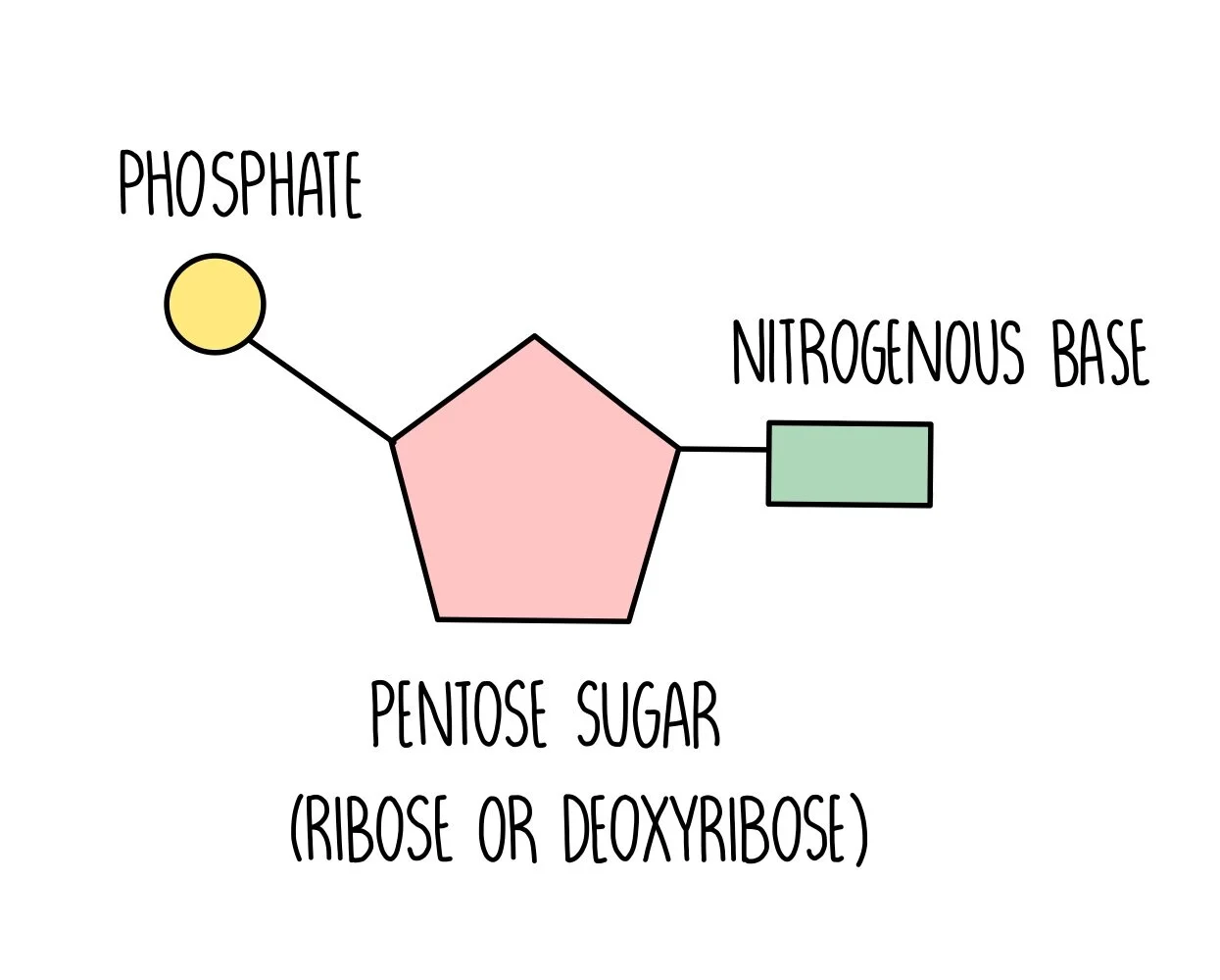
How to draw a nucleotide (IB convention)
Circle = phosphate, pentagon = pentose sugar, rectangle = nitrogenous base. Label everything; words horizontal, lines must not cross; spell out bases or give a key.
Purine
Nitrogenous base with a double ring: adenine and guanine.
Pure As Gold
Puine = Adenine Guanine

Pyrimidine
Nitrogenous base with a single ring: cytosine, thymine, uracil.
(Pyrimidine: “CUT" the PY” PY = PYrimidine. CUT = Cytosine, Thymine, Uracil)
(Purine: “Pure as Gold” — Adenine, Guanine)

