Nucleic Acids
 Call Kai
 Learn
Learn Practice Test
 Spaced Repetition
 Match
Match Flashcards
 Knowt Play
1/123

There's no tags or description
Looks like no tags are added yet.
Name | Mastery | Learn | Test | Matching | Spaced | Call with Kai | Chat |
|---|
No analytics yet
Send a link to your students to track their progress
124 Terms
Nucleic Acids are a type of
macromolecules
Cytosine (C)
A nitrogenous base that pairs with guanine (G) in both DNA and RNA
Deoxyribonucleic Acid (DNA)
The molecule that stores and transmits genetic information in living organisms.
Deoxyribose
The five-carbon sugar found in DNA nucleotides
DNA Nucleotide
the basic unit of DNA, made of a deoxyribose sugar, phosphate group, and nitrogenous base.
Double Helix
The twisted ladder shape of a DNA molecule
Gene
A segment of DNA that contains instructions for making a protein or functional RNA molecule.
Guanine (G)
A nitrogenous base that pairs with cytosine (C).
Hydrogen Bonding
Weak chemical bonds that hold complementary DNA base pairs together
Karyotype
A picture of all the chromosomes in a cell arranged in homologous pairs
Nitrogenous Base
The nitrogen-containing part of a nucleotide. Examples include A, T, C, G, and U for RNA
Nucleotide
The basic building block of nucleic acids, consisting of a sugar, phosphate group, and nitrogenous base
Phosphate Group
The component of a nucleotide that links sugars together to form the backbone of DNA and RNA
Polynucleotide
A long chain of many nucleotides joined together
Ribonucleic Acid (RNA)
A nucleic acid involved in protein synthesis and gene regulation
Ribose
The five-carbon sugar found in RNA nucleotides.
RNA Nucleotide
The basic unit of RNA, made of ribose sugar, phosphate group, and nitrogenous base
Sugar-Phosphate Backbone
The repeating pattern of sugars and phosphates that forms the sides of a DNA or RNA strand
Thymine (T)
A nitrogenous base found only in DNA that pairs with adenine (A)
Transcription
The process of copying genetic information from DNA into RNA
Uracil (U)
A nitrogenous base found only in RNA that pairs with adenine (A)
Kerry Mullis
The scientist who developed the Polymerase Chain Reaction (PCR) technique in 1983
Taq DNA Polymerase
A heat-resistant enzyme used in PCR to synthesize new DNA strands.
Magnesium
A required cofactor that helps Taq polymerase function properly during PCR.
Primer
A short piece of DNA that binds to a target sequence and provides a starting point for DNA replication
Denaturation
The first step of PCR in which DNA is heated to separate its two strands
Annealing
The second step of PCR in which primers bind to complementary sequences on the DNA template.
Extension
The third step of PCR in which Taq polymerase adds nucleotides to create new DNA strand
PCR Cycle Memory trick
D-A-E
Adenine (A)
A nitrogenous base found in DNA and RNA. It pairs with thymine (T) in DNA and uracil (U) in RNA.
DNA contains 2 nucleotide strands each composed of
4 kinds of nucelotide
nucleic acids job
store info, provide instructions, for creating proteins
What are 2 types of nucleotides
DNA and RNA
Genetic materials is
DNA
what functions in protein synthesis
RNA
Instead of deoxyribose for carbon sugar, RNA has
ribose
Nucleotides
monomers of nucleic acids
gene
unit of inheritance
gene is encoded in
encoded in DNA
Gene programs
amino acid sequence of polypeptide
nucleotides are made up of
5 carbon sugar, phosphate group (PO4-), nitrogen base
Nucleotides of DNA
deoxyribose sugar, phosphate group, nitrogenous bases (A,C,G,T)
Nucleotides for RNA
Ribose sugar, phosphate group, nitrogenous bases (A,C,G,U)
What is DNA
genetic materials that all humans, all other organisms inherit
The process of DNA → RNA → Proteins enable
the transmission of heredity info
Phosphate group
PO4- (negatively charged)
Polynucleotide
dehydration reactions link nucleotide polymers
genes in polypeptide provide instructions for
building specific polypeptides from amino acids
For DNA, Adenine always pairs with
Thymine
For DNA, Guanine always pairs with
Cytosine
Each DNA strand has
weak H-bonds
DNA strands together have
a stable double helix
For RNA, Uracil bonds with
Adenine
All 4 possible nitrogenous bases for RNA
A, G, C, U
RNA/DNA both consist of
nucleotides consisting of sugar, phosphate
RNA and DNA has identical
polynucleotide chains (aside from U and T)
RNA is single
stranded
DNA exists as
a double helix
Diploid
2 sets of chromosomes (46 chromosomes) - 23 × 2
Haploid
1 set of chromosomes (23)
Karyotype
picture or display of all the chromosomes in a cell, arranged in pairs according to their size, order, shape, and banding pattern.
nucleic acids are
information storage molecules
nucleic acids provide directions for
building proteins
DNA resides in cells in long fibers called
chromosomes
Genes are a specific ____ that…
stretch of DNA that programs amino acid sequence of polypeptides
chemical code for DNA must be translated from “nucleic acid language” to
“Protein language”
nucleic acids are polymers of
nucleotides
nucleic acids are assembled by
dehydration synthesis
What are both nucleic acids?
RNA and DNA
structure of a nucleotide

structure of nucleotide when attached to other nucleotides
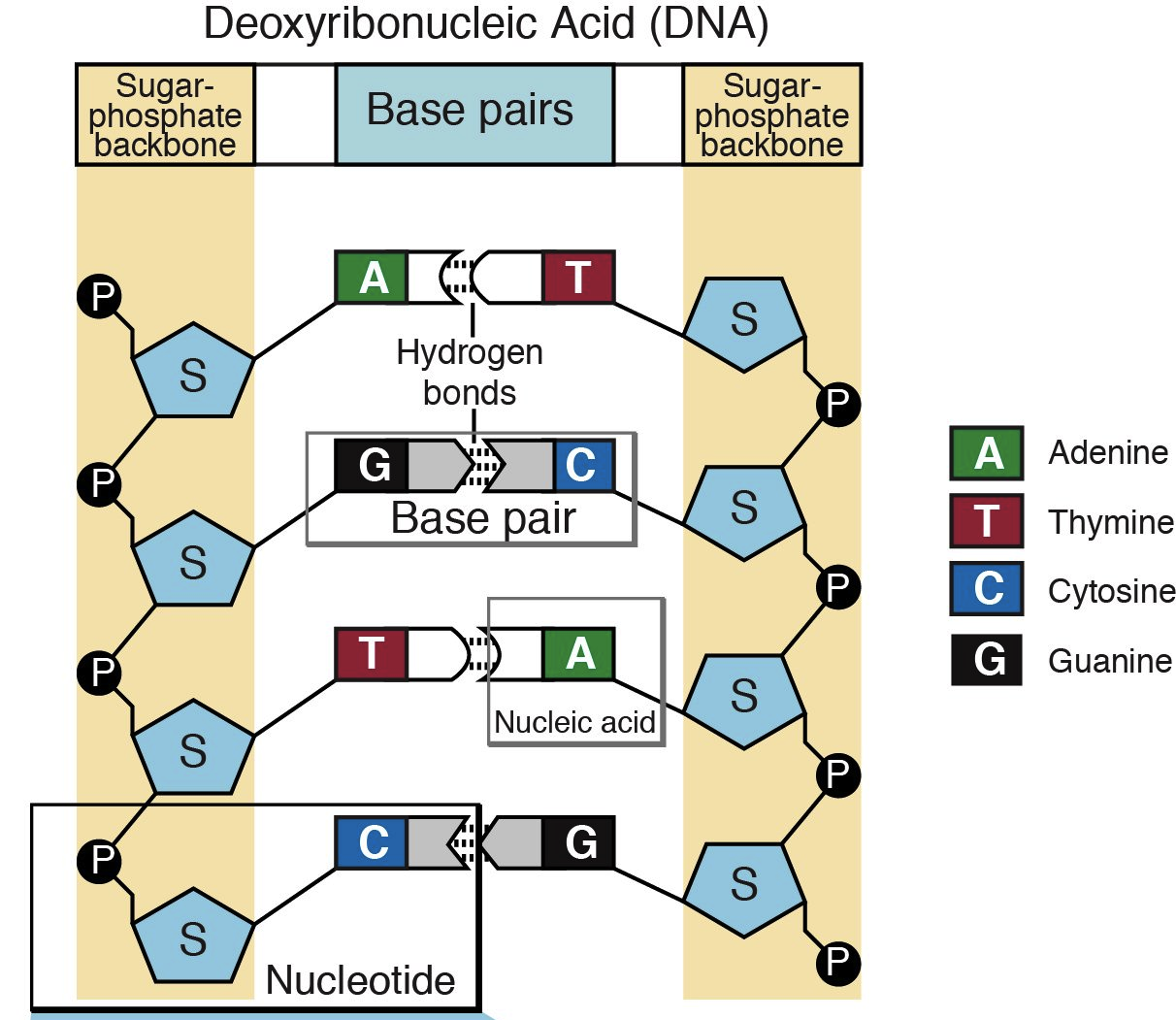
denaturation of DNA
Double stranded DNA to single stranded DNA
bonds with between DNA strands is usually
very strong/stable
RNA is ____ stranded
single stranded
Ribonucleic acid is for
for RNA
Compared to DNA, RNA’s sugar has
an extra OH group
central dogma of molecular biology
Replication → transcription → translation
RNA nucleotide structure
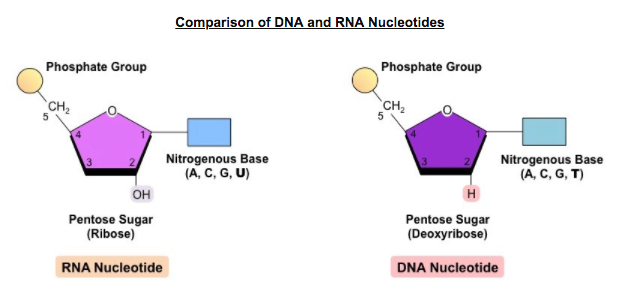
DNA contains
instructions to make protein
gene is copied to
make its own RNA molecule
RNA used to make
specific protien
u have ____ genes in a unique order
3 billion
_____ genes direct synthesis of all proteins that make u
2000 genes
sequencing DNA
elucidation of the order of bases in an organism’s DNA strand
unique order of ur bases greatly influences
what diseases u can get, how u will react to medications,
human genome is about ____ of DNA
6ft
each cell contains
2 copies of ur genome
polymorphisisisms
gene can exist in 2 or more common forms within a population
polymorphisms can be important in
influencing traits and medically important characteristics
polymerase chain reaction (PCR)
method that takes a small piece of DNA and makes millions of copies on it
Kerry Mulis
biochemist, invented polymerase chain reaction (PCR), nobel prize
through PCR, scientists can get enough DNA from
Blood, fingerprints
Major applications of PCR
DNA fingerprinting, forensic analysis, pedigree analysis, genetic disease diagnosis, pathogen detection, analysis of gene expression, cloning of genes, change/mutation of genes
pedigree analysis
how trait/disorder can be passed down
Thermus aquaticus
bacterium in hot springs
Taq DNA polymerase
heat resistant enzyme produced by Thermus aquaticus
Thermus aquaticus is used in ___ to ___
PCR to thrive in hot temp
PCR components of reaction
template DNA, 2 DNA primers, Taq DNA polymerase, Buffer, MgCl2, dNTPS (A,C,G,T)
PCR Thermal cycle conditions, 1 cycle a) 94 C
DNA denaturation
PCR Thermal cycle conditions, 1 cycle b) 55 C
primer annealing