polymers haddleton
 Call Kai
 Learn
Learn Practice Test
 Spaced Repetition
 Match
Match Flashcards
 Knowt Play
1/70

There's no tags or description
Looks like no tags are added yet.
Name | Mastery | Learn | Test | Matching | Spaced | Call with Kai | Chat |
|---|
No analytics yet
Send a link to your students to track their progress
71 Terms
Radical polymerisation using chain transfer, what does this mean
radical polymerisation is one active chain grows rapidly by adding monomers one at a time.
diff types are radical
cationoc
anionic
coordination (zieglar natta) we gonna focus on radical
What is the advantage of chain transfer here
chain transfer instead of having
aaaaaaaaa
u get
aaaa
aaaaaaaa
aaa.
This is beneficial overall because u get lots of few chains rather than large chains, which decreases molecular weight, creates more polymer chains, lowers degree of polymerisation.
Equations for each and their rate
Intitiaon
propagation
termination
Initiation:
Initiation →2R°
R° + {monomer} →RM°
Rate:K₁[M][R°]
Propagation
[RM°] + [M] → [RMM°]
Rate=Kp [RM°][M]
Termination
Pol° + pol° → Polymer
Rate= Ktc[Pol*]² +Ktd[Pol*]²
Termination can be disproportion or combination.
combination is 2 monomers with radical at the end joining to become one. no radical left.
disproportion is when dead chain + dead chain, by stealing hydrogen from another.
this is extra intel. how does a monomer know to terminate by combo or disproprtion
Bulky steric hinderance and high temp usually go for stealing H, so disproportion.
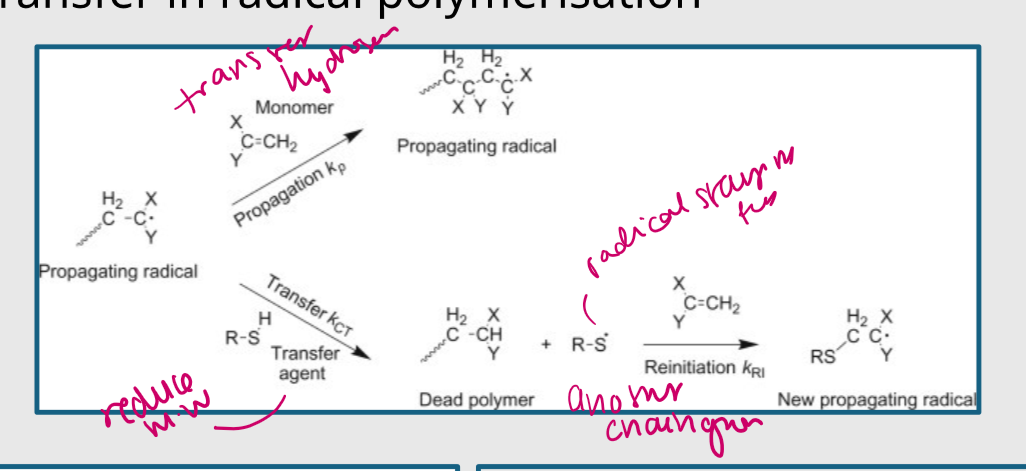
what is an example of chain transfer
in chain transfer a new radical is born
P• + X-H → P-H + X•
then X becomes radical
what is cctp aka batch
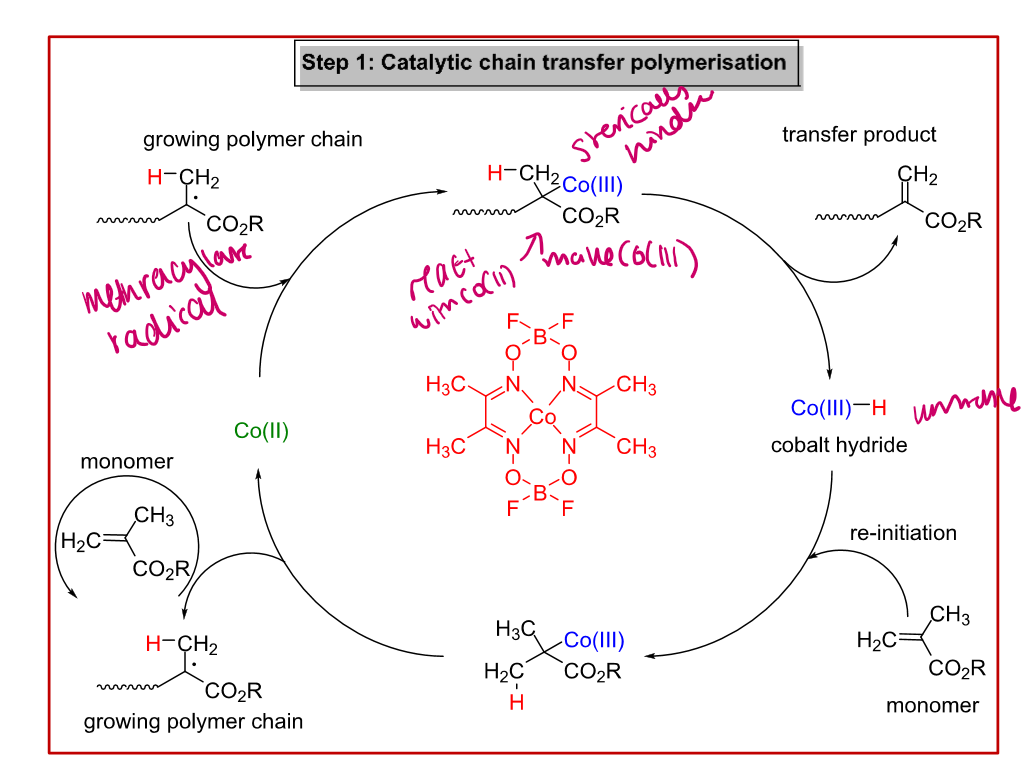
catalytic chain transfer polymerisation. uses a catalyst to promote chain transfer, producing low-molecular-weight polymers and macromonomers.deliberately make chains stop growing early via chain transfer.
Whats CCTP mechanism
Use Cobalt 2+ as the catalyst here. starting from green.
add the growing chain radical then the carbon becomes sterically hindered. becomes co 3+. leaves by sn2 i think reaction.
cobalt hydride left which is unstable initiates the next chain
makes co2+ again
Give me an overview on living radical polymerisation
living polymerisation is a type of radical polymer. it chains reversibly switch between active and dormant states, greatly reducing termination and allowing precise control over molecular weight, dispersity, and polymer architecture.
Ok so what is RAFT
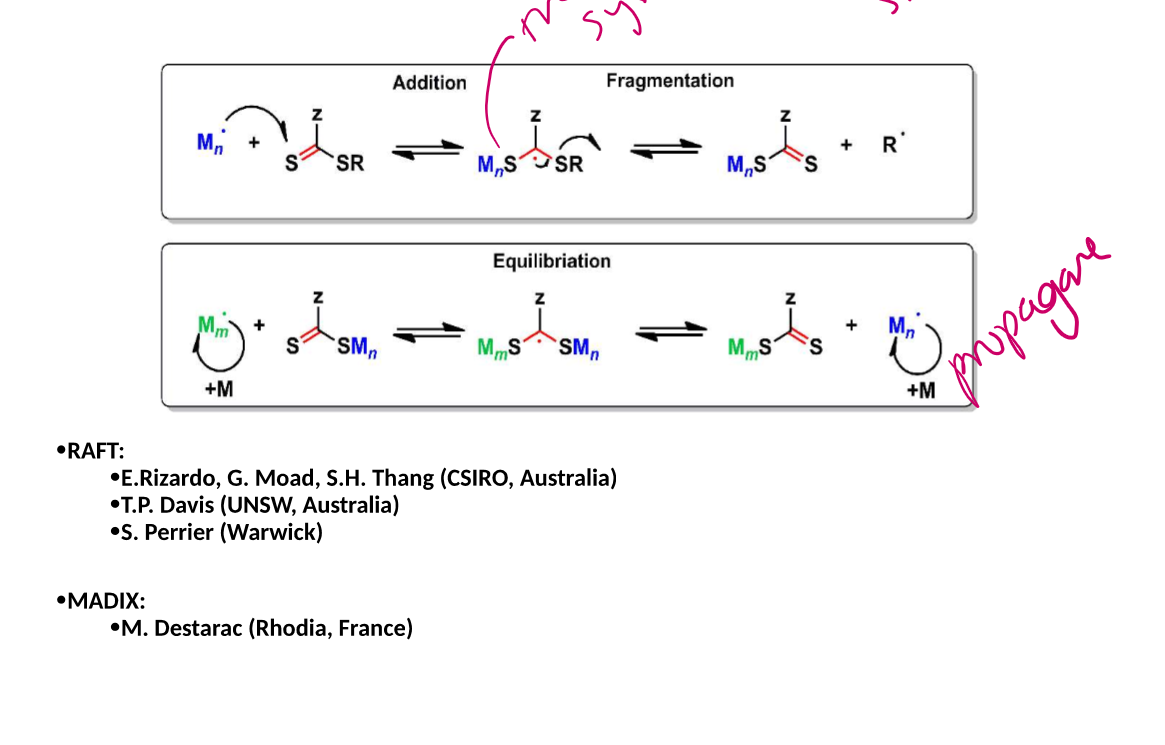
RAFT is a type of living polymerisation. it is reversible addition fragment transfer
what is happening in each step
RAFT Mechanism
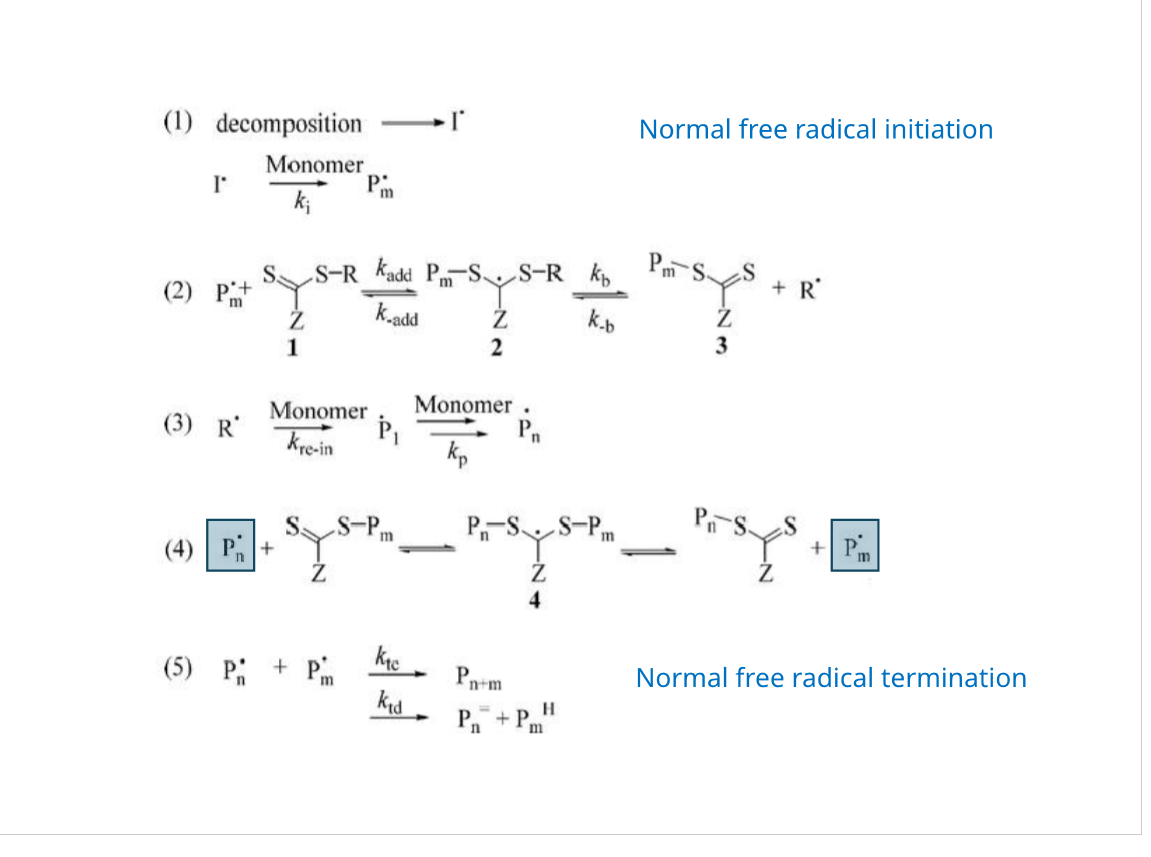
1. Initiation
Initiator → 2R•
R• + M → RM•
RM• + M → RMM•
RMM• + M → RMMM•
(Growing polymer radical forms)
--------------------------------------------------
2. Addition
Mn• + Z-C(=S)-S-R
↓
Mn-S-C•(Z)-S-R
(Growing radical adds to the RAFT agent)
--------------------------------------------------
3. Fragmentation
Mn-S-C•(Z)-S-R
↓
Mn-S-C(=S)-Z + R•
(The original polymer chain becomes dormant and a new radical is released)
--------------------------------------------------
4. Re-initiation
R• + M → RM•
RM• + M → RMM•
(New polymer chain begins growing)
--------------------------------------------------
5. Equilibration
Mm• + Mn-S-C(=S)-Z
↓
Mm-S-C•(Z)-S-Mn
↓
Mm-S-C(=S)-Z + Mn•
(Radical activity is transferred from one chain to another)
--------------------------------------------------
6. Reversible Exchange
Chain A active → Chain A dormant
Chain B dormant → Chain B active
Chain B active → Chain B dormant
Chain C dormant → Chain C active
Chain C active → Chain C dormant
Chain D dormant → Chain D active
(The radical is continually passed between chains)
--------------------------------------------------
Outcome
ACTIVE ⇌ DORMANT
Only a small number of radicals exist at any time.
↓
Less radical-radical termination
↓
More uniform chain growth
↓
Controlled molecular weight
↓
Low dispersity
↓
Block copolymers can be formed
on a paper write out raft in chemical equation terms. using Pm* as initiation monomer
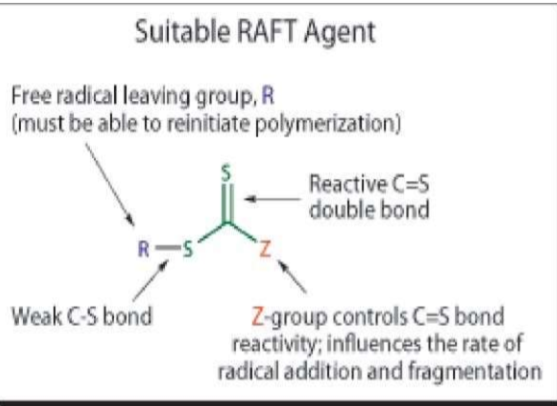
what are three main suitable RAFT agents
Dithiobenzoates
trithiocarbonates
dithiocarbamates
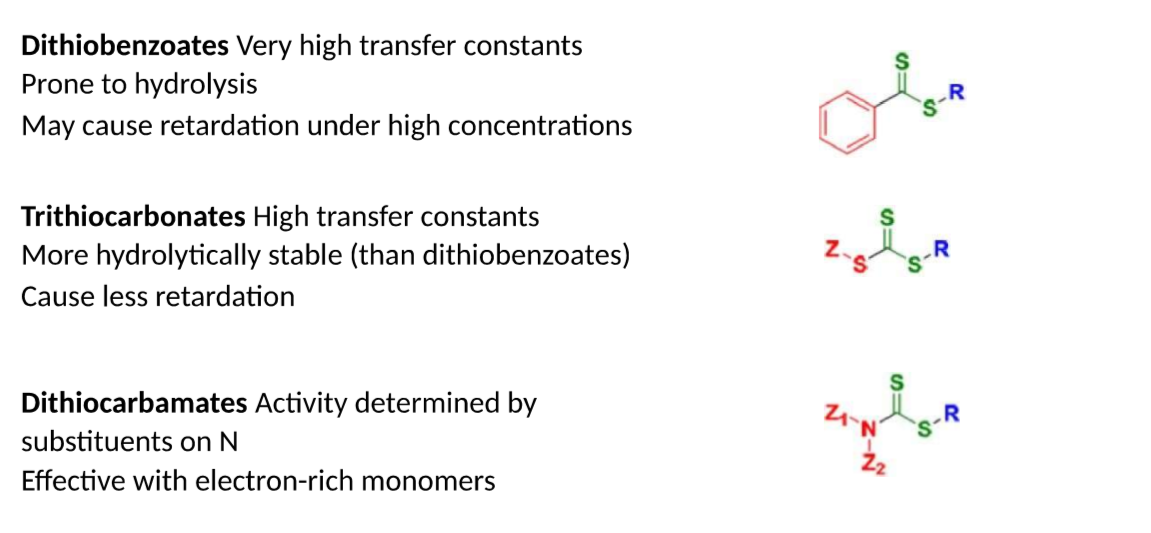
Dp equation for raft
DP=[Monomer]/[Raft]
need a constant supply of radicals
always some polymer with twice the target MWt due to combination
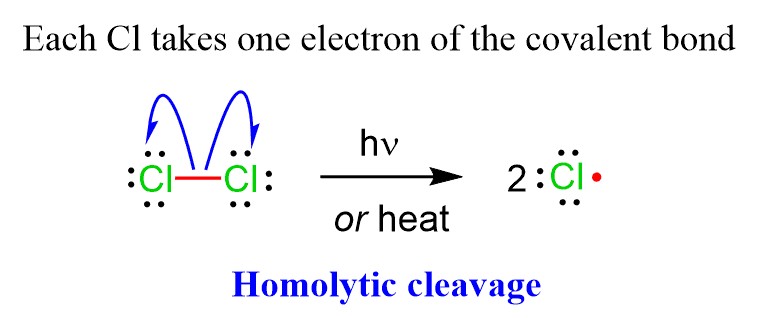
Why does reversible homolytic dissociation lead to living radical polymerisation
The growing polymer radical reversibly forms a dormant covalent adduct. Since only a very small concentration of radicals is present at any time, termination reactions are greatly reduced, allowing controlled growth of polymer chains and narrow molecular weight distributions
write out a covalent adduct formula and what is it
L—>←—[R* T] —>←- R* +T*
BASICALly, T here depending on what method can be nitrogen (nmp) or copper complex.
What it shows is two chains joined together by covalent bond important because R* can terminate. But R*-nitrox cannot, its like a lid on top
![<p>L—>←—[R* <em>T] —>←- R</em>* +T*</p><p>BASICALly, T here depending on what method can be nitrogen (nmp) or copper complex.</p><p>What it shows is two chains joined together by covalent bond important because R* can terminate. But R*-nitrox cannot, its like a lid on top</p>](https://assets.knowt.com/user-attachments/16ff7032-d601-43bf-8165-4718fc66dcf9.png)
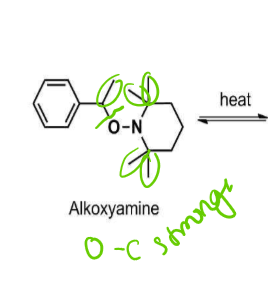
what is aloxyamine
when heated molecule breaks off to become TEMPO and a reactive radical
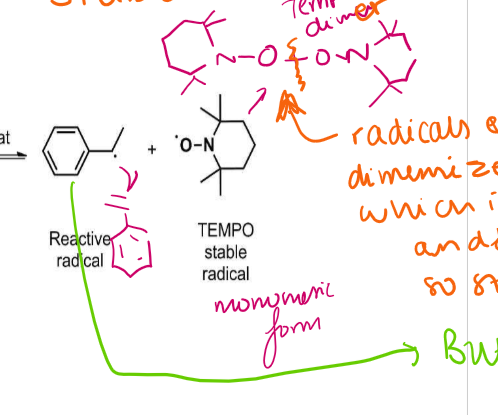
whats special about tempo
Tempo is a stable radical, because lots of steric hinderance lots of bulky group preventing it from bonding to another radical so it can exist as tempo* for a long time. Then
polymer*+M→ polymer-M*
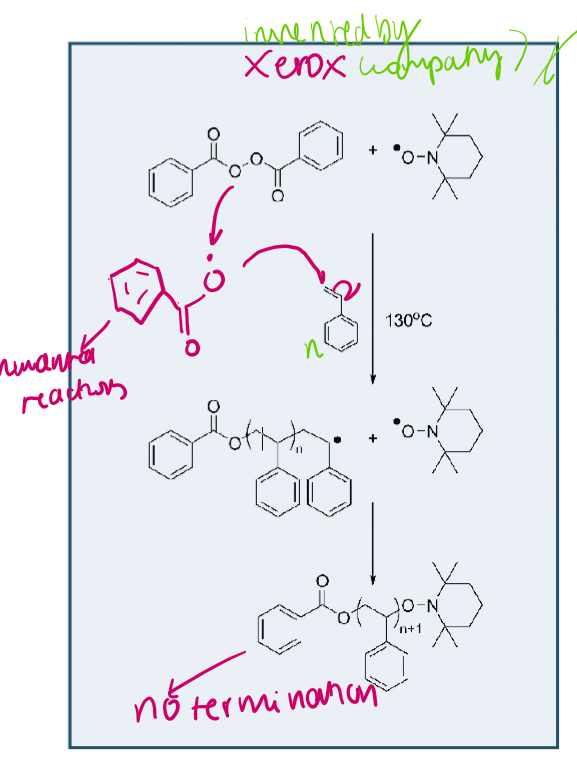
polymer-M* +Tempo*→ polymer Mtempo becomes dormant this usually works with reasonably stable monomers such as styrene, acrylates no catalyst required. Raft usually has sulphur catalyst
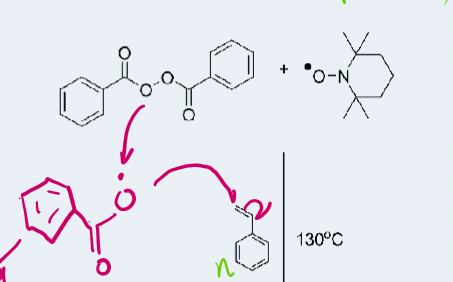
how would a bimolecular compound like this react with TEMPO
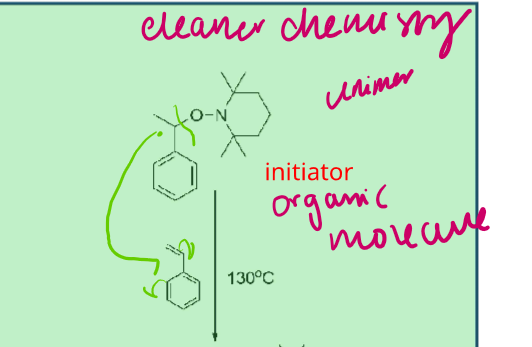
unimolecular and TEMPO
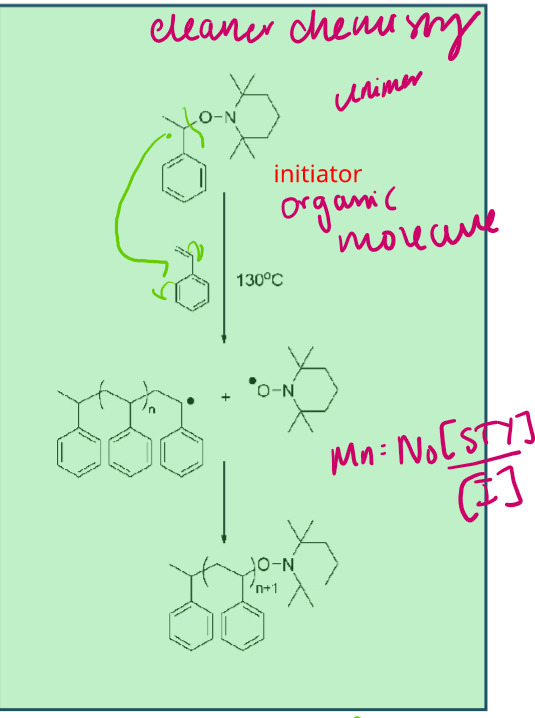
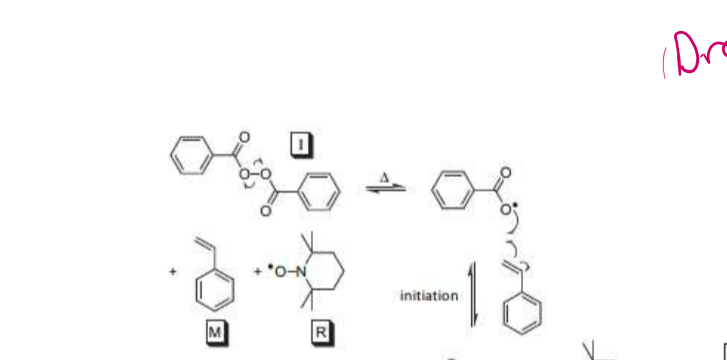
draw out initiation , prop and reverersible termination with this
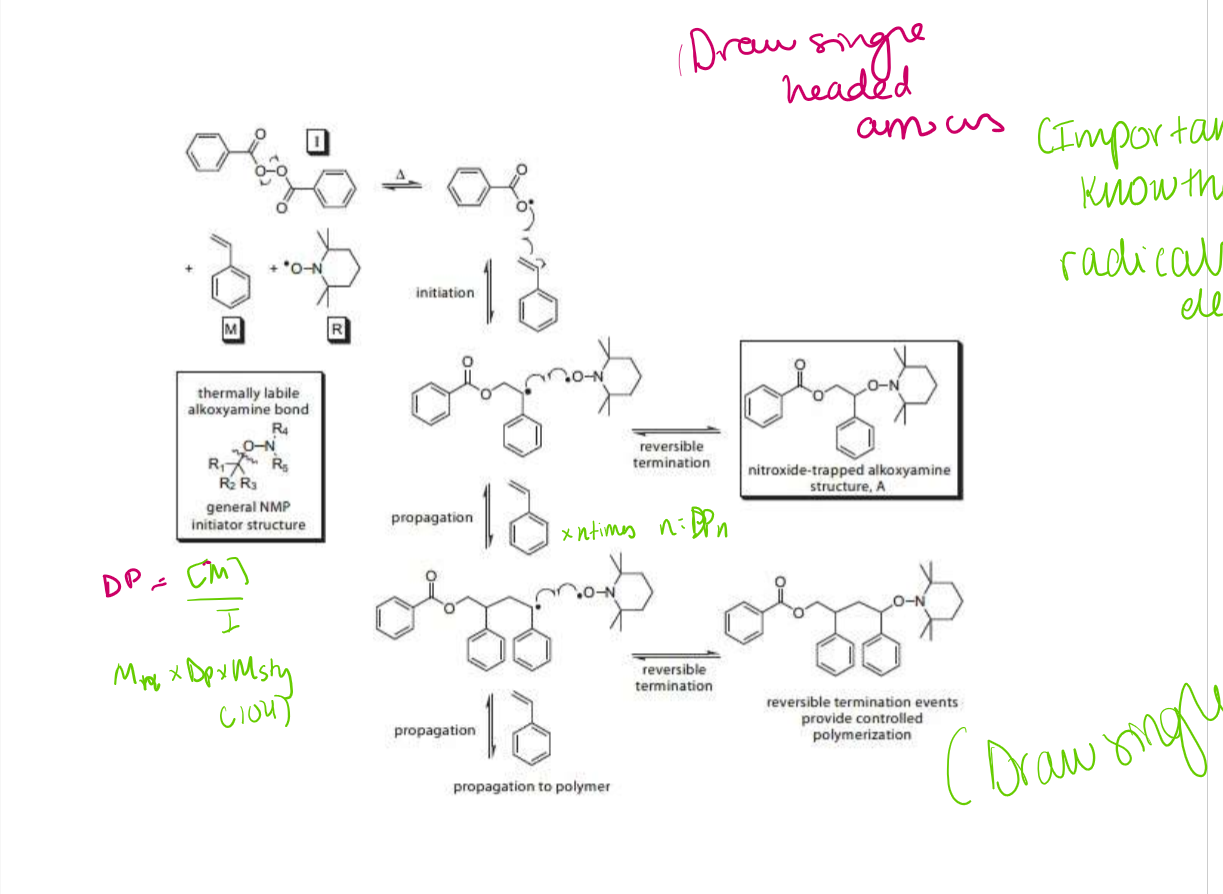
whats this equation showing Mn= Mo x [M]/[I]
Mn is number average molecular weight, so tells u how big a polymer is like 100 chains etc
and Mo of one repeat unit, so styrene being 104 gmol-1
DP= M/I. degree of polymerisation. How many monomers joined together in one chain. so styrene x 4. DP=4
Styrene is polymerised by living radical polymerisation.
Given:
Molecular weight of styrene = 104 g mol⁻¹
Initial monomer concentration = 0.50 mol
Initiator concentration = 0.010 mol
Calculate the theoretical Mn
DP= 0.5/0.01
=50
Mn= 50× 104
=5200g mol
nitroxide mediated copolymerisation out of acrylate, methacrylate and styrene. Is bad for which one
works well with styrene, not much acrylates because side reactions start occuring
Whats the concept of ATRP
atom transfer radical polymerisation. A halogen atom (br/cl) keeps hopping on and off the polymer chain instead of nitrogen
p*
p-br
p-br →← P*
This uses a metal catalyst so sometimes uses cu(ii) to cu(iii)
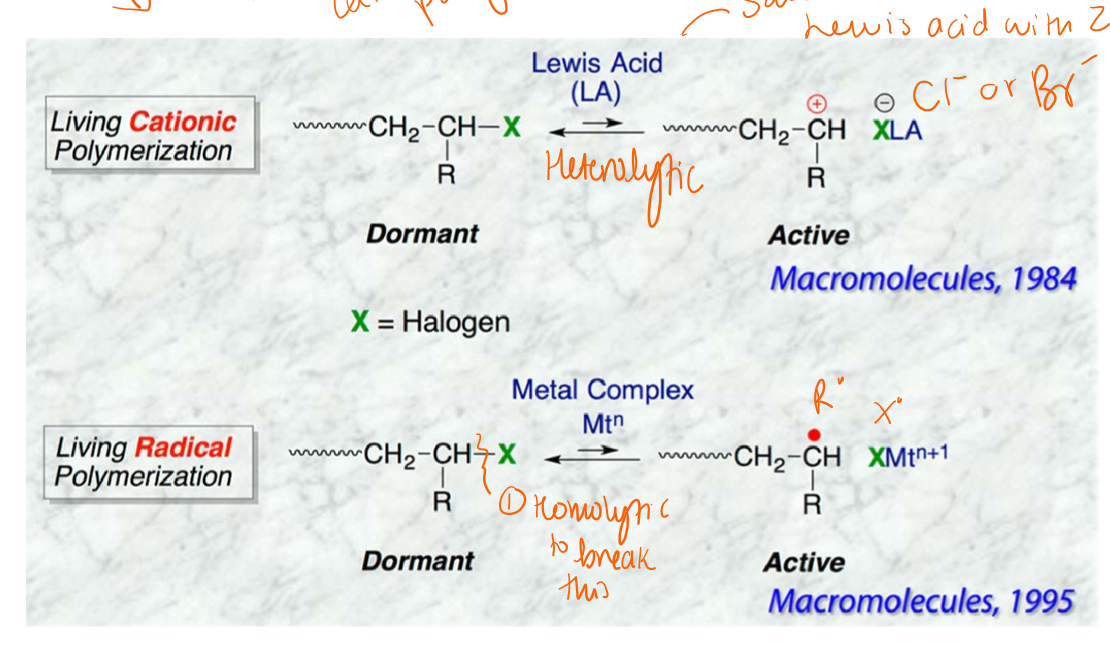
what essentiall is happening between these two pics
Top one is cationic, lewis acid being alcl3 or BF3, breaks the C-X bond heterolytically, meaning both electron goes to one atom, so ions form. active species is a polymer+, a carbocation
Bottom one, basically atrp, but the difference is it uses metal catalyst Cu(I) and breaks homolytically. c-x → polymer* and X-cu (II).
basically both system use the same active dormant technique but in different ways,
Pn-X + Mtn/L for this how would you expect initiation to go
Pn* + X-Mtn+1/L
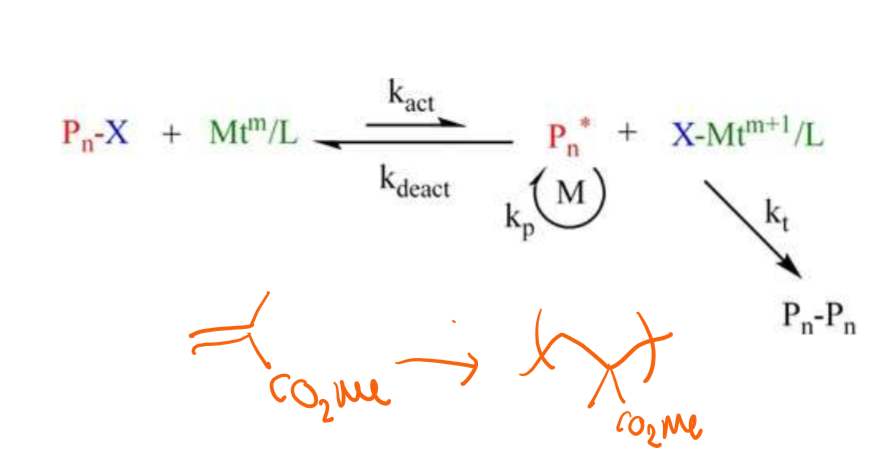
sometimes the metals are binded to a ligand for example
Cu (i)TMEDA, why?
to stabilise the metal, and tune its reactivity
why is ATRP considered living
because p* conc is low and termination is also kept low. Mn increases with conversion
Why must initiation be faster than propagation in living polymerisation
So all polymer chains start growing at approximately the same time, leading to uniform chain lengths and low dispersity.
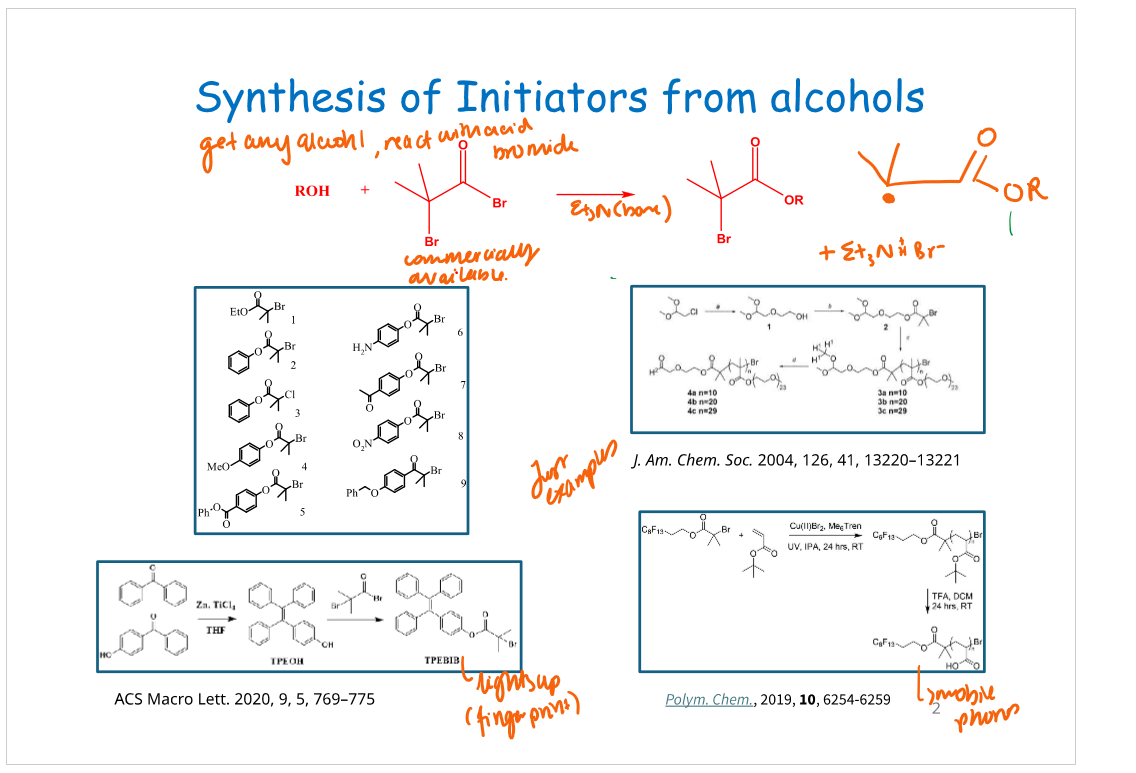
how do we make atrp initiators from alcohols
alcohol+ aklkyl halogen→atrp ester
an example being 2 bromoisobutyryl bromide
its to show that atrp can occur from wide range of molecules
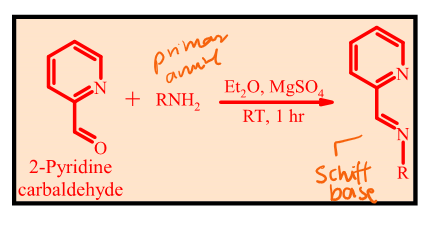
why is this reaction important
the product is a schiff base, its a ligand that attaches itself to the transition metal in atrp reactions
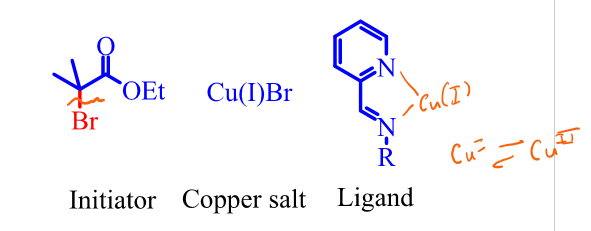
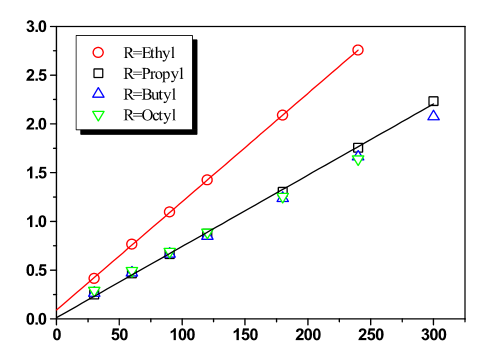
what can be inferred from the diagram and its R group
Changing the ligand has an impact of the atrp rate, this is because the ligand can change the density around copper, redox potential, Kact
What is Kact
activation rate constant, describes Pn-X→Pn*
Why is Cu (0) also usefeul in atrp
its really good at reactivating dormant chains and its also very fast. in SET-LRP
whats set lrp
A controlled radical polymerisation technique in which Cu(I) disproportionates to Cu(0) and Cu(II). Cu(0) acts as a powerful activator through single-electron transfer, generating radicals from dormant halogen-capped chains while Cu(II) provides deactivation control.
Whats the equation for set-LRP
2Cu+⇌Cu0+Cu2+
if you use ligands like Me6TREN and PMDETA, then disproportionation happens fast
why is there Cu0 and Cu 2+ in the equation
Cu0 activates and the other deactivates, BUT GENERATE THESE FIRST. then add monomer and initiator
what can SET LRP fix in normal atrp
acrylamides, bc theyre water soluble and highly polar, they cannot work for normal atrp, but set lrp converts >99 percent. dispersity values of 1.09, 1.10
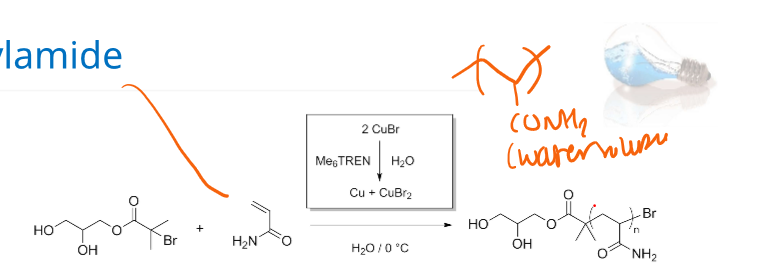
whats the idea of block copolymer
AAAAAAAA-Br and before chain dies, its AAAAAAA-BBBBBBBB
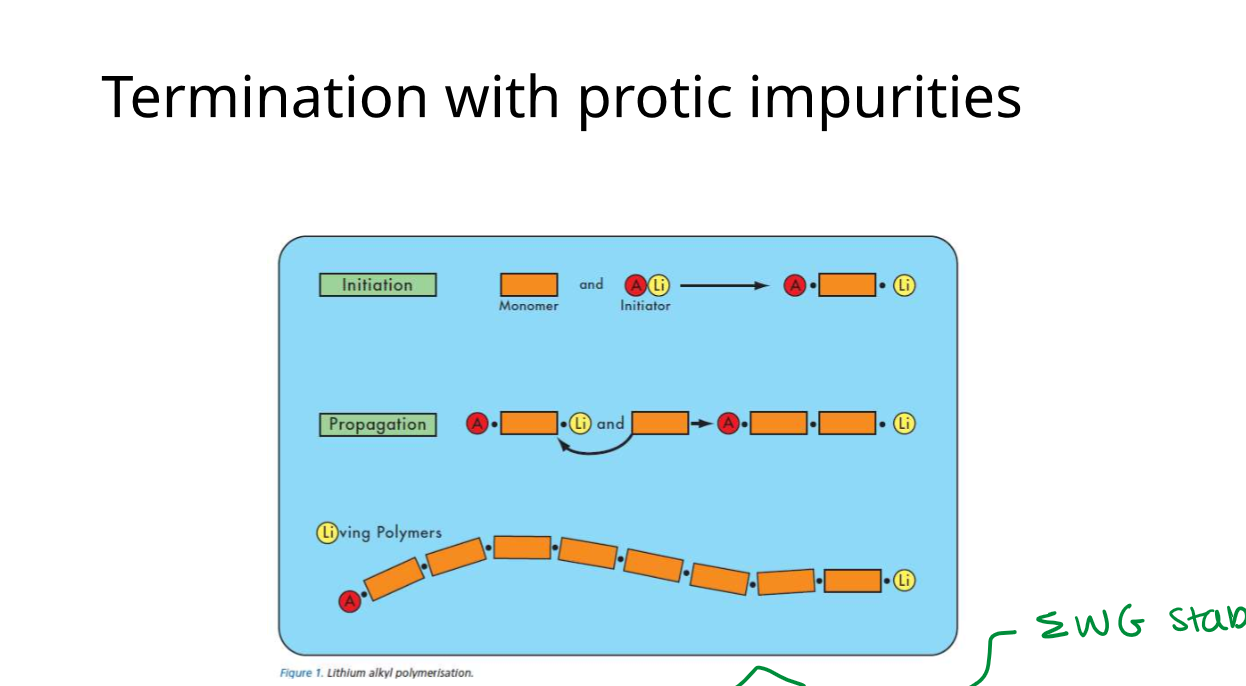
Why are protic impurities problematic in living anionic polymerisation?
Protic impurities such as water and alcohols protonate the living carbanion chain end, terminating polymer growth.
Why is styrene suitable for anionic polymerisation?
The benzylic carbanion formed during propagation is resonance-stabilised by the phenyl ring.
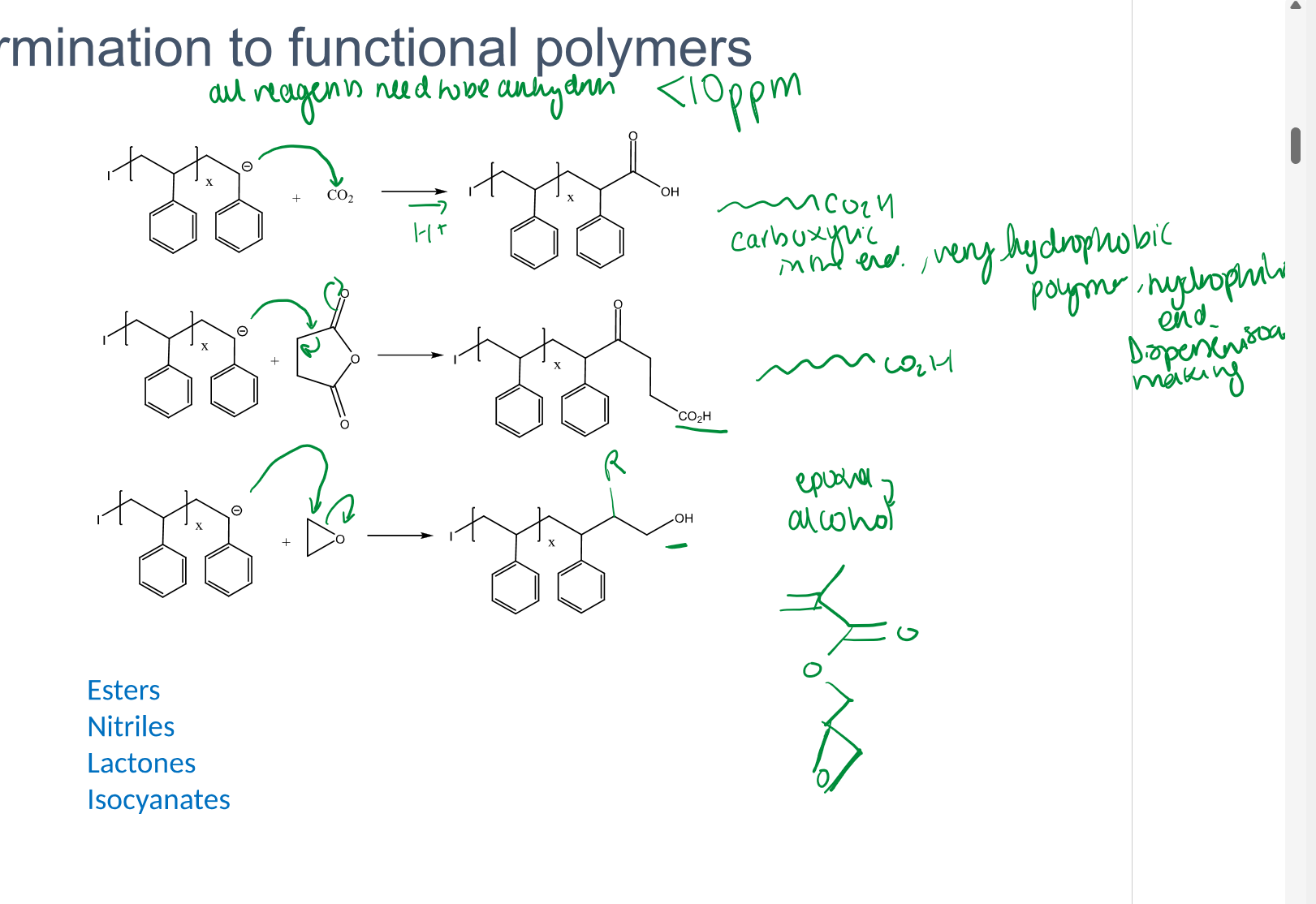
How are functional polymers produced?
The living carbanion is reacted with an electrophile (e.g. CO₂, epoxide, alkyl halide) to introduce a desired end group before termination.
Why must anionic polymerisations be moisture free?
Water and other protic impurities protonate the living carbanion, terminating chain growth.
polystyrene radical + co makes
polystyrene radical + cyclic anhydride makes
same + epoxide
How can block copolymers be prepared?
Sequential monomer addition – polymerise monomer A then add monomer B while chain ends remain living.
Coupling/linking reactions – join two reactive polymer chains using a multifunctional linker.
Macroinitiator approach – use a polymer bearing an initiating group to grow a second block.
Transformation of active chain end – convert one living chain end into another type of initiating species before polymerising a second monomer.
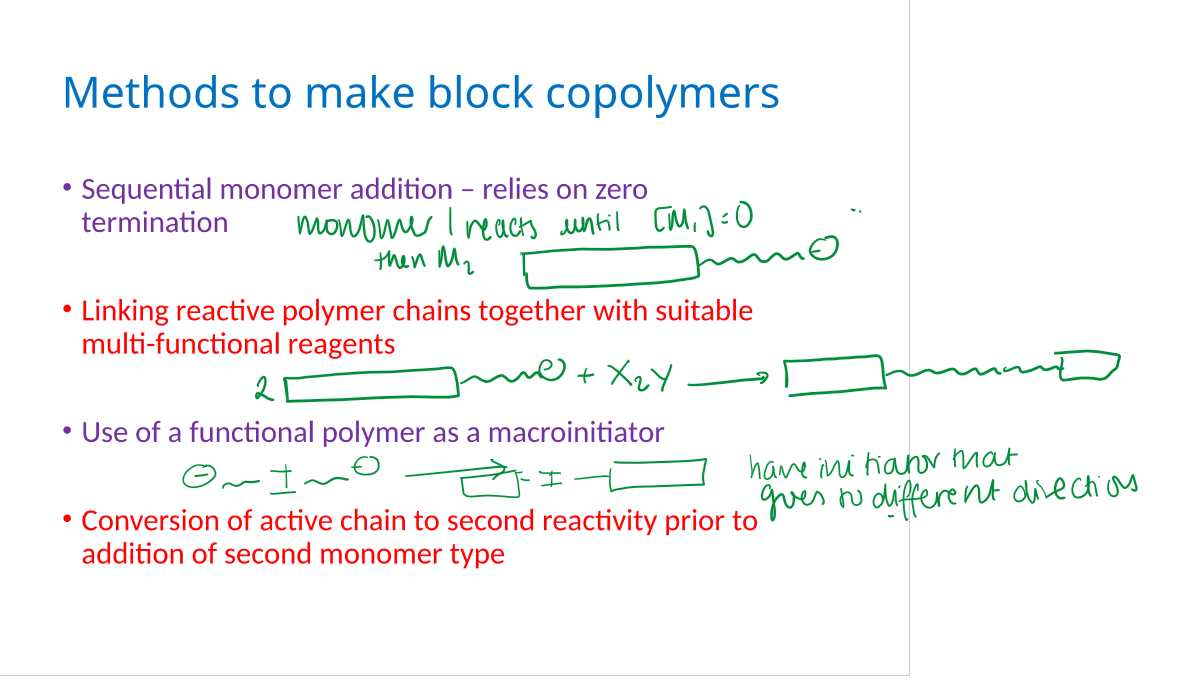
how does each of copolymer block work
1) Polystyrene → add MMA → PS-b-PMMA aaaa+bbbb
2)AAAAAA-X + X-Y-X + X-BBBBBB →PS-OH + PEG-OH + diacid chloride → PS-b-PEG
3)Macroinitiator Method
AAAAAA-Br
PS-Br ATRP macroinitiator → MMA → PS-b-PMMA
4)Active Chain-End Transformation
anionic PS → convert to radical initiator → polymerise MMA → PS-b-PMMA
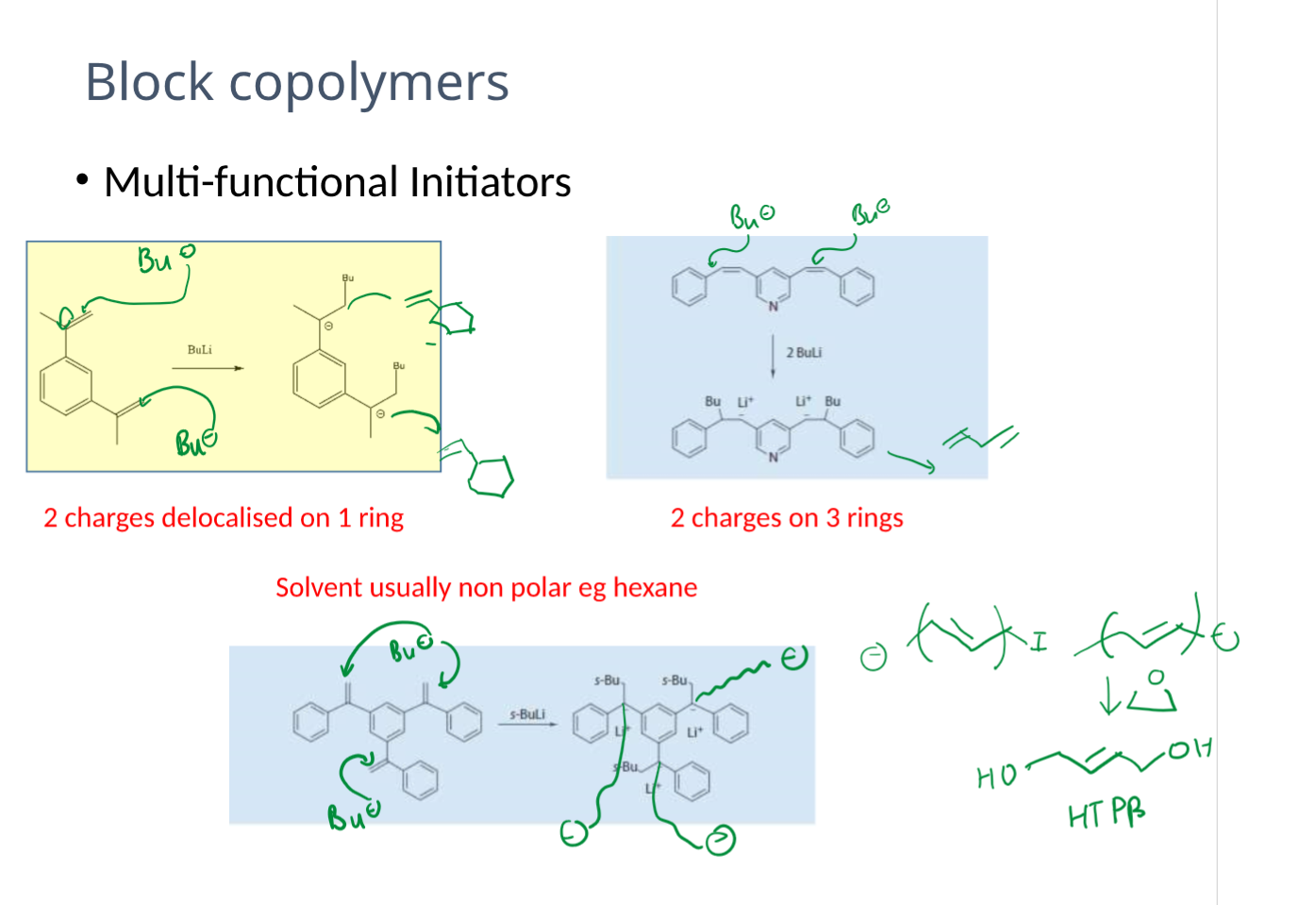
whats the concept of multifunctional initiators
instead of one initiator site, you have multiple
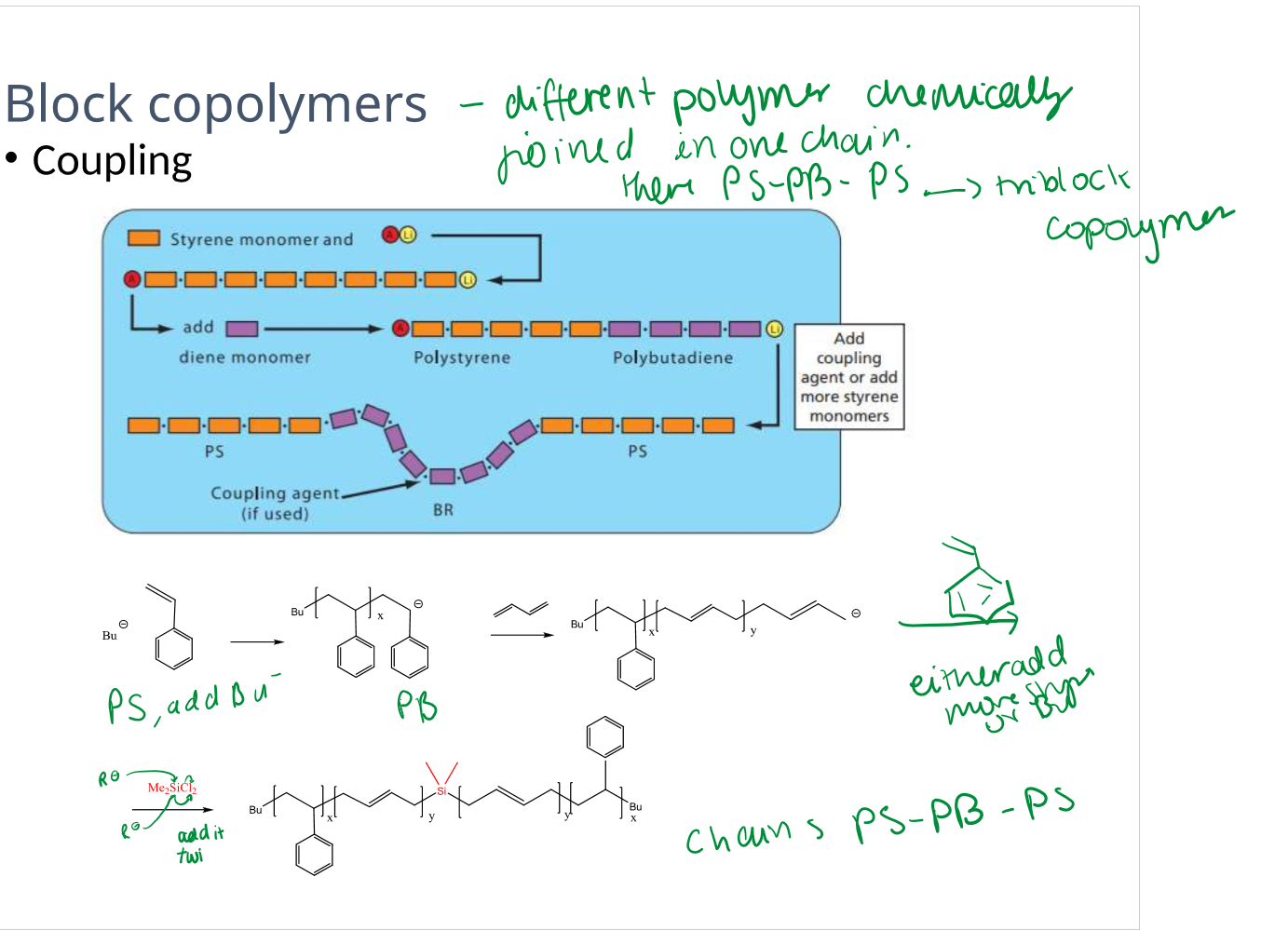
whats the concept of coupling polymerisation
Living polymer chains are reacted with a multifunctional coupling agent (e.g. dichlorodimethylsilane) to chemically join polymer blocks and form diblock or triblock copolymers such as PS-b-PB-b-PS.
why is coupling useful for ps-pb-ps
ps is hard glossy and pb is soft rubbery. together you get hard-soft-hard, this gives thermoplastic elastomer. behaves like a rubber⊕
whats the problem with anionic polymerisation with acrylates, and what can we do to get passed this. ausing side reactions and ester cleavage rather than controlled polymerisation.
anionic is ideal for styrene. acrylates create something else we dont want. to get around this we do something called GTP, group transfer polymerisation
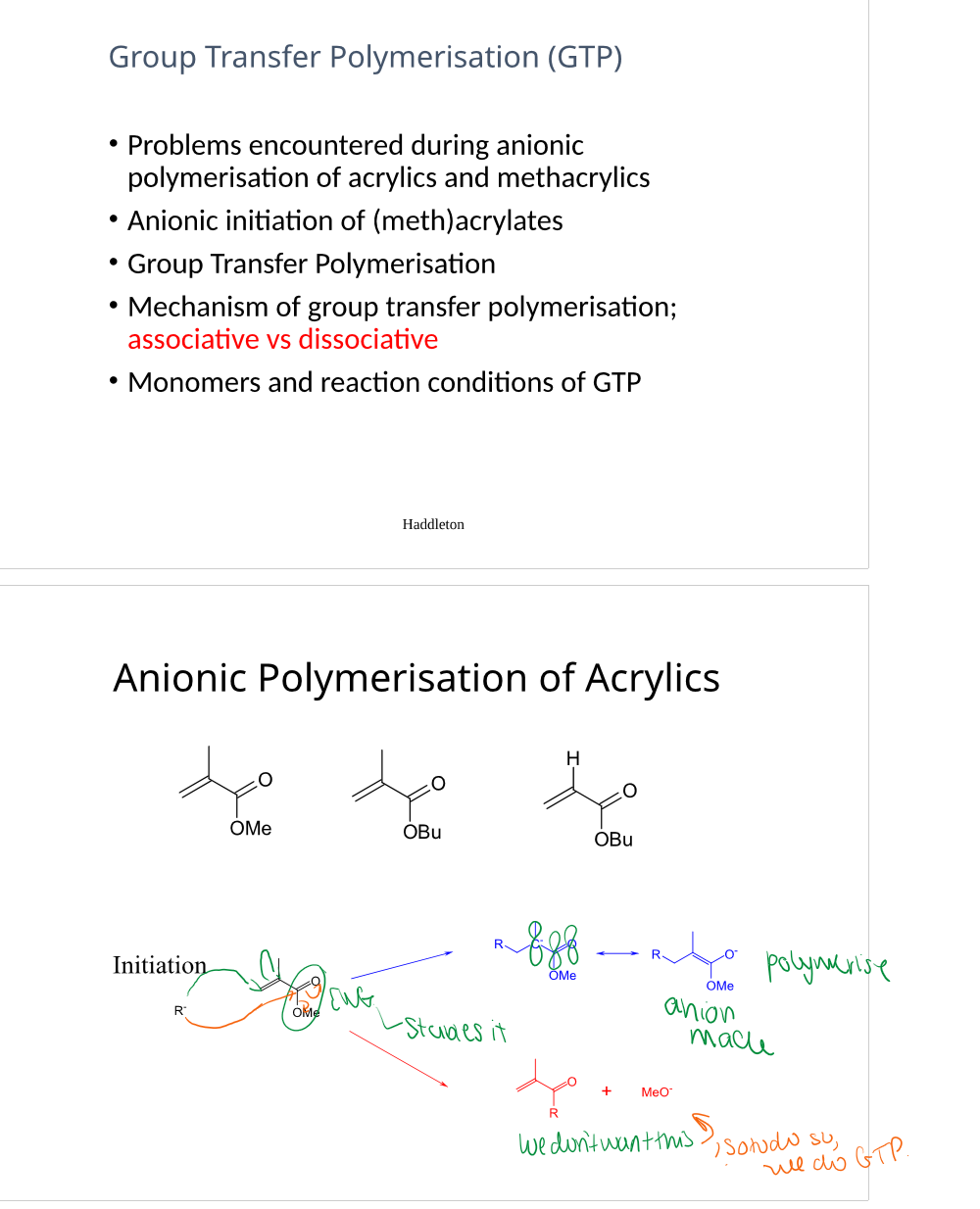
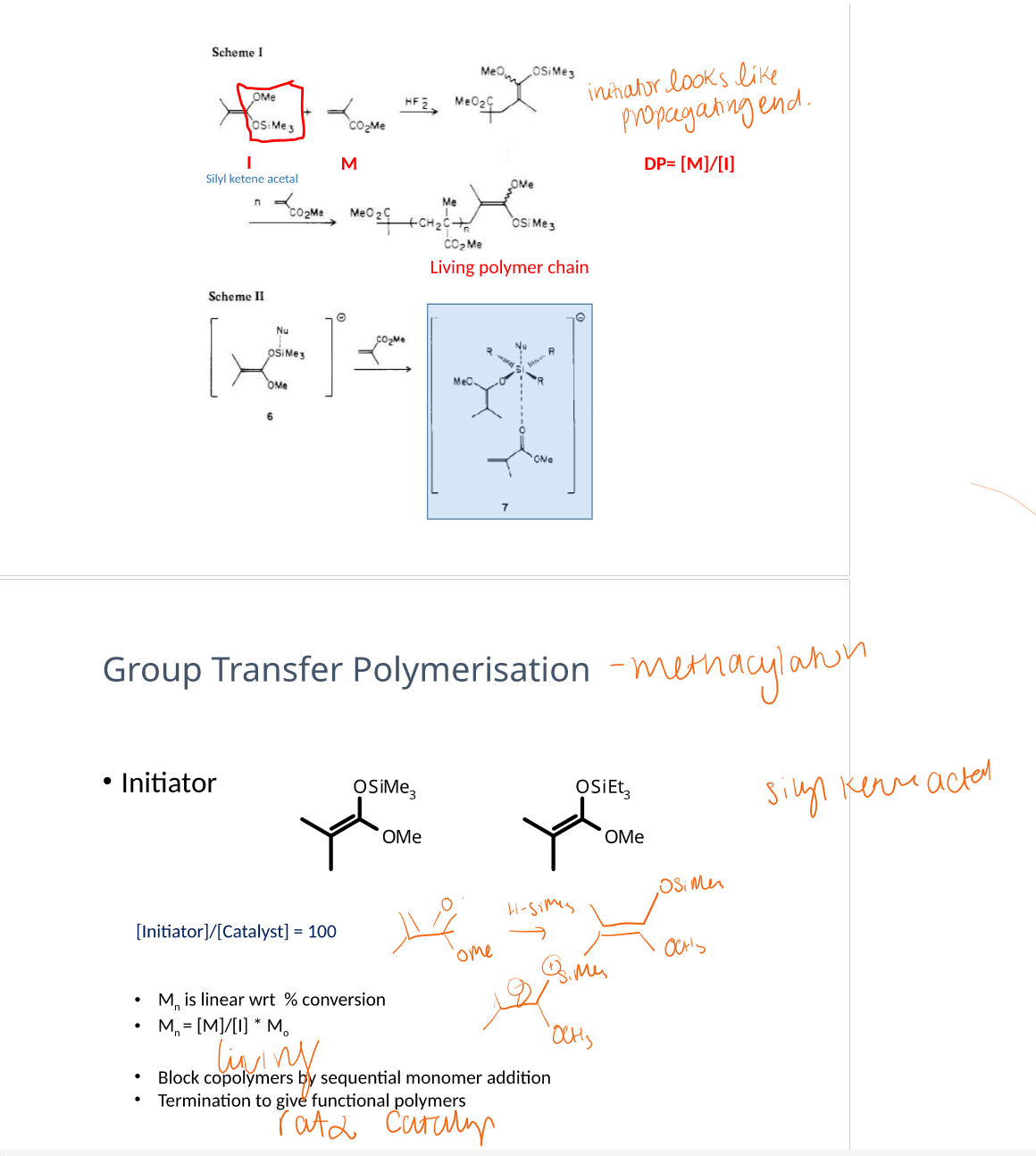
whats GTP general idea
we use silyl ketene acetal instead of R-, its like an enolate wearing a silicone hate. here notice the end of the ketene is hte end of the propagating end, hence why polymerisation can continue. its called gtp, bc the silicon group moves everytime chains added
gtp comes under associative and dissociative pathways, what does each path entail
associative: everyones together, old bond there while new bond forms
dissociative: think sn1, si-nu breaks away, nu is usually f- catalyst
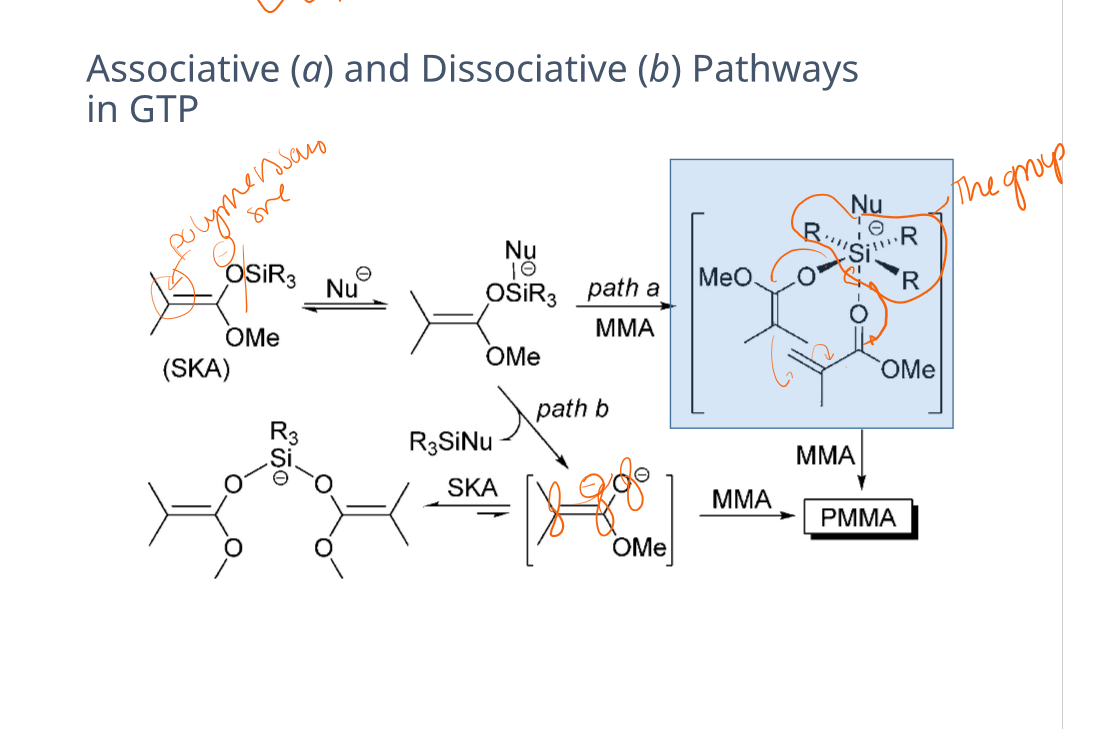
what are GTP solvent and catalyst requirements
solvent: usually polar solvents like thf, catalyst usually hard nucleophiles, F-, HF- or large gegeen ions
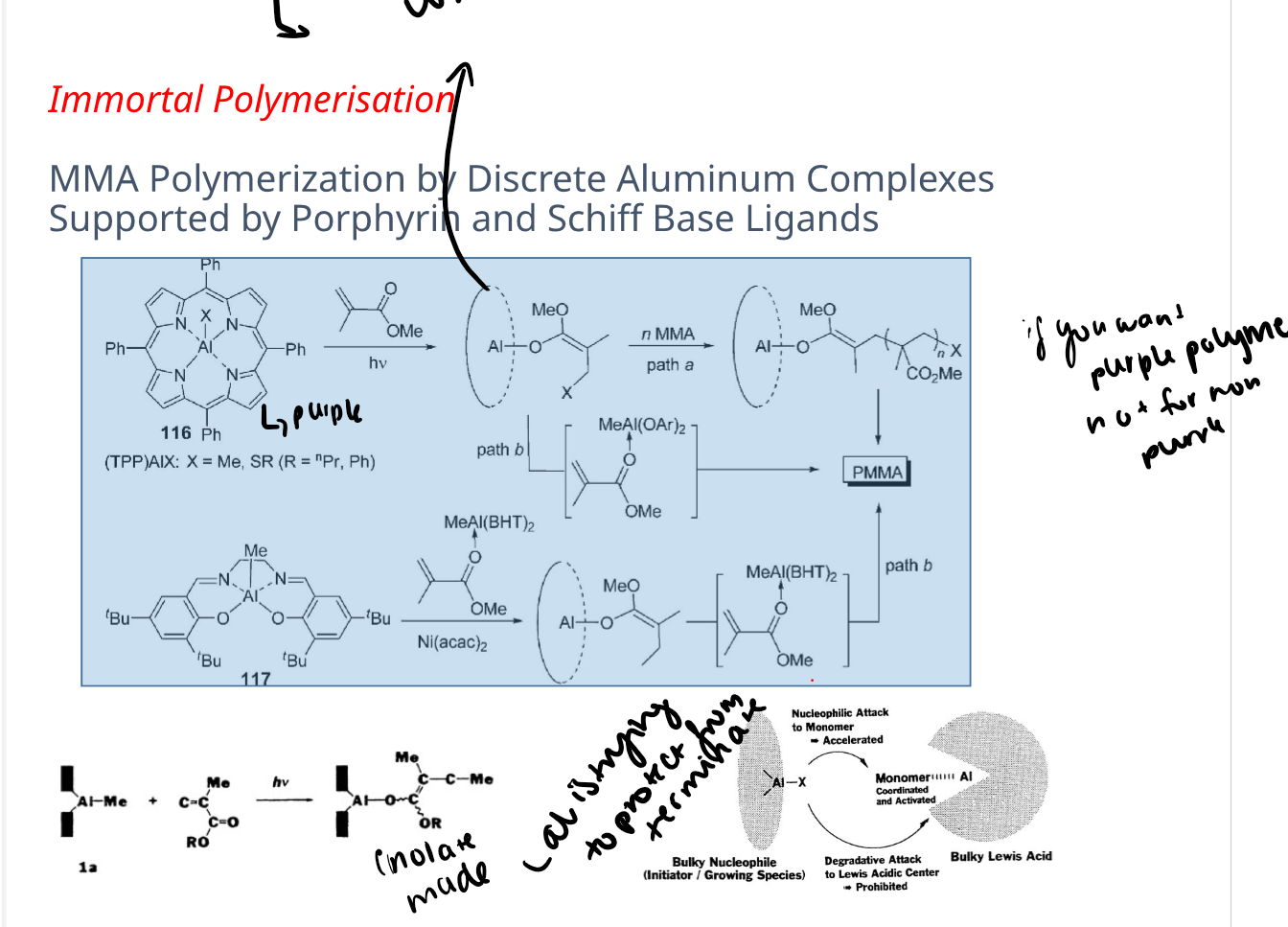
whats the difference between gtp associative/dissociative vs immortal polymerisation
immortal uses aluminium, downside is its only for purple polymer.
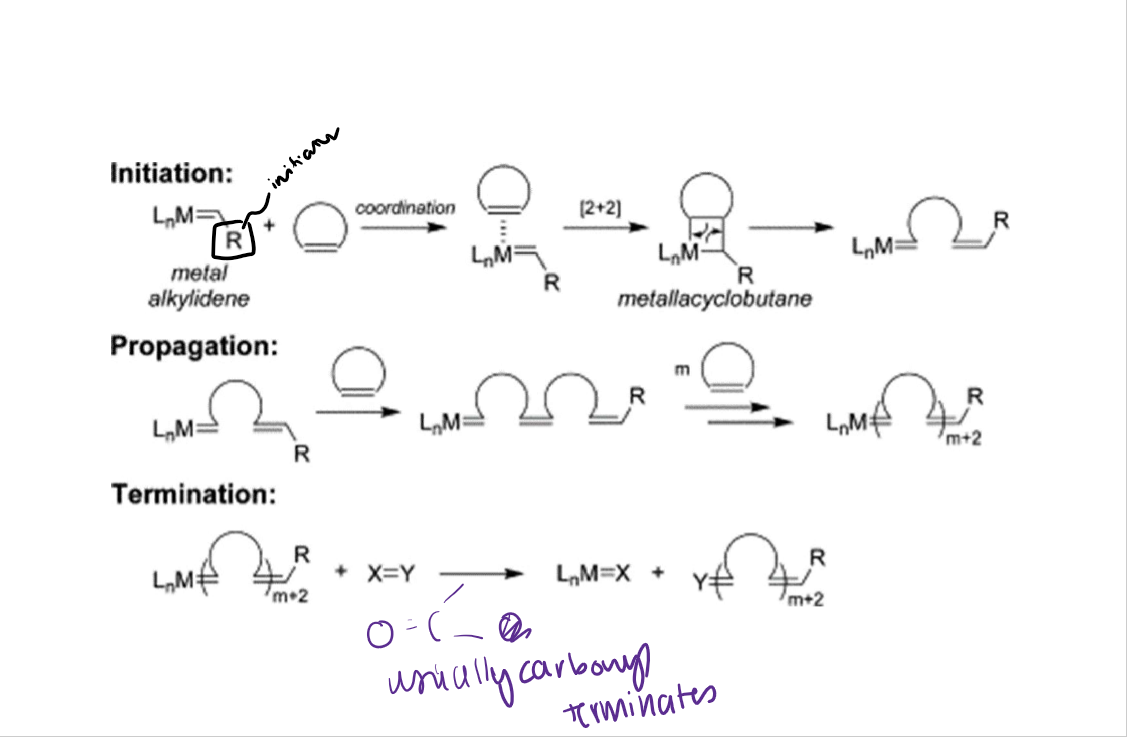
for living ROMP, ring opening monomer polymerisation, what is it good with and what catalyst typically used
catalyst Ru, W or Mo.
bulky ligands used
whats ROMPs initiation, propagation, termination step like
X=Y group is usually a carbonyl
how does romp become a block polymeer
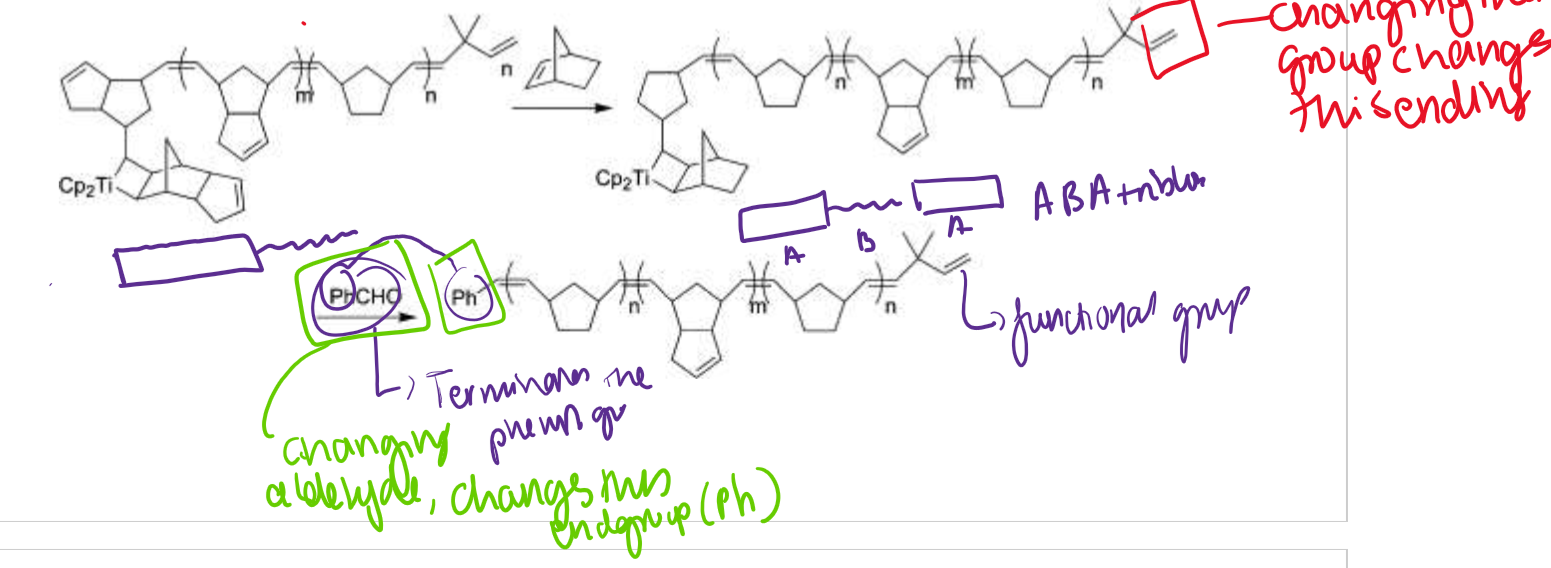
whats the purpose of bioconjugation
to attach a synthetic polymer to a biologically active molecule.
what are the 4 ways to make functional polymers
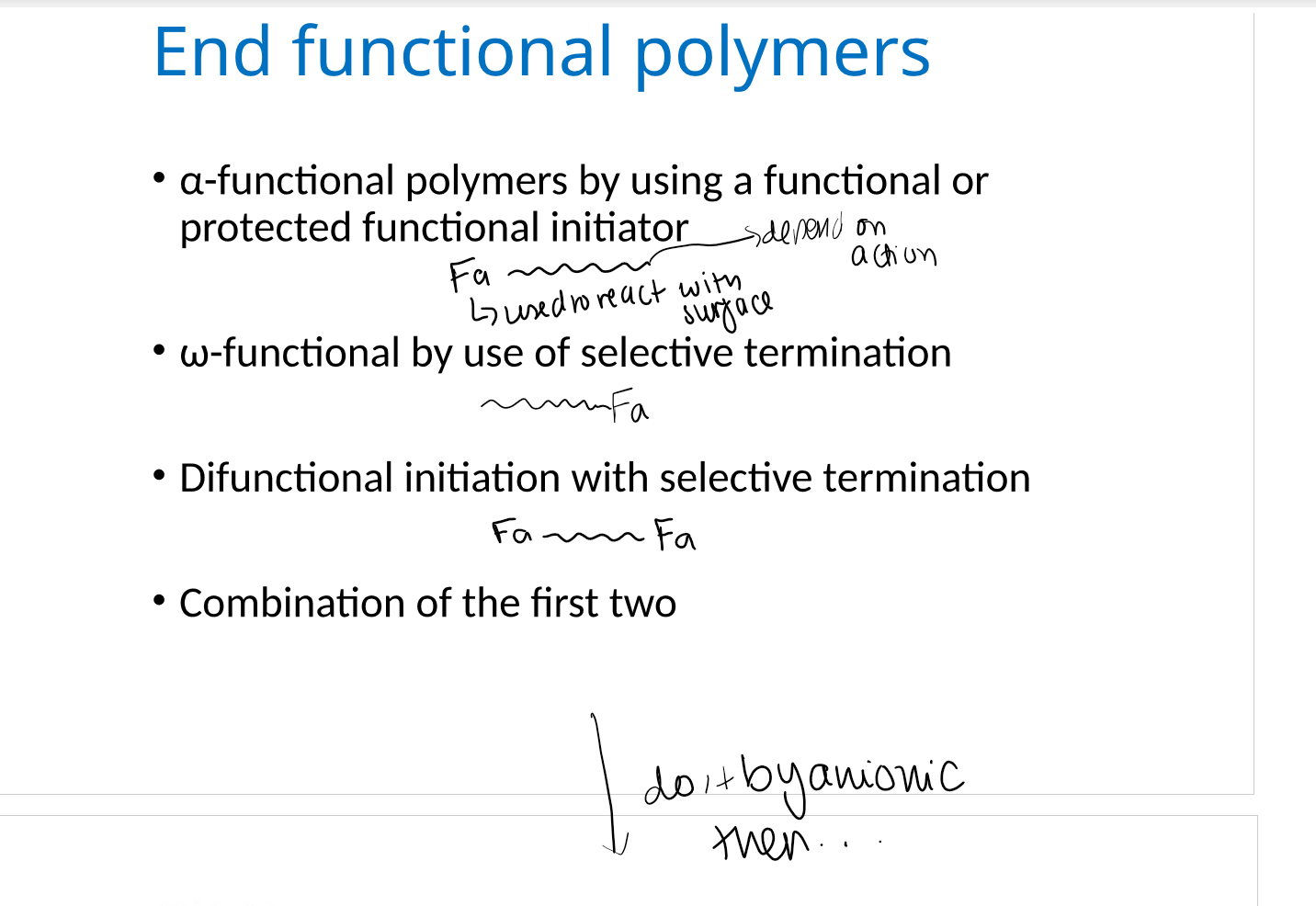
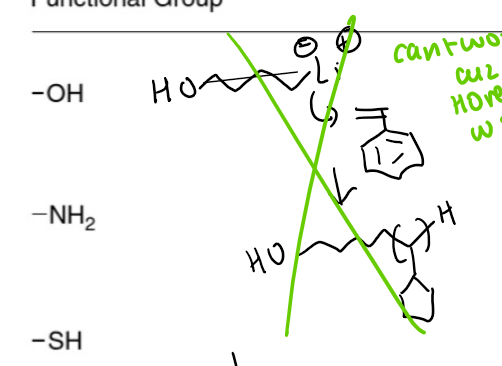
why cant this work
Because the OH group will end up reacting with styrene. the goal of this is to attach an end functional group.
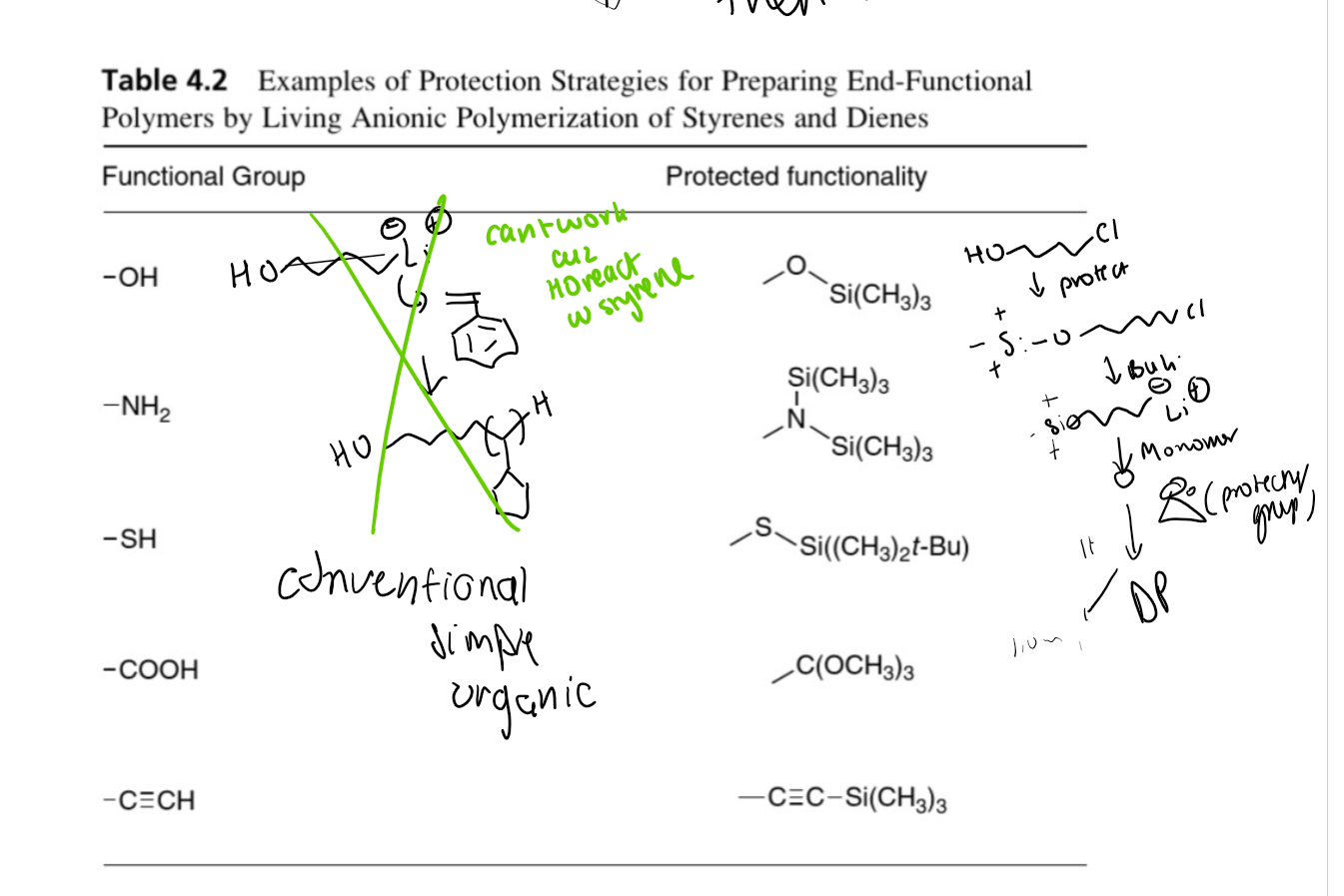
what does this show
using sulfur as a protecting group to attach the endings.
whats the structure of PEG
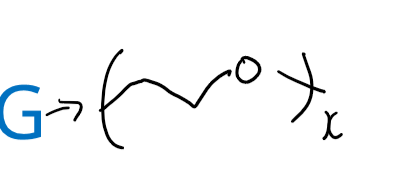
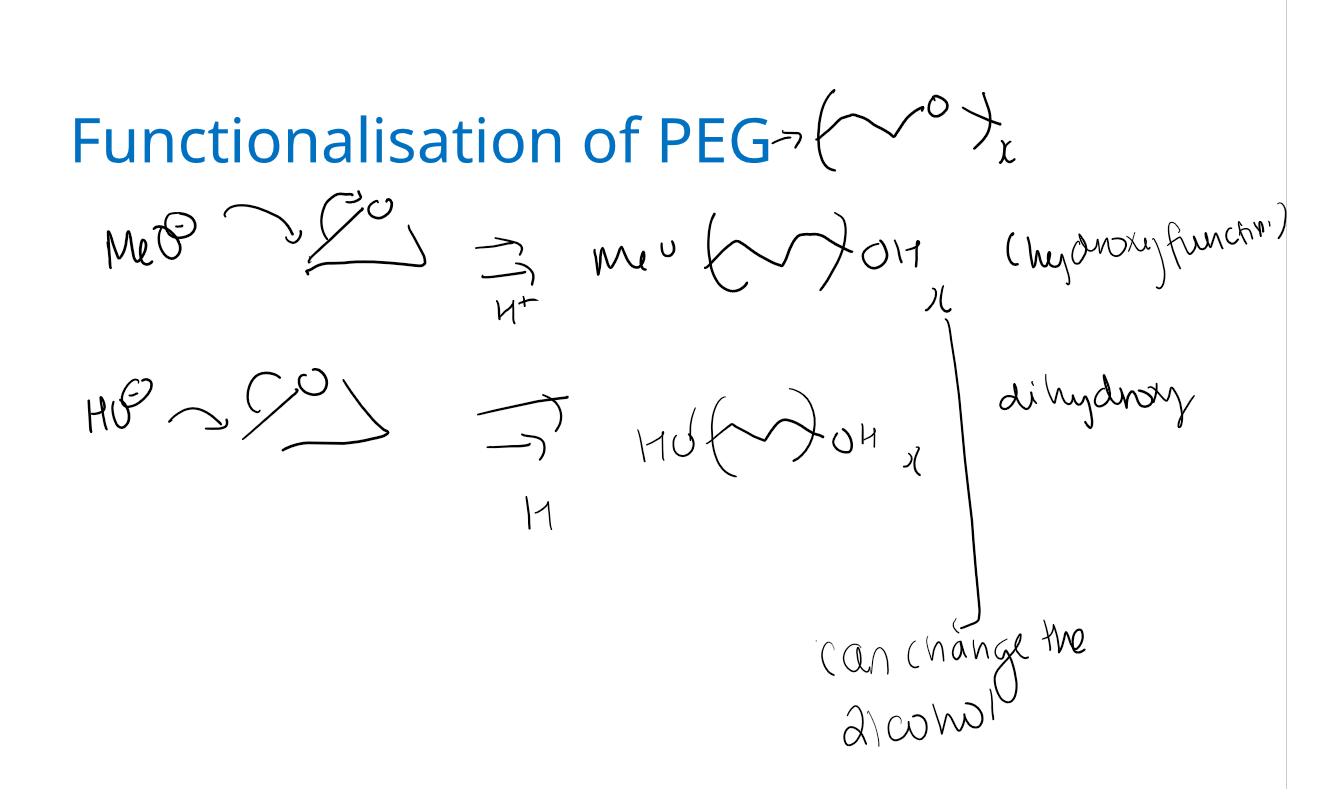
How can you change the functionalisation of PEG to make a hydroxy and dihydroxy function
What is a functional initiator in LRP?
A functional initiator contains both:
an initiation site (e.g. C–Br for ATRP)
a useful functional group (FG) such as aldehyde, amine, or maleimide.
What happens during polymerisation with a functional initiator
Polymer grows from the initiator’s reactive site while the functional group remains intact.
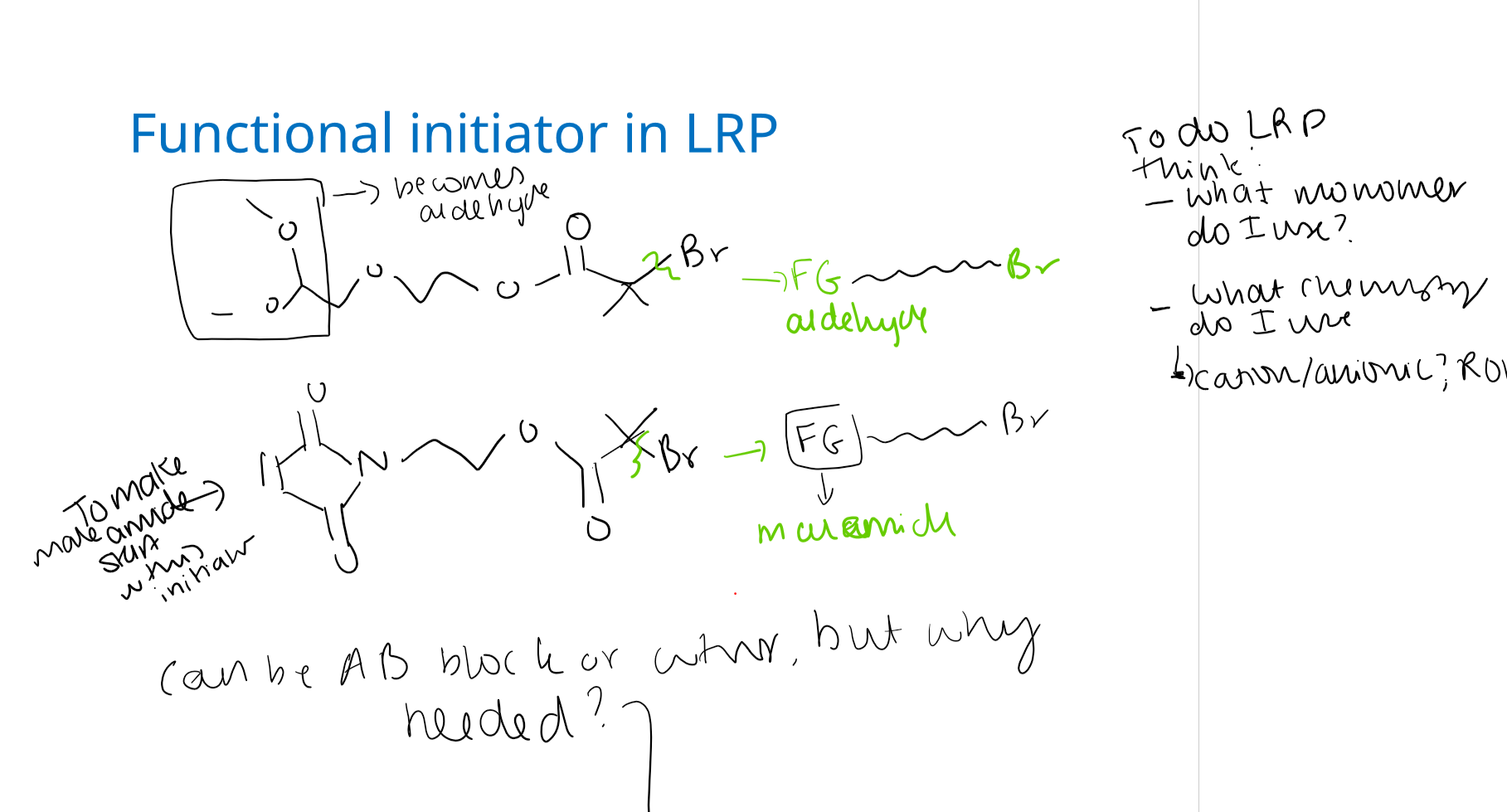
Why use functional initiators in LRP
To make end-functional polymers for further modification.
What is PEGylation
PEGylation is the covalent attachment of Polyethylene glycol chains to another molecule, usually a drug or therapeutic protein
Why is PEGylation useful?
PEGylation improves pharmaceutical properties by:
reducing immune recognition (masks drug from immune system)
increasing water solubility of hydrophobic drugs
increasing hydrodynamic size
reducing renal clearance → longer circulation time / longer half-life
Example: PEGylated insulin or protein drugs stay in blood longer.
whats Lysine conjugation
Lysine conjugation attaches polymers/drugs to the amine group (-NH₂) on lysine residues in proteins.
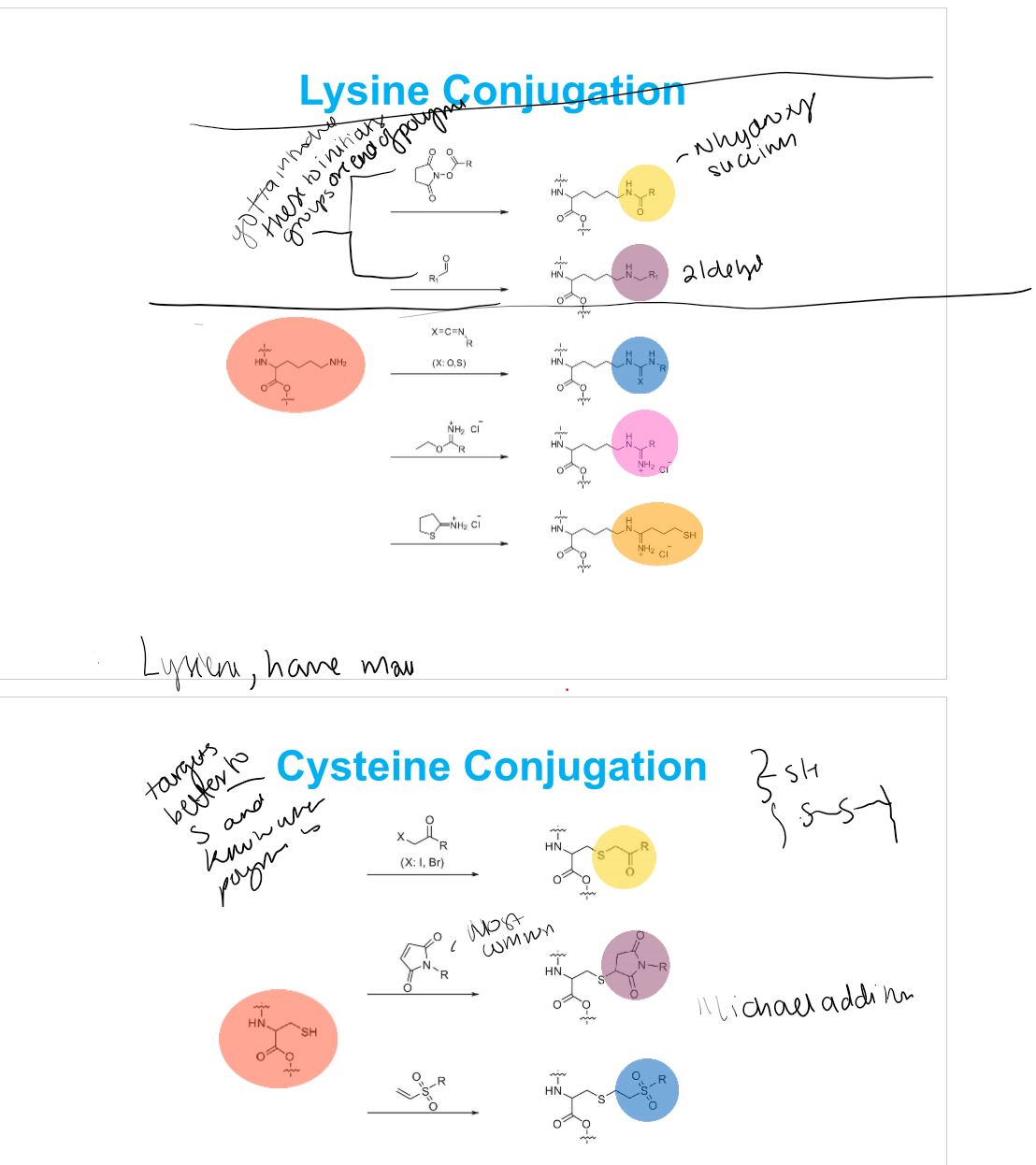
Cysteine conjugation
Cysteine conjugation attaches polymers/drugs to the thiol group (-SH) on cysteine residues.
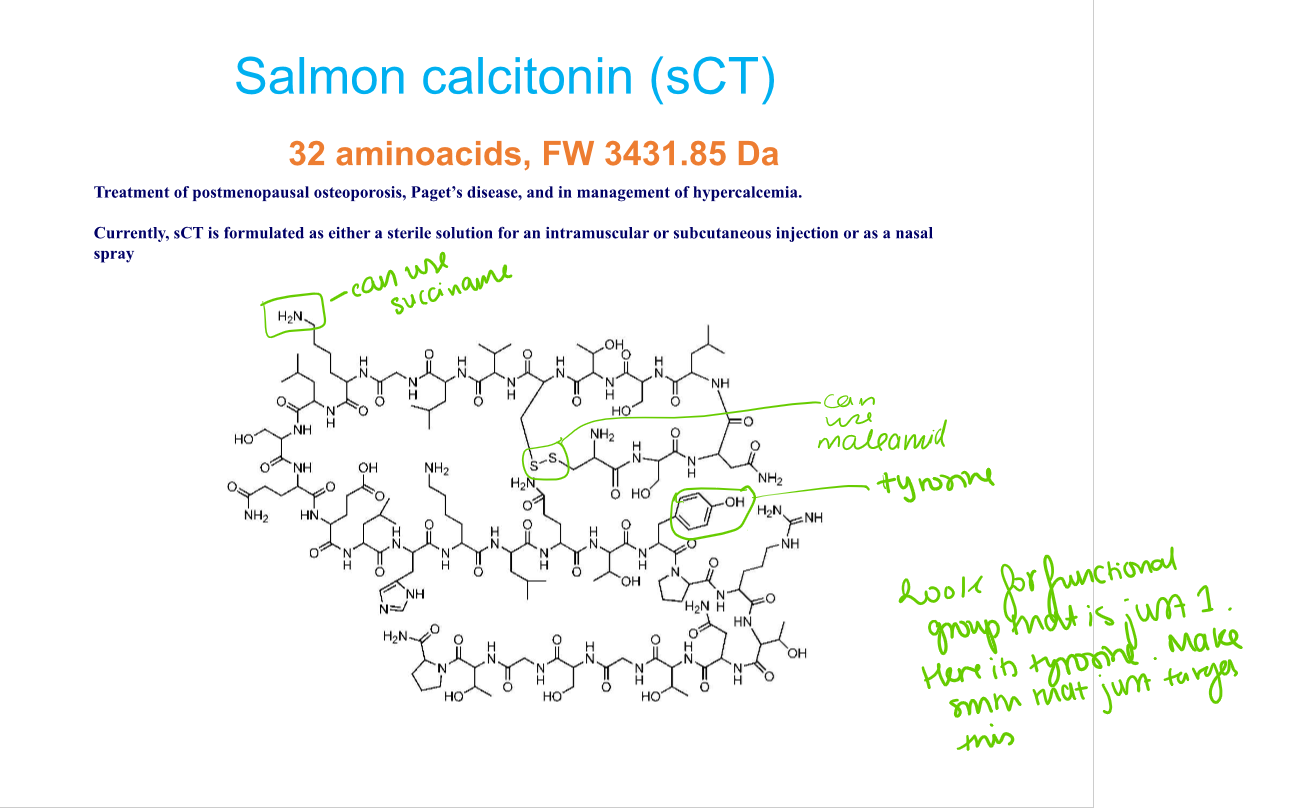
how can you make a drug thats functional here
theres only one tyresine here,but multiple OH groups or NH, the tyresine can get targetted to be rendered useless