Patho Exam 1
 Call Kai
 Learn
Learn Practice Test
 Spaced Repetition
 Match
Match Flashcards
 Knowt Play
1/146

There's no tags or description
Looks like no tags are added yet.
Name | Mastery | Learn | Test | Matching | Spaced | Call with Kai | Chat |
|---|
No analytics yet
Send a link to your students to track their progress
147 Terms
skin function
provide protection, serve as area for heat exchange, prevent fluids from leaving the body
epidermis
4-5 layers of avascular stratified squamous keratinized epithelium that migrate to the skin surface to replace cells lost during normal shedding
basement membrane
thin adhesive layer that cements epidermis to dermis (where blisters happen)
dermis
vascularized connective tissue that separates the epidermis from subcutaneous fat
keratinocyte
makes up 95% of all 5 layers of the epidermis; change as they are pushed out to the outer layer of the epidermis
epidermis cells
keratinocytes, melanocytes, merkel cells, langerhans cells
papillary dermis
thin layer of the dermis up against the epidermis; nourishes the epidermis
reticular dermis
thicker layer of the dermis
subcutaneous layer
vascularized layer of adipose tissue and connective tissue; energy, storage, and cushion
pressure ulcer (decubiti)
ischemic lesions of the skin caused by unrelieved pressure, shear forces, friction, and moisture that impairs the flow of lymph
stage 1 pressure ulcer
area of red, intact skin that is isolated to the epidermis; does not disappear when pressure is relieved

stage 2 pressure ulcer
partial thickness skin loss to the dermis; red or pink ruptured blister or shallow crater

stage 3 pressure ulcer
full thickness skin loss to subcutaneous fat; deep crater

stage 4 pressure ulcer
full thickness tissue loss to the bone and muscle; deep crater that may include necrotic tissue, slough, and eschar; tunneling often present
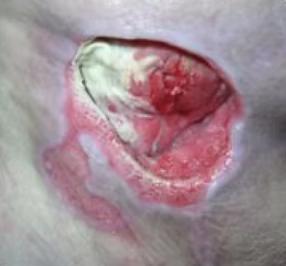
unstageable pressure injury
full thickness loss of tissue with base covered by slough or eschar; cannot be determined until either are removed
rule of nines
head & neck - 9%
right arm - 9%
left arm - 9%
trunk - 36%
groin - 1%
right leg - 18%
left leg - 18%
first degree burn
superficial partial thickness burns that only impact the outer layers of the epidermis; take 1-13 days to heal
ex. mild sunburn
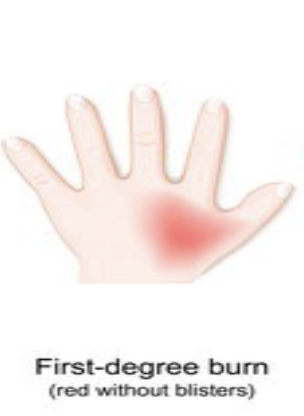
mis
second degree burn
partial thickness burn that impacts the epidermis and some of the dermis or full thickness which impacts both; injury is painful, moist, red, and blistered; takes 1-3 weeks to heal

third degree burn
full thickness burn that extends into subcutaneous tissue and may involve muscle and bone; hardy, dry and leathery, after grafting take 1-2 weeks to heal

primary lesions
lesions arising from previously normal skin
ex. macules, papules, nodules, vesicles, wheals, pustules, cysts
secondary lesions
lesions arising from other disease conditions
ex. erosion, ulcer, fissure, scales, crust, scars, keloids, atrophy, lichenification
potassium hydroxide (KOH)
used to prepare slides of skin scrapings to test for fungal infections; KOH dissolves keratin but not fungal spores, leaving them visible on the slide
wood’s lamp
diagnostic tool that uses UV light to examine skin in a darkened room for fungal infections, bacterial infections, pigment disorders, and porphyria (useful for discerning conditions that look similar in normal light)
cranial nerve I
olfactory nerve; controls smell
cranial nerve II
optic nerve; controls vision
cranial nerve III
oculomotor nerve; controls eye movements, eyelid elevations, pupil constriction, and lens accommodation
cranial nerve IV
trochlear nerve; controls the superior oblique muscle which allows the eye to move downward and inward
cranial nerve V
trigeminal nerve; controls facial sensation (touch, pain, temperature) in the face and chewing
cranial nerve VI
abducens nerve; controls the lateral rectus muscle which allows the eye to move outward
cranial nerve VII
facial nerve; controls facial expression, taste from the anterior two thirds of the tongue, and salivation and tear production
cranial nerve VIII
vestibucochlear nerve; controls hearing and balance
cranial nerve IX
glossopharyngeal nerve; controls taste from posterior third of the tongue, sensation from the pharynx, swallowing, salivation, and gag reflex
cranial nerve X
vagus nerve; controls muscles of pharynx and larynx (swallowing and speaking), parasympathetic control of the heart, lungs, and digestive tract, and sensation from the throat and internal organs
cranial nerve XI
accessory nerve; controls sternocleidomastoid and trapezius muscles (head turning and shoulder shrugging)
cranial nerve XII
hypoglossal nerve; controls tongue movements (speech and swallowing)
communicating with pts with visual impairments
announce yourself when entering the room
orient pt to environment
explain what you’re doing before you do it
state when you’re leaving the room
ensure adequate lighting
address glasses
ask if they want paperwork in braille
communicating with pts with hearing impairments
face the pt directly and maintain eye contact
ensure adequate lighting on your face
speak clearly at a normal pace
reduce background noise
ask if pt wants ASL interpreter
address hearing aids
use written communication when appropriate
types of hearing loss
conductive (stimuli not adequately translated)
sensorineural (disorders that affect the inner ear, auditory nerve, or auditory pathways of the brain)
mixed (combo of both simultaneously)
eustachian tube
tube that extends from middle ear to the nasopharynx and allows air or secretions to enter or leave the middle ear cavity; opens with swallowing and yawning to allow for equalization of pressure between middle ear and outer environment
conjunctivitis
inflammation of the conjunctiva caused by bacterial or viral infection, allergens, chemical agents, physical irritants, or radiant energy
types of conjunctivitis
allergic: caused by itching due to allergens
bacterial: caused by hyperacute, acute, or chronic infections; purulent discharge and redness
viral: caused by adenoviruses, herpes, or enteroviruses; clear discharge and accompanied by upper respiratory tract infection
body water distribution
ICF: 2/3 total body water (40% body weight)
ECF: 1/3 total body water (20% body weight)
average adult male: 60% body water
average adult female: 50% body water
arterial blood gas (ABG)
normal pH (acid base status): 7.35-7.45
normal PaCO2 (respiratory status): 35-45 mmHg
normal HCO3 (metabolic status): 22-26 mEq/L
normal PaO2 (oxygenation): 80-100 mmHg
respiratory acidosis
high HCO2 + low pH
hypoventilation → CO2 retention
respiratory alkalosis
low HCO2 + high pH
hyperventilation → excess CO2 elimination
metabolic acidosis
low HCO3 + low pH
ketoacidosis, renal failure, severe diarrhea → acid gain/bicarbonate loss
metabolic alkalosis
high HCO3 + high pH
prolonged vomiting, NG suction, diuretic use, hypokalemia, cushing syndrome → acid loss/bicarbonate gain
hypertonic solution
solution causes water to move out of cell
hypotonic solution
solution causes water to move into the cell
isotonic solution
solution and cell have the same osmotic pressure (same size)
selye’s general adaptation syndrome (GAS)
stress response characterized by three stages:
alarm (generalized stimulation of the sympathetic nervous system)
resistance (body selects most effective and economic channels of defense)
exhaustion (resources are depleted and systemic damage appears)
negative feedback loop
sensor detects change → integrator sums and compares data with set point → effector returns system to within range of set point → again
positive feedback loop
sensor detects change → integrator receives signal → effector amplifies original stimulus → sensor detects amplification → effector continues to respond until event ends
stress
body’s physical and psychological response to a stressor
distress
negative stress; perceived as harmful
eustress
positive stress; perceived as manageable and rewarding
exocrine
substance released via body surface or cavity (ex. sweat glands or digestive enzymes enzymes into the GI tract)
endocrine
hormone released into bloodstream to target distant cells (ex. insulin to pancreas)
paracrine
cell releases a signal that acts on neighboring cells (ex. histamine to inflamed tissue)
autocrine
cell releases a signal that acts on itself (ex. cancer cells stimulating more growth)
heterocrine
gland with endocrine and exocrine function (ex. pancreas secrets insulin and glucagon into the blood and enzymes into the GI tract)
recessive genotype
requires two recessive alleles to express recessive phenotype
allele
alternate form of gene at the same locus (control trait expression)
homozygous
same two alleles
heterozygous
two different alleles
mutation
accidental errors in DNA replication (substitution of one base pair for another, loss or addition of one or more base pairs, or rearrangement of base pairs)
transcription
process in which RNA is synthesized from the DNA template
translation
the synthesis of a protein using the mRNA template
transduction
communication between cells through chemical messengers that bind to protein receptions on other cell surfaces or inside of cells
somatic cells
cells other than sperm and ovum
gametes
sperm and ovum
mitosis
the replication of DNA to duplicate somatic cells in the body
meiosis
the replication of germ cells to produce gametes
teratoid
related to teratoma (a tumor made from tissue not normally found at the site arising from germ cells)
chromosomes
stores genetic information in pairs
genome
total genetic content that is organized into chromsomes
genotype
genetic information stored in the sequence of base pairs
phenotype
recognizable traits associated with a specific genotype
x-linked recessive inheritance
traits are expressed phenotypically in male offspring while female offspring are strictly carriers
x-linked dominant inheritance
dominant trait linked to X chromosome are expressed phenotypically in both male and female offspring
carrier status
when a person carries a copy of a recessive allele but does not actively express the phenotype
congenital defects
structural or functional abnormalities at birth that develop during fetal development; caused by chromosomal abnormalities, single-gene mutations, teratogens, combos of genetic and environmental factors, etc.)
neural tube defects
congenital structural defects that occur when the neural tube fails to close completely during fetal development (ex. spina bifida, meningocele, anencephaly)
chemotherapy
systemic treatment that enables drugs to reach the site of the tumor as well as other distant sites; usually used in combo with radiation
radiation
uses high energy particles or waves to destroy or damage cancer cells; usually used in combo with chemo
surgery
oldest treatment for cancer that is used for diagnosis, staging of cancer, tumor removal, and palliation (relief of symptoms) when a cure cannot be achieved
stem cell therapy
treatment for blood cancer and certain blood/immune disorders; uses undifferentiated cells to repair, replace, or regenerate damaged tissue cells in the body
alopecia
hair loss caused by toxicities from vinca alkaloids involved in chemotherapy
weight loss due to cancer
cancer pts lose weight due to increased cytokines (increase resting energy expenditure, break down muscle and fat directly, and suppress appetite), cancer competing for nutrients, dysphagia, nausea, and pain
cachexia
weight loss and wasting of body fat and muscle tissue, accompanied by profound weakness, anorexia, and anemia; part of cancer anorexia-cachexia syndrome
pap smear
test to detect cancer in the cervix
mammography
x-ray technique used to detect breast cancer
rectal exam
physical exam of the rectum to assess for prostate, colorectal, or anal cancer
fecal occult blood test
positive test can be an indicator for colorectal cancer
colonoscopy
test that uses direct visualization of the colon via glass fiber bundle to assess for colon cancer; can also be used to remove polyps or biopsy
prostate-specific antigen (PSA)
blood test to assess for prostate cancer
transrectal ultrasonography
biopsy needle is guided to obtain sample tissue; can detect cancers that are too small to be detected through physical exam
ribosomes
site of protein synthesis
endoplasmic reticulum
rough: makes and stores proteins that become parts of organelles or cell membranes
smooth: smooth structure that synthesizes lipids (including steroid hormones)
golgi
four stacks of thin, flattened vesicles that receive substances from the ER via vesicles