Kinesiology 2000 Final
 Call Kai
 Learn
Learn Practice Test
 Spaced Repetition
 Match
Match Flashcards
 Knowt Play
1/222

There's no tags or description
Looks like no tags are added yet.
Name | Mastery | Learn | Test | Matching | Spaced | Call with Kai | Chat |
|---|
No analytics yet
Send a link to your students to track their progress
223 Terms
Sports Medicine
Any professional associated with the medical and therapeutical aspect of sports participation and physical activity
Physical Fitness
ABILITY of the body to ADJUST to the demands and stresses of PHYSICAL EFFORT (a measure of health)
Physical Activity
Any MOVEMENT carried out by the skeletal muscles requiring ENERGY
Components of Physical Fitness
Muscular Strength, Muscular Endurance, Cardio/respiratory Endurance, Flexibility, Body Composition, & Psychomotor Ability
Stress (component of fitness)
Ability of a muscle to do work
Power (component of fitness)
Ability to generate force quickly
Endurance (component of fitness)
Ability to sustain the force over time
Cardiorespiratory Fitness
- Requires oxygen to get to muscles
- Aerobic Function
Energy Sources for Muscle Contraction
ATP, Oxygen, Glucose, Fat
Metabolic Syndrome
Cluster of conditions (Obesity, Hyperinsulinemia, Elevated triglycerides, Hypertension, Type 2 Diabetes)
Exercise
is medicine! (decrease rates of cancer and other illnesses )
Health Assessment
Body Comp, Fitness Assessment, Wellness Assessment, and Risk
Overweight
Total body weight (fat) above a recommended range of good health
Obesity
Severely overweight and over-fat; excessive accumulation of body fat
Female Athlete Triad
3 interrelated disorders (Abnormal eating patterns & excessive exercising -- Amenorrhea (absence of menstruation) -- Premature osteoporosis)
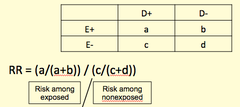
Relative Risk
Helps determine risk of disease
(Condition absent or present) Formula: (a/(a+b)) / (c/(c+d))
Biometrics
- Height, weight, BMI
- Blood pressure
- Cholesterol
- Triglycerides
Activity Scales
Tegner, Godin Leisure Questionnaire, Accelerometers - Pedometers
ACSM Guideline for Physical Activity
American adults (18-65) should do 30 min of moderate-intensity aerobic activity for 5 days OR 20-min of vigorous activity for 3 days
Different ways to look at human Body Composition
Medical (health), Anthropological, Performance & Appearance (MAPA)
Body Composition
The body's relative amounts of fat mass and fat-free mass (bone, water, muscle, connective and organ tissues, teeth)
Essential Fat
- Crucial for normal body functioning
- 3-5% of total body weight in males
- 8-12% in females
- consists of fat stored in major organs, muscles & central nervous systems
- important for functioning
Nonessential Fat
adipose tissue (distributed in trunks, thighs, legs, arms)
Fat-Free Body Mass (FFM)
Body mass devoid of all extractable fat
FFM = Body Mass - Fat Mass
(Fat mass = Body mass (kg) * % Body Fat)
Lean Body Mass (LBM)
an In-vivo concept essential for normal physiological functioning throughout the life span (different from FFM because includes "lipid-rich" essential fat stores in bone marrow, brain, spinal cord, internal organs -- Includes ESSENTIAL FAT)
The Concept of Minimal Weight
- Lowest you can weigh before compromising FFM stores
- Males: includes 3% essential body fat
- Females: Includes 12% essential and sex-specific fat
Body Composition Measurement
Scale Weight, BMI (body mass index), circumferences (areas on body measured with measuring tape), Waist to Hip Ratio, Near Infrared Interactance, Skinfolds, Bioelectrical Impedance Analysis, Hydrostatic Weighing, Air Displacement, DEXA
Body Mass Index (BMI)
weight / square of height
Underweight
Waist to Hip Ratio
- 2 circumferences: waist and hip
- Measures provide CV disease risk info (abnormal fat)
- Men: 0.9 - 1.0+ "high"
- Female: 0.75 - 0.85+
Near Infrared Interactance
Method based on light absorption, reflectance
- Probe placed on body & emits infrared light
- Fat absorbs more light than fat-free mass
- The more light absorbed, the higher the fat mass
Skinfolds
Instruments called "calipers" used to asses amount of fat under skin
Subcantaneous Fat
- Fat under skin
- Healthy males 12%
Bioelectrical Impedance Analysis
A small, painless electrical current passes through body
- Fat impedes current more than fat-free mass
Hydrostatic weighing
- Person weighed in regular environment & under water
- Based on difference can measure body volume to calculate body density
- Body density gives fat percentage
- Higher density = leaner subject
Air Displacement
- Similar to hydrostatic weighing
- Fat percentage can be calculated
- Higher density = leaner subject
Dual Energy X-Ray Apsorptiometry (DEXA)
- Low-radiation dose of dual energy x-ray beams pass over body
- Fat mass can be calculated
Body Image is...
- Mental, Physical, Emotional, Perceptive, and Imaginative
- related to self-esteem
- developed through interactions with others
- contains thoughts, behavior, etc
Men's Image Issues
- Glamorous "macho figures"
- tough
- muscular
- competitive
- athletic
Media Influence on Body Image
- Models, magazines, photoshop, "barbie", mic videos, tv
- Diet and fitness craze
Personal Boundaries Physical Limits
Our skin distinguishes whats inside and outside of us
Personal Psychological Boundaries
A person with strong psychological boundaries helps others but maintains his or her sense of self & has an intrinsic sense of self
Weak psychological boundaries -- has an extrinsic sense of self and finds it painful to be alone or has sex with anyone to feel whole
Psychological and Emotional Limits
- boundaries are based upon how we were held/touched in life
3 A's to Healthy Body Image
Attention -- listening to internal cues
Appreciation -- enjoying the pleasure your body can provide
Acceptance -- accepting what is instead of longing for what is not
Muscle Strength
Ability of muscle to do work
Body Shape in Risk of Cardiovascular Disease
Apple
Orthorexia
Fixation on healthy eating
Anatomical position
a common visual reference point(person, erect, palms anterior
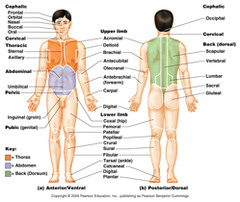
Axial Region
main axis of body
Appendicular Region
the Limbs (upper & lower limb)
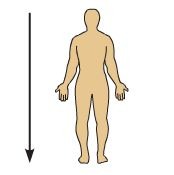
Superior
Toward the head or upper body
Inferior
Away from head or lower body
Anterior
Toward / at the front of the body
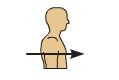
Posterior
Toward / at the back of the body
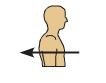
Medial
Toward the middle of the body
Lateral
Away from the middle of the body / towards outer sides
Proximal
Closer to the origin of the body part (point of attachment for limb to body
Distal
Farther from the origin/attachement of body
Superficial
Toward or at the body surface "skin"
Deep
Away from the body surface; internal
Ipsilateral
On the same side
Contralateral
On opposite sides
Regional Terms
Cephalic (face), Cervical (throat), Thoracic (chest), Abdominal, Pelvic, Pubic (genital), Upper Limb, Manus, Lower Limb, Pedal
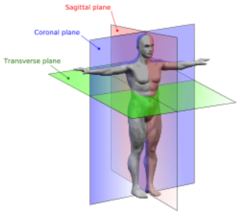
Frontal Plane
Lies vertically and divides body into anterior (front) and posterior (back)
Sagittal Plane
Lies vertically and divides body into left and right sides
Transverse Plane
Runs horizontally and divides body into superior (up) and inferior (down)
Biomechanics
The study of forces and their effects on living systems
Translational Motion
Movement in a straight line
Angular Motion
Rotational movement about an axis
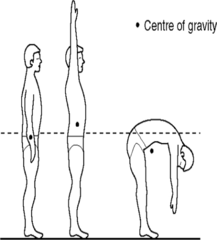
Center of Gravity
Avg location of distributed weight
- point at which mass is evenly distributed
- the balance point
Base of Support
Area of your feet that is in contact with the floor
(wider your feet are, the larger the base of support)
Center of Pressure
the point of Base of Support (BoS) where the resultant of all ground forces act -- point on foot, where the ground is exerting force back on to your body
Statistics
Refers to the situations where the body or object remains at rest or moving at a constant speed - Equilibrium
Dynamics
Deals with the changes in motion brought on by unbalanced forces
Kinematics
the study of motion w/o consideration to its causes
Kinetics
Study of motion and causes
Newton's Laws of Motion
1st -- if nothing exerts a force on the body, it will keep going strait F = 0 at equilibrium
2nd -- F = ma
3rd -- every force has and equal and opposite force F(1) = - F(2)
Forces
- Internal -- force body creates (muscle create force)
- External -- forces outside body (gravity)
- Internal forces CANNOT produce changes in the motion of the body's COM (center of mass) only external
How to Calculate Forces
Step 1: Draw it
Step 2: Choose an equation
F = F(object) + F(ground) + Body Weight = 0
**look at direction)
F = (-F object) + (-W) + F ground = 0
Step 3: Write what's given
Weight = mg (N)
g = 10 m/sec squared
Mass = kilograms
Givens
Moment Arms
Perpendicular distance between the line of action of force and the axis of rotation
(use Pythagorean theorem)
Torques
Turning effects produced by a force
T = F * moment arm (r or d) = 0
T = 0 at equilibrium
Work
the product of Force ad Displacement
U = F*d
Power
The rate of doing work
P = U/t
Osteokinematics
(Bone Motion)
- Relative motion determined by the excursion of bone relative to ground
- Center of goniometer is placed on axis of joint
Arthrokinematics
(Joint Motion)
- Describes movement of joint surfaces
Movement is Planar (deals with planes)
- Sagittal = Flexion & Extension
- Frontal = Abduction (outward) & Adduction (draw limbs towards the body) (Ex: head moves side to side, movement of limbs in and out)
- Transversal = Rotation (Ex: trunk rotation, moving torso)
Active Range of Motion
using the muscle, the person moves the joint through the arc as far as possible (determines the willingness to move)
Passive Range of Motion
the arc of the joint when the person is relaxed (no muscular work)
(generally more than AROM)
End feel
the "feel" that limits ROM: soft or tissue approx, springy or firm, hard, empty
Goniometry
- Use anatomical landmarks
- Axis placed over joint axis
- Stationary arm -- parallel to the proximal segment
- Moving arm -- parallel to the distal segment
Intra-rater reliability
- determines how well the same person can take a measurement, several times
- mean is used
- see measurement errors
Inter-rater reliability
- determines whether a measure varies between individuals
Factors affecting balance
Muscular weakness (motor), proprioceptive (sensory), ROM deficits , visual impairments
Balance
Process of maintaining body's Center of Gravity within the Base of Support
- dynamic and static process
Kinesthesia
Awareness of movement due to joint and muscle receptors
Limits of Stability (LOS)
As long as your center of gravity is insider your Base of Support, you are within your LOS
Proprioception
Body's ability to transmit position sense - where the part is in space
Coordination
Smooth pattern of activity is produced through a combo of muscles acting together with appropriate intensity and timing
Agility
ability to control the direction of a body or segment during rapid movement
Postural Control System
- Sensory - detection of body motions (visual, vestibular, somatosensory)
- Integration - of sensorimotor info within the CNS
- Execution - of musculoskeletal responses
- Balance is both a static & dynamic process
Sensory organization
- Vision (used to monitor changes in body position)
- Vestibular (know head position in space)
- Somatosensory (know body position in space)