Lecture 9 Early experience and Later Development
 Call Kai
 Learn
Learn Practice Test
 Spaced Repetition
 Match
Match Flashcards
 Knowt Play
1/8

There's no tags or description
Looks like no tags are added yet.
Name | Mastery | Learn | Test | Matching | Spaced | Call with Kai | Chat |
|---|
No analytics yet
Send a link to your students to track their progress
9 Terms
What happens to children who experience psychosocial deprivation?
Children raised in institutions are at increased risk for a variety of cognitive, social and behavioural problems, this may take place in the form of psychosocial dwarfism, intellectual delay, disturbances of attachment and lastly psychiatric problems (externalising problem, inattentional, syndrome that mimics autism). Institutionalised children are indiscriminately friendly, the stress of inconsistent caregiving can contribute to stunted growth.
What are some methods that can be used to understand interventions in early psychosocial deprivation?
Adoption studies → English and Romanian Adoptee (ERA) project) Are some confounds - selection bias associated with adoptions
Intervention studies → Bucharest Early Intervention Projection (BEIP) (began in 2000), had random assignment to foster care
Describe the BEIP study?
children are randomly assigned to institutional care as usual and foster care. Children are assessed before enrollment including any possible psychiatric disorders, and at follow up are excluded if individuals are reintegrated or adopted, before being analysed. Longitudinal study
Is it ethical to randomly assign people to a potentially negative outcome?
In doing the BEIP study - there were 3 x US Institutional Reviews boards, exploring the idea of informed consent, whether or not the study involves more than minimal risk, if there are direct or indirect benefits for participants and questioned why ethics may or may not be approved or not. They found that the indirect benefit to the children of Romania could be very high – results are so compelling that the institutionalisation changed in Romania. They found that the Clinical Equipoise was very high, studies have never randomised before this. Convinced the ethics board to use the intent to treat rule, that is, individuals in the Institutionalised group, would still be followed despite being adopted out.
be able to talk about why the sensitive period for intervention might differ across domains.
What were measures in the BEIP?
Neurocognitive assessments were taken at baseline, 30 months, 42 months, 54 months, 8 years, 12 years, 16 years (currently testing at 21 years) - Psychiatric symptoms – Language development – Socio-emotional development – Physical growth – Cognitive development – Brain development
What did the BEIP find about physical growth?
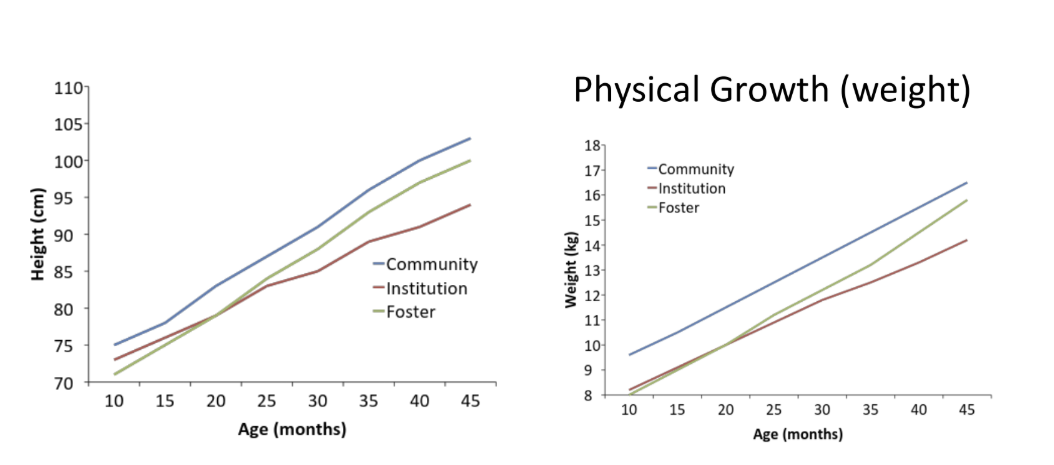
ING - growth is the flattest in height and weight. FCG - growth increased very quickly. This illustrates a catch up effect of being placed in foster care - this was an effect seen in only height and weight. COG - higher than both ING and FCG.
What did the BEIP find about cognitive development?
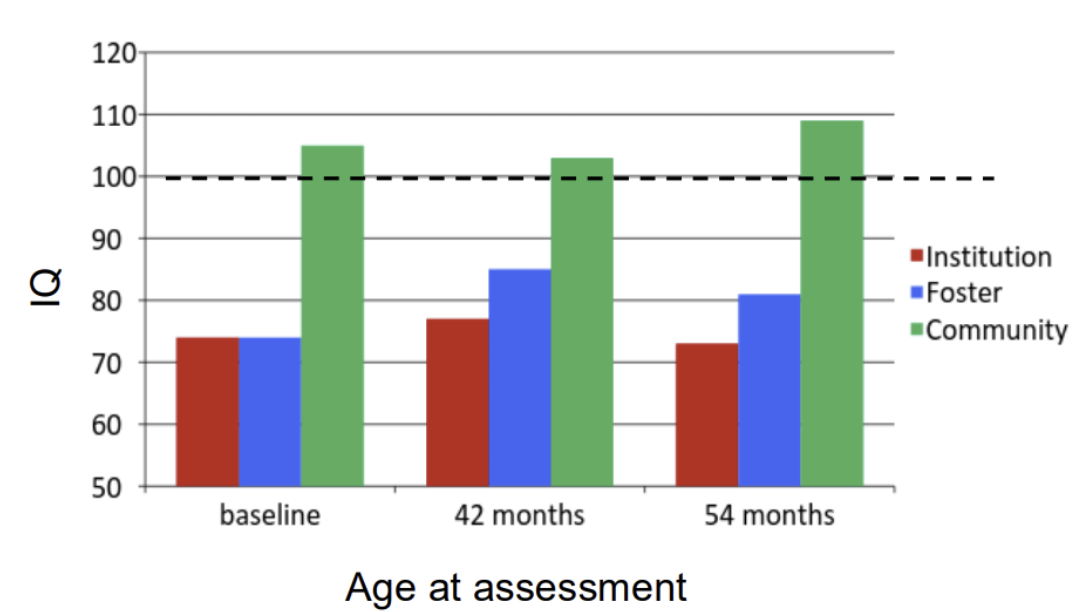
Institutionalised children show severe delays in cognitive development, mean IQ= 70 Placing kids in foster kid show better IQ 42 months and 54 months They found that the timing of intervention matters, that is, foster care is effective in improving cognitive function for those children placed before age 2. Duration of time in foster care is not as important as the timing of foster care intervention. It is best to be placed earlier than it is to be placed later.
Describe brain development findings from BIEP?
Individuals were measured using Electroencephalogram (EEG) and event-related potentials at each assessment, with MRI scans conducted at 9-10 years of age. Looked at ERP in reaction to a face. → NIG - has a faster and bigger response, but FCG has a bigger reaction, both of these effects are higher and faster than the Institutionalised group. Looking at the EEG power (alpha) for NIG, FCG and ING → found that the power spectrum looks similar for both NIG and FCG if placed after 24 months. Looking at MWV and GMV → found that community groups have higher white and grey matter than FCG and ING. However, FCG has more white matter compared to ING, this effect was not found in grey matter - speaks to the effect of proliferation of cells during infancy (for grey matter), but myelination happens during childhood ( so it can still be impacted) .
What to say generally about the timing of foster care?
Timing is important but effects are domain specific → they found that the language closes earlier than other components of cognitive development. → kids that were placed before 24 months do much better compared to other kids. By 24 months, the plasticity in the system is lower, such that the intervention is less impactful. You can only play catch up when plasticity is still available. Brain development processes undergoing change are most open to the effects of experience – This plasticity applies to both deprivation and recovery