Psychoanalytic Learning Theory - John Dollard & Neal Miller
 Call Kai
 Learn
Learn Practice Test
 Spaced Repetition
 Match
Match Flashcards
 Knowt Play
1/33

There's no tags or description
Looks like no tags are added yet.
Name | Mastery | Learn | Test | Matching | Spaced | Call with Kai | Chat |
|---|
No analytics yet
Send a link to your students to track their progress
34 Terms
Dollard & Miller
In 1950, wrote Personality and Psychotherapy
Translation of psychotherapy into learning
Both worked with (behaviorist) Clark Hull at Yale, who emphasized “unobservables” (drives) rather than observable environment
Drives originate
In the environment (hot sand to water), OR
In the person (hunger)
2 Types of Drives
Primary
Physiological drives
Pain, hunger
Secondary
Acquired on the basis of associating event with satisfaction/frustration of the primary drives
Fear from a painful stimulus
Behaviors are reinforced to the degree that drives are reduced
Cues
Discriminative stimuli that help inform how, when, and how quickly a response is made
Sights, smells, even internal dialogue!
Responses
We have a multitude of possible responses to a given situation
The most likely response is called the dominant response
Rewards
Primary and secondary rewards
The Gradient of (Effects of) Reward
Essentially, the quicker a reward is given following a desirable behavior . . . The more likely the behavior will be strengthened!
Immediate versus delayed gratification
Anticipatory Response
We learn to behave more quickly in response to reward or punishment
We are actually relatively poor at removing our hand from an electrical cord! Gets better with time . . .
Anticipation
Relationships too!
The Learning Process
The Learning Dilemma
If the dominant response reduces our drives, no additional learning will occur
If it does not, or if we do not like the dominant response, we have a dilemma!
To create new learning, a situation to promote a desired response must be arranged
May need to “coax” the desired response verbally or via modeling
Undesired responses can be punished or, at the least, not rewarded
Extinction & Spontaneous Recovery
Undesired responses that are not met with reward will eventually be extinguished
However, the response can occasionally reoccur after time (spontaneous recovery)
They re-extinguish more quickly this time, when they are met without reward or with punishment
Critical Training Periods in Childhood
Feeding
Cleanliness Training
Early Sex Training
Anger-Anxiety Conflicts
Feeding
What is the primary reinforcer?
What is the secondary reinforcer?
What behavior, when hungry, gets reinforced?
Children who are not fed when crying learn to be apathetic and apprehensive
Cleanliness Training
Initially, child learns that full bladder and bowels require urination/defacation
But then needs to learn a more complex behavior (seeing bathroom, feeling toilet on legs, etc.)
If this process is rushed, the child may learn to avoid bathroom for fear of punishment
Early Sex Training
Masturbation is often met with punishment
Leads to approach-avoid anxiety . . .
Child may become anxious when experiencing sexual feelings
Anger-Anxiety Conflicts
Children are often frustrated by lack of skill, sibling rivalry, etc. —> anger
Anger is often met with punishment
Anger becomes very anxiety-provoking
Anger should be motivating, not simply labeled as “bad” and “repressed”
Approach-Avoidance Conflicts
If one “end-state” is clearly positive with little negative, it is easy to make the decision!
GO FOR IT!
Similarly, if one “end-state” is clearly negative with little positive . . .
GET THE HECK OUT OF THERE!
Often, it’s not so easy . . . Four conflicts
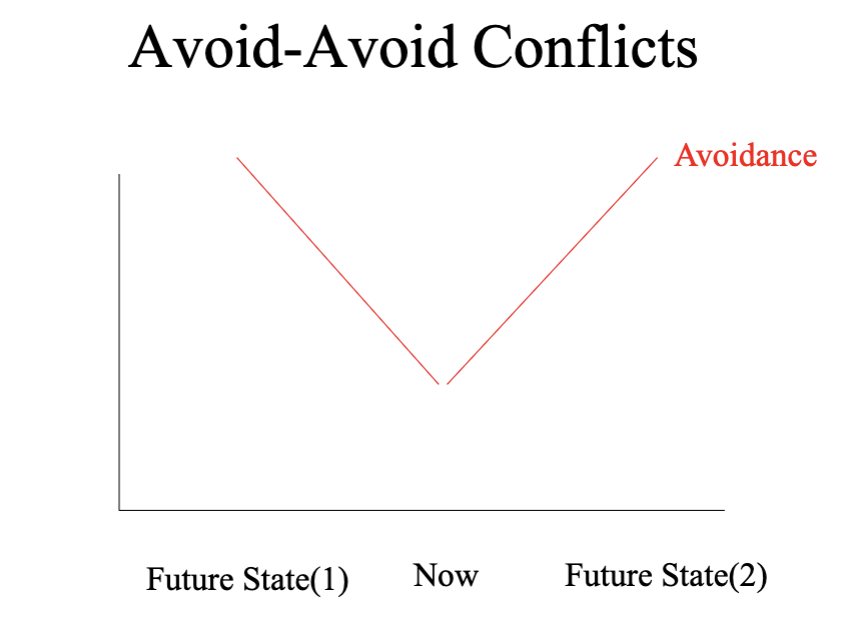
Avoidance-Avoidance Conflict (often difficult)
Choosing between two undesirable end-states (going to the dentist to get a root canal)
Movement in either direction increases anxiety
To get a change, one could increase (or decrease) the punishment of one of them . . .
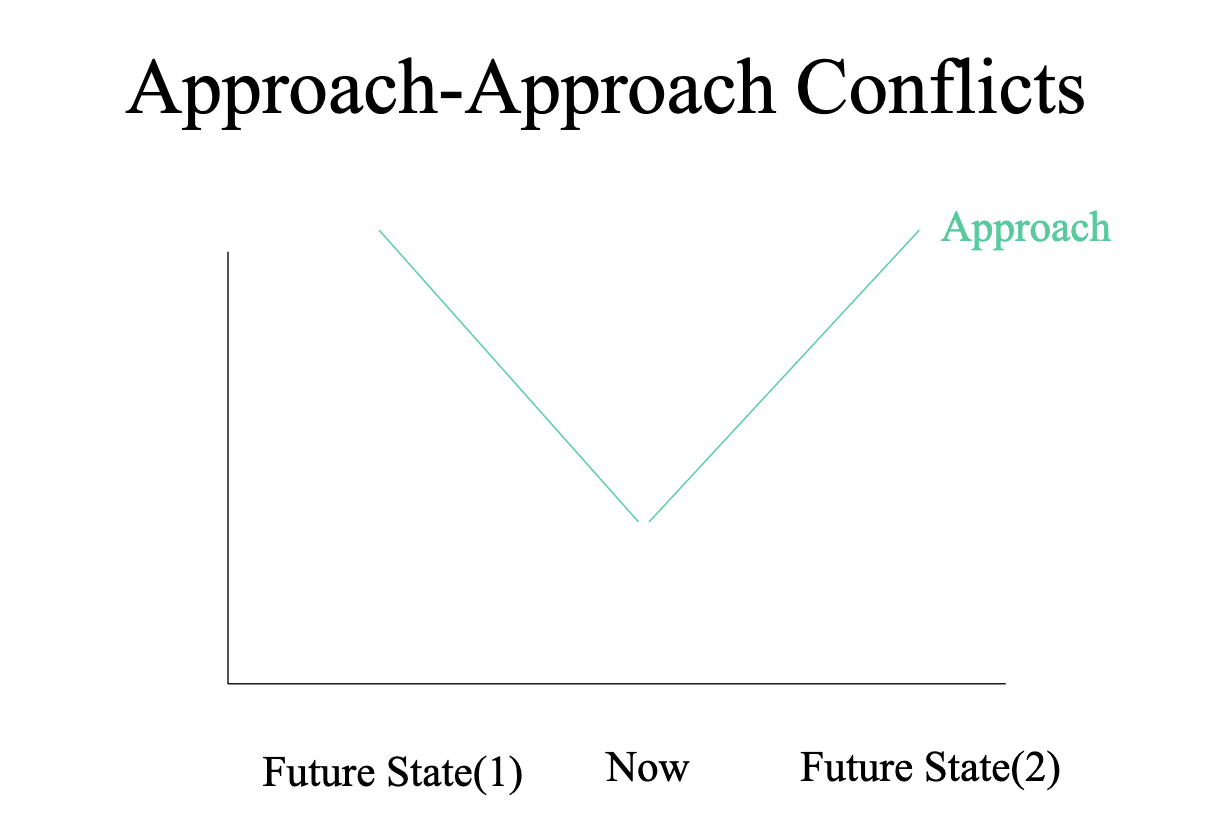
Approach-Approach Conflict (not too bad)
Choosing between two positive end-states
Any movement in one direction will make it easier to attain, and thus they will move in that direction
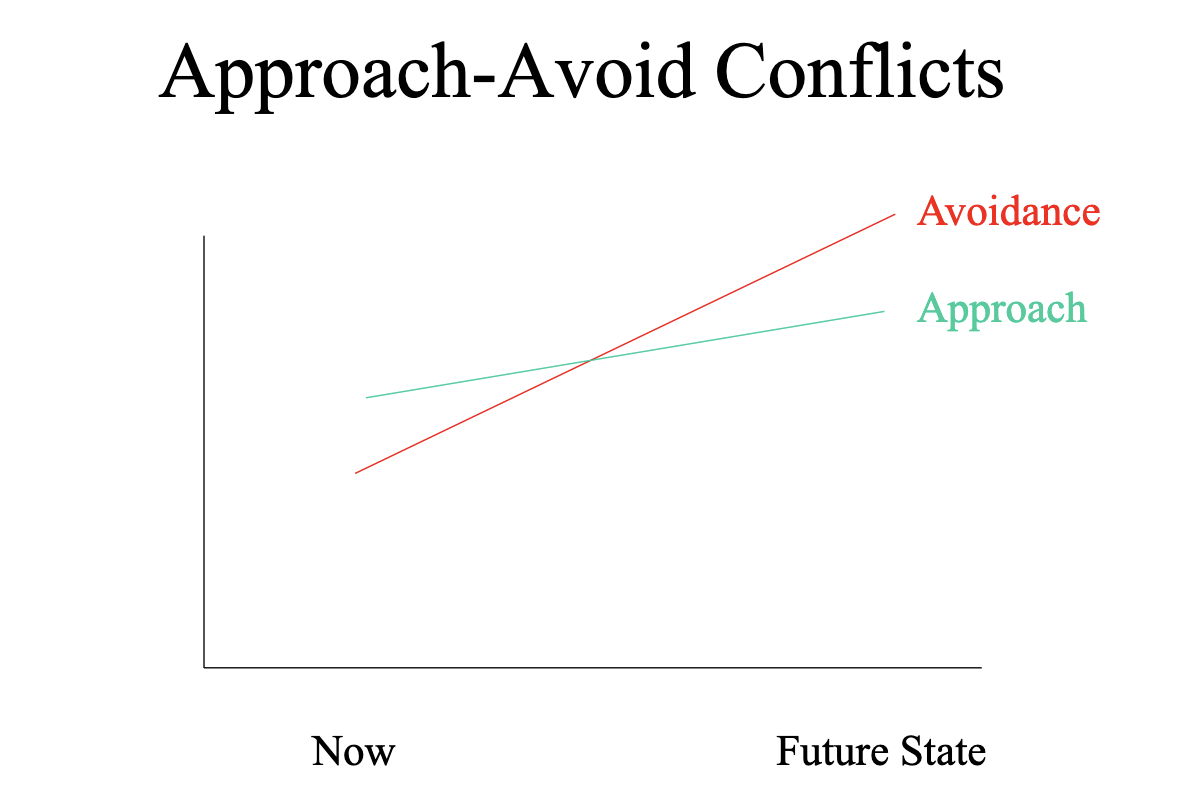
Approach-Avoidance Conflict
Choosing whether to approach or avoid an end-state with both positive and negative attributes
E.g., going to the work party
At the point of “cross-over,” there is much anxiety
Relaxation training may be helpful to persons who have difficulty with such situations (which abound in our society)
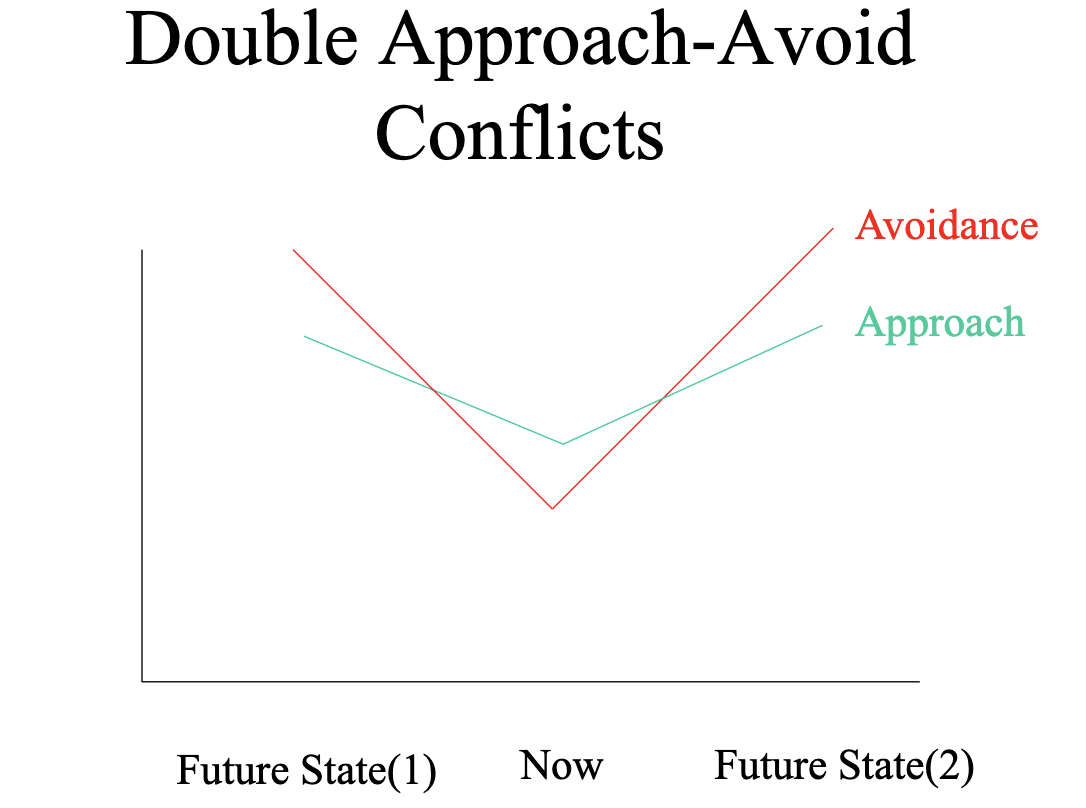
Double Approach-Avoidance Conflict
Choosing between two end-states, each with positive and negative aspects
After the choice has been made, sometimes people “waffle” at the cross-over point and no longer approach the goal . . .
Again, relaxation training may be helpful
Application to Personality
The Frustration-Aggression Hypothesis
Frustration is a necessary and sufficient condition for aggression
Frustration: “any interruption of a goal-directed behavior.”
Too strong, but has survived in a weaker form:
Frustration that is intense or arbitrarily imposed increases aggression
Agression
Is often rewarded
You may get what you want! (at least initially!)
Is often elicited by cues in one’s environment
Observe others in the environment and sense what they expect you to do
May be learned
From television and the like
Similar application to therapy
Personality may be viewed in terms of habits
Links between stimuli and responses established by learning
ALL behavior – normal or pathological – is established via drive-reduction learning
Learn to fear dog because previously bitten
Learning response is initially adaptive: dog —> fear —> run —> less fear
Therapy involves replacing problematic habits
Place in room with puppies to reduce fear (extinguish)
Similar emphasis in psychotherapy
Repression
Regression
Repression
Freud
Repression is motivated
Ideas are banished to unconscious
Dollard and Miller
Repression is not thinking about a topic and being reinforced for not thinking about it (decreased anxiety)
Regression
Freud
A more primitive defense mechanism to reduce anxiety
Dollard and Miller
Animal and human research shows that enhanced drive (motivation) disrupts poorly learned responses and facilitates well-learned responses
Habits acquired in early life are better learned
Similar emphasis in Freud’s psychosocial development
Freud
Conflict during psychosocial stages leads to neurotic personalities
Dollard and Miller
Parents can produce conflict in the areas of hunger, elimination, sex, and aggression by punishing child’s attempt at drive reduction
Applications of Instrumental Conditioning: Parent Training
Catch them being good!
Avoid accidentally “rewarding” bad behavior
Use mild punishment for bad behaviors
Actively ignore bad behavior
Use “time outs” to minimize positive reinforcement
Social skills training
Helps to increase rewards from social world
Token economy
Earn and lose for good and bad behavior, respectively
Applications of Classical Conditioning: Therapy
Flooding
Repeated pairing of aversive stimuli with reinforcement
Relaxation training (deep breathing, progressive muscle relaxation)
You cannot be relaxed and tense at the same time!!
Systematic Desensitization
Make hierarchy
Relaxation training
Aversion Therapy
Repeated pairing of undesirable pleasurable stimuli with punishment
Sensate Focus
Touch with goal of pleasure; relax with touch
Modeling (continued)
Processes in Observational Learning
Attention
Retention
Motor Processes
Motivation
Attentional Processes
Model
Age & Sex
Prestige & Status
The higher the better!
Kind of Behavior Performed
Complex are less imitated
Observer
Self-Confidence & Esteem
Past Reinforcement
If previously reinforced (be like Daddy!), then more likely to imitate
Motor Reproduction & Motivation
Can you do it?
Do you want to do it?
Can be external or vicarious reinforcement (much self-reinforcement: set standards and give rewards to self)
Latter is related to self-efficacy and standards. If standards are too high —> depression
Self-Efficacy
Definition: Belief that one can organize and execute given courses of action required to deal with prospective situations
Four (4) sources:
Performance Attainment
Previous successes and failures
Vicarious Experiences
Seeing others succeed or fail
Verbal Persuasion
Other people telling you that you can/can’t do it
Physiological Arousal
Level of fear/calm
Measured of Perceived Control (associated with “Self-efficacy”)
STEP 1: Reverse score items 3, 6, 7, 8, & 10
i.e., 1 —> 7, 2 —> 6, etc. . . .
Step 2: Add responses from all 10 items
MEAN: 52.0
SD: 9.8
Internals
DO have more influence on their environments
Study harder and receive higher grades/evaluations
Greater self-control, too:
Show fewer relapses when quitting smoking
More likely to engage in exercise to lose weight
More likely to wear seatbelts
Preventive dental care, too!