section B
 Studied by 0 people
 Call Kai
 Learn
Learn Practice Test
 Spaced Repetition
 Match
Match Flashcards
 Knowt Play
1/87

There's no tags or description
Looks like no tags are added yet.
Name | Mastery | Learn | Test | Matching | Spaced |
|---|
No study sessions yet.
88 Terms
Characteristics of a skill
aesthetically pleasing
Consistent
Efficient
Fluent
Accurate
Controlled
Economical
Open skill
performed when sporting environment is unpredictable
Closed skill
performed in a predictable environment (repeated actions)
Self paced skill
performer controls sped and when to start
Externally paced skill
Performer has no control over speed or when it starts
Discrete skill
clear beginning and end
Serial skill
several discrete skills linked together in a specific order to form a completed task (dance)
Continuous skill
No clear beginning or end, one movement is start of the next (running)
Gross skill
Performed using large muscle groups
Fine skills
Performed using small muscle groups
Low organised skills
Easily broken down (swimming stroke)
highly organised skill
Not broken down easily (forward roll)
Simple skill
Limited decisions
Not a lot to think about
Complex skill
Many decisions
Prior information is needed
Positive transfer
when the learning of one skill helps the learning of another
Tends to happen when two skills have similar shape or form
Negative transfer
when the learning of one skill hinders the learning of another
Happens when there might be some familiarity with the environment in which the two skills are being performed
Bilateral transfer
when the learning of one skill is passed across the body from limb to limb
Zero transfer
when the learning of one skill bas no impact on the learning of another
No similarities and no aspect of confusion
Massed practise
no rest (repetitive)
Used when skills are discrete, simple, closed, highly organised and self paced
Increases fitness
Good habitual responses
No time for feedback
Tiring
Distributed practise
includes rest intervals
When skills are continuous, complex, low organised, serial and self paced
Allows recovery
Less mental pressure
Reduces chance of injury
Time consuming
Can limit speed of progress
Varied practise
varying how skill is practised
When skills are open and externally paced
Allows adaptations
Gives motivation
Time consuming
Fatigue/ too demanding
Mental practise
going over the skill in your mind
When skills are serial and complex
Used by autonomous performers
Builds confidence
Controls anxiety
Environment must be calm
Not suitable for beginners
Whole practise
practising skill in its entirety
Fast skills, closed, discrete, simple
Time efficient
Aids memory
May overload performers
Not for beginners
Can lead to injury
Whole part whole practise
perform whole task, isolate weakness, work on it, put it back into whole task
When skills are complex and fast
Shows weaknesses and corrects them
Time consuming
Some skills cannot be broken down
Progressive part practise
adding parts gradually
Complex skills, serial skills, externally paced
Stages of success gives motivation
Reduce danger
Reduce fatigue
Time consuming
Negative transfer
Visual guidance
using demonstrations to create mental image
Good for beginners
Can be used to show specific weakness
Demonstration must be completely accurate
Verbal guidance
explanation of a task
Quick guidance for experienced players
Not good for beginners
Performer may lose concentration
Risk of information overload
Language barrier
Manual guidance
involves physical support
Eliminates danger
Helps build confidence
May begin to depend on support
Dependent on relationship
Mechanical guidance
artificial aid
Eliminates danger
Can be used for disabled athletes
Equipment can be expensive
Motivation could be lost if performer doesn’t feel independent
Definition of learning
permeant change in behaviour
Performance definition
temporary occurrence influenced by other factors
Cognitive stage of learning
performer has to think carefully and copy demonstrations
Extrinsic feedback
Movements are slow and uncoordinated
Motor programmed haven’t developed
Associative stage of learning
longer duration in this phase
Lots of practise
More intrinsic feedback
Movements are smoother and more coordinated
Motor programmes forming
Autonomous stage of learning
reached after effective practise
Practise must continue to stay in this stage
Actions are fluent, efficient and automatic
Concentrate on finer details
Motor programme fully developed
Performer is classed as expert
Motor programme
Components of the skill that can be stored in the memory
Positive feedback
information about what is good
Offers motivation which maintains effort levels
Used on cognitive performers
Negative feedback
information about what is going wrong
Allows for errors to be corrected and bad habits eliminated
Used on associative performers
Extrinsic feedback
comes from an outside source (coach)
Performers gains view on what they need to improve
Advice on types of methods of practise
Used mainly for cognitive performers
Intrinsic feedback
used by autonomous performers
Information from within
Performed may have developed a feel for the task using kinaesthetic
Knowledge of performance
detailed analysis
Concerned with technique
Comparison with yourself not with others
Knowledge of results
gives initial outcome
Indication whether skill is successful
Comparison to opponent
Learning plateau
A period during performance where there is no signs of improvement
Causes of learning plateau
lack of motivation
Boredom
Bad coaching
Limit of ability
Fatigue
Targets set too low
Solutions to learning plateau
extend task to challenge performer
Find a new coach
Gives breaks to offer breaks
Vary practises
Explain plateau concept
Insight learning
using experience and understanding to solve problems relating to the whole skill
Performer uses existing knowledge to form an idea of how to deal with problematic sporting situations because they might have an idea form their general sporting knowledge which they can put into practise
Good for use in realistic situations
May provide self satisfaction and give intrinsic motivation
Encourages performer to think for themselves and develops cognitive process
Operant conditioning
the use of reinforcement to ensure correct responses are repeated
Coach could use manipulative approach to ensure skills are learned
Reward athletes for correct actions
Features of operant conditioning
based on trial and error
Shapes behaviours (strengthens S-R bond)
Positive reinforcement
pleasant stimulus that increases likelihood of correct response being repeated
Negative reinforcement
removal of unpleasant stimulus to encourage desired response
Punishment
introduction of unpleasant stimulus to break SR bond and prevent incorrect response occcuring
Observational learning - 4 parts
suggest that unacceptable and acceptable behaviour can be learned by watching and copying other people
Attention - make demonstration loud, bright and attractive
Retention - break up information so it can be recalled
Motivation - use praise and rewards to encourage success
Motor production - make sure performer is capable of task
How is observational learning more likely to be copied
performed by player of similar ability
Reinforced
Consistent
Relevant
Social development theory
learning by association with others
More knowledgable others - experts, coaches
Inter psychological learning
external
Learning from others
Intra psychological learning
internal
Learning from within after inter psychological stage
3 questions of zone of optimal development
what can I do alone
What can I do with help
What can I not do yet
Constructivism
building up learning in stages, based on current level of performance
Input
performer uses senses to pick up information from the environment
Senses - sight, hearing, touch, balance, kinethesis
Information is picked up using senses from display (senses are collectively known as receptors systems)
Selective attention
the process that helps the performer filter relevant information from irrelevant information
How do you develop selective attention
make stimulus more intense, loud or bright
Improve motivation
Mental practise
Benefits of selective attention
improves reaction time
Improves chances of making correct decision
Concentrate on more detailed aspects of tasks
Helps decision making process become faster
Memory has limited capacity so too much information could affect memory function
Decision making
involves player making a decision based on all of the information collected by senses
Perceptual stage - DCR (decision making)
D - detection - performer picked up relevant information using selective attention
C - comparison - trying to match important information to information stored in the memory
R - recognition - used relevant information to identify appropriate response
Translatory mechanisms
helps to convert information by using past experiences to link to relevant information
Actions stored in the memory are stored in the form of a motor programme
Use coded information from perceptual process to pick an appropriate motor programme
Output
effector mechanisms and muscle output
Effector mechanism is the network of nerves that is responsible for delivering the decision made during the perceptual process to the muscles so that those muscles can perform the action
Muscles will receive information in the form of coded impulses and once this impulse is received, muscles will contract and response can begin
Feedback - information used during or after the response to aid movement
Process of processing information
environment
Display
Receptor systems
Perceptual mechanisms
Translatory mechanisms
Effector mechanisms
Muscular systems
Feedback data
Working memory model
Badley and Hitch
central executive
Phonological loop and episodic buffer
Visuospatial sketch pad
Long term memory
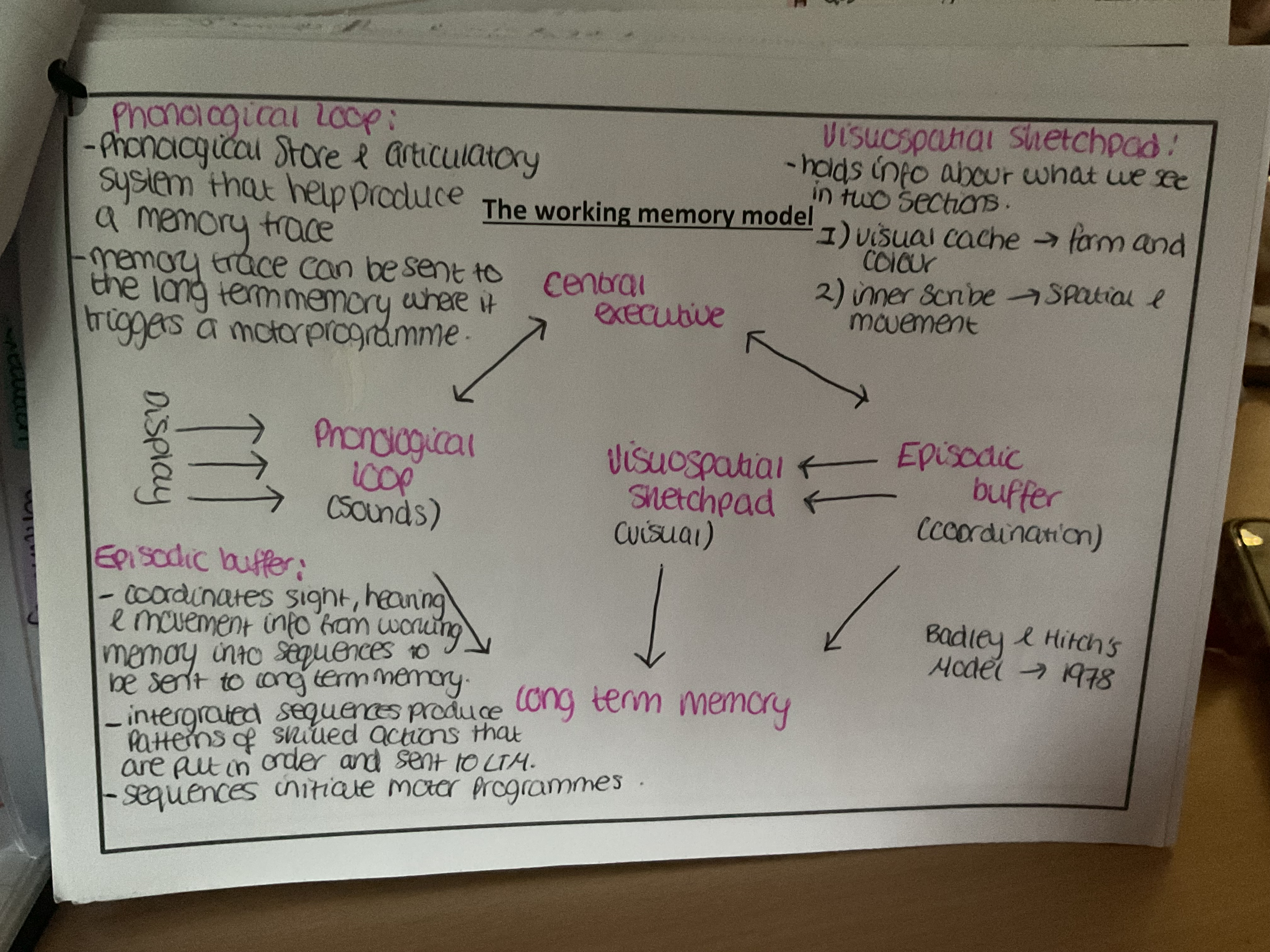
Phonological loop
help produce memory trace
Memory trace can be sent to long term memory where it triggers a motor programme
Visuospatial sketchpad
holds information about what we see in two sections
Visual colour - form and colour
Inner scribe movement - spatial and movement
Episodic buffer
coordinates sight, hearing and movement information from working memory into sequences to be sent to long term memory
Integrated sequences produce patterns of skilled actions that are put in order and sent to long term memory
Sequences initiate motor programmes
how do the long term memory and the working memory work together?
working memory picks up relevant information from sporting environment
selective attention used to filter out irrelevant information
working memory produces a memory trace and sends it to long term memory so that the trace can be compared to existing information contained in the storage area of the LTM
LTM then sends info back to the working memory for use in current situation
characteristics of working memory
initiates action
limited capacity (7 items of info)
limited timescale (30 seconds)
strategies of storing information
mental practise
association
focus
chunking - breaking skill down into chunks
rewards
chaining - info is called as a sequence
repetition
acronym of strategies of storing information
males
and
females
can
run
charity
races
what does the schema theory suggest
suggests that the core principles of an existing motor programme can be taken and adapted using info from the environment and feedback from the senses
components of a schema
recall - responsible for initiating the movement
recognition - happens once action is underway, used to control movements
initial conditions - info from sporting environment (recall)
response specifications - assess available options to performer (recall)
sensory consequences - uses of sense to guide movement and apply movement to situation (recognition)
response outcome - motor programme is updates by getting knowledge of results of the action, if unsuccessful, adjustments are made to motor programme.
strategies coaches can use to encourage successful schemas
vary practise conditions
offer frequent feedback
point out and explain when a schema could be used
parts of skills that can be transferred should be pointed out
positive reinforcement or praise to encourage motivation
hicks law
states that as the number of choices increases so does reaction time
sometimes this is not the case though as some players become familiar with the environment so response becomes quicker
definition of reaction time
time taken from onset of stimulus to onset of response
definition of movement time
time taken from start of movement to completion of movement
definition of response time
time taken from onset of stimulus to completion of movement
reaction time + movement time
simple reaction time
simple choice = quick
involves one stimulus and one specific response
fast reaction
swimmer/sprinter
choice reaction time
more choices = more time
involves when AND how to react
involves choosing from numerous stimuli that may each have a different response
much slower response due to number of choices
basketball/netball player
single channel hypothesis
suggests that stimuli can only be processed one at a time
a second stimuli must wait until the one first has been processed before it can be processed
the delay in processing a second stimuli increases response time
definition of anticipation
when a sports performer tries to pre-judge a stimulus
try to work out what is going to happen before it does using signals from the environment
correct anticipation can reduce response time
incorrect anticipation delays response time
2 types of anticipation
temporal - pre judging WHEN a stimuli will happen
spatial - pre judging WHERE AND WHAT the stimulus is going to be
4 ways to improve response time
mental practise - action can be predicted
train specific stimuli - training expected stimuli will reduce response time
improve fitness - improves reaction time, plyometric/ interval training can improve speed and power during movement
anticipation - predicting stimuli
what is the psychological refractory period
a delay when a second stimuli is presented before the first has been processed
performer may freeze completely for split second it takes to sort out conflicting information