Chapter 1-5 Financial Institutions and Market Notes
 Call Kai
 Learn
Learn Practice Test
 Spaced Repetition
 Match
Match Flashcards
 Knowt Play
1/29

There's no tags or description
Looks like no tags are added yet.
Name | Mastery | Learn | Test | Matching | Spaced | Call with Kai | Chat |
|---|
No analytics yet
Send a link to your students to track their progress
30 Terms
Financial Market
A market in which financial assets (securities) such as stocks and bonds can be purchased or sold.
(Funds are transferred in financial markets when one party purchases financial assets previously held by another party)
What is the role of Financial Markets?
Financial markets transfer funds from those who have excess funds to those who need funds
What are surplus units?
Participants who receive more money than they spend, such as investors.
What are deficit units?
Participants who spend more money than they receive, such as borrowers.
What do securities represent?
Represents a claim on the issuers
What are debt securities?
debt (also called credit, or borrowed funds) incurred by the issuer
What are equity securities?
(also called stocks) represent equity or ownership in the firm.
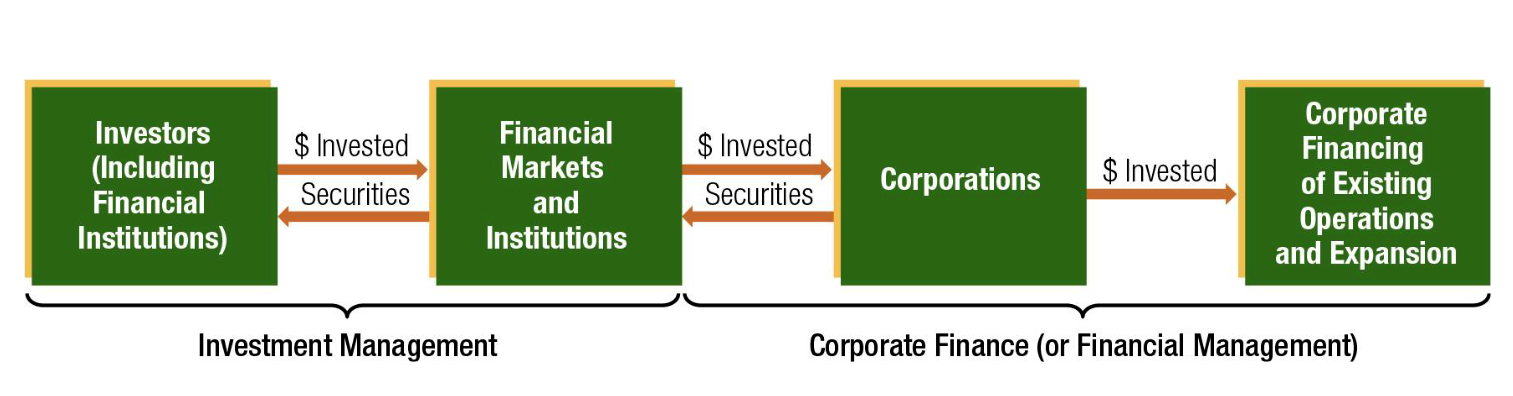
Accommodating Corporate Finance Needs: Financial markets serve as…?
The mechanism whereby corporations (acting as deficit units) can obtain funds from investors (acting as surplus units)
Accommodating Investment Needs: Financial markets serve as…?
Intermediaries to connect the investment management activity with the corporate finance activity
Why do we need financial markets serving as intermediaries?
To efficiently connect surplus and deficit units by significantly reducing transaction and information costs while providing market liquidity.
Primary markets…?
Facilitate the issuance of new securities
Secondary markets…?
Facilitate the trading of existing securities, which allows for a change in the ownership of the securities
Liquidity is?
The degree to which securities can easily be liquidated (sold) without a loss of value
If a security is illiquid, investors may not be able to find a willing buyer for it in the secondary market and may have to sell the security at a large discount just to attract a buyer
Securities can be classified as…?
money market securities
capital market securities
derivative securities
Money Market Securities…?
Facilitate the sale of short-term debt securities by deficit units to surplus units
Debt securities that have a maturity of one year or less
Capital Market Securities…?
Facilitate the sale of long-term securities by deficit units to surplus units
Bonds are?
Long-term debt securities issued by the Treasury, government agencies, and corporations to finance their operations
Mortgages are?
Long-term debt obligations created to finance the purchase of real estate
Mortgage-backed securities are?
debt obligations representing claims on a package of mortgages
Stocks are?
Represent partial ownership in the corporations
that issued them
Derivative Securities are?
Financial contracts whose values are derived from the values of underlying assets
Common derivatives are?
financial options, futures, etc
Speculation allows…?
An investor to speculate on movements in the value of the underlying assets without having to purchase those assets
Risk management allows?
Financial institutions and other firms to use derivative securities to adjust the risk of their existing investments in securities
What is the impact of information on valuation?
Estimate future cash flows by obtaining information that
may influence a stock’s future cash flows
Use economic or industry information to value a security
Use published opinions about the firm’s management to
value a security
Behavioral Finance is?
The application of psychology to make financial decisions
The Securities Act of 1933 was intended to?
Ensure complete disclosure of relevant financial information on publicly offered securities and to prevent fraudulent practices in selling these securities
The Securities Exchange Act of 19 34 extended?
the disclosure requirements to secondary market issues
The Sarbanes-Oxley Act of 2002 required?
that firms provide more complete and accurate financial information