04 - Melt flow behaviour
 Call Kai
 Learn
Learn Practice Test
 Spaced Repetition
 Match
Match Flashcards
 Knowt Play
1/5

There's no tags or description
Looks like no tags are added yet.
Name | Mastery | Learn | Test | Matching | Spaced | Call with Kai | Chat |
|---|
No analytics yet
Send a link to your students to track their progress
6 Terms
Definition of melt flow behaviour
How a thermoplastic material in its molten state deforms & flows under the influence of temperature & shear stress
Definition of viscosity
A measure of the fluid’s resistance to flow
→ quantifies how easily the fluid deforms under shear stress
→ high viscosity = high resistance to flow (e.g. honey)
→ low viscosity = low resistance to flow (e.g. water)
Give some examples of high & low viscosity materials
Low viscosity
air
Water
Olive oil
High viscosity
honey
Glass
What’s the particularity of plastics about viscosity?
They exhibit a wide range of viscosities
(100 → 1 000 000)
What’s the shear rate?
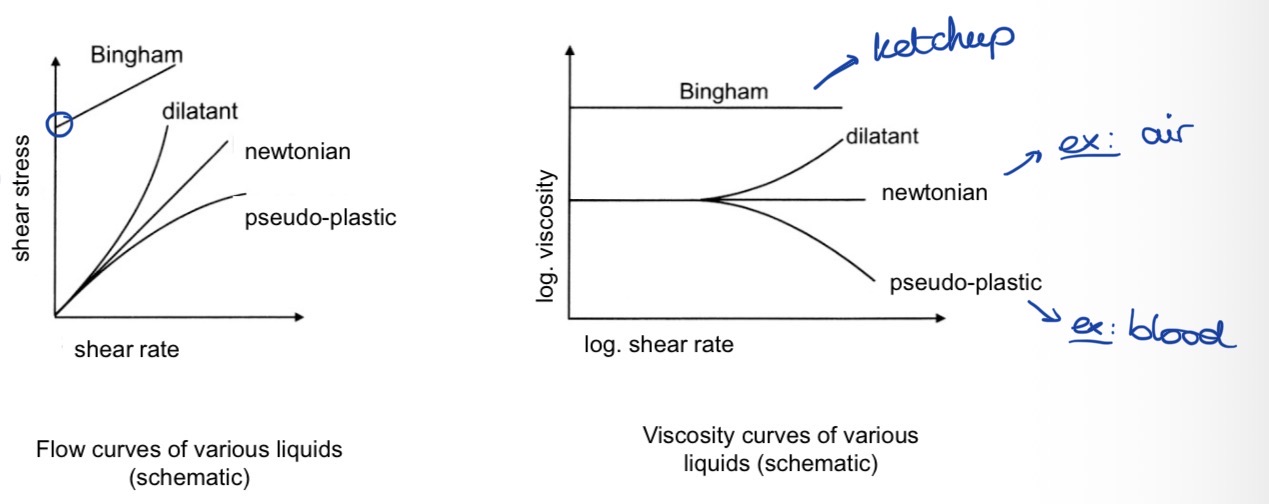
What are the 4 different types of fluids that we get depending on the shear rate?
What is its influence on the required shear stress to induce a flow & on the viscosity for each fluid?
Draw 2 graphs to illustrate your explanations
Shear rate = how fast the layers of a liquid slide past each other
4 types of fluids
Bingham
→ needs a minimum shear stress to start flowing (below it, it behaves like a solid, no flow, once it’s reached, it flows like a Newtonian fluid)
→ once the stress is reached, the viscosity remains constant
→ e.g. ketchup
dilatant fluid
→ the required shear stress increases more rapidly than the shear rate
→ viscosity first constant & then increases for higher shear rates
→ e.g. starch corn + water
Note: the ease to penetrate the liquid depends on the speed with which the force is applied)
Newtonian fluid
→ shear stress & shear rate are proportional
→ viscosity remains constant
→ e.g. air
pseudo-plastic fluid
→ shear stress increases more slowly than the shear rate
→ viscosity first constant & then decreases for higher shear rates
→ e.g. blood
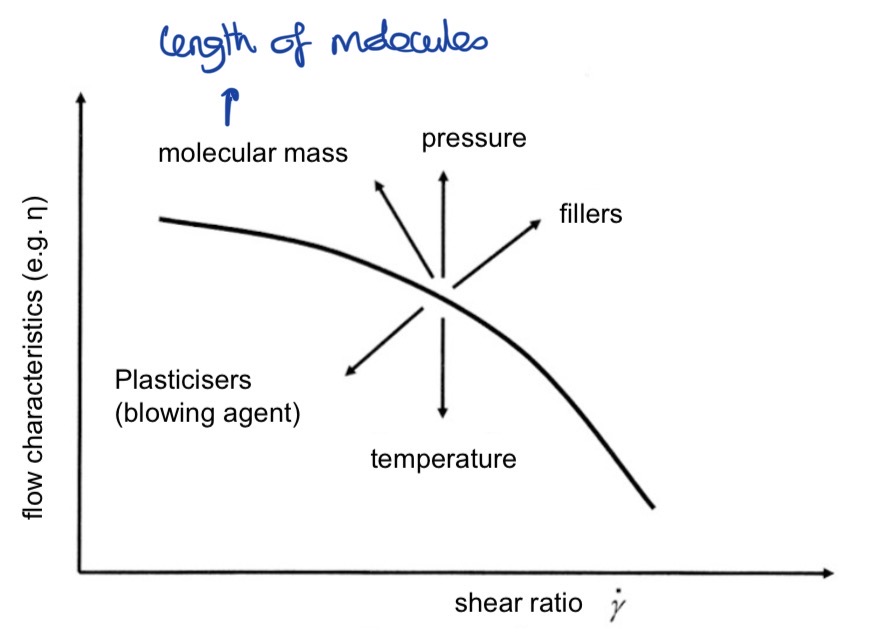
What other factors than the shear rate can influence the melt flow behaviour of thermoplastics?
How do they affect it?
Sketch a graph to illustrate it
Molecular mass
Increased molecular mass → increased molecules’ length → increased viscosity
(Because the molecules are more likely to entangle)
filler content
Increased filler content = increased viscosity
plasticisers
Increased plasticisers = decreased viscosity
pressure
Increased pressure = increased viscosity
temperature
Increased temperature = decreased viscosity
Note: the graph indicates « if this parameter increases, the viscosity moves in the direction of the arrow »