Wake PA Unit 3: (PHARM) Cirrhosis & Drug-Induced Liver Injury
 Call Kai
 Learn
Learn Practice Test
 Spaced Repetition
 Match
Match Flashcards
 Knowt Play
1/77

There's no tags or description
Looks like no tags are added yet.
Name | Mastery | Learn | Test | Matching | Spaced | Call with Kai | Chat |
|---|
No analytics yet
Send a link to your students to track their progress
78 Terms
What is cirrhosis of the liver?
End histologic stage of any chronic liver disease
Normal architecture is converted to structurally abnormal nodules
What are the mechanisms of decompensation?
Portal hypertension and hepatic insufficiency
What defines decompensated cirrhosis?
presence of ascites, variceal hemorrhage, hepatic encephalopathy and/or jaundice

What is ascites?
accumulation of free fluid in the peritoneal cavity due to increased resistance within the liver and/or reduced osmotic pressure within the bloodstream (hypoalbuminemia)
What is the focus of pharmacological management of ascites?
Reduce intravascular volume and thus reduce hydrostatic pressure and leakage of plasma into the peritoneal space
What is the pharmacological management of ascities
Furosemide and spironolactone in a 40:100 ratio
Escalate doses until patient is ascites-free, then reduce to lowest effective dose
What is the pharmacological management of moderate to large volume ascites?
furosemide and spironolactone +
therapeutic paracentesis (if removing more than 5L of ascitic fluid, give weight-based dose of IV albumin to support oncotic pressure)
What are the precautions of ascites management?
Over-diuresis can precipitate hepatic encephalopathy (watch for signs of confusion)
What is the mechanism of action of furosemide?
Loop diuretic – inhibits reabsorption of Na and Cl in the kidney
What are the AE and C/I of furosemide?
AE: Hypo- Na/K/Mg, Orthostatic HoTN, AKI, Pancreatitis, Ototoxicity, Cytopenias
C/I: anuria
What is the patient education and monitoring for furosemide?
PE: Will increase urination (avoid taking before bedtime), watch for signs of dehydration, HoTN
Monitor: BP, electrolytes (Na, K, Mg), renal funtion (Cr)
What is the MOA for spironolactone?
Aldosterone antagonist – increases secretion of water and Na; decreases excretion of K
What are the AE and C/I of spironolactone?
AE: Hypo-Na/Mg, Hyper-K, AKI, Gynecomastia, Stomach upset
C/I: Addison’s disease, hyperkalemia
What is the patient education and monitoring for spironolactone?
PE: Report dehydration, HoTn, other side effects
Monitoring: BP, electrolytes (Mg/Na/K), renal function (Cr)
What is spontaneous bacterial peritonitis (SBP)?
Infection of the peritoneal fluid; likely from translocation from the GI tract (E. coli, klebseilla, pneumonia)
When should clinicians evaluate for SBP?
Patients with fever, abdominal pain, AMS in setting of cirrhosis w/ ascites should be evaluated for SBP
What are the diagnostics of SBP?
Perform diagnostic paracentesis and send ascitic fluid to pathology for cell count, cytology testing, and culture
Assume SBP if elevated neutrophil count >250
What is the pharm management of SBP? (when to treat empirically? What about with kidney injury?)
Treat with IV antibiotics (third gen cephalosporin)
Patients with variceal bleeding and known ascites are treated empirically
Patients with SBP and kidney injury are given albumin to support intravascular volume and prevent kidney injury
What is the prophylactic management of varices?
Focused on reducing portal pressures with NSBB (carvedilol, propranolol, nadolol)
Carvedilol has best data
What is the MOA of NSBB for variceal prophylaxis? What monitoring is required? When do you hold/reduce dose?
Reduces vascular resistance in the liver (alpha 1 blockade), decreases portal venous inflow (beta 2 blockade), but also decreases HR and cardiac contractility (B1 blockade)
oMonitor for signs of low cardiac output and low BP
oHold or reduce dose if systolic BP <90 mmHg
What is the goal of management for a variceal hemorrhage?
Focus of management is to resuscitate the patient and to reduce portal pressures quickly to slow the velocity of bleeding.
What is the pharmacologic management for a variceal hemorrhage?
Octreotide IV decreases portal pressures within minutes (Helps in short term while stabilizing and awaiting EGD)
Transfuse w/ RBC to Hgb ~7
Give IV antibiotics to cover for SBP
EGD w/ banding achieves hemostasis. If EGD fails, patient may get TIPS (transjugular intrahepatic portosystemic shunt)
What is the indication for carvedilol?
Prevent variceal hemorrhage in patients with varices
What is the MOA of carvedilol?
NSBB lowers cardiac output and splanchnic pressures
Alpha blockade lowers intrahepatic resistance
What are the AE and C/I of carvedilol?
AE: Bradycardia, hypotension, dizziness, fatigue, bronchospasm; may mask hypoglycemia in DM
C/I: Asthma/bronchospasm; 2nd/3rd-degree AV block, sick sinus or severe bradycardia without pacer; cardiogenic shock; severe hepatic impairment
What is the patient education and monitoring for carvedilol?
PE: Take with food. Rise slowly. Report wheezing, fainting, or very slow pulse. Advise that this is a medication to prevent a significant bleed, not to make them feel better.
Monitor: EKG before starting, HR, BP, renal function, and glucose in DM
Reduce/hold if SBP <90 mmHg
What are the indications of Octreotide IV?
Adjunct for suspected/confirmed acute variceal hemorrhage
What is the MOA for Octreotide IV?
Somatostatin analog; quickly decreases splanchnic blood flow by inhibiting vasodilatory GI peptides
What are the AE and C/I of Octreotide IV?
AE: Nausea, abdominal pain, diarrhea, hyper/hypoglycemia, bradycardia, biliary sludge/cholelithiasis *GI peptide inhibition
C/I: Hypersensitivity to octreotide or components
What is the patient education and monitoring for Octreotide IV?
PE: Short-term IV therapy to try to control bleeding before EGD
Monitoring: Hemodynamics, telemetry, bleeding
What is hepatic encephalopathy? What precipitates it?
Altered mentation that occurs d/t an excess of neurotoxic substance ammonia
Precipitated by: dehydration, infection, over-diuresis, GI bleeding, high protein diet, constipation, use of narcotics/sedatives
What is the focus of treatment for HE?
Reduce the ammonia that is absorbed into the body
What is the pharmacologic management of HE?
Lactulose in divided daily doses, titrated to 2-3 soft BMs daily
Rifaximin can be used in place of or in addition to lactulose, but is often cost-prohibitive
What are the indications of lactulose?
Prevention and treatment of HE
What is the MOA of lactulose?
Nonabsorbable disaccharide traps nitrogen in the colon and prompts elimination rather than absorption
What are the AE and C/I of lactulose?
AE: Diarrhea, cramping, bloating, nausea; Dehydration, hyperNa or hypoK with excessive dosing **pulls extra water into GI tract
C/I: requiring a low-galactose diet, caution in dehydration or hypernatremia
What is the patient education and monitoring for lactulose?
PE: Titrate to 2–3 soft stools/day. Call for signs of HE or severe diarrhea, vomiting, dizziness
Monitor: Mental status (typically every 4 hours inpatient, or have patient report frequency of AMS at home), Stool frequency (goal 2-3 daily), Check electrolytes and kidney function
What are the indications of rifaximin?
Prevention and treatment of HE
What is the MOA of rifaximin?
Minimally absorbed antibiotic; reduces the number of nitrogen-fixing bacteria in the colon
*therefore reduces absorbable nitrogen
What are the AE and C/I of rifaximin?
AE: Nausea, edema, dizziness, fatigue; C. difficile diarrhea uncommon but serious
C/I: hypersensitivity to rifaximin
What is the patient education and monitoring for rifaximin?
PE: Take consistently with or without food. Continue lactulose unless told otherwise. Report severe/persistent diarrhea or allergic symptoms.
Monitoring: Mental status (typically every 4 hours inpatient, or have patient report frequency of AMS at home), Stool frequency (goal 2-3 daily), Check electrolytes and kidney function
What is metabolic associated liver disease (MASLD)? What is the pathophysiology?
Hepatic steatosis + ≥1 cardiometabolic RF (obesity, HTN, HLD, DMT2)
Simple steatosis → steatohepatitis (fatty liver + elevated AST/ALT) (MASH) → fibrosis → cirrhosis
How do we assess for MASLD?
Elastography or fibroscan for fibrosis
What is the lifestyle and pharmacologic management for MASLD? What are the indications?
WL >= 10% (histologic improvement) and EtOH avoidance
Resmetirom - MASH w/ F2-F3 fibrosis
GLP-1 RA - MASH w/ F2-F3 fibrosis
What are the indications for resmetirom?
Metabolic dysfunction-associated steatohepatitis (MASH)
Non-cirrhotic with moderate to advanced liver fibrosis, (F2-F3) in conjunction with diet and exercise
What is the MOA of resmetirom (Rezdiffra)?
Partial agonist of the thyroid hormone receptor-beta (THR-beta), which reduces intrahepatic triglycerides
What are the AE and precautions of resmetirom?
AE: Mild - Abdominal pain, constipation, diarrhea, N/V; Serious – Cholecystitis, cholelithiasis, gallbladder pancreatitis
Precautions: Do not use in patients with cirrhosis, Gallbladder-related adverse reactions have been reported, can increase AE of statins
What is the monitoring for resmetirom (Rezdiffra)?
Check liver chemistries every 3-6 months
What is drug induced liver injury (DILI)?
DILI is a clinical diagnosis of exclusion that requires exclusion of other common causes of liver injury, and a compatible temporal association with a suspected drug
Common cause of abnormal liver chemistries
As a part of an evaluation for abnormal liver chemistries, clinicians should:
Assess last known normal liver chemistries
Trend changes in liver chemistries over time
Classify liver injury as hepatocellular, cholestatic, or mixed
New medications or recent dose changes over the past six months
Identify "latency period" (amount of time between medication exposure and the development of abnormal labs; usually between 3 days and 3 months)
What is the diagnostic criteria for clinically significant DILI?
One of these:
AST or ALT ≥ 5 x ULN - OR – Alk Phos ≥ 2 x ULN (or)
Serum bilirubin ≥ 2.5mg/dl w/ elevated AST/ALT/ALP (or)
INR > 1.5 w/ elevated AST/ALT/ALP
*we often make a diagnosis of DILI if there are rising liver chemistries and a temporal association with the drug, even if AST/ALT have not exceeded 5x ULN
What are the two ways to classify DILI?
Based on biochemical pattern (hepatotoxic, cholestatic, or mixed)
Based on how predictably the liver injury behaves (intrinsic vs idiosyncratic)
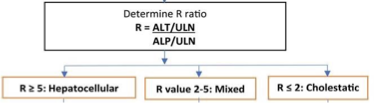
What classifies DILI as hepatocellular?
Elevated AST and ALT disproportionate to alkaline phosphatase
What classifies DILI as cholestatic?
Elevated alkaline phosphatase and total bilirubin disproportionate to AST and ALT
Can have scleral icterus, jaundice, pruritus
Less severe than hepatocellular
What classifies DILI as mixed?
Elevated AST/ALT and ALP
What is the R ratio?
What classifies DILI as intrinsic/direct?
*Most common
Dose-dependent
Common
Short latency
Predictable
What classifies DILI as idiosyncratic?
Dose independent
Uncommon
Long latency
Unpredictable
What is the most common drug cause of idiosyncratic DILI?
Augmentin (and supplements)
Common drug causes of DILI
Antibiotics
Anti-epileptics
NSAIDs
Immune therapies (azathioprine, methotrexate, immune-checkpoint inhibitors)
Herbals (green tea extract, tumeric, ashwagandha, garcinia cambogia)
Supplements (anabolic bodybuilding products)
How do you determine how likely a med is to cause DILI?
Assess whether clinical presentation fits with regard to latency, pattern, and overall likelihood (LiverTox, Micromedex)
How do we manage DILI?
Discontinue offending agent
Recheck liver chemistries to observe for peak and until return to baseline
What is the DILI antidote for acetaminophen?
N-acetylcysteine
What is the DILI antidote for methotrexate?
Folic acid
What is the DILI antidote for valproic acid?
L-carnitine
What is the prognosis for DILI? Who’s at greater risk for poor outcomes?
Most patients will fully recover
Those with pre-existing liver disease are at a greater risk for poor outcomes
Which features are more likely to have a poor prognosis for DILI?
Development of jaundice with ALT >3x ULN
Concomitant kidney injury
Acute liver failure due to anti-epileptics in children
Acute liver failure due to acetaminophen in adults
How do we prevent DILI?
Use recommended dosing for rx meds
Check for drug interactions when prescribing
Obtain baseline liver chemistries and monitor periodically when using drugs known to elevate liver chemistries
Recommend patients minimize use of other hepatotoxins (herbals, supplements, alcohol, illicit drugs)
How does Tylenol cause DILI?
Toxic metabolite NAPQI accumulates and causes hepatocellular necrosis
What are the clinical phases of Tylenol toxicity?
1 (<24h): N/V, malaise, anorexia – labs often NORMAL
2 (24-72h): RUQ pain, AST/ALT start to rise, elevated PT/INR
3 (72-96h): Peak hepatotoxicity: AST/ALT >1,000 (often 3k-10k), jaundice, coagulopathy, encephalopathy, AKI
4 (4 days – 2 weeks): Recovery or progression to acute liver failure and death
How do we evaluate patients for tylenol toxicity?
Plot 4-hour APAP and start N-acetylcysteine (NAC) if at or above “possible toxicity”
How long should N-acetylcysteine be continued?
Replenishes gluathione and helps process toxic NAPQI
Continue until AST/ALT trending down and INR <2 and clinical improvement
What are the benefits of N-acetylcysteine?
Nearly 100% hepatoprotective if given within 8h of ingestion, still beneficial up to 24h
Continue even if acute liver failure as this improves transplant survival
What else can we do/give for Tylenol toxicity?
Activated charcoal if <4 hours after ingestion and no C/I
Consider referral for liver transplant
What are the indications of N-acetylcysteine (NAC)
Acetaminophen toxicity, known or suspected
What is the MOA of N-acetylcysteine?
Restores hepatic concentrations of glutathione, which inactivates a hepatotoxic metabolite of acetaminophen
What are the AE and C/I of N-acetylcysteine?
AE: N/V, hypervolemia, bronchospasm, hypersensitivity reactions (rash, wheezing)
C/I: No absolute C/I. Caution in patients who are fluid overloaded d/t risk of hyponatremia, seizures
What is the monitoring for N-acetylcysteine?
Telemetry
Assess for peripheral edema
CMP for electrolytes, liver chemistries