econ unit 13 ch. 17

0.0(0)
studied byStudied by 0 people
0.0(0)
full-widthCall Kai
learnLearn
examPractice Test
spaced repetitionSpaced Repetition
heart puzzleMatch
flashcardsFlashcards
GameKnowt Play
Card Sorting

1/43

encourage image

There's no tags or description

Looks like no tags are added yet.

Study Analytics
Name
Mastery
Learn
Test
Matching
Spaced

No study sessions yet.

44 Terms

1
New cards

Chapter 17 — Markets for Factors of Production

  1. Describe the anatomy of ___ markets

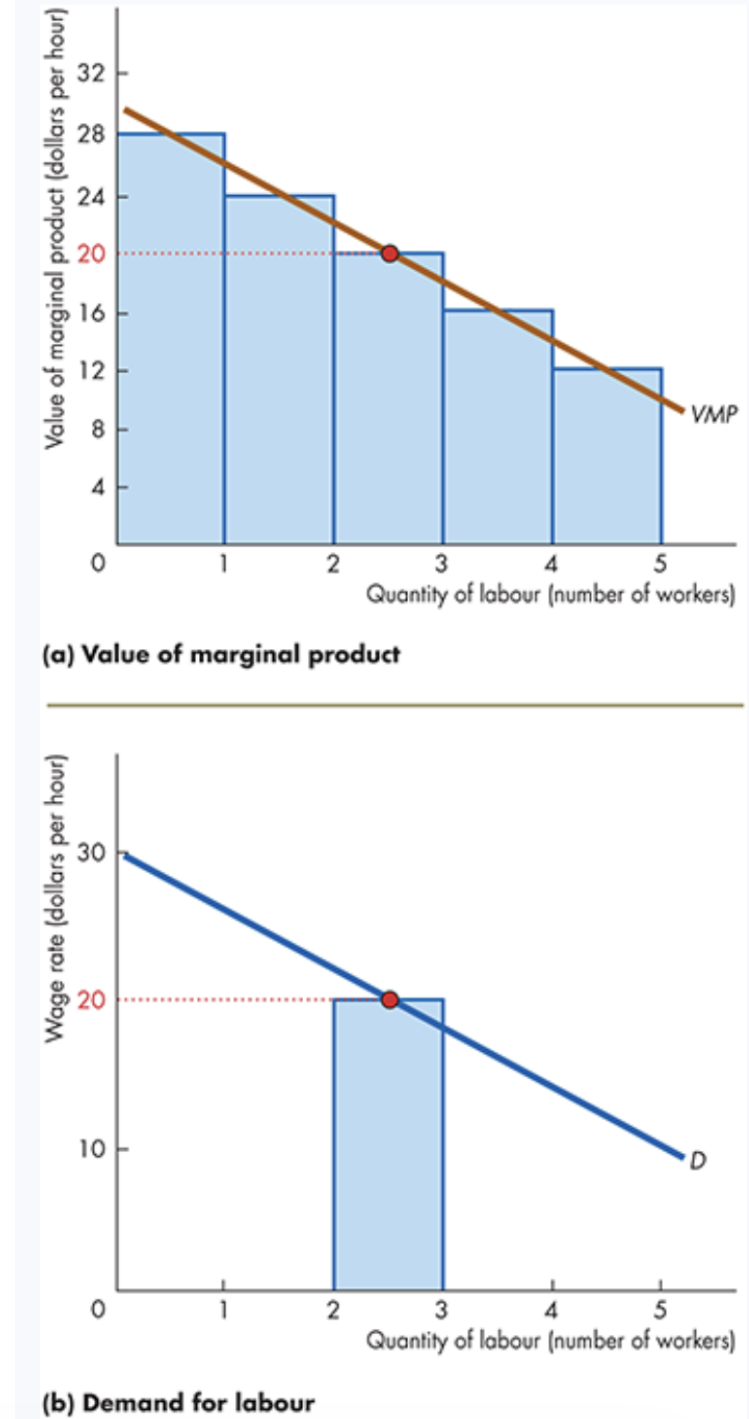
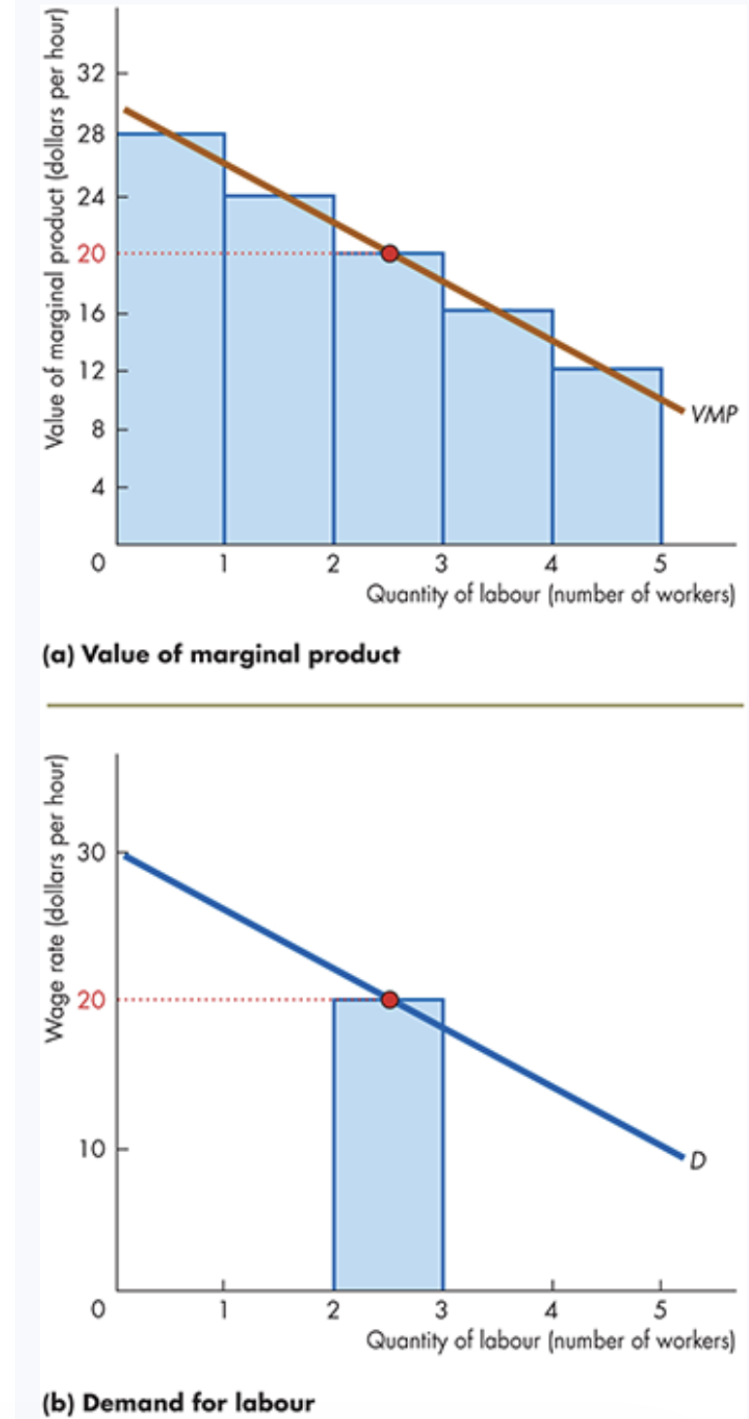
  2. Explain how the value of marginal product (VMP) determines the demand for a factor of production

  3. Explain how wage rates and employment are determined & the role of labour unions

  4. Explain how rental rates for capital and land, and natural resource prices, are determined

factor

2
New cards

The Anatomy of Factor Markets

Factor markets allocate the four factors of production:

  1. __ – human physical & mental effort

  2. ___ – tools, machinery, buildings used to produce goods/services

  3. ___ (Natural Resources) – gifts of nature (land, minerals, oil, water)

  4. ___ – organization, ____, and risk-taking

These factors are ____ in the production process. Their __ are determined in __ markets.

labor, capital, land, entrepreneurship, organization, inputs, prices, factor

3
New cards

1. Markets for Labour Services

  • Labour = physical and ___ effort supplied to produce goods & services.

  • Labour market = people and firms trading ___ services.

  • Price of labour = ___ rate.

Types of Labour

  • Casual labour: hired __-by-day (fruit pickers).

Contract labour: ___ job contracts (most labour).

mental, labor, wage, day, long-term

4
New cards

Competitive Labour Markets

  • Many buyers (firms) and sellers (workers)

  • No one controls the wage → wage rate determined by supply & demand

  • Higher demand → more jobs

  • Lower demand → job losses

Labour Unions

  • Act like a ___ on the ___ side.

  • Wage rate determined through collective ___ between union & employer.

  • Can negotiate higher wages but sometimes reduce employment.

monopoly, supply, bargaining

5
New cards

2. Markets for Capital Services

  • Capital goods = produced goods used to produce ___ goods (machines, buildings, tools).

  • Capital goods themselves are traded in goods markets (market for dump trucks).

Capital Services

  • The ___ of capital is traded in ___ markets.

  • Rental rate = price for ___ capital (renting a ___ or truck from U-Haul).

Implicit Rental Rate

Most firms own their capital
Even then, using capital has a cost:

  • __

  • ____cost (__ of tying up funds)

These make up the __ rental rate of capital → the price the firm “pays itself” for using its own capital.

other, use, rental, hiring, car, depreciation, interest, OC, implicit

6
New cards

3. Markets for Land Services & Natural Resources

Land - Includes all natural resources (land surface, water, minerals, forests).

____ Rate of Land - The price for the use of land 

Renewable vs. Nonrenewable Resources

Renewable (can be used repeatedly) - farmland, forests (if replanted), water

Nonrenewable (can only be used once):

  • Oil

  • Natural gas

  • Coal

Commodity Prices

  • Prices of ___ resources are determined in global commodity markets.

  • These prices fluctuate with global supply & demand.

rental, nonrenewable

7
New cards

4. Entrepreneurship

  • Entrepreneurial services ___ traded in markets.

  • Entrepreneurs earn ___ or take on losses based on their business decisions.

  • Profit is the “___” of entrepreneurship.

aren’t, profit, price

8
New cards

1. What are the factors of production and their prices?

  • Labour → Wage rate

  • Capital → ___ rate (implicit or explicit)

  • Land (natural resources) → Rental rate or ___ price

  • Entrepreneurship → Profit (or loss)

rental, commodity

9
New cards

2. What is the distinction between capital and the services of capital?

  • Capital = physical objects used in production (machinery, buildings, equipment).

Services of capital = the productive __ of that equipment (hours of machine operation).

use

10
New cards

3. What is the distinction between the price of capital equipment and the rental rate of capital?

  • Price of __ equipment = the purchase price of the physical good (buying a truck).

Rental rate of capital = the price of using the equipment for a period (renting a truck for a day).

capital

11
New cards

Chapter 17 — The Demand for a Factor of Production

Key Idea - The demand for any factor of production (labour, capital, land) is a derived demand.

Derived Demand

  • A firm demands a factor because it needs it to produce ___.

Demand for factors comes from demand for the goods/services produced.

output

12
New cards

How Firms Decide How Much Labour to Hire

A firm hires labour based on a comparison between:

  1. Cost of hiring one more worker → ___ rate

  2. Value to the firm of hiring one more worker → Value of ___ Product (VMP)

A profit-maximizing firm hires a factor only if ____ ≥ __ price.

wage, marginal, VMP, factor

13
New cards

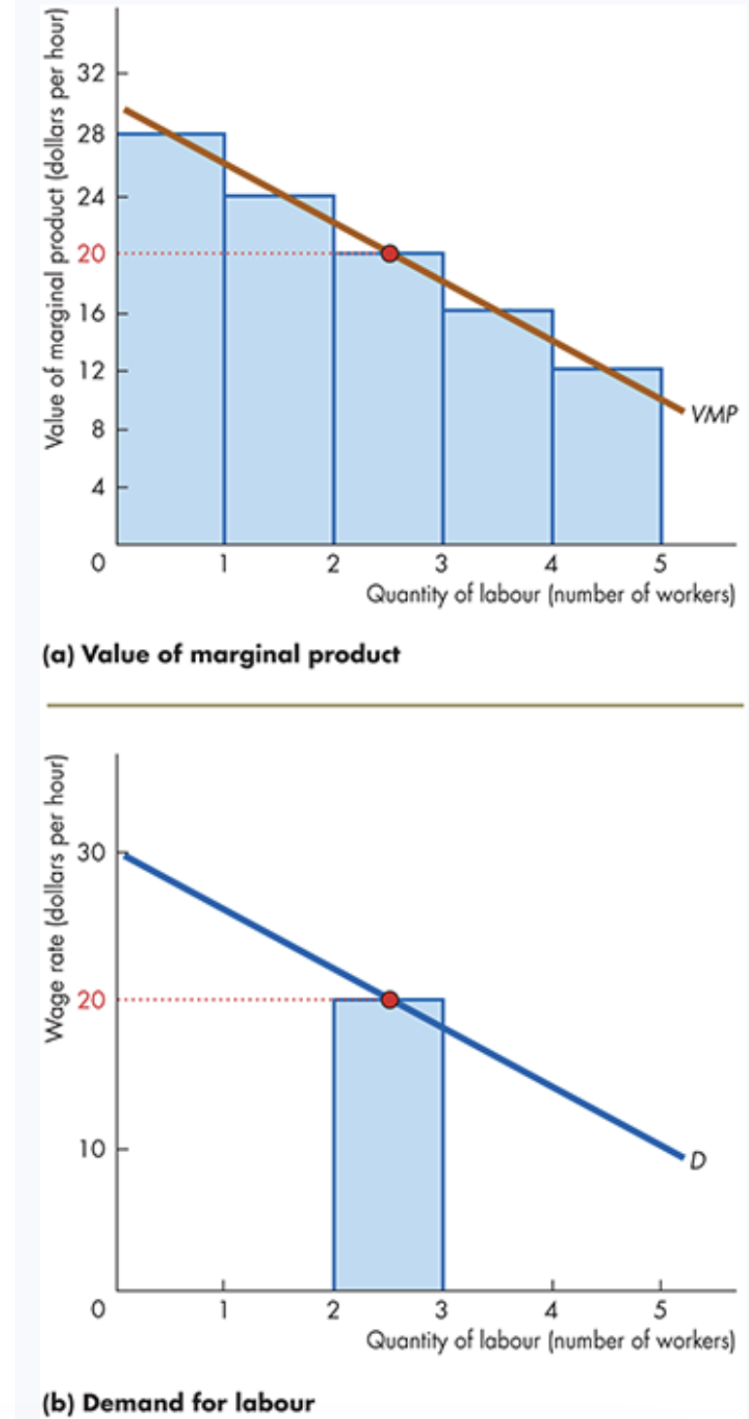
Value of Marginal Product (VMP)

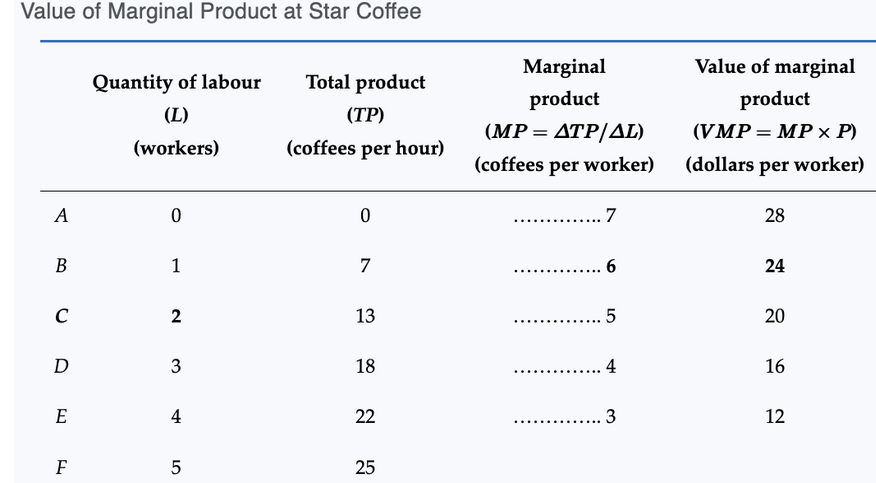
The value of marginal product is the value of the output produced by one more ___ of a factor.

VMP = ___ of Output × __ Product (MP)

Star Coffee

  • Price of coffee = $4 per cup

  • MP of 2nd worker = 6 cups/hour

  • VMP of 2nd worker = 6 × 4 = $24

Interpretation: Hiring the second worker adds $24 of revenue per hour.

unit, price, marginal

14
New cards

A Firm’s Demand for Labour

The Core Rule - A firm maximizes profit by hiring workers up to the point where: __ = Wage Rate

  • If VMP > wage, __ more workers increases profit.

  • If VMP < wage, firing workers increases profit.

  • If VMP = wage, profit is maximized → optimal quantity of labour.

Decreasing VMP

  • VMP falls as more workers are hired because ___ diminishes.

This makes the demand for labour downward sloping.

VMP, hiring, MP
15
New cards
<p><span style="background-color: transparent; font-family: &quot;Times New Roman&quot;, serif;"><strong><span>A Firm’s Demand for Labour Curve</span></strong></span></p><p><span style="background-color: transparent; font-family: &quot;Times New Roman&quot;, serif;"><span>How It’s Derived</span></span></p><ul><li><p><span style="font-family: &quot;Times New Roman&quot;, serif;"><span>The </span><strong><span>VMP curve</span></strong><span> becomes the </span><strong><span>firm’s ____ for labour curve</span></strong><span>.</span></span></p></li><li><p><span style="font-family: &quot;Times New Roman&quot;, serif;"><span>Shows how many workers the firm hires at different wage rates.</span></span></p></li></ul><p><span style="background-color: transparent; font-family: &quot;Times New Roman&quot;, serif;"><span>Star Coffee</span></span></p><p><span style="background-color: transparent; font-family: &quot;Times New Roman&quot;, serif;"><span>If wage = </span><strong><span>$20/hour</span></strong><span>:</span></span></p><ul><li><p><span style="background-color: transparent; font-family: &quot;Times New Roman&quot;, serif;"><span>Worker 2: VMP = $24 → hire</span></span></p></li><li><p><span style="background-color: transparent; font-family: &quot;Times New Roman&quot;, serif;"><span>Worker 3: VMP = $20 → hire</span></span></p></li><li><p><span style="background-color: transparent; font-family: &quot;Times New Roman&quot;, serif;"><span>Worker 4: VMP = $16 → __ hire</span></span></p></li></ul><p><span style="background-color: transparent; font-family: &quot;Times New Roman&quot;, serif;"><strong><span>Quantity of labour demanded = 3 workers.</span></strong></span></p><p><span style="background-color: transparent; font-family: &quot;Times New Roman&quot;, serif;"><span>Movement versus Shift</span></span></p><ul><li><p><span style="font-family: &quot;Times New Roman&quot;, serif;"><strong><span>Change in ____ rate → </span></strong><span>__</span><strong><span> along the demand curve</span></strong></span></p></li><li><p><span style="background-color: transparent; font-family: &quot;Times New Roman&quot;, serif;"><strong><span>Change in anything else → shift of the entire demand curve</span></strong></span></p></li></ul><p></p>

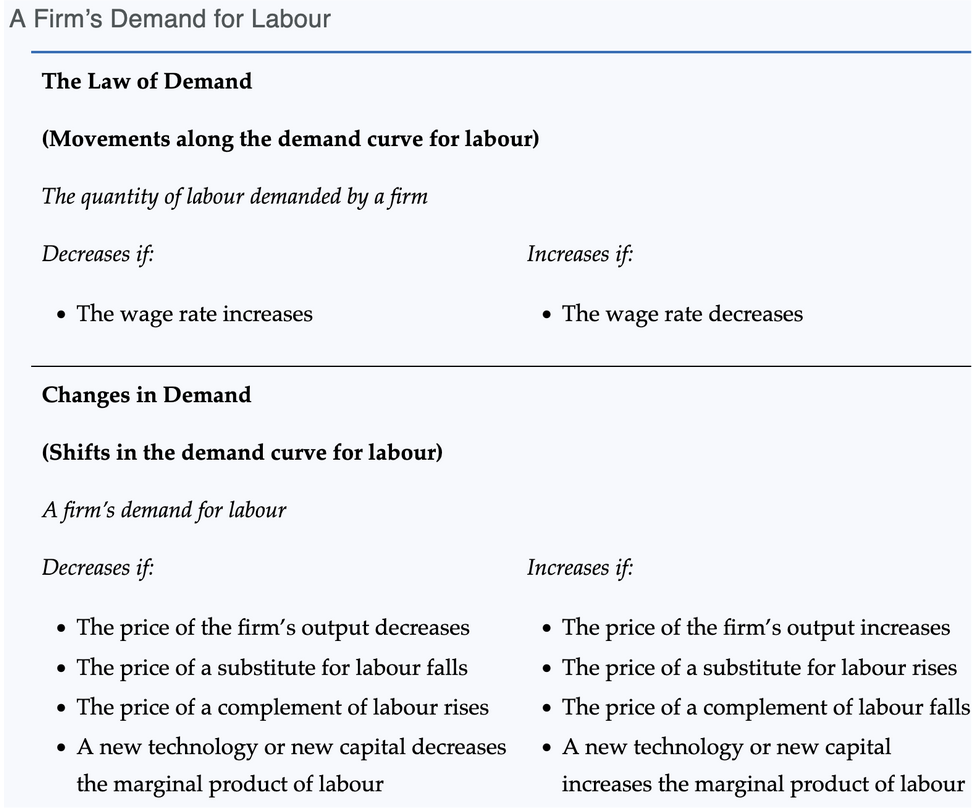
A Firm’s Demand for Labour Curve

How It’s Derived

  • The VMP curve becomes the firm’s ____ for labour curve.

  • Shows how many workers the firm hires at different wage rates.

Star Coffee

If wage = $20/hour:

  • Worker 2: VMP = $24 → hire

  • Worker 3: VMP = $20 → hire

  • Worker 4: VMP = $16 → __ hire

Quantity of labour demanded = 3 workers.

Movement versus Shift

  • Change in ____ rate → __ along the demand curve

  • Change in anything else → shift of the entire demand curve

demand, don’t, wage, movement
16
New cards
<p><span style="background-color: transparent; font-family: &quot;Times New Roman&quot;, serif;"><strong><span>What Shifts a Firm’s Demand for Labour?</span></strong></span></p><p><span style="background-color: transparent; font-family: &quot;Times New Roman&quot;, serif;"><span>A firm’s labour demand depends on:</span></span></p><p><span style="background-color: transparent; font-family: &quot;Times New Roman&quot;, serif;"><span>1. Price of the Firm’s Output</span></span></p><ul><li><p><span style="font-family: &quot;Times New Roman&quot;, serif;"><span>Higher output price → higher ___ → </span><strong><span>demand for labour __</span></strong><span> (shifts right)</span></span></p></li><li><p><span style="background-color: transparent; font-family: &quot;Times New Roman&quot;, serif;"><span>Lower output price → lower VMP → demand decreases</span><strong><span><br></span></strong><span> If coffee price rises to $6:</span></span></p></li></ul><ul><li><p><span style="background-color: transparent; font-family: &quot;Times New Roman&quot;, serif;"><span>VMP of the 4th worker increases from $16 → $24</span></span></p></li></ul><p><span style="background-color: transparent; font-family: &quot;Times New Roman&quot;, serif;"><span>At wage = $20, the firm now hires </span><strong><span>4 workers instead of 3</span></strong></span></p>

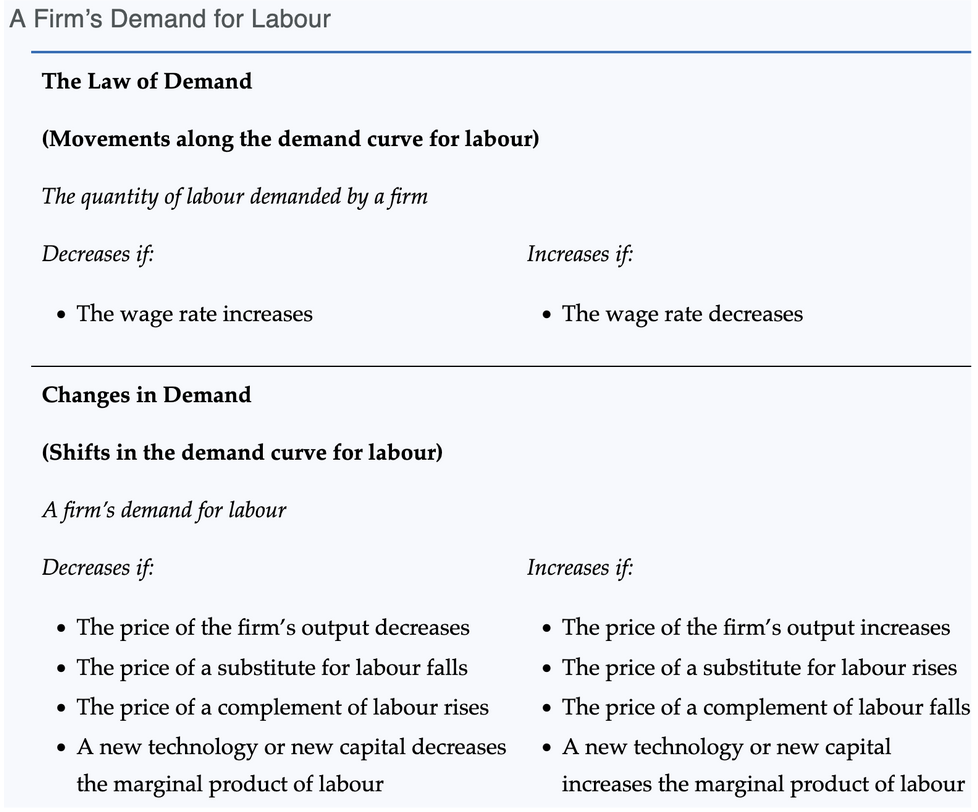
What Shifts a Firm’s Demand for Labour?

A firm’s labour demand depends on:

1. Price of the Firm’s Output

  • Higher output price → higher ___ → demand for labour __ (shifts right)

  • Lower output price → lower VMP → demand decreases
    If coffee price rises to $6:

  • VMP of the 4th worker increases from $16 → $24

At wage = $20, the firm now hires 4 workers instead of 3

VMP, increases
17
New cards
<p><span style="background-color: transparent; font-family: &quot;Times New Roman&quot;, serif;"><strong><span>2. Prices of Other Factors of Production</span></strong></span></p><p><span style="background-color: transparent; font-family: &quot;Times New Roman&quot;, serif;"><span>If capital becomes cheaper:</span></span></p><ul><li><p><span style="background-color: transparent; font-family: &quot;Times New Roman&quot;, serif;"><span>The firm may substitute ___ for labour → </span><strong><span>demand for labour decreases</span></strong></span></p></li><li><p><span style="font-family: &quot;Times New Roman&quot;, serif;"><span>But if cheaper capital expands production enough, labour demand may </span><strong><span>increase</span></strong></span></p></li></ul><p><span style="font-family: &quot;Times New Roman&quot;, serif;"><strong><span>Short run:</span></strong><span> Usually labour __<br></span><strong><span>Long run:</span></strong><span> Could be ↑ or ↓ depending on scale effects</span></span></p>

2. Prices of Other Factors of Production

If capital becomes cheaper:

  • The firm may substitute ___ for labour → demand for labour decreases

  • But if cheaper capital expands production enough, labour demand may increase

Short run: Usually labour __
Long run: Could be ↑ or ↓ depending on scale effects

capital, decreases

18
New cards

3. Technology

  • ____technology → demand for certain labour types ↓

  • Labour-using/____ technology → demand ↑

  • Self-serve coffee machines reduce demand for baristas.

  • Growth of online shopping reduces demand for store clerks but increases demand for:

    • warehouse workers

    • delivery drivers

    • software engineers

    • website designers

labour-saving, skill-complementing

19
New cards

Factor

Effect on Labour Demand

Price of output

↑ price → ↑ VMP → demand shifts ___

Price of capital or other inputs

Cheaper capital → usually ↓ labour demand; but may ↑ if scale increases

_

Can increase or decrease depending on whether labour is replaced or complemented

right, tech

20
New cards
<p><span style="font-family: &quot;Times New Roman&quot;, serif;"><strong><span>1. What is the value of marginal product of labour? </span></strong><span>The </span><strong><span>value of the output produced by one additional worker</span></strong><span>; VMP = __ × __</span></span></p>

1. What is the value of marginal product of labour? The value of the output produced by one additional worker; VMP = __ × __

Price of Output, Marginal Product
21
New cards
<p><span style="background-color: transparent; font-family: &quot;Times New Roman&quot;, serif;"><strong><span>2. Relationship between VMP and marginal product?</span></strong></span></p><ul><li><p><span style="background-color: transparent; font-family: &quot;Times New Roman&quot;, serif;"><span>Marginal product reflects </span><strong><span>___ output added by an ___ worker</span></strong><span>.</span></span></p></li></ul><p><span style="background-color: transparent; font-family: &quot;Times New Roman&quot;, serif;"><span>VMP converts marginal product into </span><strong><span>___ value</span></strong><span> using the price of output.</span></span></p>

2. Relationship between VMP and marginal product?

  • Marginal product reflects ___ output added by an ___ worker.

VMP converts marginal product into ___ value using the price of output.

physical, extra, dollar
22
New cards
<p><span style="background-color: transparent; font-family: &quot;Times New Roman&quot;, serif;"><strong><span>3. How is the firm’s demand for labour derived from VMP?</span></strong></span></p><ul><li><p><span style="background-color: transparent; font-family: &quot;Times New Roman&quot;, serif;"><span>The VMP curve shows the value of each additional __.</span></span></p></li><li><p><span style="background-color: transparent; font-family: &quot;Times New Roman&quot;, serif;"><span>The firm hires workers until </span><strong><span>VMP = wage</span></strong><span>.</span></span></p></li></ul><p><span style="background-color: transparent; font-family: &quot;Times New Roman&quot;, serif;"><span>Thus, the </span><strong><span>downward-sloping VMP curve becomes the demand for labour curve</span></strong><span>.</span></span></p>

3. How is the firm’s demand for labour derived from VMP?

  • The VMP curve shows the value of each additional __.

  • The firm hires workers until VMP = wage.

Thus, the downward-sloping VMP curve becomes the demand for labour curve.

worker

23
New cards

4. What influences the demand for labour?

  1. Price of the firm’s output

  2. Prices of ____ factors (__)

  3. Technology changes

other, capital

24
New cards

Chapter 17 — Labour Markets (Detailed Notes)

1. Overview of Labour Markets

Labour services are traded in many different labour markets, varying by scope:

  • ___ markets (coffee shop workers, bakers)

  • ____ markets (air traffic controllers, nurses)

  • ___ markets (superstar athletes)

Labour markets determine:

  • Wage rates

  • ___ levels

  • How unions or market power influence __

local national global employment wages

25
New cards

2. Competitive Labour Market

A competitive labour market has:

  • Many firms demanding labour

  • Many ___ supplying labour

  • No single buyer or seller can influence the wage

Wage and employment are determined by market supply & demand

households

26
New cards

2A. Market Demand for Labour

  • Derived from ___ firms’ demand for labour.

  • A firm hires workers up to the point where: Wage = Value of Marginal Product (VMP).

Because each firm’s demand curve slopes downward, the market demand curve also slopes downward.

individual
27
New cards
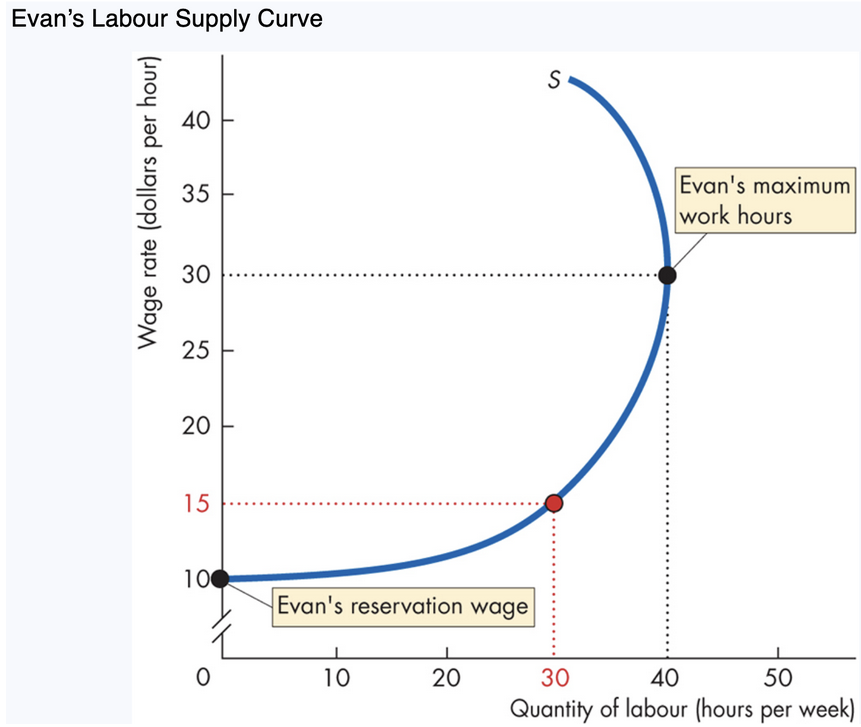
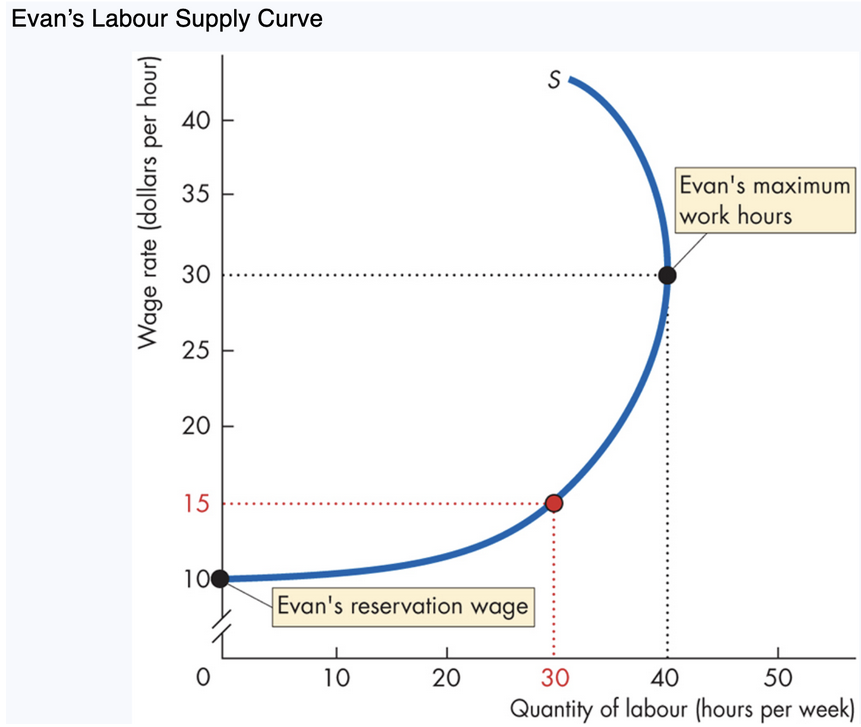
<p><span style="font-family: &quot;Times New Roman&quot;, serif;"><strong><span>2B. Market Supply of Labour</span></strong></span></p><p><span style="font-family: &quot;Times New Roman&quot;, serif;"><span>Derived from households’ decisions on </span><strong><span>labour vs. leisure</span></strong><span>.</span></span></p><p><span style="background-color: transparent; font-family: &quot;Times New Roman&quot;, serif;"><span>___ Wage</span></span></p><ul><li><p><span style="font-family: &quot;Times New Roman&quot;, serif;"><span>____ wage at which a worker is willing to work.</span></span></p></li><li><p><span style="background-color: transparent; font-family: &quot;Times New Roman&quot;, serif;"><span>Evan’s reservation wage = </span><strong><span>$10/hour</span></strong><span>.</span></span></p></li><li><p><span style="background-color: transparent; font-family: &quot;Times New Roman&quot;, serif;"><span>Below $10 → Evan supplies </span><em><span>no</span></em><span> labour.</span></span></p></li><li><p><span style="background-color: transparent; font-family: &quot;Times New Roman&quot;, serif;"><span>Above $10 → he supplies labour.</span></span></p></li></ul><p></p>

2B. Market Supply of Labour

Derived from households’ decisions on labour vs. leisure.

___ Wage

  • ____ wage at which a worker is willing to work.

  • Evan’s reservation wage = $10/hour.

  • Below $10 → Evan supplies no labour.

  • Above $10 → he supplies labour.

reservation, minimum
28
New cards
<p><span style="background-color: transparent; font-family: &quot;Times New Roman&quot;, serif;"><span>Labour Supply Curve (Individual)</span></span></p><ul><li><p><span style="background-color: transparent; font-family: &quot;Times New Roman&quot;, serif;"><span>At first slopes upward: as wage ↑, labour supplied ↑.</span></span></p></li><li><p><span style="background-color: transparent; font-family: &quot;Times New Roman&quot;, serif;"><span>Eventually </span><strong><span>___ backward</span></strong><span>: After $30/hour, Evan prefers more </span><strong><span>leisure</span></strong><span>, so he works fewer hours.</span></span></p></li></ul><p><span style="background-color: transparent; font-family: &quot;Times New Roman&quot;, serif;"><span>Why backward?</span></span></p><p><span style="background-color: transparent; font-family: &quot;Times New Roman&quot;, serif;"><span>Substitution Effect</span></span></p><ul><li><p><span style="background-color: transparent; font-family: &quot;Times New Roman&quot;, serif;"><span>Higher wage = higher opportunity cost of leisure</span></span></p></li><li><p><span style="background-color: transparent; font-family: &quot;Times New Roman&quot;, serif;"><span>Worker substitutes </span><strong><span>leisure → labour</span></strong></span></p></li><li><p><span style="background-color: transparent; font-family: &quot;Times New Roman&quot;, serif;"><span>Labour supplied </span><strong><span>increases</span></strong></span></p></li></ul><p><span style="background-color: transparent; font-family: &quot;Times New Roman&quot;, serif;"><span>Income Effect</span></span></p><ul><li><p><span style="background-color: transparent; font-family: &quot;Times New Roman&quot;, serif;"><span>Higher wage = higher income</span></span></p></li><li><p><span style="background-color: transparent; font-family: &quot;Times New Roman&quot;, serif;"><span>Workers “buy” more </span><strong><span>leisure</span></strong></span></p></li><li><p><span style="background-color: transparent; font-family: &quot;Times New Roman&quot;, serif;"><span>Labour supplied </span><strong><span>decreases</span></strong></span></p></li></ul><p><span style="font-family: &quot;Times New Roman&quot;, serif;"><span>When ___ effect &gt; __ effect → </span><strong><span>curve bends backward</span></strong></span></p>

Labour Supply Curve (Individual)

  • At first slopes upward: as wage ↑, labour supplied ↑.

  • Eventually ___ backward: After $30/hour, Evan prefers more leisure, so he works fewer hours.

Why backward?

Substitution Effect

  • Higher wage = higher opportunity cost of leisure

  • Worker substitutes leisure → labour

  • Labour supplied increases

Income Effect

  • Higher wage = higher income

  • Workers “buy” more leisure

  • Labour supplied decreases

When ___ effect > __ effect → curve bends backward

bends, income, substitution
29
New cards
<p><span style="background-color: transparent; font-family: &quot;Times New Roman&quot;, serif;"><span>Market Labour Supply Curve</span></span></p><ul><li><p><span style="background-color: transparent; font-family: &quot;Times New Roman&quot;, serif;"><span>Always </span><strong><span>upward sloping</span></strong><span>&nbsp;</span></span></p><ul><li><p><span style="background-color: transparent; font-family: &quot;Times New Roman&quot;, serif;"><span>Many households with different reservation wages</span></span></p></li><li><p><span style="background-color: transparent; font-family: &quot;Times New Roman&quot;, serif;"><span>Higher wages attract more </span><strong><span>__</span></strong><span>, not more hours</span></span></p></li></ul></li></ul><p></p>

Market Labour Supply Curve

  • Always upward sloping 

    • Many households with different reservation wages

    • Higher wages attract more __, not more hours

workers
30
New cards
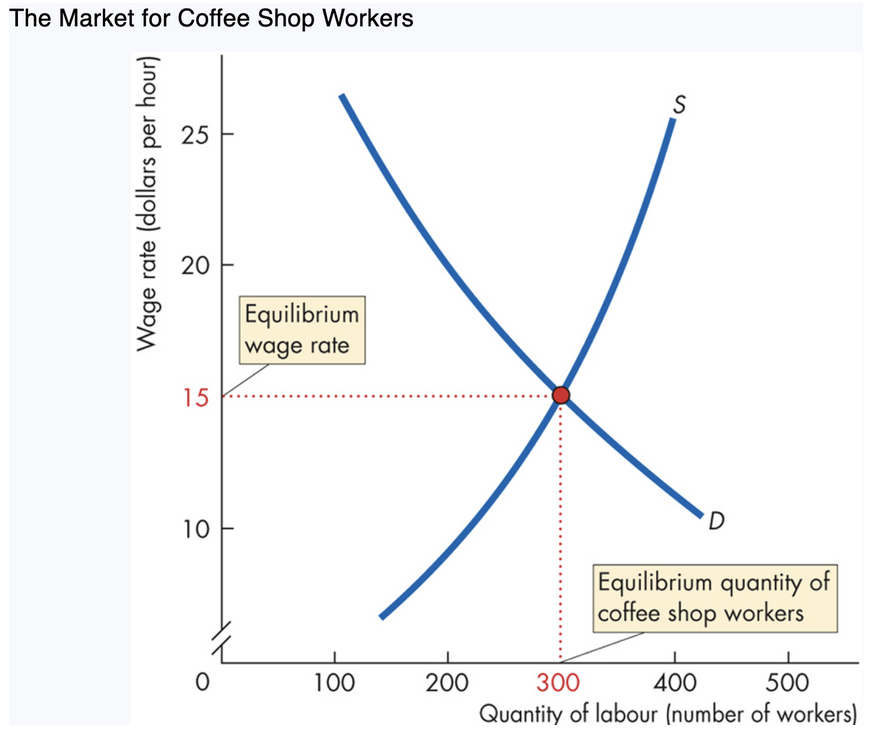
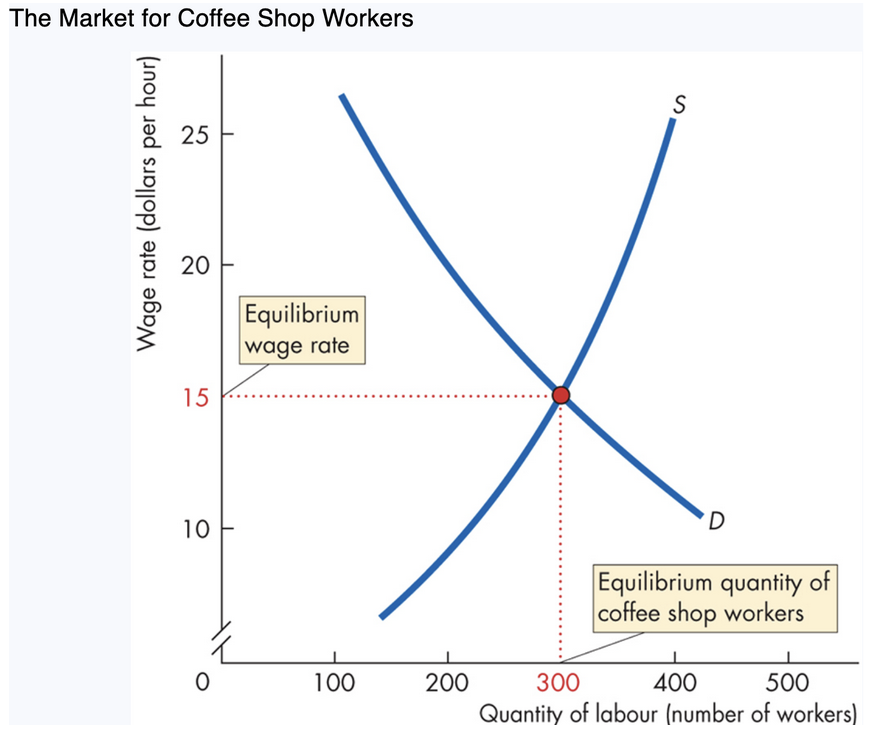
<p><span style="background-color: transparent; font-family: &quot;Times New Roman&quot;, serif;"><strong><span>3. Labour Market Equilibrium</span></strong></span></p><p><span style="background-color: transparent; font-family: &quot;Times New Roman&quot;, serif;"><span>When supply (S) meets demand (D):</span></span></p><ul><li><p><span style="background-color: transparent; font-family: &quot;Times New Roman&quot;, serif;"><strong><span>Equilibrium wage:</span></strong><span> where quantity supplied = quantity demanded</span></span></p></li><li><p><span style="background-color: transparent; font-family: &quot;Times New Roman&quot;, serif;"><span>Coffee shop workers: Wage: </span><strong><span>$15/hour</span></strong></span></p><ul><li><p><span style="background-color: transparent; font-family: &quot;Times New Roman&quot;, serif;"><span>Employment: </span><strong><span>300 workers</span></strong></span></p></li></ul></li></ul><p><span style="background-color: transparent; font-family: &quot;Times New Roman&quot;, serif;"><span>How market fixes disequilibrium</span></span></p><ul><li><p><span style="background-color: transparent; font-family: &quot;Times New Roman&quot;, serif;"><span>Wage &gt; $15 → </span><strong><span>surplus</span></strong><span> of workers → wage ____</span></span></p></li><li><p><span style="background-color: transparent; font-family: &quot;Times New Roman&quot;, serif;"><span>Wage &lt; $15 → </span><strong><span>shortage</span></strong><span> → wage rises</span></span></p></li><li><p><span style="background-color: transparent; font-family: &quot;Times New Roman&quot;, serif;"><span>Only at $15 are there no forces pushing wage up/down</span></span></p></li></ul><p></p>

3. Labour Market Equilibrium

When supply (S) meets demand (D):

  • Equilibrium wage: where quantity supplied = quantity demanded

  • Coffee shop workers: Wage: $15/hour

    • Employment: 300 workers

How market fixes disequilibrium

  • Wage > $15 → surplus of workers → wage ____

  • Wage < $15 → shortage → wage rises

  • Only at $15 are there no forces pushing wage up/down

falls

31
New cards

4. Wage Differences + Trends in Canada

Average wage: $32.06/hour

Reasons wage rates differ across occupations

  • Differences in VMP (__/productivity)

  • Differences in training or ability

  • Scarcity of workers in high-skill jobs

  • Some occupations experience more market power

Why wages rise over time

  • Technological change → workers become more __ → ↑ VMP → ↑ labour demand

  • Education & experience increase VMP

  • Even jobs with ___ physical output (childcare) can experience rising VMP due to high-income parents ___ more.

skills, productive, fixed, WTP

32
New cards

5. Wage Inequality Rising

  1. Technology

    • Increases productivity of high-skilled workers (↑ wages)

    • Eliminates low-skill jobs (↓ wages)

      • ATMs reduced bank teller jobs

      • Computerization increased programmer wages

  2. Globalization

    • More global __ for low-skill workers

    • More global opportunities for high-skill workers

competition

33
New cards

6. Gender Pay Gap — Explanation

  1. Hours worked differ - Men average 40 hrs, women 35.4 hrs

  2. ___ choices

    • Women → more arts degrees

    • Men → more STEM degrees (higher paying)

  3. Marriage & children

    • Women take on more parenting → reduces career time

    • Study (never-married men vs women) → no wage gap

Possible ___ - After adjusting for all factors → 0–5% wage difference

educational, discrimination

34
New cards

Why gap narrowed historically?

  • More women entering high-paying fields

  • More equal division of parenting duties

Why it widened in 2022?

  • COVID harmed women’s employment more

  • Effects lingered into 2022

Is this a new trend?

  • Unlikely.

  • Earnings in __-dominated sectors started rising faster as the economy reopened in 2023.

female
35
New cards
<p><span style="background-color: transparent; font-family: &quot;Times New Roman&quot;, serif;"><strong><span>7. Labour Unions</span></strong></span></p><p><span style="background-color: transparent; font-family: &quot;Times New Roman&quot;, serif;"><span>A </span><strong><span>labour __</span></strong><span> is an organized group of workers aiming to:</span></span></p><ul><li><p><span style="background-color: transparent; font-family: &quot;Times New Roman&quot;, serif;"><span>Increase wage rates</span></span></p></li><li><p><span style="background-color: transparent; font-family: &quot;Times New Roman&quot;, serif;"><span>Improve working conditions</span></span></p></li></ul><p><span style="background-color: transparent; font-family: &quot;Times New Roman&quot;, serif;"><span>How unions influence supply</span></span></p><ul><li><p><span style="font-family: &quot;Times New Roman&quot;, serif;"><span>Restrict ___ (apprenticeships, certification)</span></span></p></li><li><p><span style="font-family: &quot;Times New Roman&quot;, serif;"><span>Only effective in markets where entry is ___ (doctors, electricians)</span></span></p></li><li><p><span style="font-family: &quot;Times New Roman&quot;, serif;"><span>Ineffective where large nonunion labour ___ exist (farm labour)</span></span></p></li></ul><p><span style="background-color: transparent; font-family: &quot;Times New Roman&quot;, serif;"><span>Tradeoff</span></span></p><ul><li><p><span style="background-color: transparent; font-family: &quot;Times New Roman&quot;, serif;"><span>Labour demand is downward sloping</span></span></p></li><li><p><span style="background-color: transparent; font-family: &quot;Times New Roman&quot;, serif;"><span>Higher wages → fewer jobs</span></span></p></li></ul><p><span style="background-color: transparent; font-family: &quot;Times New Roman&quot;, serif;"><span>Unions must also try to raise </span><strong><span>__</span></strong><span> for union labour.</span></span></p>

7. Labour Unions

A labour __ is an organized group of workers aiming to:

  • Increase wage rates

  • Improve working conditions

How unions influence supply

  • Restrict ___ (apprenticeships, certification)

  • Only effective in markets where entry is ___ (doctors, electricians)

  • Ineffective where large nonunion labour ___ exist (farm labour)

Tradeoff

  • Labour demand is downward sloping

  • Higher wages → fewer jobs

Unions must also try to raise __ for union labour.

union, entry, limited, supplies, demand

36
New cards

Union Methods to Increase Labour Demand

  1. Increase VMP

    • ___ programs

    • Certification

  2. Lobbying for ___ restrictions - Protect domestic union jobs

  3. Support minimum wage laws - Makes low-skilled labour more expensive → firms hire higher-skilled union workers

Lobby for ___ restrictions - Reduces supply of competing workers

training, import, immigration
37
New cards
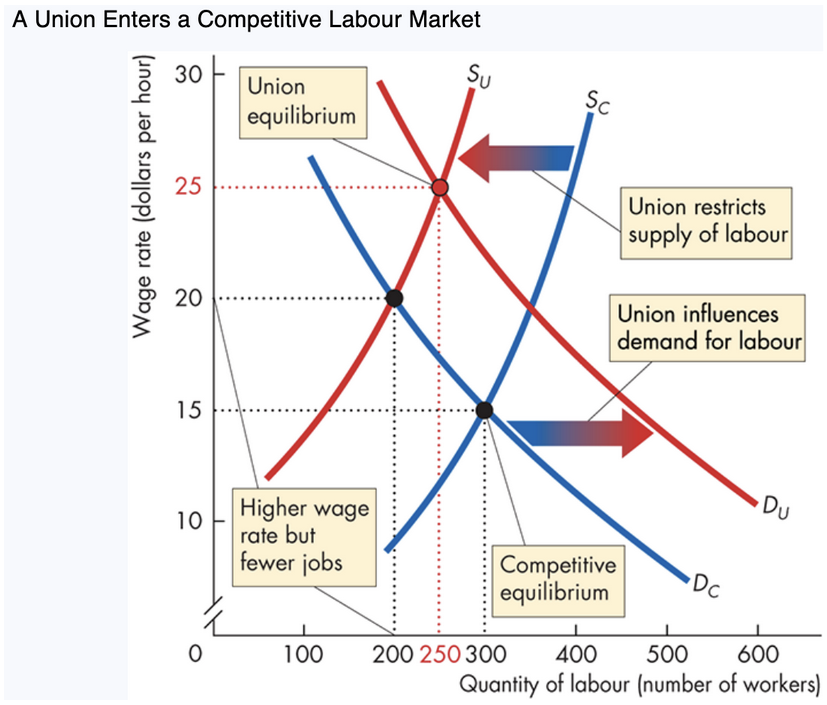
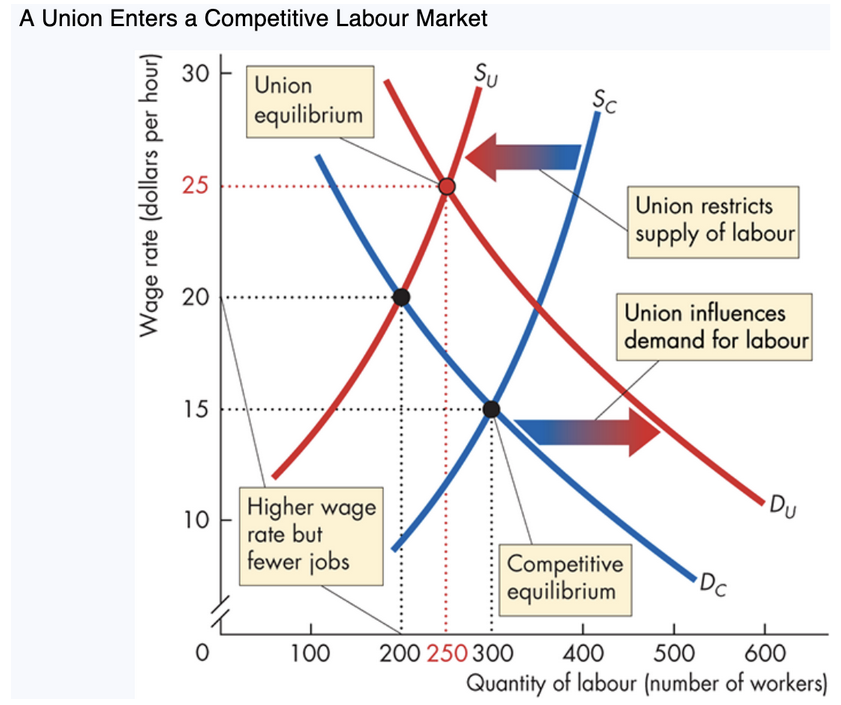
<p><span style="background-color: transparent; font-family: &quot;Times New Roman&quot;, serif;"><strong><span>8. Union Market Equilibrium (Graph Summary)</span></strong></span></p><p><span style="background-color: transparent; font-family: &quot;Times New Roman&quot;, serif;"><span>Without union:</span></span></p><ul><li><p><span style="background-color: transparent; font-family: &quot;Times New Roman&quot;, serif;"><span>Wage = </span><strong><span>$15</span></strong></span></p></li><li><p><span style="background-color: transparent; font-family: &quot;Times New Roman&quot;, serif;"><span>Employment = </span><strong><span>300</span></strong></span></p></li></ul><p><span style="background-color: transparent; font-family: &quot;Times New Roman&quot;, serif;"><span>Union restricts supply (SC → SU):</span></span></p><ul><li><p><span style="background-color: transparent; font-family: &quot;Times New Roman&quot;, serif;"><span>Wage rises to </span><strong><span>$20</span></strong></span></p></li><li><p><span style="background-color: transparent; font-family: &quot;Times New Roman&quot;, serif;"><span>Employment falls to </span><strong><span>200</span></strong></span></p></li></ul><p><span style="background-color: transparent; font-family: &quot;Times New Roman&quot;, serif;"><span>Union also increases demand (DC → DU):</span></span></p><ul><li><p><span style="background-color: transparent; font-family: &quot;Times New Roman&quot;, serif;"><span>Wage rises further to </span><strong><span>$25</span></strong></span></p></li><li><p><span style="background-color: transparent; font-family: &quot;Times New Roman&quot;, serif;"><span>Employment increases to </span><strong><span>250</span></strong></span></p></li></ul><p><span style="background-color: transparent; font-family: &quot;Times New Roman&quot;, serif;"><span>Spillover effect:</span></span></p><ul><li><p><span style="background-color: transparent; font-family: &quot;Times New Roman&quot;, serif;"><span>Excess workers enter </span><strong><span>___</span></strong><span> markets → ↑ supply in nonunion sectors → ↓ wages there</span></span></p></li></ul><p><span style="background-color: transparent; font-family: &quot;Times New Roman&quot;, serif;"><span>Increases </span><strong><span>union–nonunion wage gap</span></strong></span></p>

8. Union Market Equilibrium (Graph Summary)

Without union:

  • Wage = $15

  • Employment = 300

Union restricts supply (SC → SU):

  • Wage rises to $20

  • Employment falls to 200

Union also increases demand (DC → DU):

  • Wage rises further to $25

  • Employment increases to 250

Spillover effect:

  • Excess workers enter ___ markets → ↑ supply in nonunion sectors → ↓ wages there

Increases union–nonunion wage gap

nonunion
38
New cards
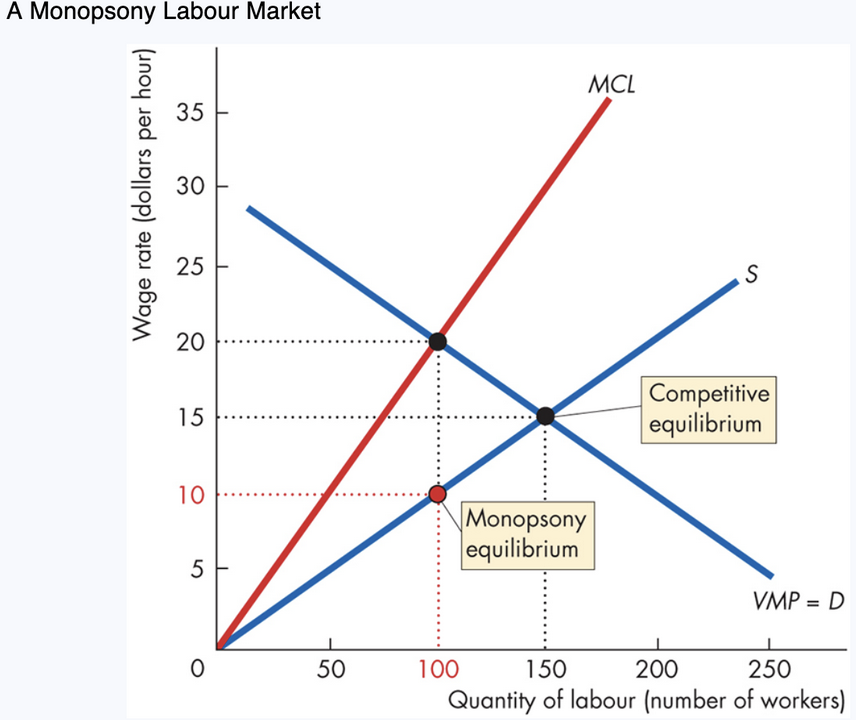
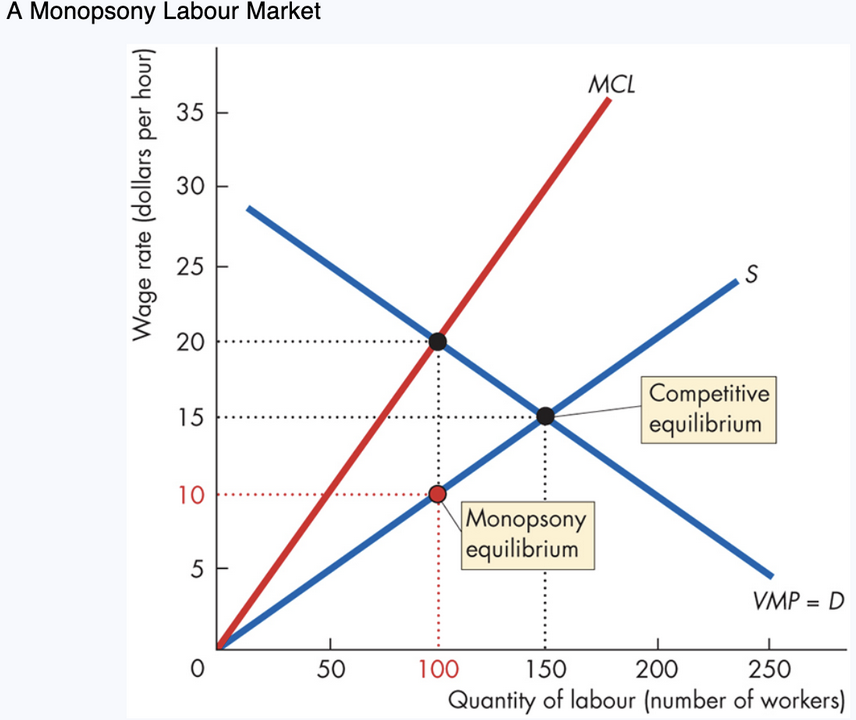
<p><span style="background-color: transparent; font-family: &quot;Times New Roman&quot;, serif;"><strong><span>9. Monopsony in Labour Markets</span></strong></span></p><p><span style="font-family: &quot;Times New Roman&quot;, serif;"><span>A </span><strong><span>monopsony</span></strong><span> = labour market with </span><strong><span>___ employer</span></strong><span>.</span></span></p><ul><li><p><span style="background-color: transparent; font-family: &quot;Times New Roman&quot;, serif;"><span>Provincial governments hiring nurses</span></span></p></li><li><p><span style="background-color: transparent; font-family: &quot;Times New Roman&quot;, serif;"><span>A mining firm in a __ town</span></span></p></li></ul><p><span style="background-color: transparent; font-family: &quot;Times New Roman&quot;, serif;"><span>Monopsony behaviour</span></span></p><ul><li><p><span style="background-color: transparent; font-family: &quot;Times New Roman&quot;, serif;"><span>Faces </span><strong><span>upward-sloping labour supply curve</span></strong></span></p></li><li><p><span style="background-color: transparent; font-family: &quot;Times New Roman&quot;, serif;"><span>Must __ wages to attract more workers</span></span></p></li><li><p><span style="font-family: &quot;Times New Roman&quot;, serif;"><span>BUT must pay the higher wage to </span><em><span>___</span></em><span> workers → </span><strong><span>Marginal Cost of Labour (MCL)___ wage rate</span></strong></span></p></li></ul><p></p>

9. Monopsony in Labour Markets

A monopsony = labour market with ___ employer.

  • Provincial governments hiring nurses

  • A mining firm in a __ town

Monopsony behaviour

  • Faces upward-sloping labour supply curve

  • Must __ wages to attract more workers

  • BUT must pay the higher wage to ___ workers → Marginal Cost of Labour (MCL)___ wage rate

one, small, raise, all, >
39
New cards
<p><span style="background-color: transparent; font-family: &quot;Times New Roman&quot;, serif;"><span>Profit-maximizing rule</span></span></p><p><span style="font-family: &quot;Times New Roman&quot;, serif;"><span>Hire workers until: ____</span><strong><span> = </span></strong><span>__</span></span></p><p><span style="background-color: transparent; font-family: &quot;Times New Roman&quot;, serif;"><span>Results</span></span></p><ul><li><p><span style="background-color: transparent; font-family: &quot;Times New Roman&quot;, serif;"><span>____ wage</span></span></p></li><li><p><span style="background-color: transparent; font-family: &quot;Times New Roman&quot;, serif;"><span>___ workers hired than in competitive market</span></span></p></li></ul><ul><li><p><span style="background-color: transparent; font-family: &quot;Times New Roman&quot;, serif;"><span>Monopsony wage: </span><strong><span>$10</span></strong></span></p></li><li><p><span style="background-color: transparent; font-family: &quot;Times New Roman&quot;, serif;"><span>Employment: </span><strong><span>100</span></strong></span></p></li><li><p><span style="background-color: transparent; font-family: &quot;Times New Roman&quot;, serif;"><span>Competitive wage: </span><strong><span>$15</span></strong></span></p></li><li><p><span style="background-color: transparent; font-family: &quot;Times New Roman&quot;, serif;"><span>Employment: </span><strong><span>150</span></strong></span></p></li></ul><p><span style="background-color: transparent; font-family: &quot;Times New Roman&quot;, serif;"><span>Thus, monopsonies </span><strong><span>pay ___</span></strong><span> and </span><strong><span>employ __ workers</span></strong><span>.</span></span></p>

Profit-maximizing rule

Hire workers until: ____ = __

Results

  • ____ wage

  • ___ workers hired than in competitive market

  • Monopsony wage: $10

  • Employment: 100

  • Competitive wage: $15

  • Employment: 150

Thus, monopsonies pay ___ and employ __ workers.

MCL=VMP, lower, fewer, less, fewer

40
New cards

10. ____ Monopoly (__ + ____)

Union = ___ seller of labour
Monopsony = monopoly ___ of labour

Outcome determined by ____ power.

If both sides are equally strong:

They split difference between monopsony wage ($10) and VMP wage ($20) →
Final wage =
$15

  • NHL (owners) vs. NHLPA (players’ union)

  • Can lead to ___/lockouts

bilateral, union, monopsony, monopoly, buyer, strikes
41
New cards
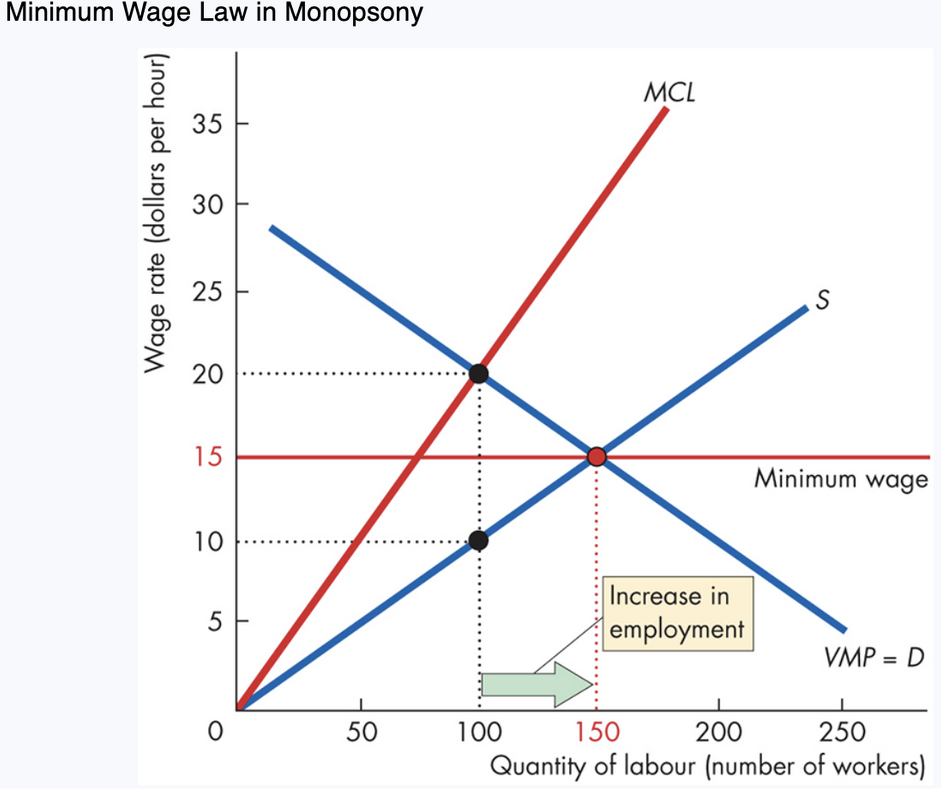
<p><span style="background-color: transparent; font-family: &quot;Times New Roman&quot;, serif;"><strong><span>11. Minimum Wage in Monopsony</span></strong></span></p><p><span style="background-color: transparent; font-family: &quot;Times New Roman&quot;, serif;"><span>Unlike in competitive markets:</span></span></p><p><span style="background-color: transparent; font-family: &quot;Times New Roman&quot;, serif;"><span>In monopsony, minimum wage can increase employment.</span></span></p><ul><li><p><span style="background-color: transparent; font-family: &quot;Times New Roman&quot;, serif;"><span>Monopsony wage: </span><strong><span>$10</span></strong></span></p></li><li><p><span style="background-color: transparent; font-family: &quot;Times New Roman&quot;, serif;"><span>Minimum wage imposed: </span><strong><span>$15</span></strong></span></p></li><li><p><span style="background-color: transparent; font-family: &quot;Times New Roman&quot;, serif;"><span>Employment rises: From </span><strong><span>100</span></strong><span> → </span><strong><span>150 workers</span></strong></span></p></li></ul><p><span style="background-color: transparent; font-family: &quot;Times New Roman&quot;, serif;"><span>Reason:</span></span></p><ul><li><p><span style="font-family: &quot;Times New Roman&quot;, serif;"><span>The minimum wage creates a </span><strong><span>perfectly elastic supply curve</span></strong><span> up to 150 workers</span></span></p></li><li><p><span style="font-family: &quot;Times New Roman&quot;, serif;"><span>Firm’s ___ becomes constant at $15, lowering ___ relative to before</span></span></p></li><li><p><span style="font-family: &quot;Times New Roman&quot;, serif;"><span>Firm hires more workers where MCL = __</span></span></p></li></ul><p></p>

11. Minimum Wage in Monopsony

Unlike in competitive markets:

In monopsony, minimum wage can increase employment.

  • Monopsony wage: $10

  • Minimum wage imposed: $15

  • Employment rises: From 100150 workers

Reason:

  • The minimum wage creates a perfectly elastic supply curve up to 150 workers

  • Firm’s ___ becomes constant at $15, lowering ___ relative to before

  • Firm hires more workers where MCL = __

MCL, MCL, VMP

42
New cards

1. What determines labour supply?

  • Tradeoff between ___ and leisure

  • ___ wage

  • Income & __ effects

labor, reservation, substitution

43
New cards

2. How are wage & employment determined in competitive markets? Intersection of market supply and demand

3. How do unions influence wages?

  • Restrict labour supply

  • ___ labour demand

  • Bargain for higher wages

increase

44
New cards

4. What is a monopsony? Why lower wages?

  • One employer

  • Faces upward-sloping supply curve

  • MCL __ wage → hires fewer workers at ___ wage

5. Wage rate when union faces monopsony? Bargained outcome between monopsony wage and competitive wage

6. Minimum wage effect in monopsony? Can raise both wage and ___ (unlike competitive market)

>, lower, employment