DANGER POINTS
 Call Kai
 Learn
Learn Practice Test
 Spaced Repetition
 Match
Match Flashcards
 Knowt Play
1/47

There's no tags or description
Looks like no tags are added yet.
Name | Mastery | Learn | Test | Matching | Spaced | Call with Kai | Chat |
|---|
No analytics yet
Send a link to your students to track their progress
48 Terms
LU 1
Transverse-oblique insertion 0.5 to 1 cun medially along the intercostal space.
Caution: deep perpendicular or oblique insertion carries a substantial risk of causing a pneumothorax.
LU 7
cephalic vein
With the fingers of one hand pinch up the skin over the point, and with the other hand needle transversely in a proximal or distal direction, 0.5 to 1 cun, avoiding the cephalic vein.
SP 21
(On the mid-axillary line, in the seventh intercostal space.)
Transverse-oblique insertion along the intercostal space, 0.5 to 1 cun.
Caution: perpendicular insertion, especially in thin patients, carries a substantial risk of inducing a pneumothorax.
LU 2
Transverse-oblique insertion 0.5 to 1 cun.
Caution: deep perpendicular or oblique insertion carries a substantial risk of causing a pneumothorax.
LU 8
Oblique proximal or perpendicular insertion 0.3 to 0.5 cun, avoiding the radial artery.
LU 9
Perpendicular insertion 0.3 to 0.5 cun, avoiding the radial artery.
LI 4
i. Perpendicular insertion 0.5 to 1 cun; ii. Oblique insertion directed proximally 1 to 1.5 cun.
Caution: contraindicated in pregnancy.
LI 13
avoid injuring artery
(On line joining LI 11 and LI 15, 3 cun above LI 11)
LI 16
Perpendicular or oblique insertion 0.5 to 1 cun.
too deep can cause pneumothorax

ST 25
Perpendicular insertion 1 to 1.5 cun; ii. oblique inferior insertion towards the uterus for diseases of the uterus.
Caution: in thin subjects, deep needling may penetrate the peritoneal cavity.
ST 41
. Perpendicular insertion 0.5 cun; ii. Oblique insertion beneath the tendons to join with SP-5 medially or GB-40 laterally.
Caution: the anterior tibial vessels and nerve lie deep to this point.
ST 42
Oblique or perpendicular insertion 0.3 to 0.5 cun.
Caution: care should be taken not to puncture the dorsalis pedis artery which lies beneath this point.
SP 6
Perpendicular or oblique proximal insertion, 1 to 1.5 cun.
Caution: contraindicated in pregnancy.
(3 cun superior to the prominence of the medial malleolus, in a depression close to the medial crest of the tibia.)
SP 11
Perpendicular or oblique insertion 0.5 to 1 cun.
Caution: deep needling may puncture the femoral artery.
SP 15
Perpendicular insertion 0.5 to 1 cun.
Caution: i. in thin patients deep needling may penetrate the peritoneal cavity; ii. deep needling at this point may penetrate a substantially enlarged spleen or liver.
HT 1
Perpendicular insertion (in the direction of GB-21) 0.5 to 1 cun, avoiding the axillary artery.
Caution: medial insertion towards the chest may puncture the lung.
HT 7
ulnar artery and ulnar nerve
SI 8
Oblique distal or proximal insertion 0.5 to 1 cun; ii. Perpendicular insertion 0.3 to 0.5 cun.
Caution: the ulnar nerve lies deep to this point.
SI 12
Oblique medial insertion towards the spine 0.5 to 1 cun.
Caution: deep perpendicular insertion, especially in thin patients, carries a substantial risk of inducing a pneumo-thorax.

SI 13
Perpendicular insertion 0.3 to 0.5 cun; ii. Oblique lateral insertion 0.5 to 1 cun.
Caution: this point is located close to the medial border of the scapula. Too medial an insertion or deep medial-oblique needling may puncture the lungs.
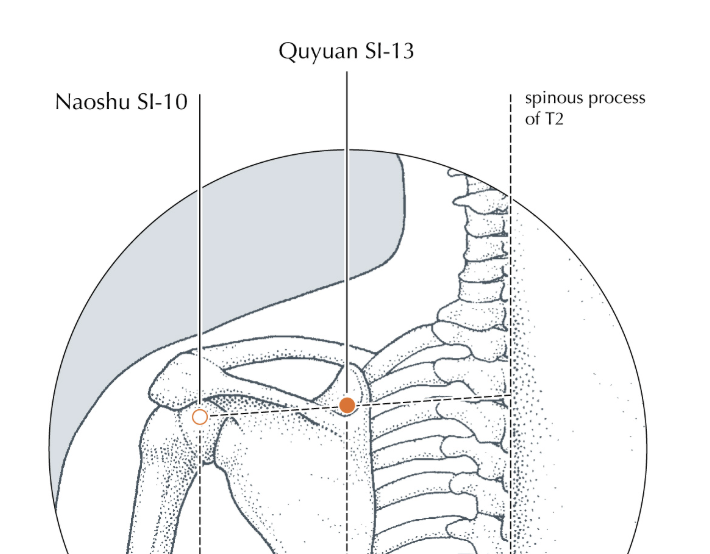
SI 14
(3c lateral T1)
Oblique medial insertion 0.5 to 1 cun.
Caution: perpendicular insertion, especially in thin patients, carries a substantial risk of inducing a pneumo-thorax.
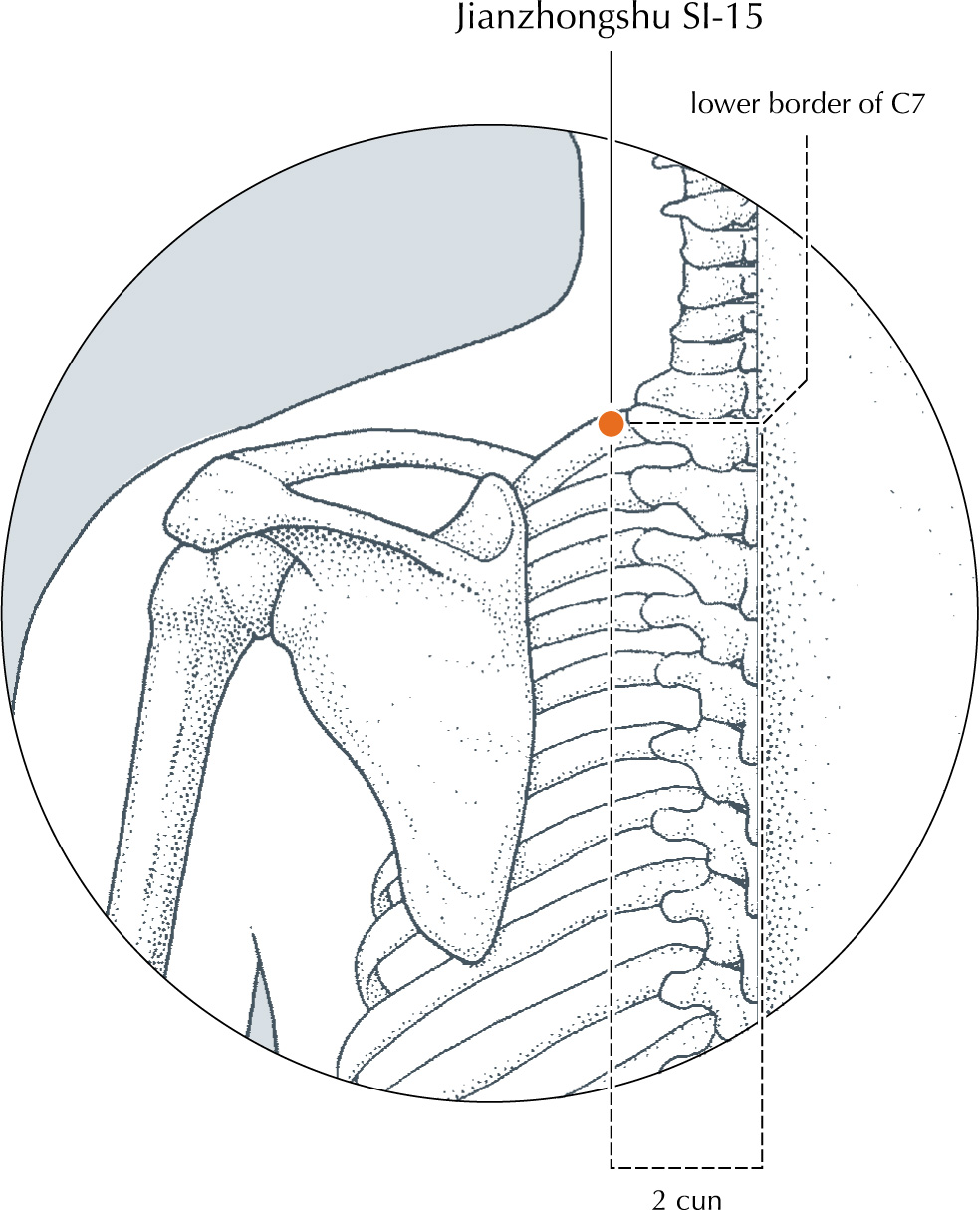
SI 15
Oblique medial insertion towards the spine 0.5 to 1 cun.
Caution: deep insertion inferiorly, especially in thin patients, carries a substantial risk of inducing a pneumothorax.
UB 11- 21
Oblique insertion towards the spine, 0.5 to 1 cun, or transverse-oblique insertion 1 to 1.5 cun.
Caution: perpendicular needling or oblique needling away from the spine carries a substantial risk of causing a pneumothorax.
UB 22 & 23
Oblique or perpendicular-oblique insertion towards the spine, 1 to 1.5 cun.
Caution: deep perpendicular needling carries a risk of injuring the kidney.
UB 43
(3 cun lateral to the midline, level with the lower border of the spinous process of T4)
Oblique insertion 0.3 to 0.5 cun. (away from spine?)
Caution: deep perpen-dicular or deep oblique needling in a medial direction carries a substantial risk of causing a pneumothorax.
UB 52
(3 cun lateral to the midline, L2)
Oblique insertion 0.5 to 1 cun.
Caution:: deep perpendicular needling carries a risk of injuring the kidney.
KI 16
Perpendicular insertion 1 to 1.5 cun.
Caution: deep needling may penetrate the peritoneal cavity.
PC 3
Perpendicular insertion 0.5 to 1 cun, or prick to bleed.
Caution: the brachial artery and veins lie deeply, just medial to this point.
PC 6
Perpendicular insertion 0.5 to 1 cun,
median nerve
PC 7
Perpendicular insertion 0.3 to 0.5 cun;
median nerve
TW 5
Caution: movement of the patient's arm or hand after needling this point can result in a bent needle.
TW 6
Caution: movement of the patient's arm or hand after needling this point can result in a bent needle.
TW 22
temporal artery
Transverse insertion 0.3 to 0.5 cun.
(0.5 cun anterior to the upper border of the root of the ear, in a slight depression on the posterior border of the hairline of the temple.)

GB 3
Perpendicular insertion 0.3 to 0.5 cun.
Caution: it is traditionally emphasised that deep needling should be avoided at this point.
GB 20
deeper needling may damage the spinal cord;
GB 21
Posterior oblique insertion, 0.5-1 cun.
Caution: i. perpendicular insertion, especially in thin patients, carries a substantial risk of inducing a pneumo-thorax; ii. contraindicated in pregnancy.
GB 24
(On the anterior chest wall, in the 7th intercostal space, directly below the nipple, 4 cun lateral to the midline.)
Transverse-oblique insertion along the intercostal space, 0.5 to 1 cun.
Caution: deep or perpendicular needling may induce a pneumothorax.
GB 25
(Below the lateral aspect of the ribcage, anterior and inferior to the free end of the 12th rib.)
Perpendicular insertion 0.5 to 1 cun.
Caution: in thin subjects, deep needling may penetrate the peritoneal cavity.
GB 26
(below LV 13 (anterior and inferior to the free end of the eleventh rib), level with the umbilicus.)
Perpendicular insertion, 0.5 to 1 cun.
Caution: in thin subjects, deep needling may penetrate the peritoneal cavity.
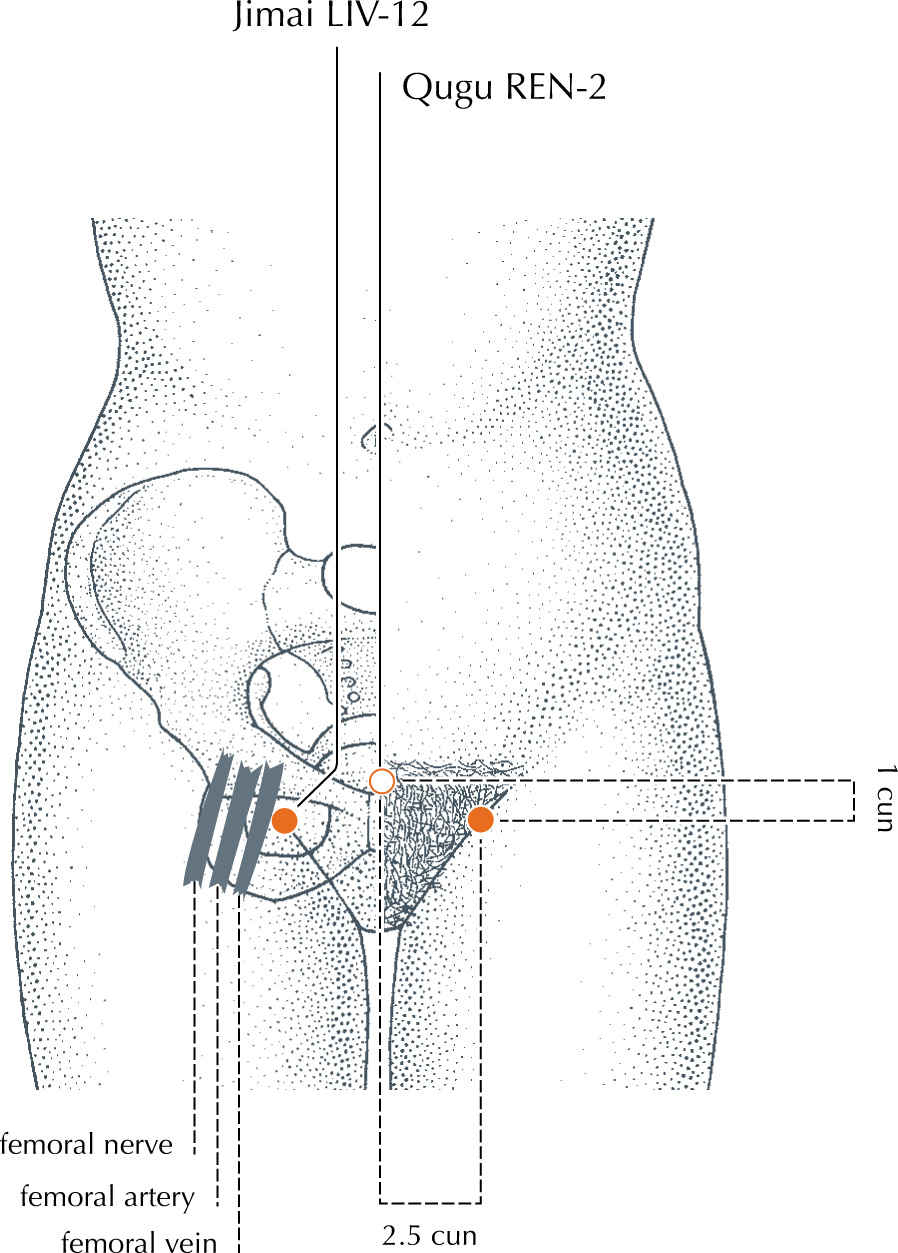
LV 12
(0.5 to 1 cun obliquely towards the heel, or perpendicular insertion 0.5 cun to 0.8 cun.)
take care not to penetrate femoral vein
LV 13
(Directly anterior and inferior to the free end of the eleventh rib.)
Transverse or oblique insertion medially or laterally (along the line of the rib) 0.5 to 1 cun.
Caution: deep perpendicular needling may damage an enlarged liver or spleen.
LV 14
(On the mamillary line, in the sixth intercostal space, 4 cun lateral to the midline.)
Oblique medial or lateral insertion 0.5 to 1 cun.
Caution: deep perpendicular or oblique insertion carries a substantial risk of causing a pneumothorax.
RN 3 & RN 4
Perpendicular insertion 0.5 to 1 cun.
Caution: deep insertion will penetrate a full bladder which should therefore be emptied before treatment.
RN 7 - RN 13
Perpendicular insertion 0.8 to 1.5 cun.
Caution: in thin patients deep needling may penetrate the peritoneal cavity.
DU 4
Perpendicular insertion 0.5 to 1 cun.
Caution: the spinal canal lies between 1.25 and 1.75 cun deep to the skin surface, varying according to body build.
DU 9
(T7)
Oblique superior insertion 0.5 to 1 cun.
Caution: the spinal canal lies between 1.25 and 1.75 cun deep to the skin surface, varying according to body build.
DU 14
(C7)
Perpendicular-oblique superior insertion 0.5 to 1 cun.
Caution: the spinal canal lies between 1.25 and 1.75 cun deep to the skin surface, varying according to body build.
DU 16
Perpendicular insertion slightly inferiorly, 0.5 to 1 cun.
Note: according to several classical texts, this point is contraindicated to moxibustion.
Caution: the spinal canal lies between 1.5 and 2 cun deep to the skin surface, varying according to body build. Deep perpendicular or superior oblique insertion is therefore strictly contraindicated.