CAD 154 MIDTERM
 Call Kai
 Learn
Learn Practice Test
 Spaced Repetition
 Match
Match Flashcards
 Knowt Play
1/87

Earn XP
Description and Tags
CHAINS, BELTS, BEARINGS
Name | Mastery | Learn | Test | Matching | Spaced | Call with Kai | Chat |
|---|
No analytics yet
Send a link to your students to track their progress
88 Terms
All industrial drive systems use belts.
False
The three types of idler pulleys are:
Kiss idler, backside idler, inside idler
Fractional Horsepower (FHP) belts are used primarily in heavy-duty applications.
False
The four layers of belt construction consist of:
Neutral axis, compression layer, cover, tension layer
What type of belt would you most likely find in a multiple-pulley drive system?
Double-angle V-belt
A synchronous belt is used in applications where:
No slippage can occur
Joined belts are:
Several belts of equal length banded together
All belts should be lubricated to ensure their flexibility.
False
Idler pulleys:
Provide tension where drive units are not adjustable
Drive system speed (not ratio) is determined by:
The speed at which sheaves rotate
When the drive sheave and the driven sheave are the same size:
Both sheaves rotate at the same speed
In a “speed-up” drive system:
The driven sheave rotates faster than the drive sheave
A system where the drive sheave has a diameter of 6 inches, and the driven sheave has a diameter of 12 inches, is called a:
Reduction drive
Belt dressing is always applied to the outside of the belt.
False
A tensiometer measures:
The amount of belt deflection between two pulleys
The tool that determines the wear in a sheave is called:
Sheave gauge
If a belt is squealing:
It is too loose
Over-tightening a belt can result in:
Excessive belt wear
Round belts are used in systems where:
Proper pulley alignment may not be possible
Most drive belt hardening and cracking is caused by:
Excessive heat
If a drive belt is whipping, you must check the:
Distance between drive centers
The drive ratio is based on:
The relative size of the pulleys
All belts can be spliced if the proper tools are used.
False
Typical belt code markings indicate:
The width, length, and type of duty the belt was designed to perform
The three most common belt shapes are:
Round, flat, and V
All industrial drive systems use chains.
False
The five types of chain lubrication systems are:
Manual, drip, oil bath, rotating disc, pump
Hooked sprocket teeth indicate:
Improper chain tension
Elongation is caused by:
Normal wear of the pins and bushings
The two types of tensioners or take-up devices are:
Rigid and flexible
The guide plates in silent chains are used to:
Keep the chain properly located on the sprocket
The distance between the center of a chain’s rollers determines:
The chain’s pitch
True or False: You should always grease a chain
FALSE
Side wear on a sprocket is an indication of:
Sprocket misalignment
Chain misalignment may be caused by:
Shafts that are not level with each other, not parallel to each other and incorrect axial alignment
Chain pitch is measured in what increments?
1/8”
Allowable chain deflection in a drive system is usually between:
2%-3%
A #160 chain is a:
Standard link roller chain with a pitch of 2”
A chain is no longer serviceable when:
It no longer engages properly on the sprockets due to damage or elongation
The clip or cotter pins in the master link must be installed:
So the closed end of the clip points in the direction of movement
Chain tension must be checked:
After lockout/tagout has been completed
Most industrial drive systems use the same type of chain.
False
Idler sprockets:
Are used to take up excessive slack in drive chains
Chain stretch helps when fitting a new chain over a sprocket.
False
Industrial drive chain needs to be greased at regular intervals
False
Roller chain is made up of:
Roller links and pin links
The most common types of industrial chains are:
Roller, rollerless, silent, detachable link, pintle, block
Excessive or accelerated chain wear is usually caused by:
Improper or inadequate lubrication
A chain that is too loose may cause the system to:
Pulsate
How do you find the Design HP?
HP x Service Factor = Design HP
To find the # of Teeth on the Drive Sprocket must be __ than the Design HP
Greater
How do you find the ratio for chains?
Drive RPM / Driven RPM= Ratio
How do you find the # of Teeth on the Driven Sprocket?
# of Teeth on Drive x Ratio = # of Teeth on Driven
How do you find the Center Distance in Chain Pitches?
Center Distance / Chain Pitch = Chain Pitches
What kind of lubrication does Type A need?
Manual or Drip Lubrication
What kind of lubrication does Type B need?
Bath or Disc Lubrication
What kind of lubrication does Type C need?
Oil Stream Lubrication
How do you find the Chain Length in Inches?
Chain Length in Pitches x Chain Pitch = Chain Length in Inches
Name the item that maintains equal spacing of rollers in a bearing.
CAGE
Shape used with bearings to compensate for minor misalignment.
SPHERICAL
Roller bearings are commonly referred to as “anti-friction” bearings because…
LESS FRICTION DURING STARTUP THAN IN FRICTION BEARINGS
AFBMA stands for what?
ANTI FRICTION BEARING MANUFACTURERS ASSOCIATION
Most common ball bearing.
SINGLE ROW DEEP GROOVE
Four specifications were mention for constructing an outer raceway as part of the machine
SURFACE FINISH, HARDNESS, OUT OF ROUNDNESS, TAPER
Roller bearings are also known as what?
ANTI FRICTION
What bearing type has a rubber seal between raceways and is considered maintenance free?
SEALED
Dimensionally, needle bearings have a relatively high ratio of what to their diameter?
LENGTH
List the term that identifies lubrication that is NOT supplied under pressure.
HYDRODYNAMIC
List the term that identifies lubrication that IS supplied under pressure.
HYDROSTATIC
Inner or outer part of a bearing assembly on which bearings travel as they rotate.
RACEWAY
Name the loads carried by any bearing.
AXIAL, RADIAL
Name one disadvantage of journal bearings over roller bearings.
STRICT LUBRICATION REQUIREMENTS, LIFE LIMITED BY SURFACE FINISH ACCURACY, NOT AS EFFICIENT AT HIGH TEMPS, SUSCEPTIBLE TO DAMAGE FROM INTERRUPTED LUBE SUPPLY
Name roller bearing element (not ball) types.
NEEDLE, TAPERED, CYLINDRICAL, SPHERICAL
Conrad is another name for what bearing.
SINGLE ROW DEEP GROOVE
Thrust load would have what type of relation to the axis of the shaft?
PARALLEL
Radial load would have what type of relation to the axis of the shaft?
PERPENDICULAR
Axial load would have what type of relation to the axis of the shaft?
PARALLEL
The primary difference between needle bearings and other roller bearings.
DIAMETER
Term that describes lining a bearing with a different metal to gain additional metallic properties.
BABBITTING
Journal bearings are a.k.a. …
PLAIN, JOURNAL, SLEEVE, BUSHING
A bearing designed to protect rollers from contaminants with a metal ring between raceways, which also makes them maintenance free.
SHIELDED
Name the oil groove that distributes lubricant lengthwise.
AXIAL
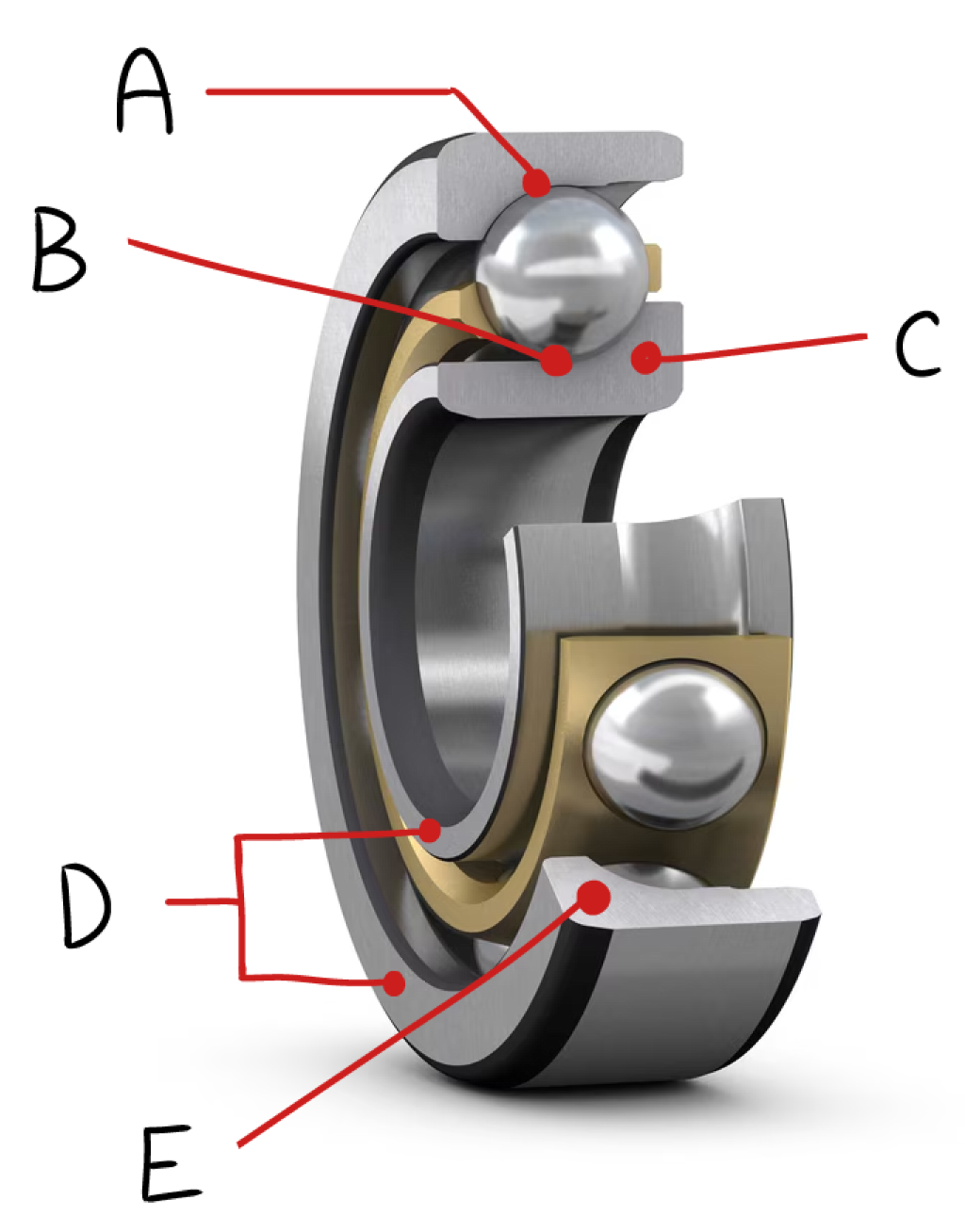
What is “A”? (Tap to expand picture)
OUTER RACEWAY
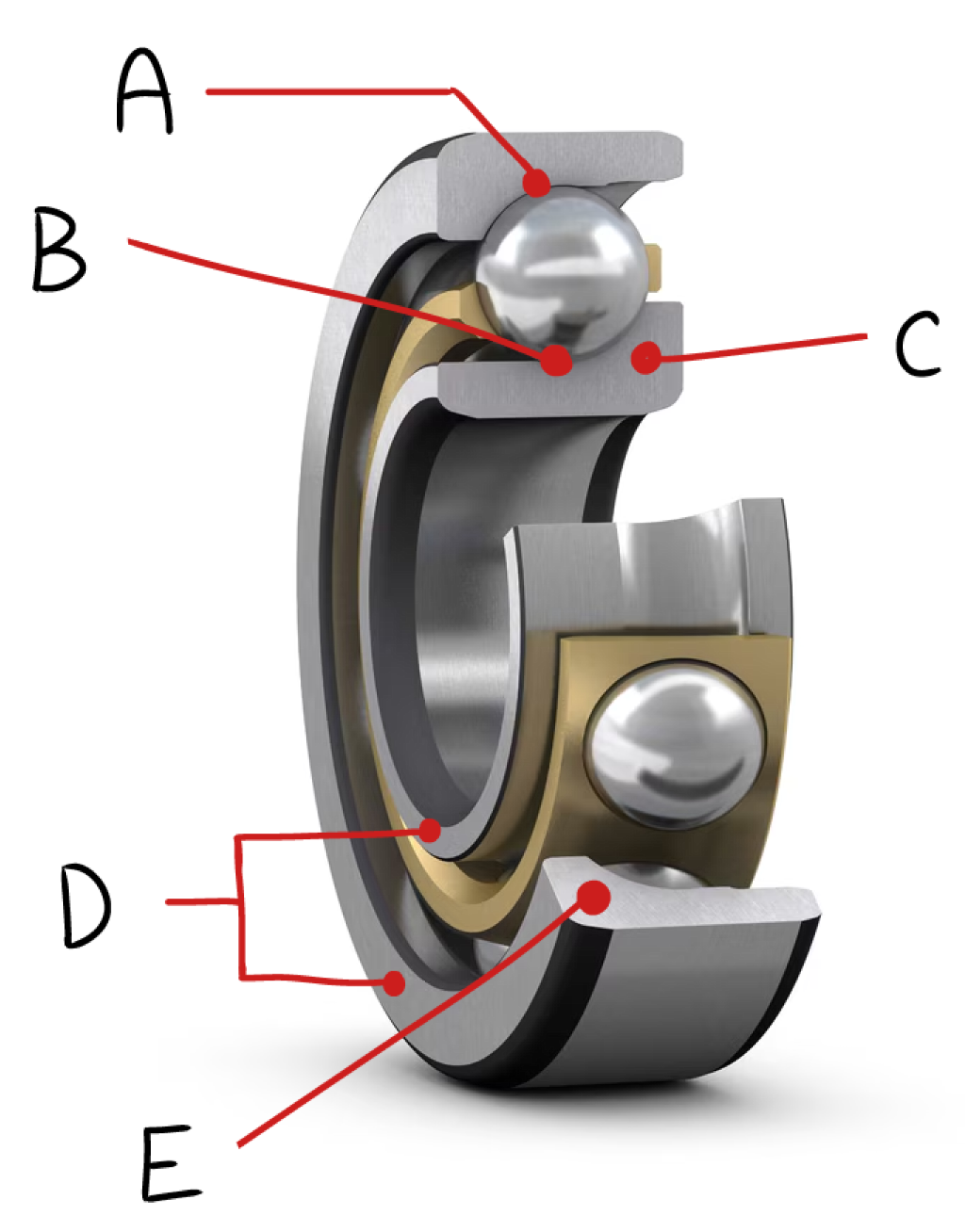
What is “B”? (Tap to expand picture)
INNER RACEWAY
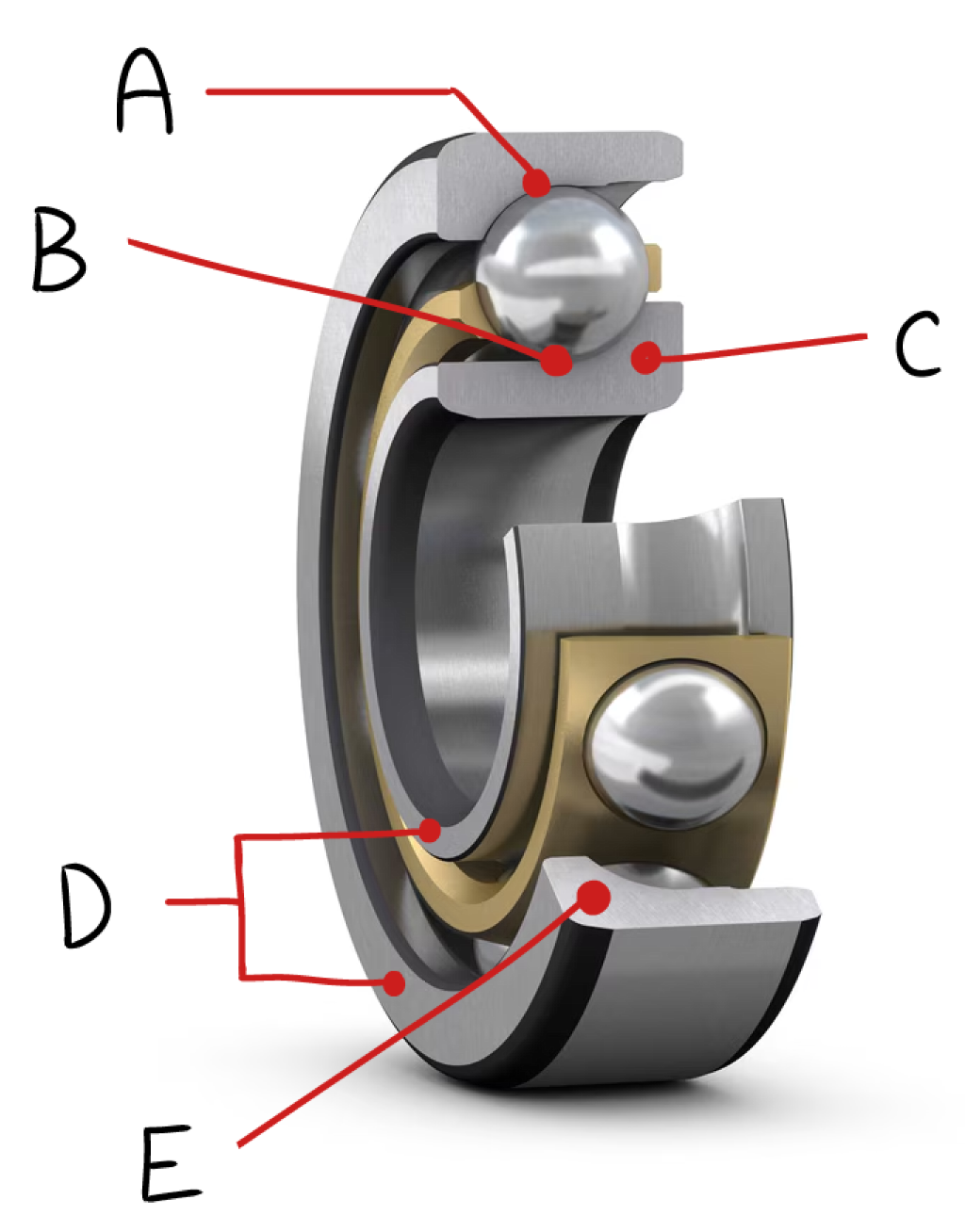
What is “C”? (Tap to expand picture)
INNER RING LAND
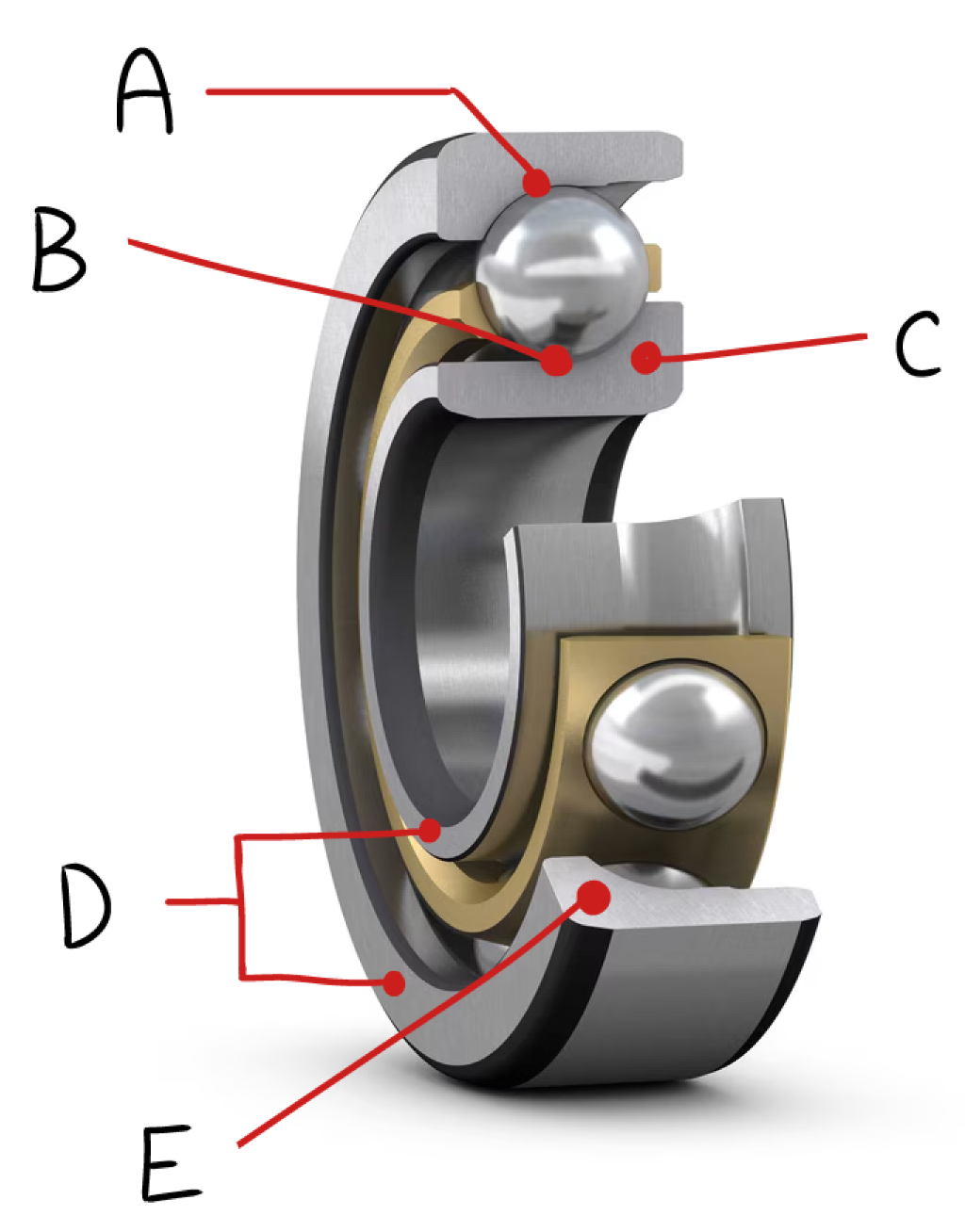
What is “D”? (Tap to expand picture)
SIDE FACES
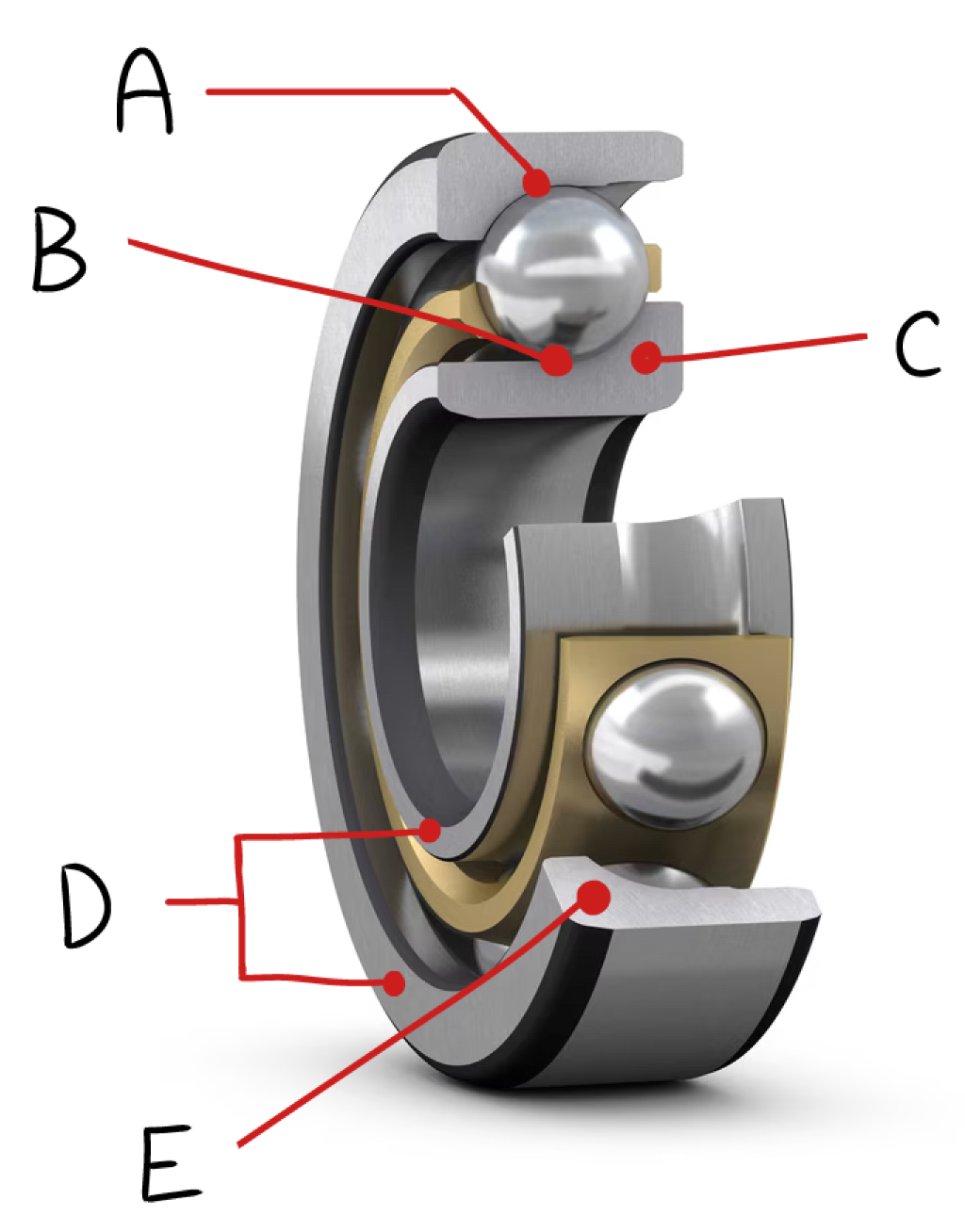
What is “E”? (Tap to expand picture)
OUTER RING LAND
Belt dressing is always applied to the _____ of the belt
Center