7. Psychopathy & Crime
 Studied by 0 people
 Call Kai
 Learn
Learn Practice Test
 Spaced Repetition
 Match
Match Flashcards
 Knowt Play
1/20

Earn XP
Description and Tags
Topic 7.2
Name | Mastery | Learn | Test | Matching | Spaced |
|---|
No study sessions yet.
21 Terms
What was the contribution of Hervey Cleckley?
first to define/describe the psychopath
delineated 16 criteria that capture the prototypical psychopath
Nine Items on Cleckley’s Checklist for Psychopathy
manipulative
superficial charm
above-average intelligence
absence of psychotic symptoms (delusions, hallucinations)
absences of anxiety
lack of remorse
failure to learn from experience
ego centric
lacking emotional depth
ASPD in Correctional Services Canada is high at ~44% (24-75%)
How is the psychopath differentiated from ASPD?
less reliant of behavioural antisocial history
more focus on the emotional-interpersonal domain
Is psychopathy a diagnosis?
No it is not a psychiatric disorder/diagnosis → it is a construct developed for the purposes of research & decision making
What was the contribution of Hare?
developed an objective assessment instrument from Cleckley’s checklist → PCL-R
estimated that 20-25% of prisoners are psychopaths vs. ~1% of the general pop
Affective Deficit Models of Psychopathy
core deficit in psychopathy relates to abnormality or lack of emotional components → reduced affect & emotionality
General Emotional Deficit Theory
(Affective Deficit Model)
have a general lack of ability to experience emotion & therefore also not able to appreciate the emotional reactions of others
Low-Fear Hypothesis
(Affective Deficit Model)
not responsive to punishment & are therefore not motivated to avoid antisocial behaviour b/c of the threat of punishment (not deterred)
Integrated Emotional Deficit Theory
(Affective Deficit Model)
specifically impaired in their ability to recognize sadness or distress in others
Attention Model
psychopaths have a response modulation deficit
once focus their attention on certain features, will fail to use info to modify their response
e.g. failure to learn behaviour inhibition
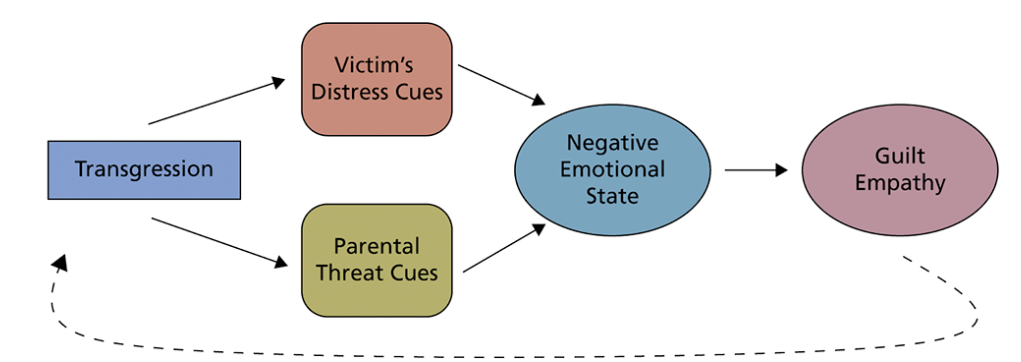
Role of Emotions in the Development of Conscience
(Developmental Model)
Pathway is disrupted b/c people psychopathic traits show reduced autonomic responses to the distress of others & reduced recognitions of sad/fearful expressions → less responsive to parental socialization practices
w/o emotional response they will not learn to inhibit behaviours
Based on neuroimaging, psychopaths have….
(Brain Models)
(5)
a reduction in prefrontal grey matter & white matter
less grey matter in the rostral temporal & the ventral frontal lobes
less hippocampal volume → fear conditioning (limbic)
less amygdala volume → social emotion judgements & moral emotions (limbic)
less volume in the anterior cingulate cortex → inhibition (limbic)
Two Self-Report Measures for Psychopathy Assessment
PPI-R (Psychopathic Personality Inventory-Revised)
SRP-4 (Self-Report Psychopathy Scale)
*TriPM (Triarchic Psychopathy Measure)
Three Rater Measures for Psychopathy Assessment
PCL-R (Psychopathy Checklist - Revised)
PCL-SV (Psychopathy Checklist - Screening Version)
PCL-YV (Psychopathy Checklist - Youth Version)
*CAPP (Comprehensive Assessment of Psychopathic Personality)
Three Concerns Assessing Psychopathy in Youth
future neg. consequences of labelling a youth w psychopathic traits (e.g. transfer to adult court, harsher sentences, denial of access to treatment)
possibility that traits are common features of normally developing youth
the stability of psychopathic traits from childhood to adolescence & on to adulthood
Stability of Psychopathic Traits:
psychopathic traits show ________ rank-order stability, meaning _________
in longitudinal studies, higher stability is found in ______ follow-up periods
most change in psychopathic traits occurs during ________
when change happens, it is towards _______ psychopathic traits
moderate to high rank-order stability → those rated highest remain highest & those rated low stay low
higher stability in shorter compared to longer follow-up periods
most change during adolescence
change towards decreasing psychopathic traits
PCL-R Structure
(Psychopathy Checklist - Revised)
20 item symptom rating using three point scale
measures two factors & four facets of psychopathy
Interpersonal/Affective → interpersonal + affective
Social Deviance → behavioural + antisocial
PCL-R Factor 1 Items
(Interpersonal/Affective) (4/4)
Interpersonal
glibness/superficial charm
grandiose sense of self-worth
pathological lying
conning/manipulative
Affective
lack of remorse or guilt
shallow affect
callous/lacking empathy
failure to accept responsibility for own actions
PCL-R Factor 2 Items
(Social Deviance) (5/5)
Behavioural
need for stimulation or proneness to boredom
parasitic lifestyle
lack of realistic, long-term goals
impulsivity
irresponsibility
Antisocial
poor behavioural control
early behavioural problems
juvenile delinquency
revocation of conditional release
criminal versatility
PCL-R as a Risk Assessment Tool:
Factor 1 scores more strongly assoc. w _____ violence
Factor 2 scores more strongly assoc. w _____ violence
Total scores moderately assoc. w all outcomes except _____ & _____
Factor ___ consistently had greater predictive value than factor ___
factor 1 scores more strongly assoc. w instrumental violence
factor 2 score more strongly assoc. w reactive violence
total scores → moderately assoc. w all outcomes except sexual recidivism & institutional violence
factor 2 (lifestyle & antisocial features) consistently had greater predictive value than factor 1 (interpersonal/affective)
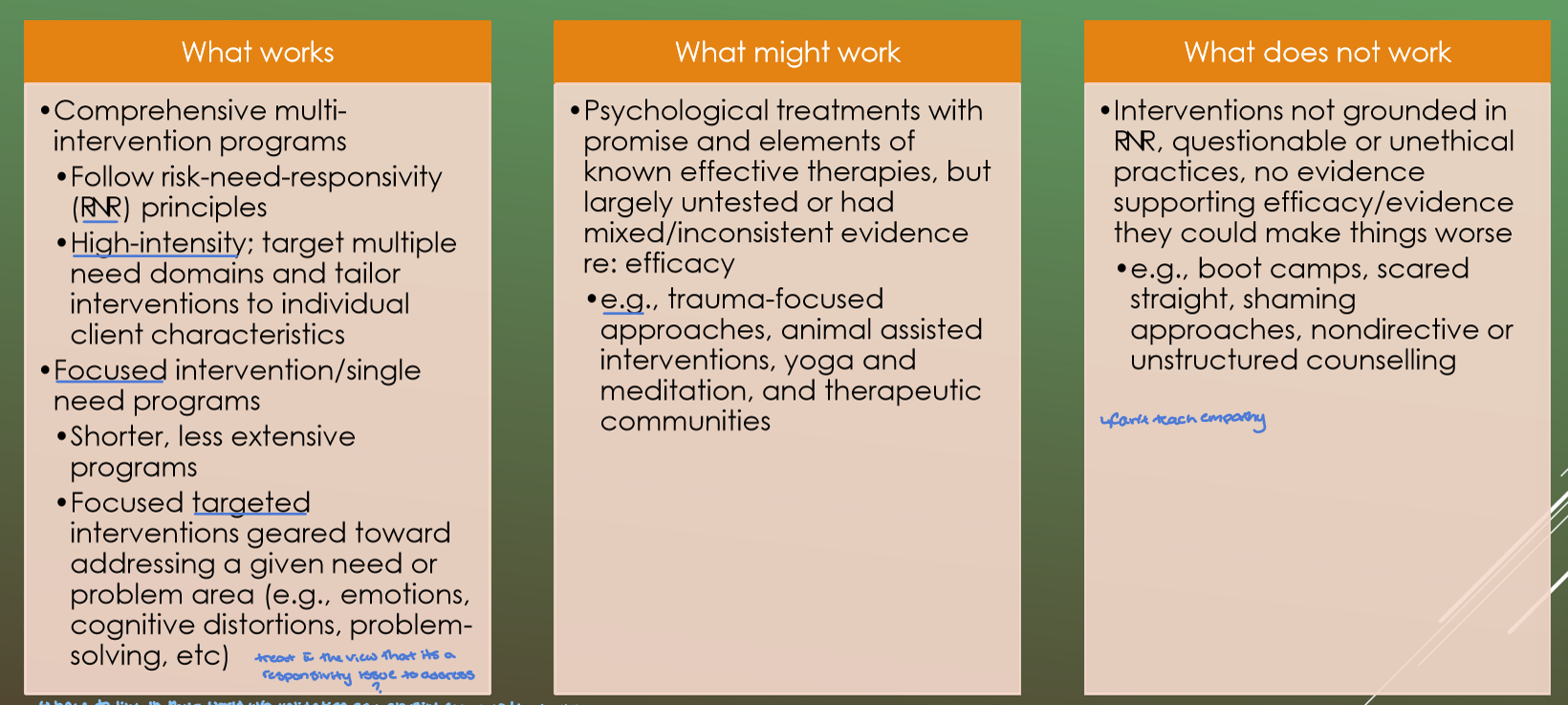
Treatment
generally respond poorly to treatment
staying in & showing treatment gains reduces reoffending
programs should be high-intensity & cognitive-behavioural
providers should be familiar w cognitive/emotional processing diffs
treatment should target treatment-interfering behaviours