UNIT 4: Definitions
 Call Kai
 Learn
Learn Practice Test
 Spaced Repetition
 Match
Match Flashcards
 Knowt Play
1/69

There's no tags or description
Looks like no tags are added yet.
Name | Mastery | Learn | Test | Matching | Spaced | Call with Kai | Chat |
|---|
No analytics yet
Send a link to your students to track their progress
70 Terms
Men: prostate, lung, colorectal
Women: breast, lung, colorectal
What are the most common cancer forms by incidence, top 3
Men: lung, prostate, colorectal
Women: lung, breast, colorectal
Which cancers are the most deadly by mortality for men and women
Prostate (98%), breast (90%), melanoma (93%), testis (97%)
High 5-year survival rate for cancers
Colon (65%), uterine (84%), ovarian (44%), leukemia (59%)
Intermediate 5-year survival rate for cancers
Lung (18%), esophageal (19%), liver (18%), pancreatic (6%)
Low 5-year survival rate for cancers
Initiation and promotion
Cancer is thought to be generated by a two-step process
Initiation
An event that alters the cell’s genome (by radiation, chemical, or virus), or activates a preexisting cancer gene, known as an oncogene.
Promotion
The subsequent stimulation of division of this faulty cell, resulting in the cancerous tumor.
Benign, malignant
Tumors in our body can be described as ______ or _____
Benign tumors
Can grow to large sizes and cause health concerns. Usually encapsulated and as a result do not spread to other body areas. Are usually not life threatening, although in some locations, their growth and expansion can cause major health issues.
Skin moles, skin nevi, fatty tumors called lipomas, and intestinal polyps
Examples of benign tumors
Malignant tumors
Cancerous tumors that usually grow at a fast rate, lack capsules, and quickly infiltrate surrounding tissue.
metastasis
Cancer that spreads to other body areas
Stage 1: confined to primary site, no metastasis, very treatable
Stage 2: migration to surrounding lymph nodes
Stage 3: metastasis from lymph nodes to additional body organ
Stage 4: multiple organ involvement, usually not very treatable
When cancer is diagnosed, it is “staged.” List the 4 stages.
80%
_______of all cancers are thought to be linked to environmental and lifestyle choices.
Free Radical Theory and Immune Theory of Aging
What theory of aging has an application to the genesis of cancer?
Free radical damage increases w/ age
Total exposure to carcinogens accumulates
Genetic damage - activation of oncogenes, mutation/damage to normal genes, damage to enzymes that repair genes/regulate cell division
Immune system declines
Hormonal changes (ex menopause)
Many, although not all cancers, are thought to be age-related. List the contributing factors.
Cell cycle
Cell division is regulated by a process known as the _____
“G0” (G zero)
There are some cells in the body that rarely divide and are essentially as old as you are. These include neurons found in the brain and spinal cord, skeletal muscle cells, and likely cardiac muscle cells. Such cells are often designated _______
G1, S, G2, and M phases
The normal cell cycle has four distinct portions. What are they?
G1, S, G2
Collectively referred to as Interphase, which is the majority of time in the cell cycle.
G1
Phase that is the largest portion of interphase. Cells are metabolizing and producing products. Toward the end of this phase, cells will produce enzymes needed to direct DNA replication.
S phase
A period of interphase when cells replicate their genome. During this time period, each chromosome will make a copy of itself.
G2 phase
When cells manufacture the enzymes and microtubules (components of spindle fibers) needed for actual cell division.
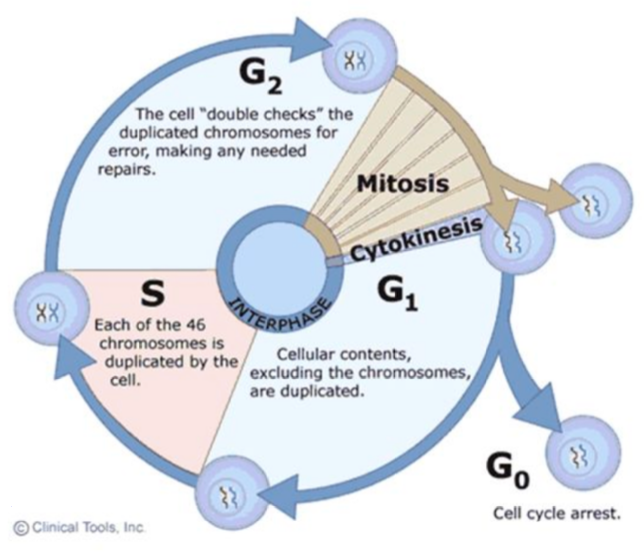
M phase (Mitosis)
The period during the cell cycle when replicated chromosomes split and migrate to opposite poles of the cell, resulting in two identical cells from the original parent cell.
Cyclins, p53
Passage through the cell cycle is aided by enzymes called ______ and regulated by an important gene complex called _______.
p53
In normal cells, the ______ gene acts as the “stop signal” and shuts down the cell cycle and cell division. However, in mutated forms, this gene does not function correctly, cells continue to divide, and do not have normal “stop signals”. Such cells can ultimately become cancer cells.
60
Mutated or abnormal p53 genes are thought to be responsible for over _____% of all cancers
Radiation
Cancer tx that directly targets the chromosomes and DNA structure of dividing cells, which makes cancer tumors esp vulnerable bc of their rapid cell division. Shatters DNA and chromosomal structures, either killing the cell outright, or making cell division impossible because of the DNA damage.
Chemotherapy
Cancer tx that targets chromosomes and DNA structure of cancer cells through chemicals that are similar to the DNA base structure of cells. These drugs are usually infused directly into the patient’s bloodstream, with the hope they will be incorporated into the DNA structure of cancer cells and disrupt cancer cell division.
It is non-specific, all rapidly dividing cells in the body are vulnerable (esp skin, hair, epithelium, blood, bone marrow, GI tract)
What accounts for the side effects noted in cancer pts undergoing chemotherapy tx including hair loss, nausea, anemia, and lack of energy.
Hormone therapy
Drugs or procedures that block release of certain hormones that can stimulate tumor cell growth.
Tamoxifen
Hormone therapy drug that blocks estrogen receptors and is useful in breast cancer tx
Flutaminde
Hormone therapy drug that is a testosterone blocker, useful in the tx of prostate cancer.
Immunotherapy
Targets the body’s immune system against the cancer cells.
“Adoptive T Cell Therapy” or CAR-T Therapy
Shows great promise in treating some leukemias and bone cancers. Involves removing patient’s T cells, incubating them with cancer cells, and then re-infusing the activated T cells into the patient to hopefully destroy the foreign cancer cells.
KeyTruda and Opdivo
New drug treatments that are designed to stimulate your immune system to fight foreign cancer cells. These therapies are monoclonal antibodies that attack a PD-1 receptor present on some cancer cells.
Angiogenesis Inhibitors
drugs that inhibit the growth of blood vessels. As cancer tumors grow, they require blood vessel vascularization. These drugs reduce blood vessel growth, in turn reducing the oxygen and nutrient delivery to the cancer cells, shrinking the tumor.
Growth Factor Inhibitors or EGFR Inhibitors (Epidermal Growth Factor Receptor inhibitors)
One of the newest class of compounds used to treat cancer. Treatment that blocks cellular growth receptors, thereby inhibiting tumor growth. Some cancers have unique growth receptors that stimulate their growth and cell division.
Herceptin
Blocks the HER2/Neu Growth Receptor present in approximately 1/3 of breast cancers.
Electrical Field Therapy
Places an electrical field around the cancer, with fluctuating polarity, meaning the field orientation runs in one direction, then shifts to an entirely different direction. The fluctuating electrical fields disrupt the migration of chromosomes during cell division, interfering with spindle fibers that guide chromosomes during division, and causing chromosomes to “pile up” and not complete the necessary migration for division.
Clonal selection
One of the biggest challenges in long-term treatment of cancer is the phenomenon of __________. This term means that cancer cell populations are very robust, dynamic, and diverse genetically. A particular drug might be 99% effective at killing the cancer cells, but the remaining 1% cancer cells are resistant to that treatment. Over time, that 1% will continue to divide and eventually break out as a new, resistant tumor. Explains the observation of cancer tends to cycle through discovery, treatment, remission, and re-emergence phases over time.
Remission
When cancer is in an undetectable state
Stop smoking
Eat healthy
HPV vaccine (Cervical & Colon Cancer prevention)
Avoid Obesity
Exercise
Avoid contact w/ harmful chems
Avoid radiation exposure
Recommendations to reduce cancer risk
Physical & chem barriers
Inflammatory response
Immune system (macrophages, T & B lymphocytes)
The body has three major defense systems that provide protection against infectious microbes:
It can respond to the presence of specific foreign antigens (proteins)
Why is the immune system referred to as a “specific” defense system
Epithelial layer (covers body, lines lumens, cavities, spaces)
What is the body’s first barrier of defense
salivary secretions, mucus secretions, tears, gastric secretion, and vaginal secretions
List examples of chemical barriers.
Macrophages
Under the lining of all tissues, are monocyte-derived and they engulf viruses and bacteria on contact
The complement system
A complex of plasma enzymes normally involved in antigen-antibody reactions, but complement can initiate bacterial or viral lysis in the absence of antibodies.
fever
A final non- specific response is the induction of ______, which is protective in some instances because some microbes cannot tolerate a rise in blood temperature.
interleukins
When bacteria are digested by macrophages, bacterial toxins (endotoxins) activate the release of chemicals such as ________, which enters the brain hypothalamus and causes a resetting of hypothalamic temperature receptors.
Physical, secretory, cellular, plasma
The first line of defense involves a widespread array of _____, ______, ______, and _____ chemical factors that protect the body from any and all types of infectious agents.
To bring greater numbers of phagocytic cells to an injured area
What is the major function of triggering the inflammatory response
Cellular
Hemodynamic events
Chemical mediators
What are the three components of the inflammatory response
complement
A plasma factor, initiates the production of chemicals that attract neutrophils to the infected area
opsonization
Immunoglobulins (IgG), which coat bacteria and render them inactive or more “tasty” to phagocytes a process called________
Histamine
Secreted by mast cells, promotes vasodilation
Bradykinin
Secreted by moncytes, stimulates pain nerve endings, and a diverse host of chemical agents (cytokines - interleukins, interferons), which attract immune system cells, stimulate fever, and in general, inhibit bacterial/viral replication
B-lymphocytes
Produce specific antibodies (immunoglobulins) against foreign proteins (antigens)
T-lymphocytes
Kill microbes on contact and also help B-cells to produce more antibodies.
Thymus
The recognition of foreign antigens seems to be most active in a gland called the______ gland
MHC restriction.
B-lymphocytes cannot recognize or respond to an antigen unless the antigen is presented to the T-cell in association with a complex of “self- proteins” known as MHC (major histocompatibility complex). This requirement for “co- recognition” of antigen and a “self” MHC molecule is referred to as
Spleen, thymus, lymph nodes, tonsils, and bone marrow (produces lymphocytes & macrophages)
List the major lymphoidal organs that are a part of the immune system
Cytotoxic T cells
Kill virus-infected and damaged cells
Helper T cells
Help cytotoxic T cells and B cells in their immune functions
Suppressor T-cells
Produce inhibitory chemicals that stop the proliferative response when the invading microbes have been destroyed.
Memory T-cells
Retain the capacity to recognize a specific foreign protein (after the infection has subsided); thus, a second exposure to the same pathogen effects a more rapid and more intensified response of both cellular and humoral immune defense mechanisms.
Macrophages
Ultimately break down foreign antigens into amino acids that can be recycled by the body
The MHC (Major Histocompatability Complex)
A gene complex that is one of the major regulators of aging and ultimately lifespan. It regulates the function of the immune system. Incorporates organs, such as the Thymus gland, where T cells learn to distinguish body “self-antigens” from non- self antigens that could be foreign cells or abnormal cancer cells. Includes the Spleen and Bone marrow, along with cells called B cells which make antibodies against non-self invaders such as bacteria and viruses.