Alkyl Halides (R-X) & Radicals
 Call Kai
 Learn
Learn Practice Test
 Spaced Repetition
 Match
Match Flashcards
 Knowt Play
1/10

There's no tags or description
Looks like no tags are added yet.
Name | Mastery | Learn | Test | Matching | Spaced | Call with Kai | Chat |
|---|
No analytics yet
Send a link to your students to track their progress
11 Terms
Alkyl Halides (R-X)
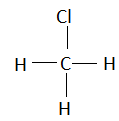
An alkyl halide is simply an alkane where one hydrogen has been replaced by a halogen.
-Halogens:
Flourine
Chlorine
Bromine
Iodine
R = carbon chain, X = Halogen
Electrophilic
Electron loving (positive charge, wants electrons)
Nucleophilic
Negative charge, will provide electrons
Alkyl Halides are reactive because
Halogens are much more electronegative. That means: The carbon is electrophilic, Electrophiles attract nucleophiles. Since the nucleophiles (halogens) will attack Carbon.
Radicals
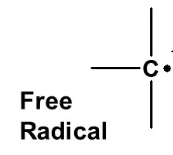
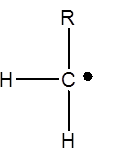
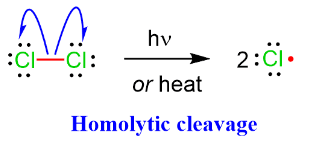
an atom, molecule, or ion that contains at least one unpaired valence electron. Because electrons naturally prefer to exist in pairs, radicals are highly reactive and typically short-lived, aggressively seeking out other electrons to become stable. (that little dot in the picture represents a radical).
There are 2 ways to break a bond
Heterolytic Cleavage
Homolytic Cleavage
Heterolytic
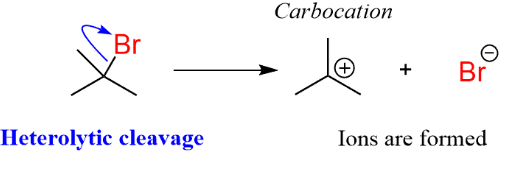
The bond breaks, Both electrons go to ONE atom, you will have a cation (+) and an anion (-). This is a polar reaction, and produces a carbocation and a halide ion.
Homolytic
Each atom keeps ONE electron. Produces radicals.
Polar Reaction
Electrons move 2 at a time and produce charged intermediates (Carbocations or sometimes carbanions).
Non-Polar Reaction
Involve Radicals, No charges.
Halogenation
NBS
Peroxides
[Radical intermediate]
Contain one unpaired electron. Radicals are neutral. Not positive, Not negative.