paul wilson radical organic
 Call Kai
 Learn
Learn Practice Test
 Spaced Repetition
 Match
Match Flashcards
 Knowt Play
1/30

There's no tags or description
Looks like no tags are added yet.
Name | Mastery | Learn | Test | Matching | Spaced | Call with Kai | Chat |
|---|
No analytics yet
Send a link to your students to track their progress
31 Terms
What is a persistent radical?
A radical with a half-life > 10⁻³ s, meaning it exists long enough to be detected or isolated.
What makes a radical persistent?
Two main factors:
Steric hindrance → bulky groups stop radicals reacting (kinetic stabilisation).
Resonance delocalisation → spreads the unpaired electron over multiple atoms (thermodynamic stabilisation).
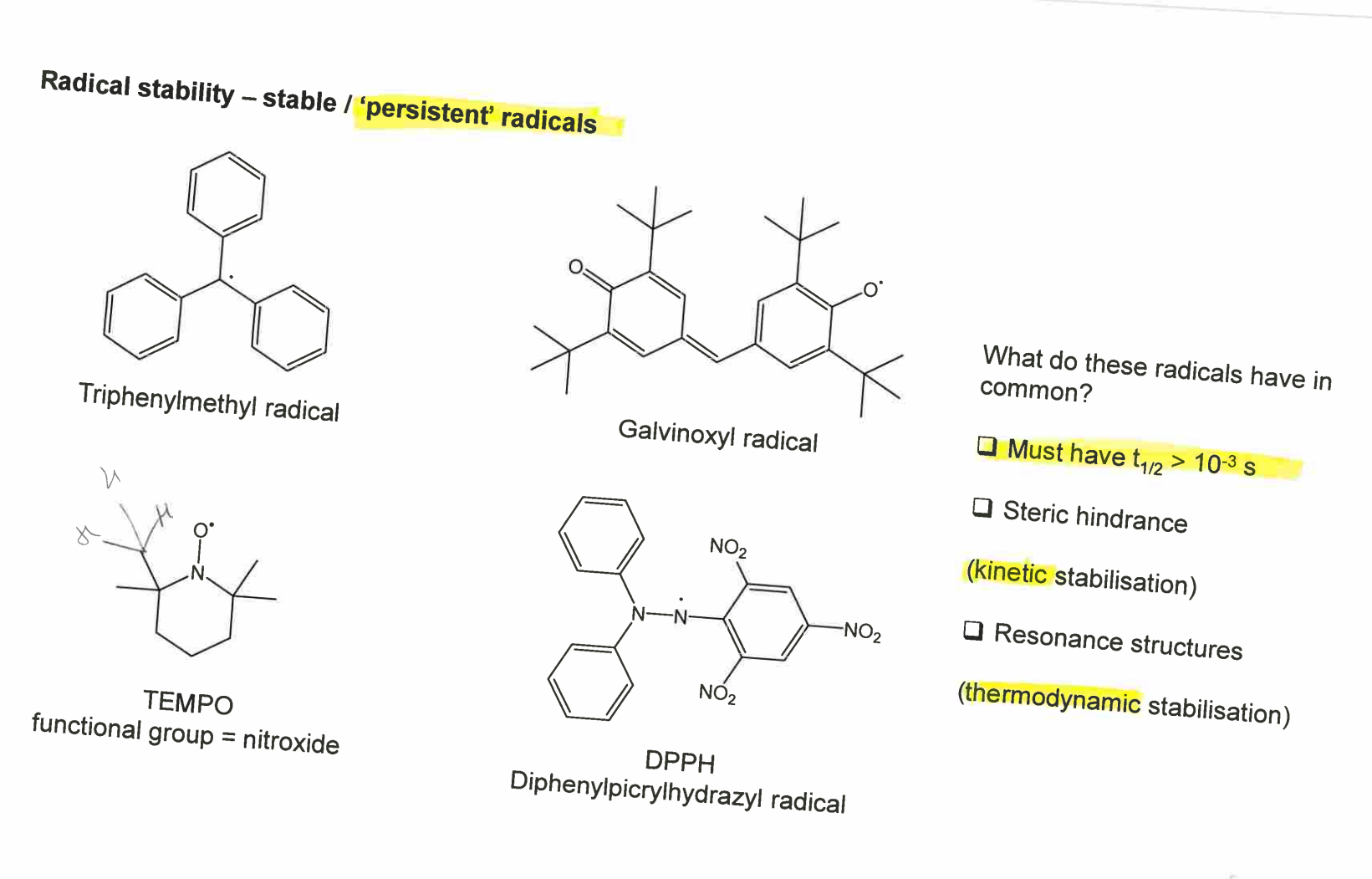
What's the difference between kinetic and thermodynamic stabilisation?
Kinetic stabilisation = radicals can't easily react (bulky groups block attack).
Thermodynamic stabilisation = radicals are lower in energy (resonance delocalisation).
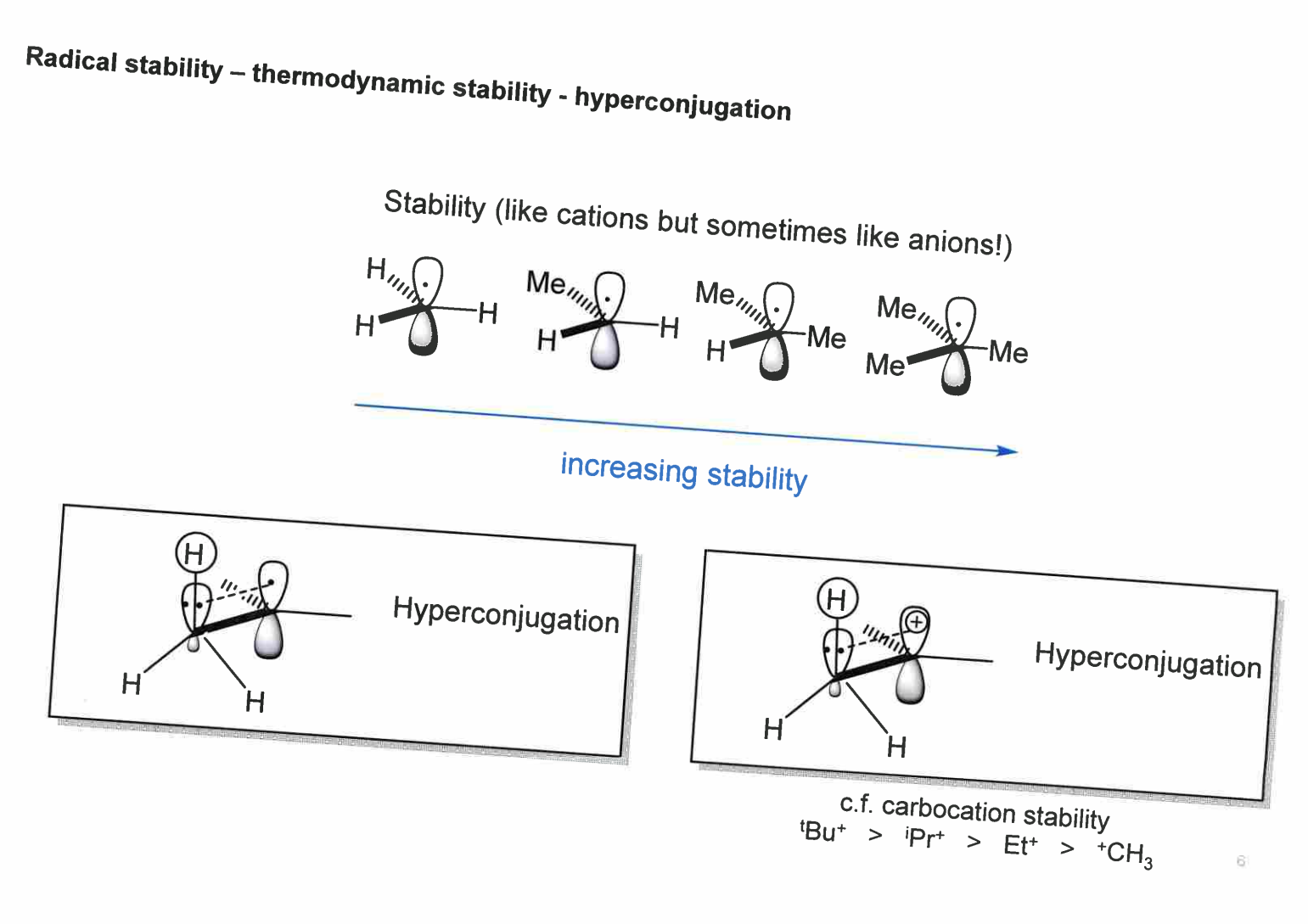
for stability of radicals, which is more stable, ch3 or CMe3
CMe3, me is ewg, it hyperconjugates
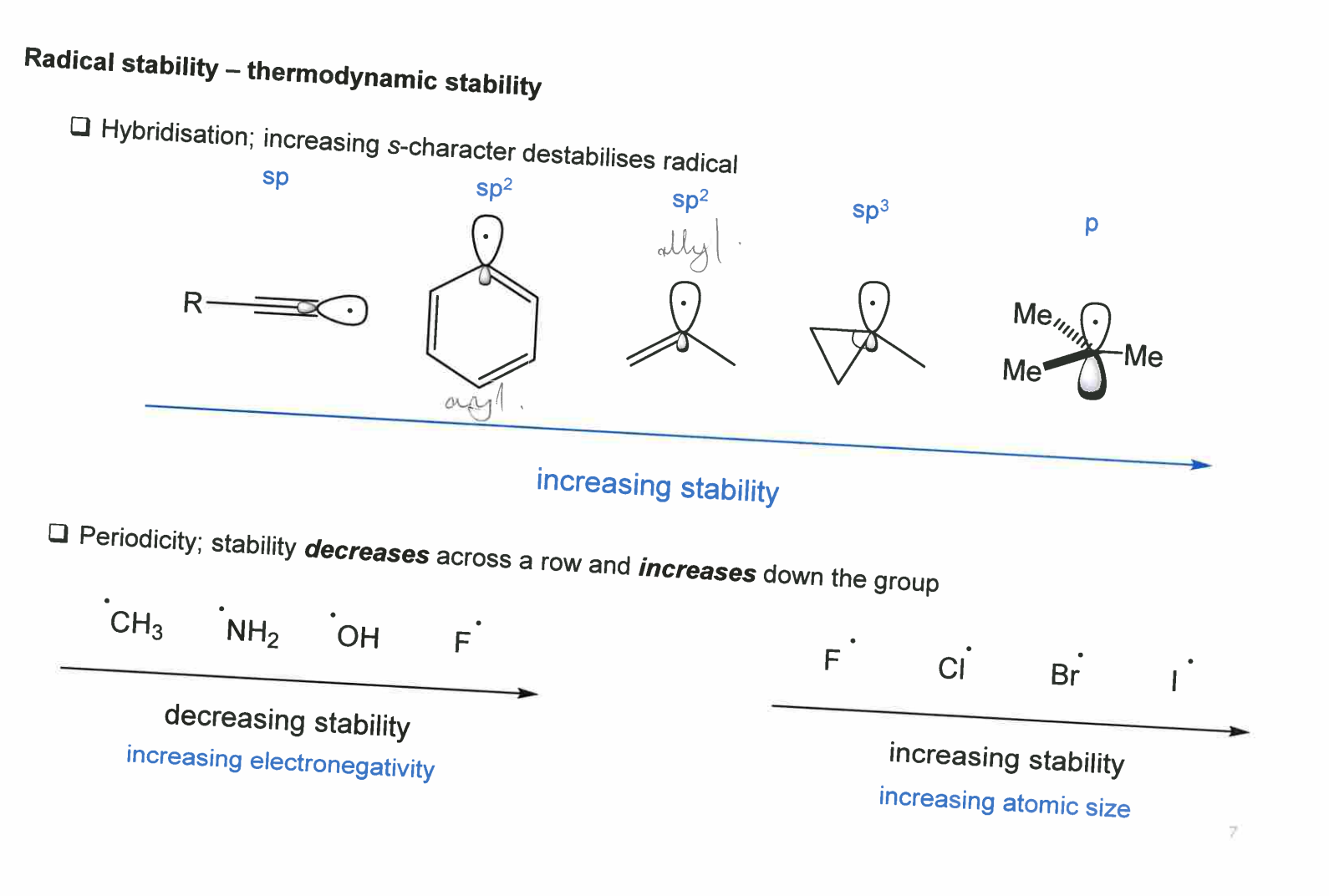
How does hybridisation affect radical stability?
More s-character = less stable radical.
Order of stability:
sp < sp² < sp³ < p
How does periodicity affect radical stability?
Across a period: Stability decreases (electronegativity ↑).
Down a group: Stability increases (atomic size ↑ spreads out the unpaired electron).
Why is benzoyl peroxide (BPO) a good radical initiator?
It has a weak O–O bond, which breaks on heating/light to form benzoyloxy radicals (2 RO•).
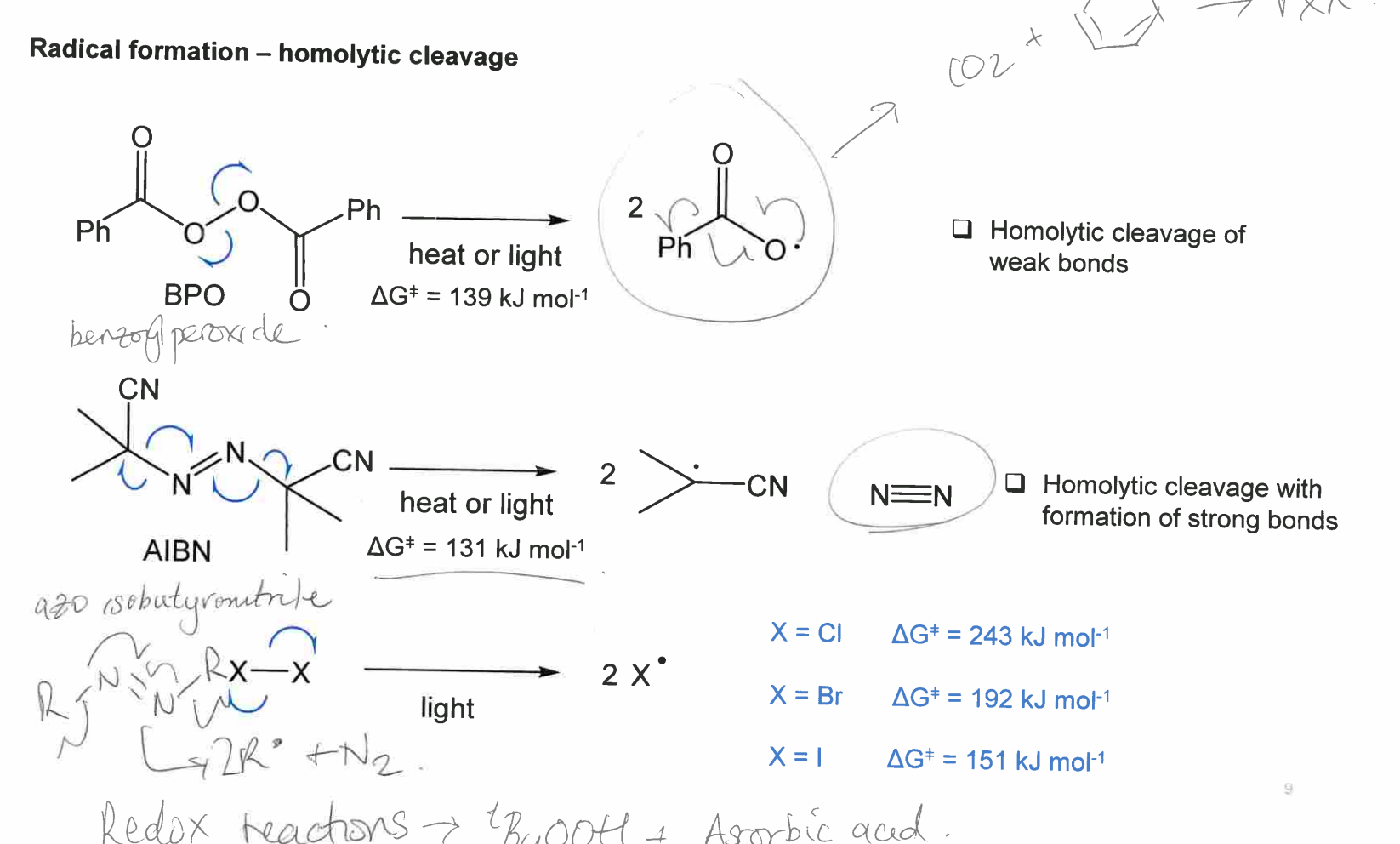
Why is AIBN a good radical initiator?
It breaks to form:
2 carbon-centred radicals
N₂ gas, which is very stable and drives the reaction forward.
Which C–X bond is easiest to break homolytically?
C–Cl > C–Br > C–I
for alkyl halide reduction, whats needed
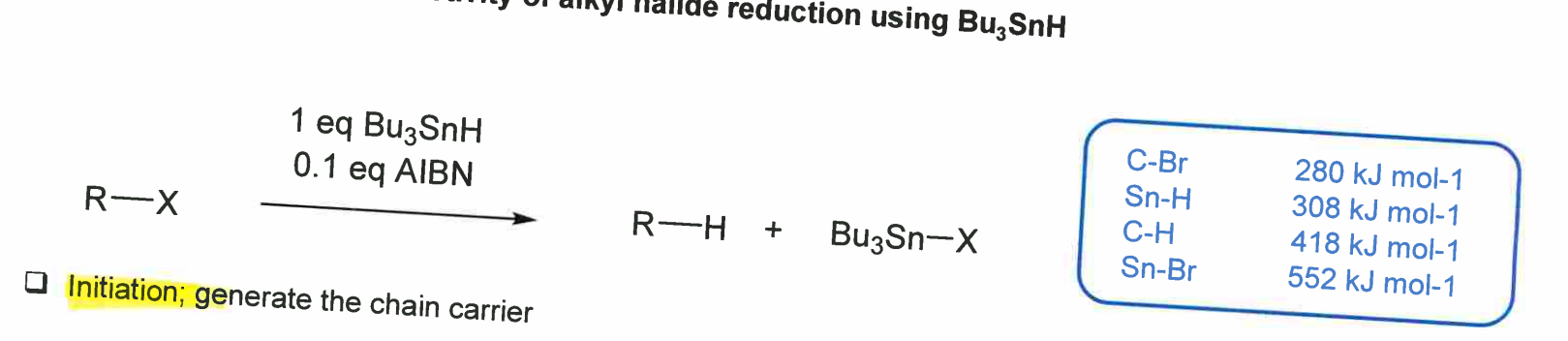
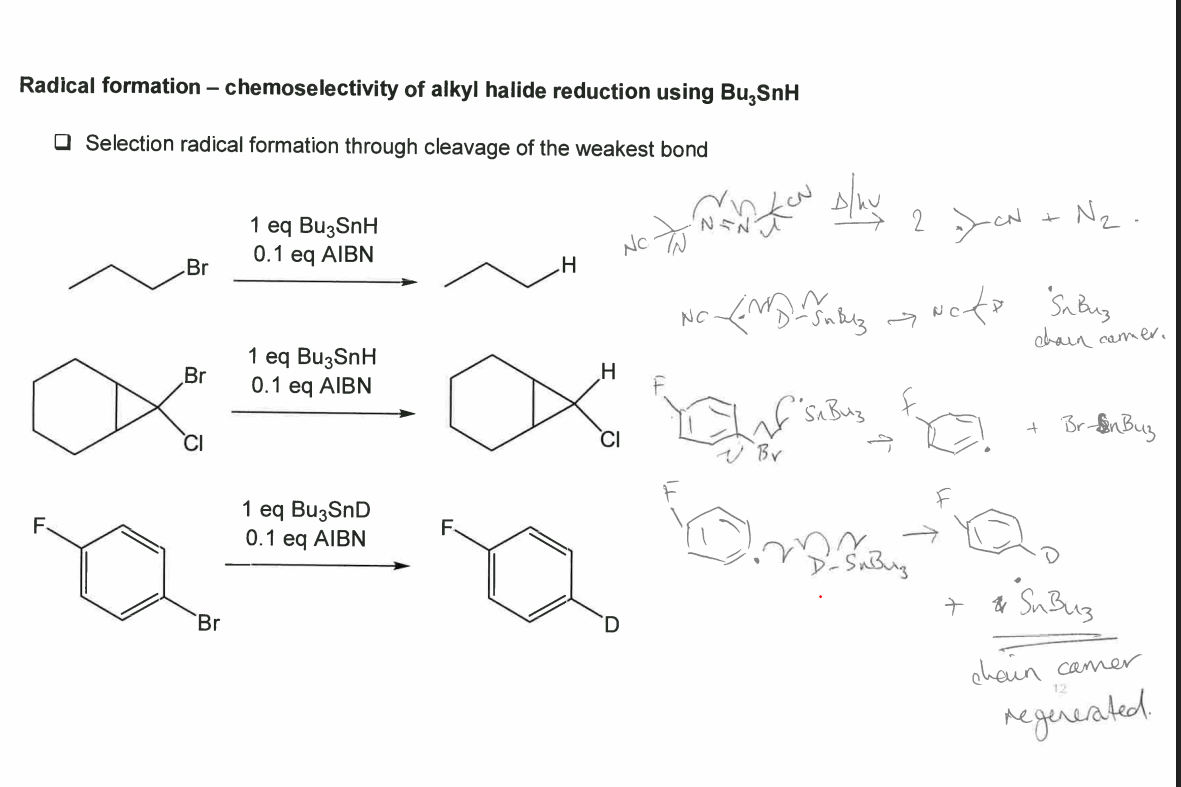
initiation, termination, propagation of alkyl reduction using bu3. starting with AIBN
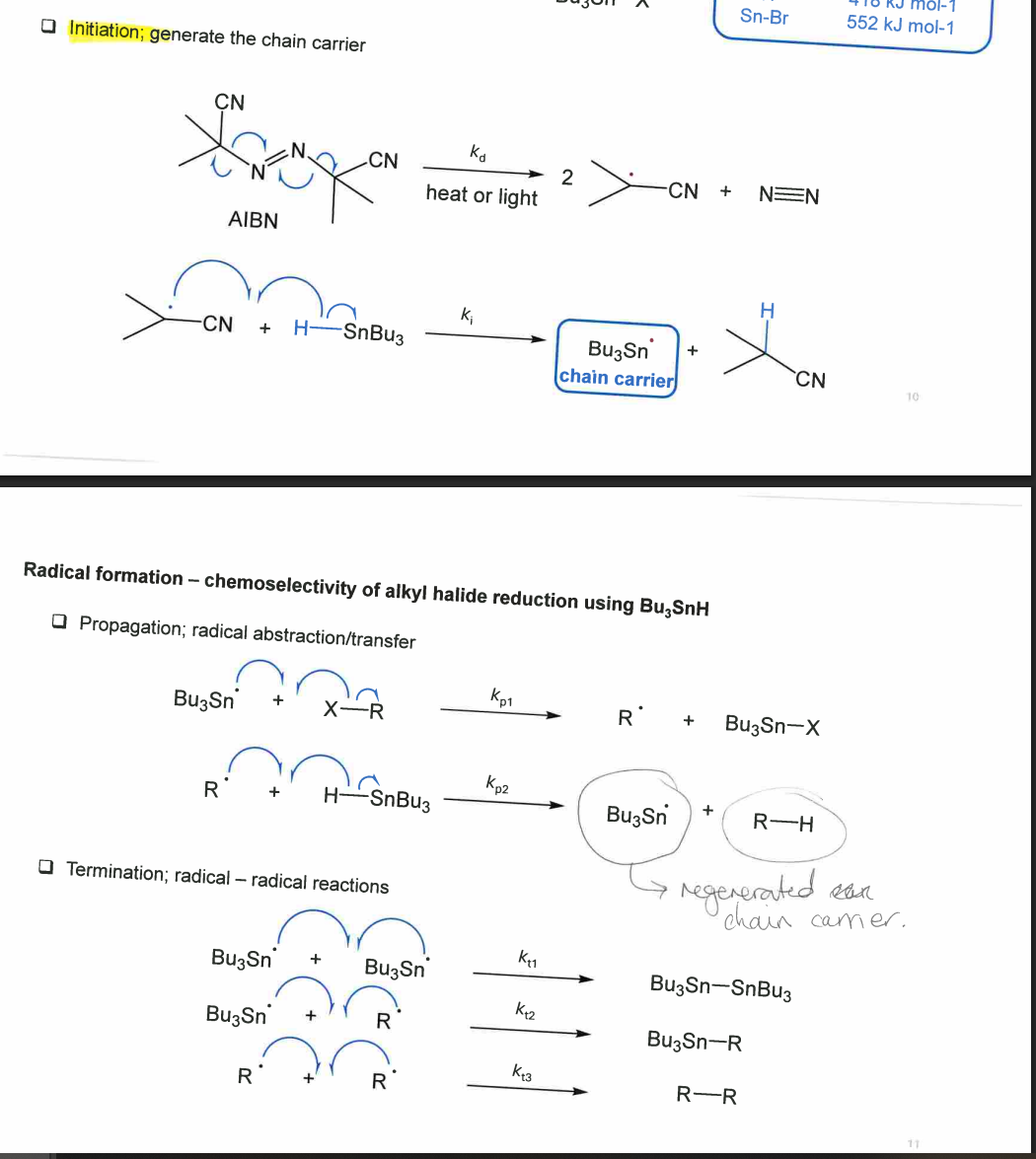
What happens when Bu₃SnD is used instead of Bu₃SnH?
The radical abstracts D (deuterium) instead of H, giving a deuterated product (C–D). showing bond strength of C-X bonds, here br is weaker than f, so that reacts instead of F
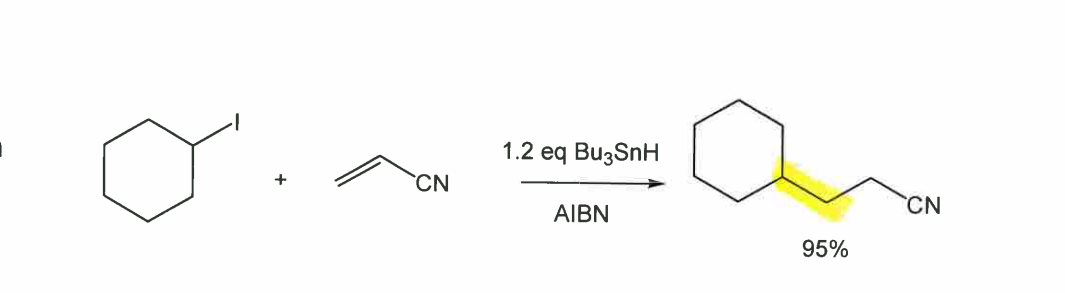
this is a radical ADDITION. draw out the circle mechanism on how these steps occur
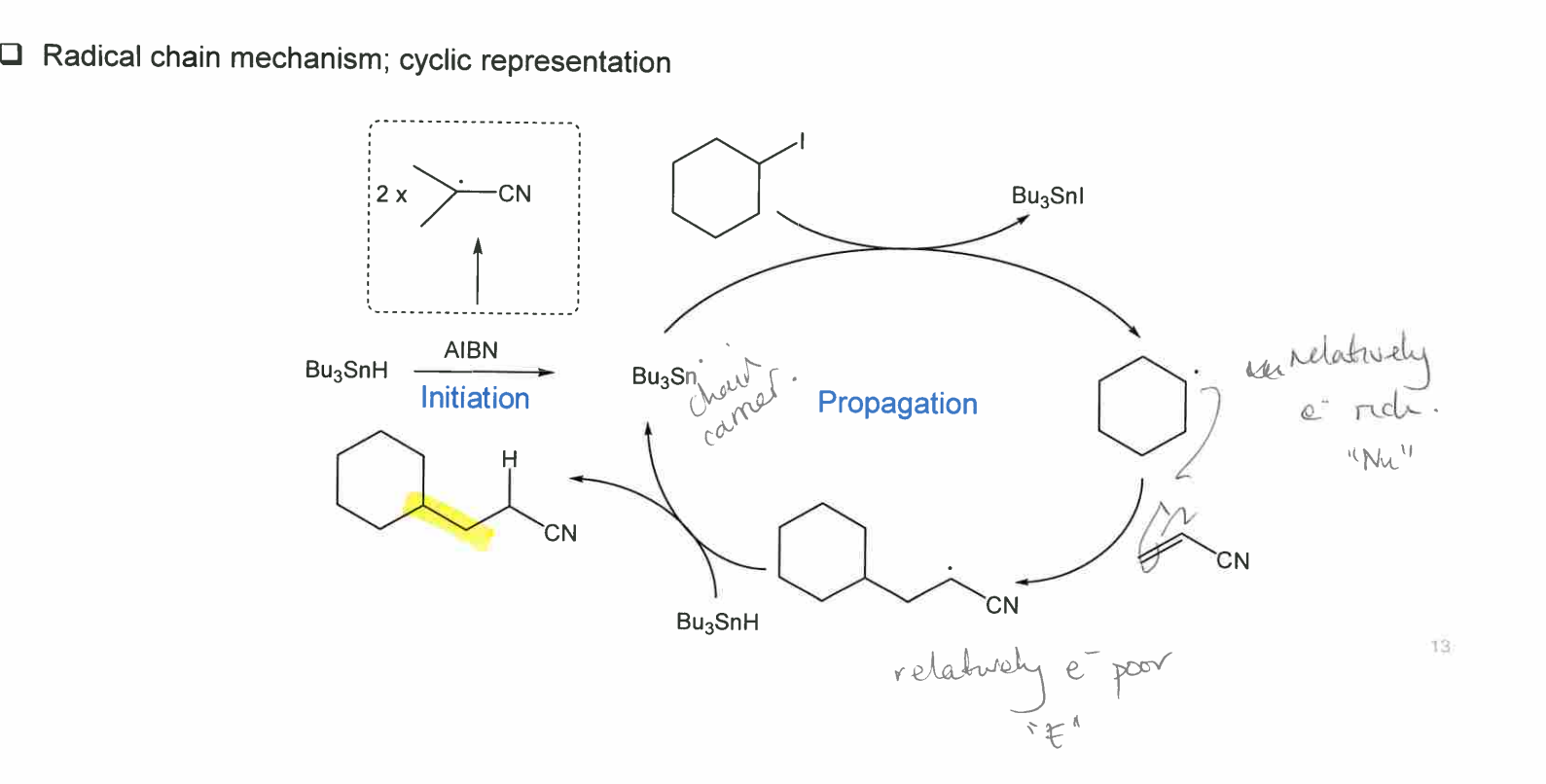
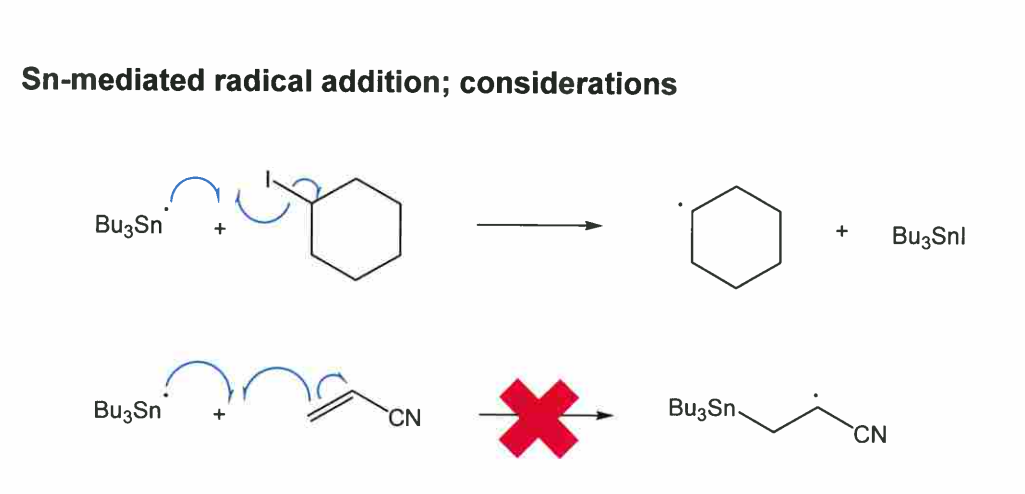
why is there an X, and what shall u be doing to avoid it
the bu3 group is meant to just steal the I, its not meant to react with the alkene, the alkene is meant to have the R group, being the benzene here. but if bu3 conc was high u have the red reaction happening which we avoid. so u wanna keep conc low.
only suitable for R-Br and R-I
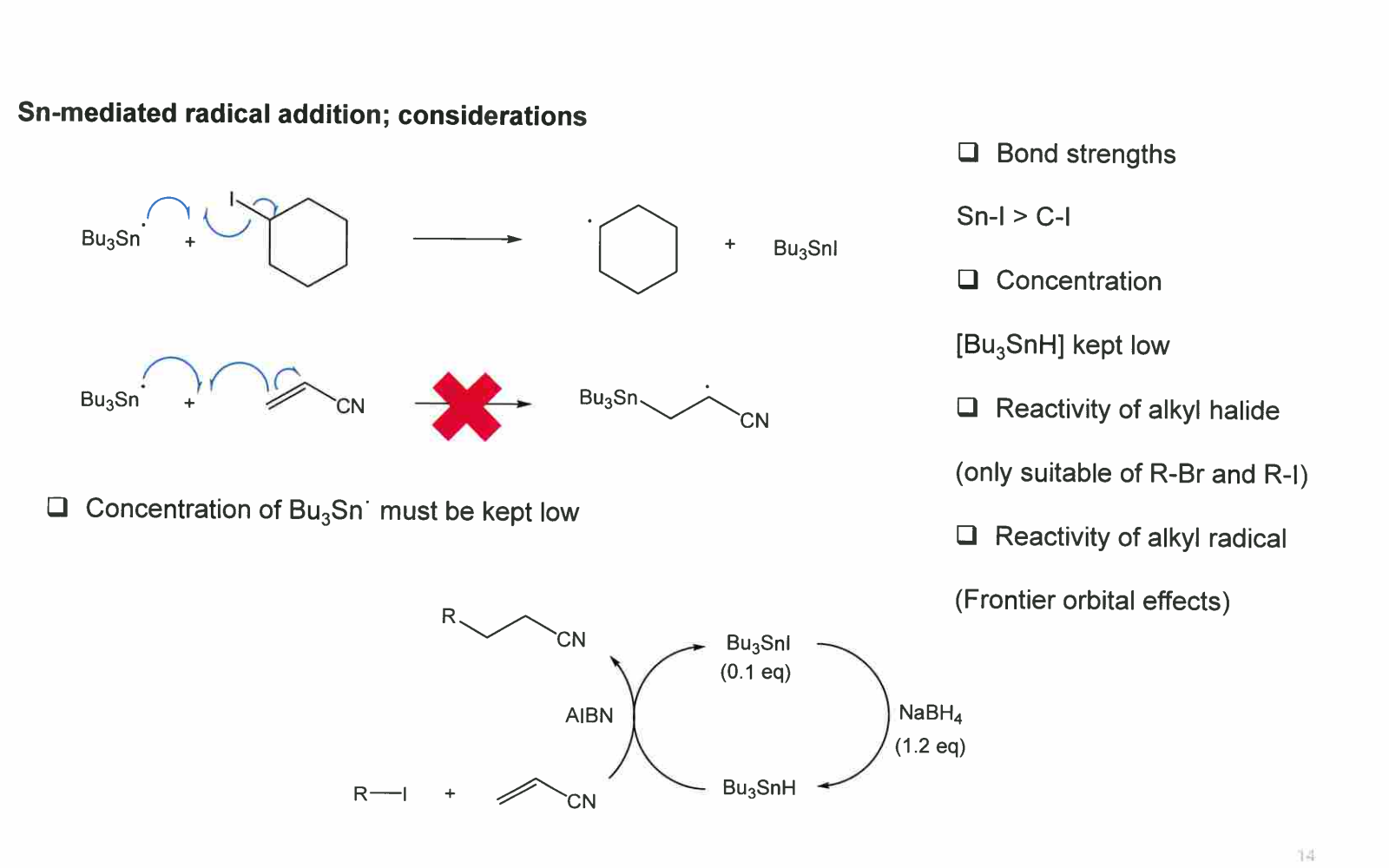
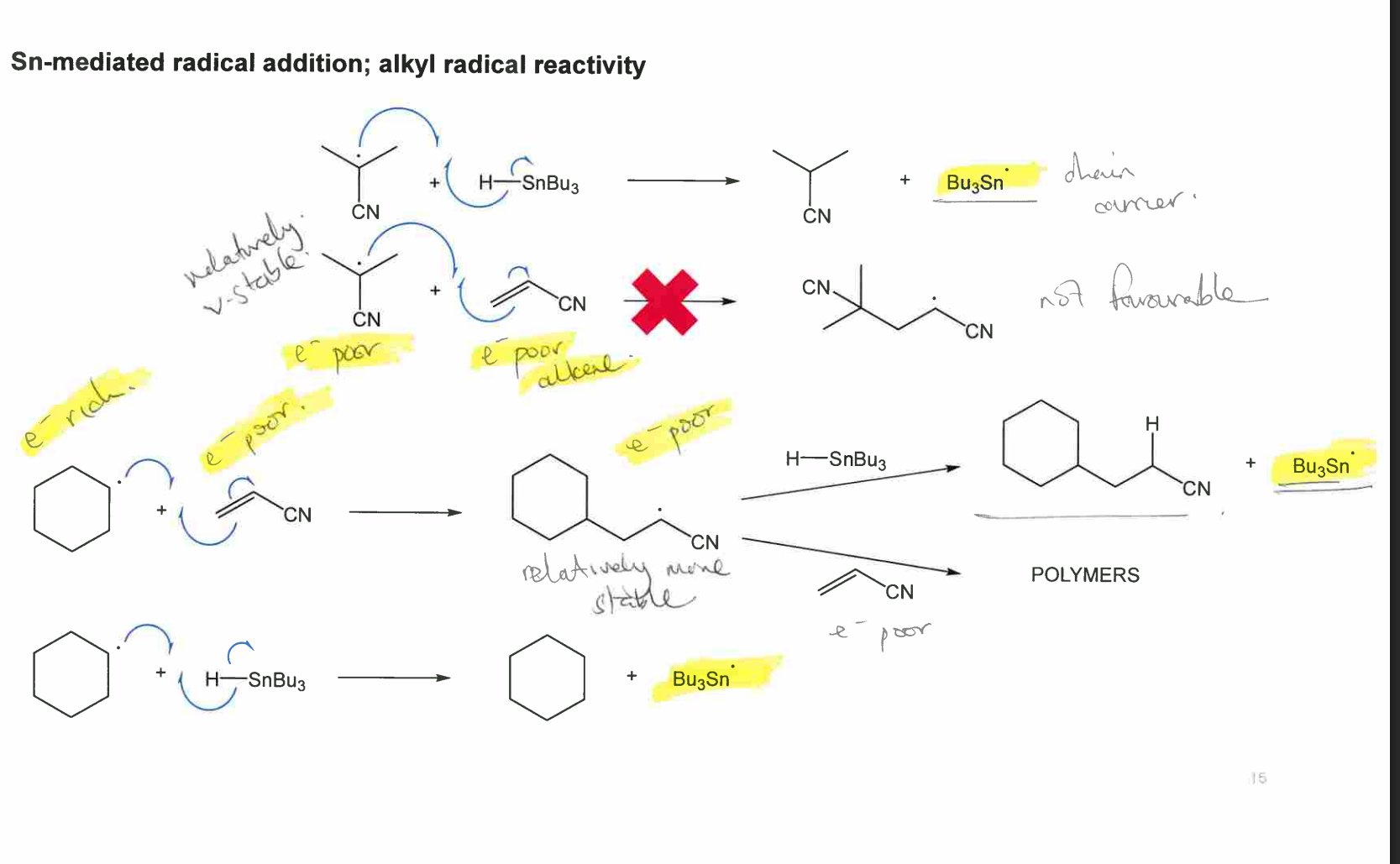
whats the general idea here.
electron rich and electron poor reactions are the favourable ones with the Sn carrier
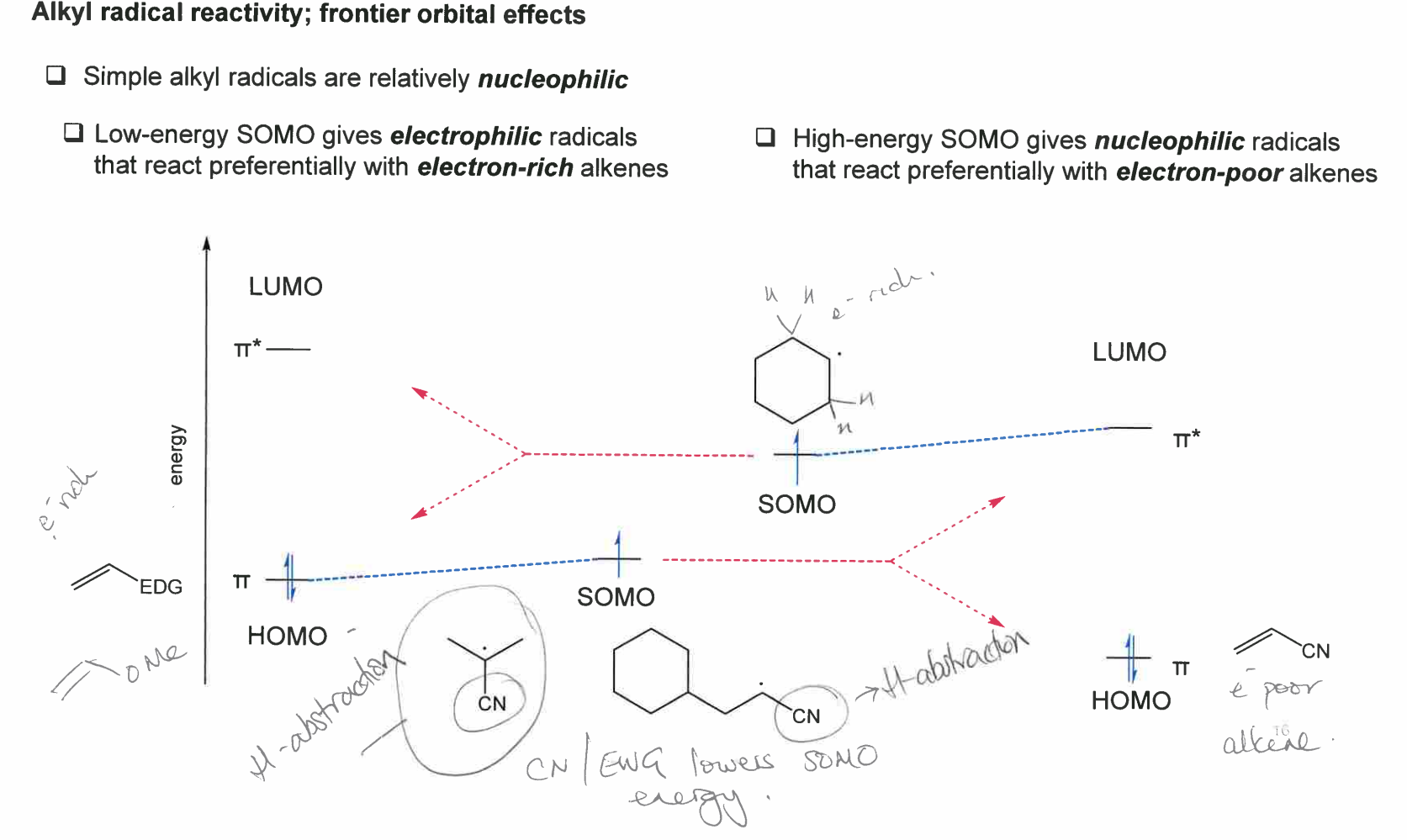
what is somo
Singly Occupied Molecular Orbital (1 electron)
When a radical reacts with an alkene, its SOMO interacts with the alkene's orbitals.
For example:
Electron-rich radical → high-energy SOMO → reacts best with an electron-poor alkene (low-energy LUMO).
Electron-poor radical → low-energy SOMO → reacts best with an electron-rich alkene (high-energy HOMO).
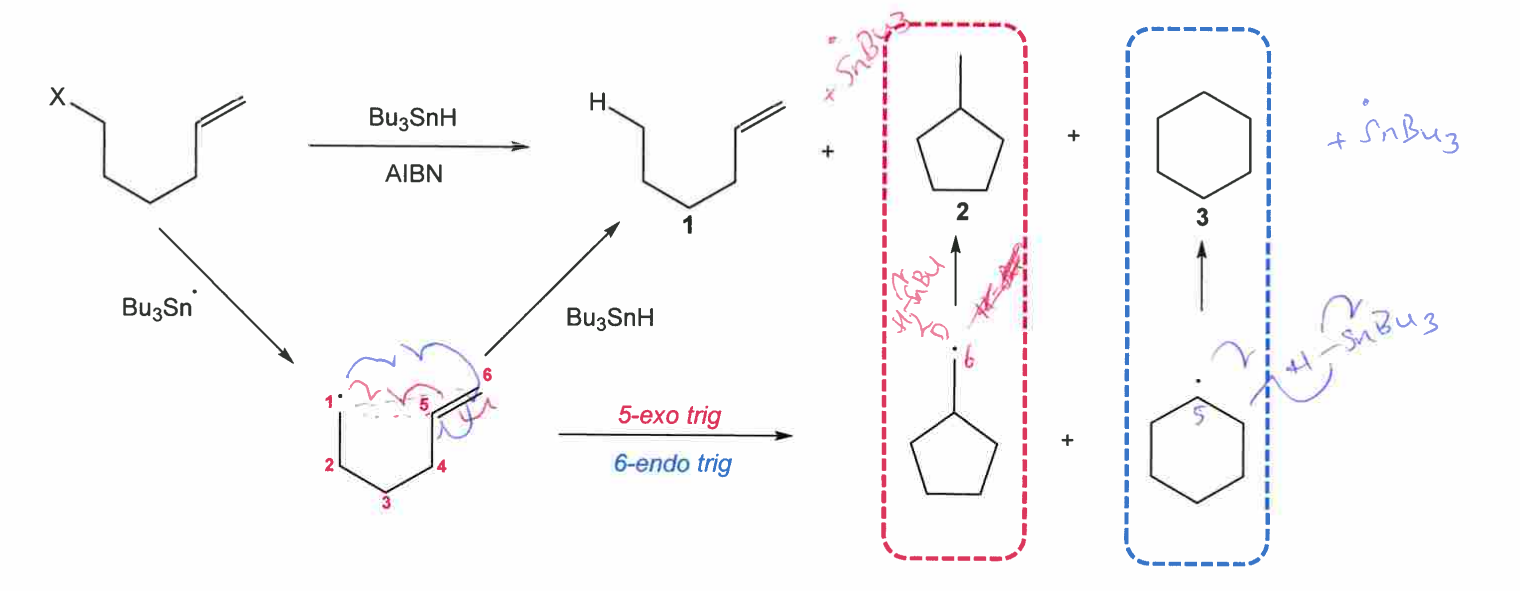
in this reaction talk about the bu3snH concentration effects
if its high conc, itll react to make product one, it conc low, then two rings where the 5 exo is more favourable than the 6 endo
how much faster is 5 exo than 6 endo
50 x faster
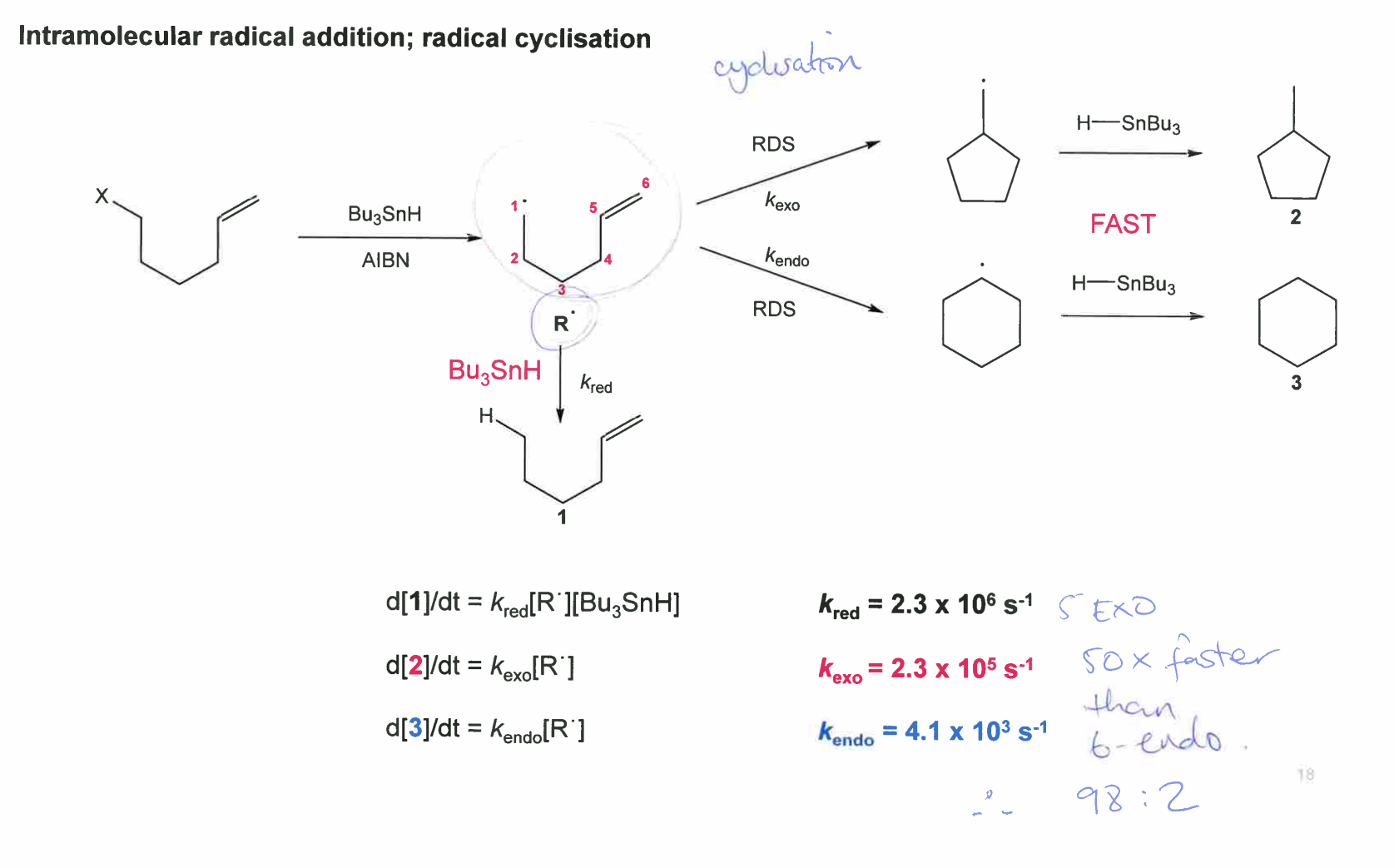
Why is 5-exo-trig usually favoured over 6-endo-trig?
It has a lower-energy transition state that better achieves the optimal 109° attack angle.
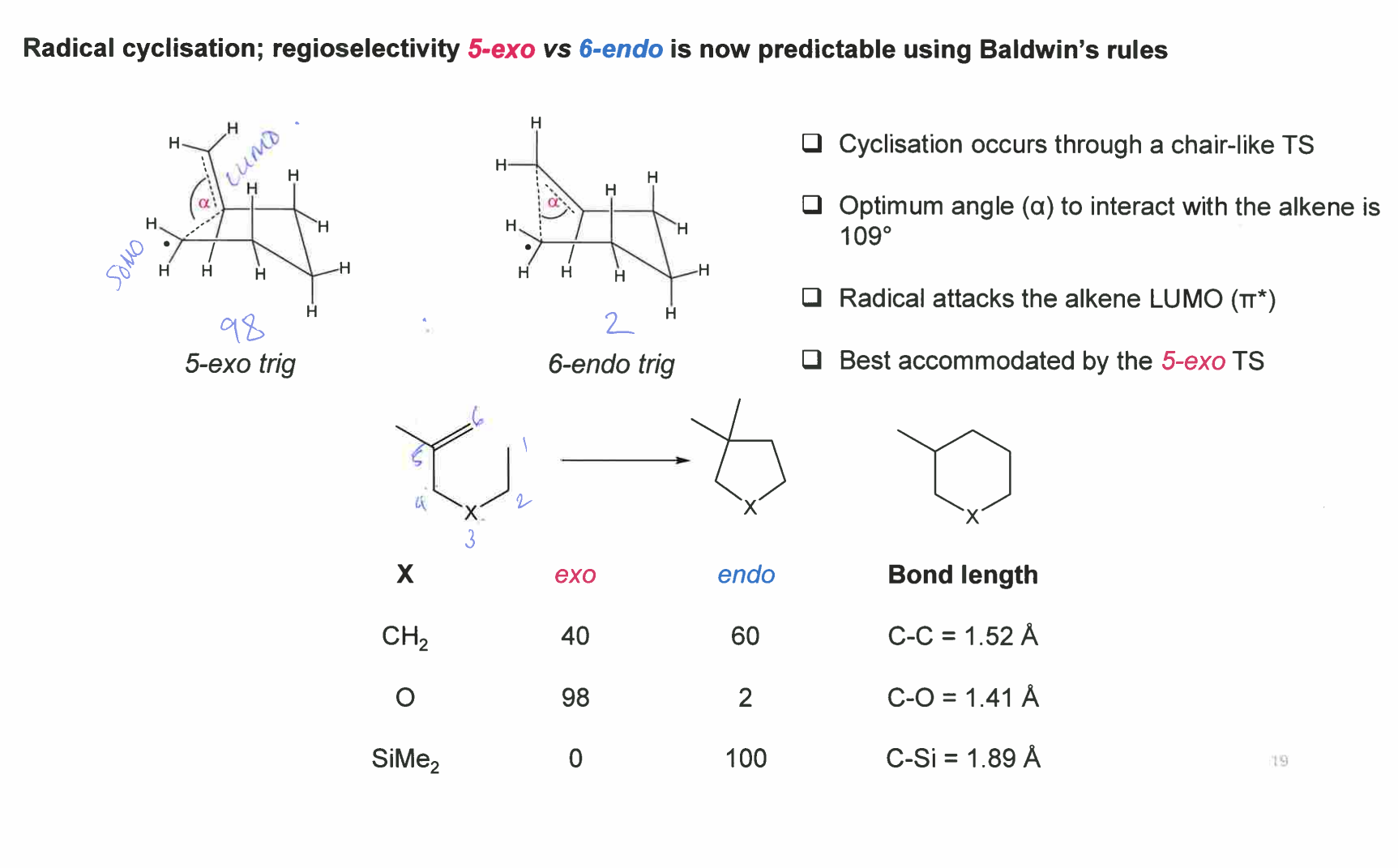
What does 5-exo-trig mean?
5 = 5-membered ring
exo = attack at the outside alkene carbon
trig = attack on an sp² carbon
What orbitals interact during radical cyclisation?
The radical SOMO overlaps with the alkene LUMO (π*).
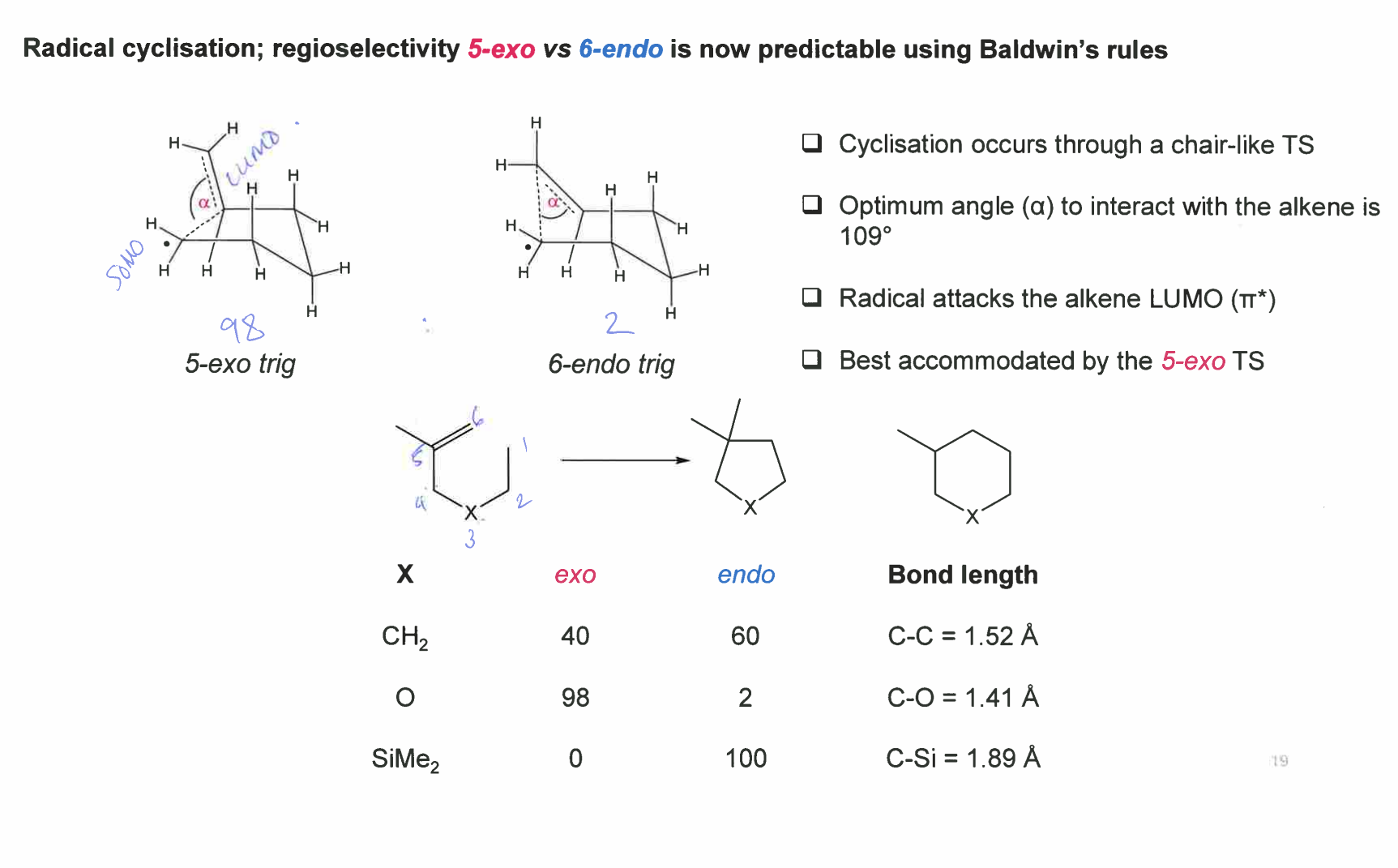
How does X affect exo vs endo selectivity?
Different bond lengths alter the transition-state geometry:
Shorter bonds (e.g. C–O) favour 5-exo.
Longer bonds (e.g. C–Si) favour 6-endo.
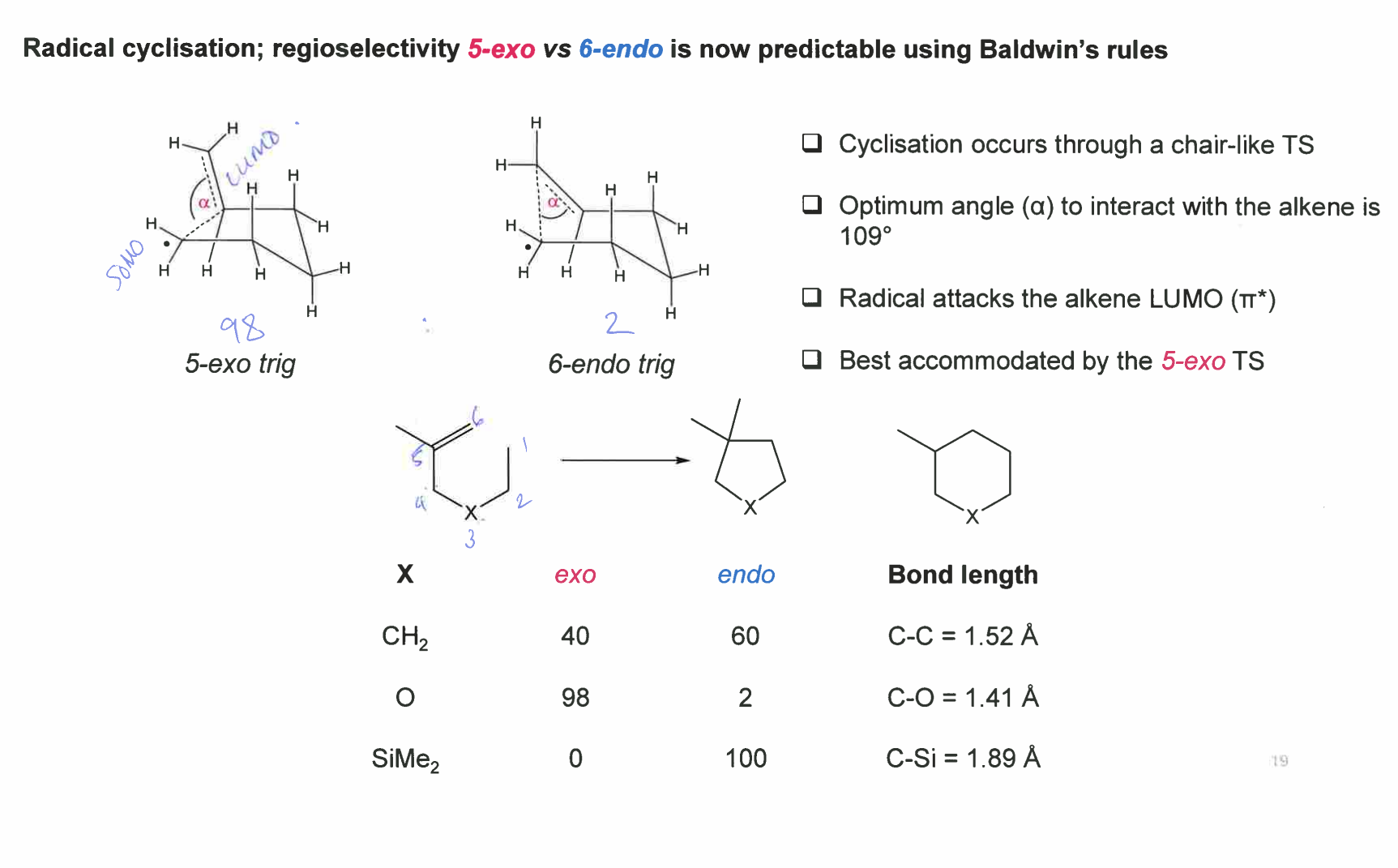
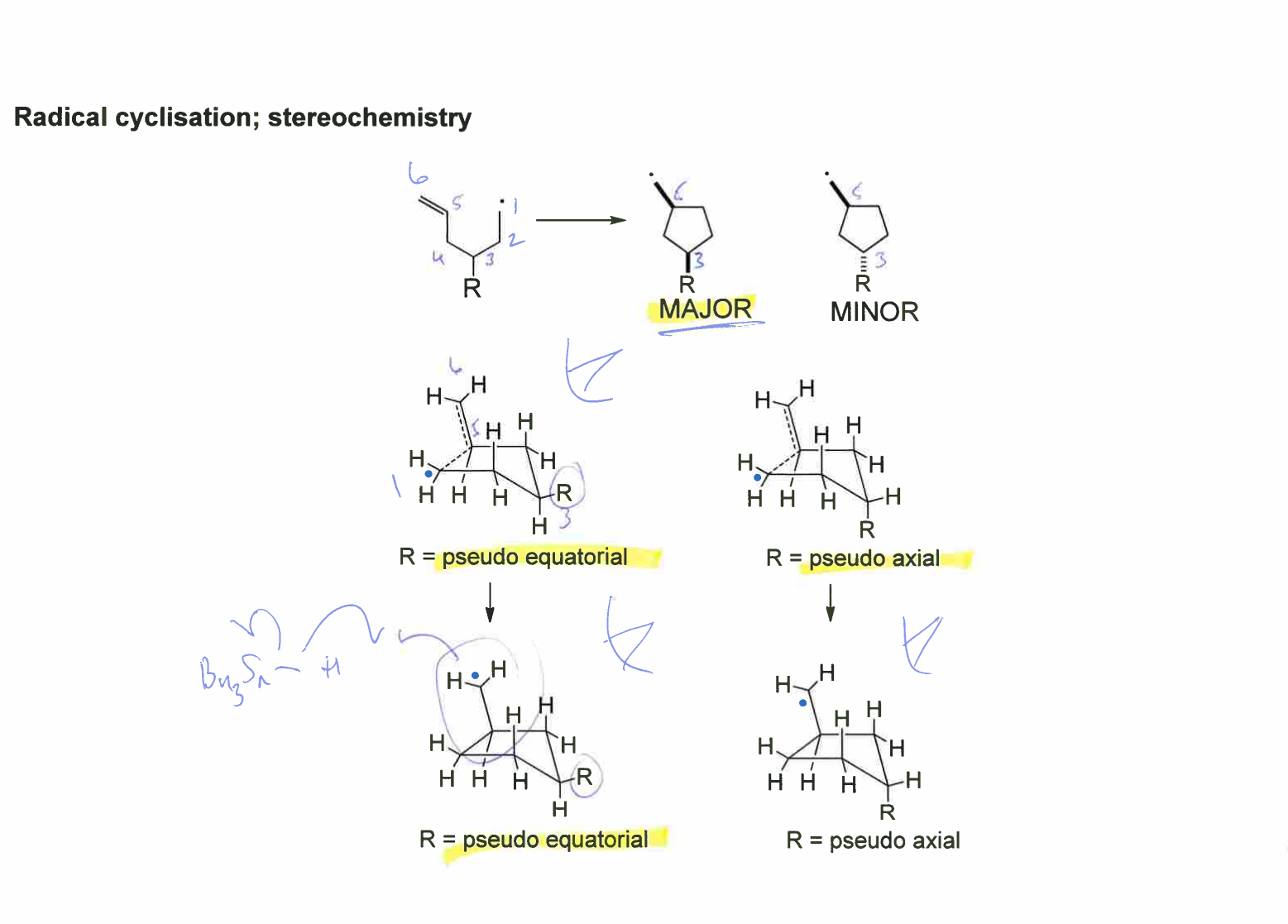
Why is one stereoisomer formed preferentially in radical cyclisation?
The reaction proceeds through the lowest-energy chair-like transition state., cis is preffered
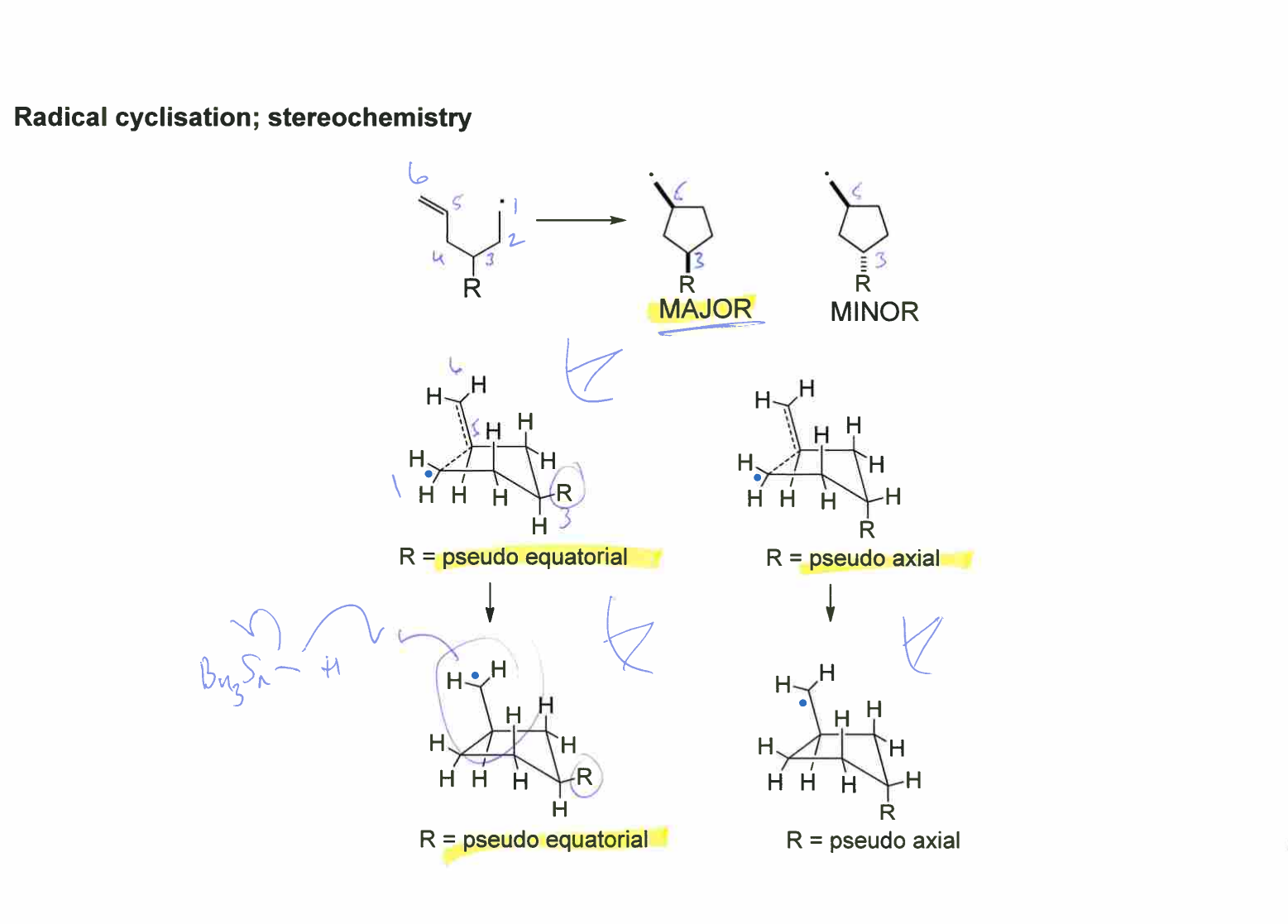
Which transition state is favoured?
Pseudo-equatorial, because it minimises steric interactions.
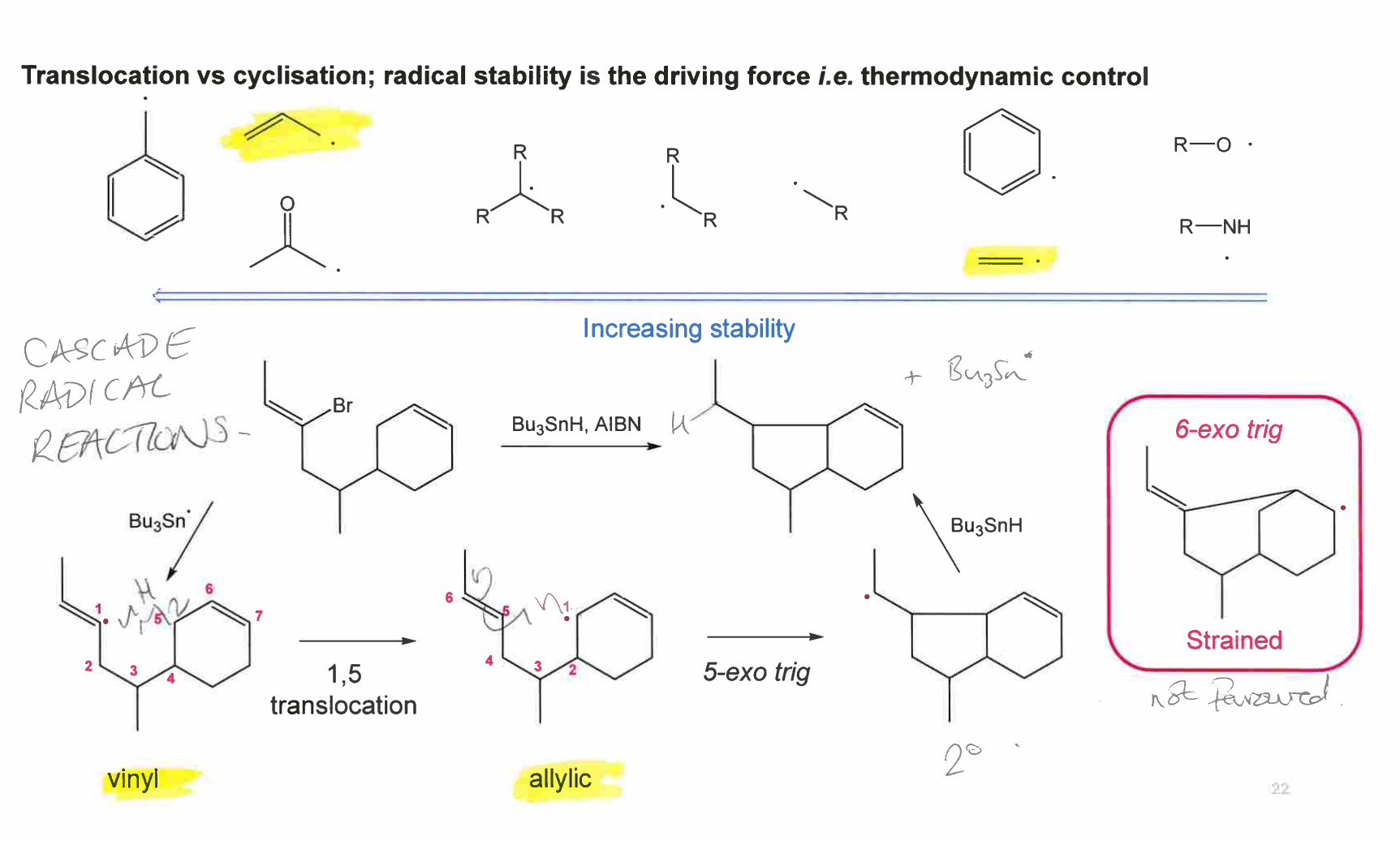
What is radical translocation?
Movement of a radical to another carbon via intramolecular H-atom abstraction.
What is a 1,5-radical translocation?
A radical abstracts a hydrogen five atoms away, moving the radical to that carbon.
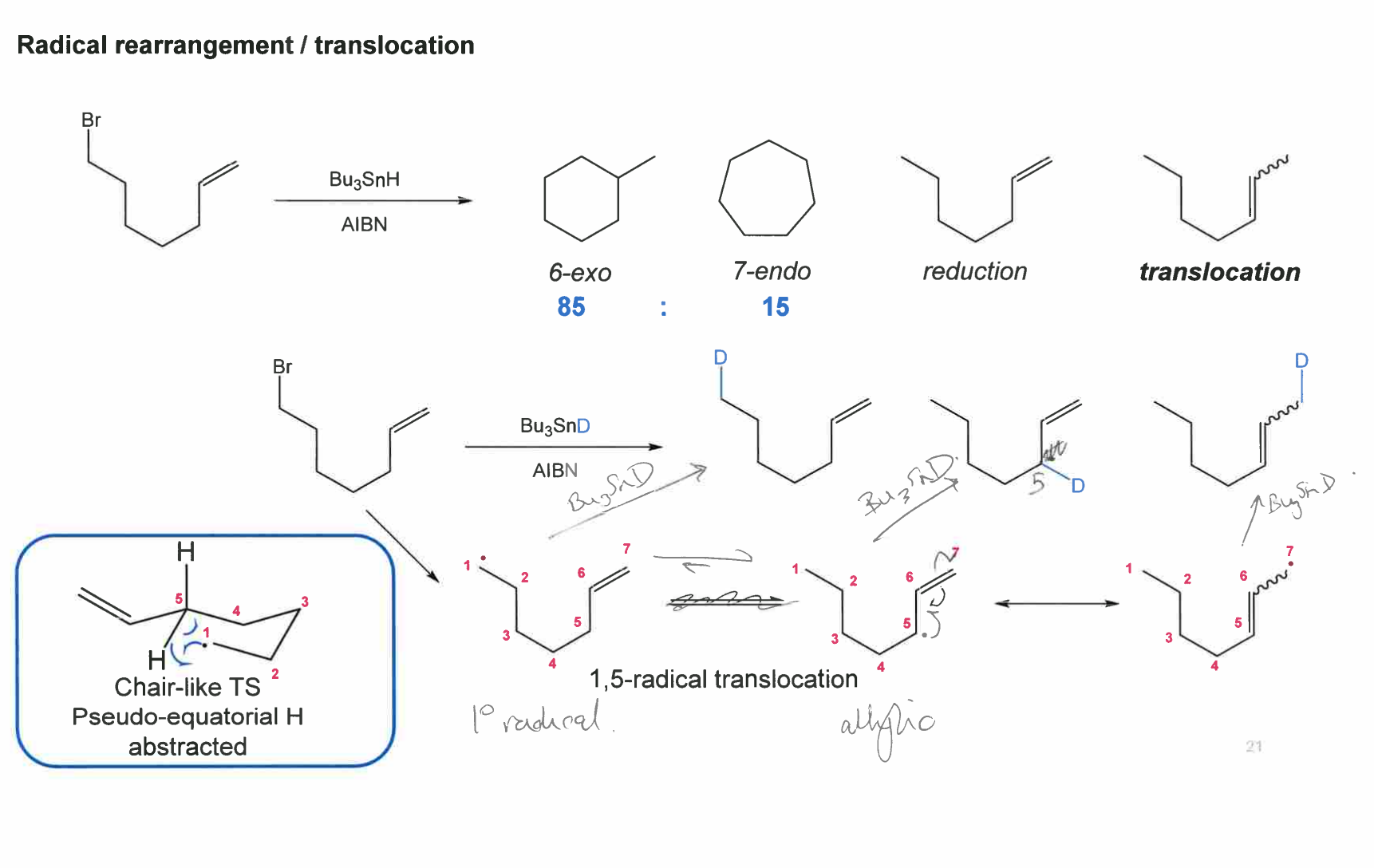
Why does 1,5-radical translocation occur?
It proceeds through a favourable chair-like transition state.
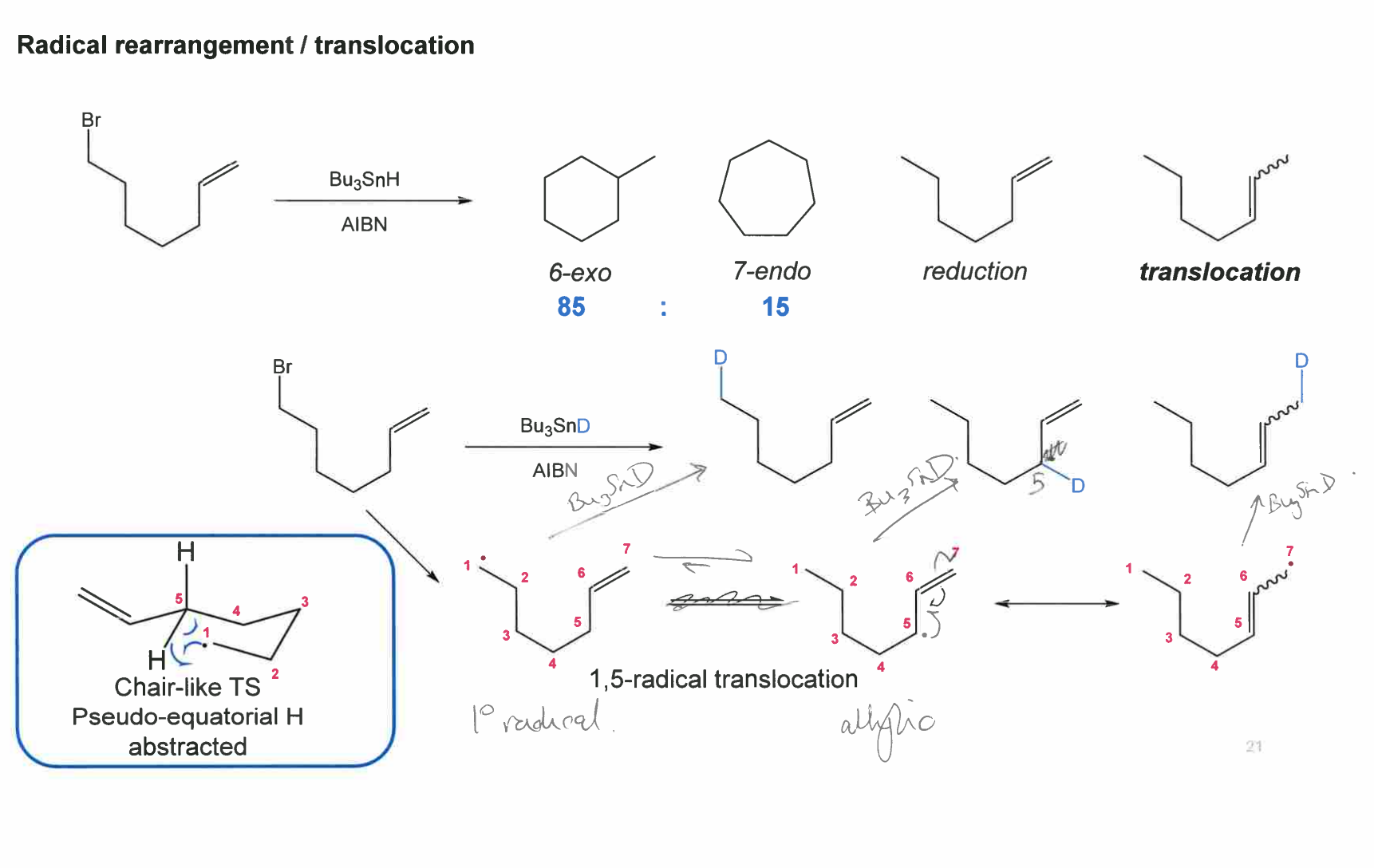
Why is Bu₃SnD used?
To label the final radical position—the radical abstracts D, revealing where it ended up before termination.
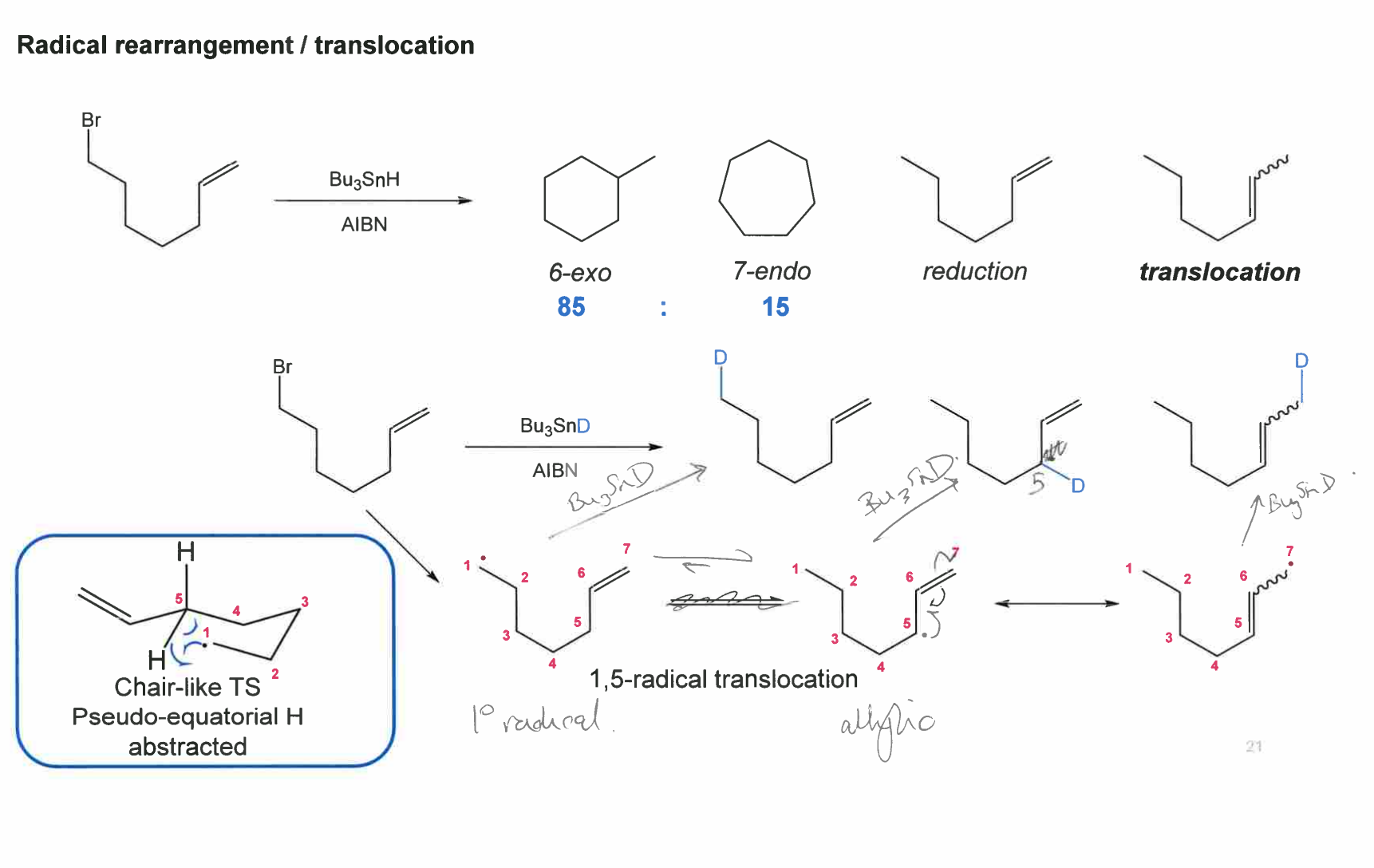
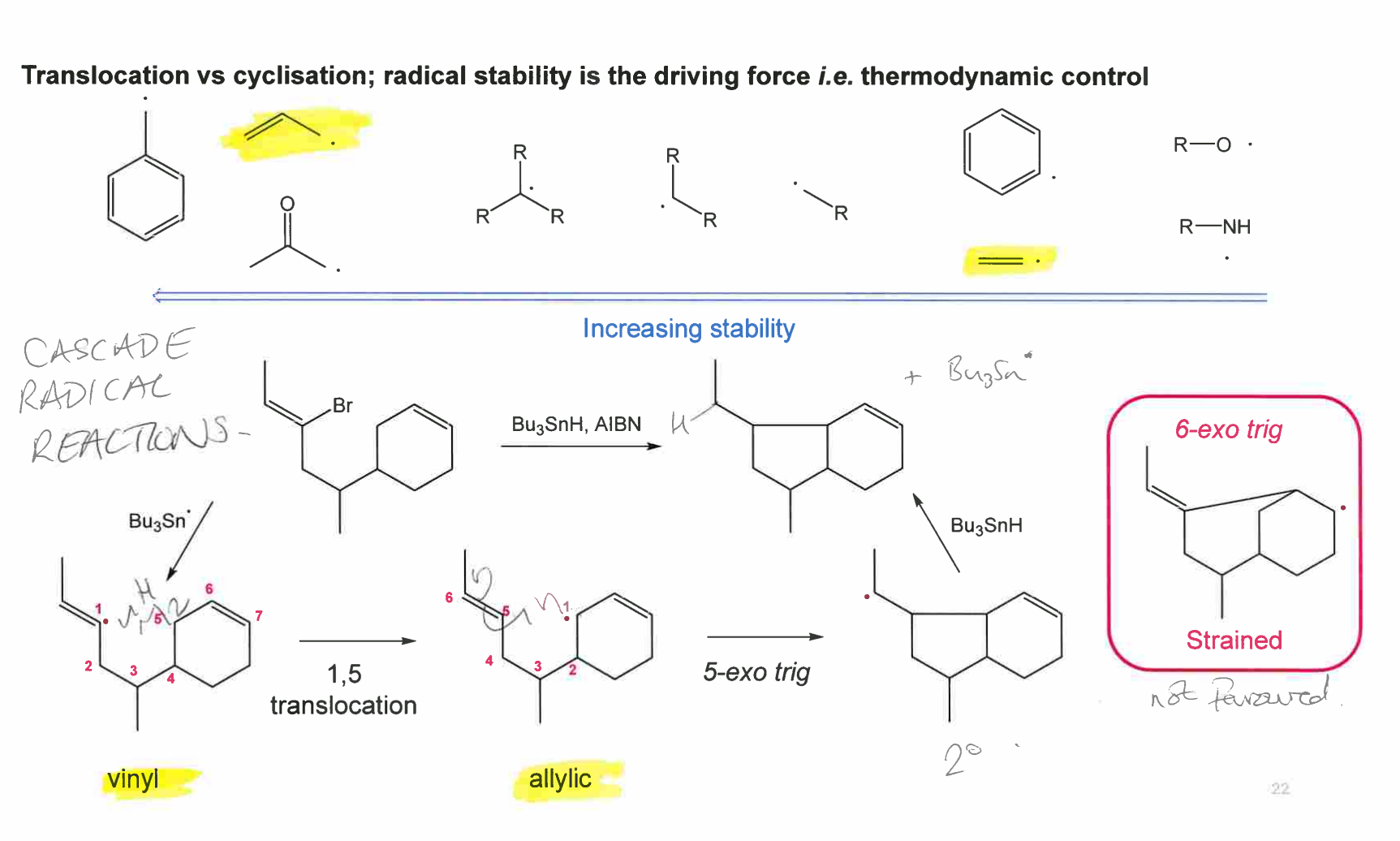
Why does the radical undergo a 1,5-H shift in this example?
To convert an unstable vinyl radical into a more stable allyl radical.
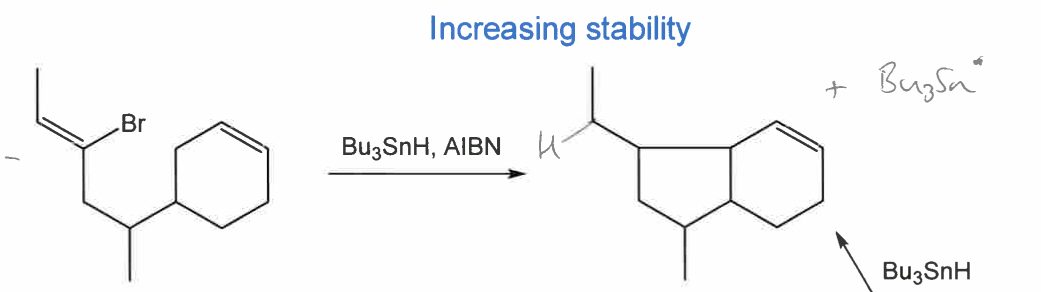
cascade radical reactions to make this